
Overview
Frank Louwers is founder of Openminds, a Ghent-based managed cloud hosting provider founded in 2005, now part of the team.blue group.
Frank Louwers is a founder based in Ghent, associated with openminds, and states expertise in technical leadership, cloud infrastructure and M&A due diligence. He co-founded Openminds bvba in July 2001 and served as co-CEO there until November 2017. Since December 2025 he has been the founder of Trustbourne, and he co-founded Krane Labs in May 2023, where he is chief executive. He founded Kiwazo in October 2017 and has been a program coach on the ClinicMaster project at Exchange vzw since February 2019.
Between October 2019 and June 2023 he was chief information officer at Oqton, Inc, and before that EMEA practice manager at Stone Door Group from November 2017. He held governance roles at DNS Belgium from December 2006 to October 2017, was president of the Belgian Registrar Association vzw from March 2016 to October 2017, and chaired Ghent Web Valley from 2011 to September 2013.
Louwers holds a master's degree in electronics and ICT engineering technology from KU Leuven, completed a postgraduate programme in modern telecommunications at Katholieke Hogeschool 'Sint-Lieven', Gent, and attended the IBBT iBootCamp at Vlerick Business School in 2008. He studied Latin-Math at Sint-Barabaracollege.
Career history

In the news
- It was an honor to moderate a panel discussion with Jo Caudron, Erik Mannens, Prof. PhD. MEng. MSc. and Stein Van Stichel yesterday at Tectonic. More about what's happening in the sovereign GPU hosting space soon
- I wrote a piece for How Brands Are Built about a strange marketing problem: how do you sell a product whose best outcome is that nobody ever uses it? Trustbourne is the worked example, mistakes included. Our first security copy said military-grade encryption. We replaced it with claims narrow enough that you can check them, including the ones that don't flatter us. The advise I'd give any founder in insurance, backup or security: the copy your customers read most isn't your homepage. It's the automated email that nobody designed.

- GPU's zijn duur. Dat moet ik je allicht niet meer vertellen. Een recent nieuwsbericht viel me wel op: Cast AI mat gemiddeld ongeveer 5% GPU-utilisation in tienduizenden niet-geoptimaliseerde Kubernetes-clusters. Als concreet voorbeeld: een STACKIT instance met één NVIDIA L40S kost vandaag ongeveer €1.74 per uur. Bij 5% nuttig gebruik betaal je dus ongeveer €34.86 voor één uur waarin de GPU actief was. Actief is dan nog niet noodzakelijk hetzelfde als productief. Het probleem zit voor een stuk in hoe Kubernetes GPU's behandelt.

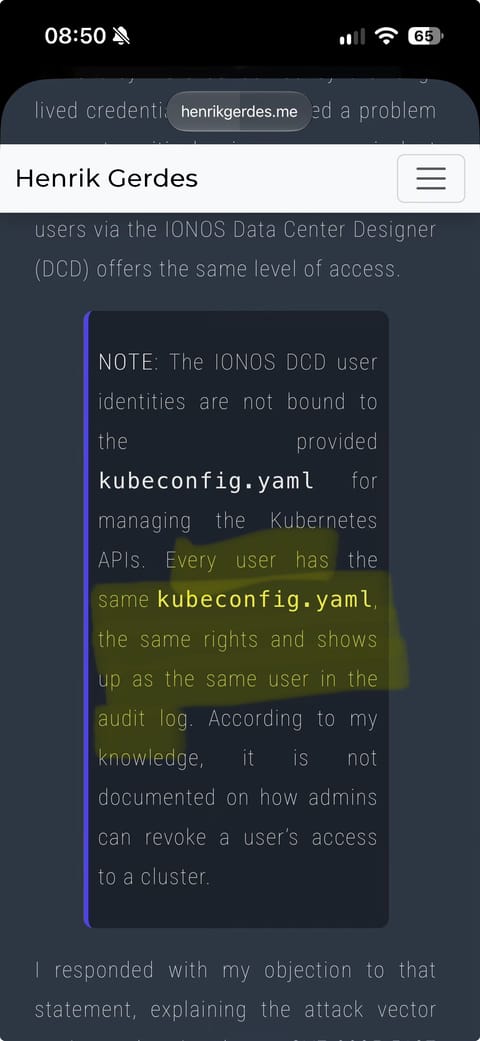
- I have previously addressed common shortcomings in European cloud providers. It was unsurprising to learn of a major European “cloud” storing administrative permissions for an entire cluster in plain text on every node. The provider’s response “that this is not a concern because all users receive the same file” was equally predictable. This configuration grants unrestricted administrative access to every user and renders audit trails ineffective, as all actions would be attributed to a single administrator, assuming logs are
- Je Kubernetes cluster draait. Super. Maar dat is niet de eindmeet. Belangijker is hoe betrouwbaar van Git naar productie gaat. Wie beheert welke stap? Hoe lopen releases door omgevingen? Waar passen rollback, security en compliance in de flow? Een cluster die draait is goed. Een deployment flow die je team vertrouwt is beter. Lees hoe we daar bij Krane Labs naar kijken: https://lnkd.in/e5vkMN6B
- NOS schrijft vandaag over digitale nalatenschap: wie erft je wachtwoorden, foto's, accounts en crypto als jij er niet meer bent? Goed dat dit nu wat mainstream pers aandacht krijgt. Veel te lang klonk digitale nalatenschap als iets voor crypto-mensen, estate lawyers van family offices of extreem georganiseerde nerds. In werkelijkheid raakt het bijna iedereen. Een mailbox is vaak de reset-knop voor je hele digitale leven. Een telefoon bevat 2FA, foto's, bankapps, recovery codes en gesprekken. Een password manager zonder context
- 𝐆𝐢𝐭𝐎𝐩𝐬 𝐢𝐬 𝐧𝐢𝐞𝐭 𝐚𝐥𝐭𝐢𝐣𝐝 𝐡𝐞𝐭 𝐚𝐧𝐭𝐰𝐨𝐨𝐫𝐝 GitOps is nuttig. Maar het is niet automatisch het juiste antwoord voor elk team. Ik heb teams "GitOps" zien toevoegen omdat het “volwassen” of “future proof” klonk. Terwijl het echte probleem veel eenvoudiger was: onduidelijke omgevingen, te veel manuele uitzonderingen of geen gedeeld deployment model. Soms is GitOps de juiste stap. Soms voeg je vooral extra mechaniek toe aan een proces dat nog niet helder genoeg is. De betere vraag is dus niet: “Moeten we GitOps doen?”
Related profiles
This page shows public professional information only, each fact cited. Is this you? send a correction, or ask for removal within 24 hours, no questions asked.