Overview
De Smet first went to Ukraine in 2008 on an assignment from his employer at the time, and he and his team went on to build an organisation there with 41 locations in 17 cities and more than 600 employees. After the full-scale Russian invasion, his work shifted to security, protection and evacuation of employees, and he chose to stay in Ukraine. De Smet wrote pieces for Knack, after which Western companies began contacting him for guidance and on-the-ground support, and four years after the start of the full-scale invasion he founded UkraineBased with a Dutch partner. De Smet puts his time living and working in Ukraine at more than 16 years, and argues that reconstruction is already under way and that few Belgian companies take part in the international tender platforms for Ukraine.
Guy De Smet is the founder of UkraineBased, an organisation based in Odesa that provides consulting and on-the-ground support to expats, businesses and governments operating in Ukraine. UkraineBased runs six service lines, covering expat services, business consulting, government liaison, market intelligence, due diligence and crisis management, and it sells a community membership at 49 euro per month. De Smet describes himself as a Belgian and a Fleming who first went to Ukraine in 2008 at the request of his employer at the time. Voka West-Vlaanderen lists him as its Global Ambassador for Ukraine.
Insights & ideas
The through-line
Everything Guy De Smet writes returns to one claim: Ukraine cannot be understood, assessed or rebuilt from a distance. He states it as a rule of investment ("Due diligence is not done from a boardroom. It is done on the ground" [2]), as a rule of politics ("Boots on the ground will always outperform PowerPoint in the boardroom" [14]), and as a personal standard he applies to the people he meets, praising those who "come, see, listen, and engage on the ground" [5] and those who show up, listen, ask difficult questions and get involved [12]. The authority he claims for this is duration and location: eighteen years in the country by one count [2], more than sixteen years living and working there by another [12], writing from an Odesa where "another air raid alert interrupts the day" [12].
The position has hardened into a commercial proposition rather than shifted. The same conviction that produces his complaint about the "reconstruction machine" of summits, reports, consultants, NGOs and billions [12] also produces Triple Checked, a verification service built on the premise that distance breeds risk [9]. What changes across the material is the register, moving from observation about how Ukraine works to an explicit argument that verified, on-site presence is a service worth buying and that the window for acting on it is closing [8][9].
On why presence beats paperwork
The central argument is that intermediaries are not substitutes for eyes on the ground. "A Ukrainian partner can open doors. But only people on the ground can tell you what is really behind that door" [2]. He is careful to separate this from suspicion of Ukrainians, noting that many are "working incredibly hard, with the best intentions, to rebuild their country," and then delivering the line that carries the whole position: "good intentions are not due diligence" [2]. A consultant, a translator, a local team, a great investment deck: none of them replace being there, because what is needed is "your own eyes, ears, hands and feet on the ground" [2]. The same yardstick is applied approvingly to visitors who make the trip, and he registers the difference between talking about opportunities and taking the time to understand the reality behind them [5][12].
This is why the Triple Checked service is framed around a single question: "when you are thousands of kilometres away, the question is: Can you trust what you are looking at?" [9]. The answer offered is independent, on-the-ground verification before a decision, covering a legal check, physical inspection, commercial assessment, and safety and risk review, across apartments, houses, land, industrial properties, warehouses and investment opportunities [9]. The formulation he uses to distinguish it from brokerage is blunt: "We don't just show opportunities. We verify them" [9]. Individual listings are pitched the same way, with the promise of a full triple-checked report standing behind the asking price [3][6].
On opportunity and trap
He is willing to make the largest possible claim and then immediately undercut it: "UKRAINE IS THE BIGGEST OPPORTUNITY SINCE WWII. BUT ALSO THE BIGGEST TRAP" [2]. The logic is that money and opportunity always attract people trying to take advantage of them, so the scale of the upside is itself the source of the risk [2]. He calls the framing provocative and says he means it, closing with a warning aimed squarely at the enthusiastic outsider: Ukraine may become the biggest opportunity of our generation, "Just make sure it doesn't become your biggest mistake" [2].
On buying at wartime prices
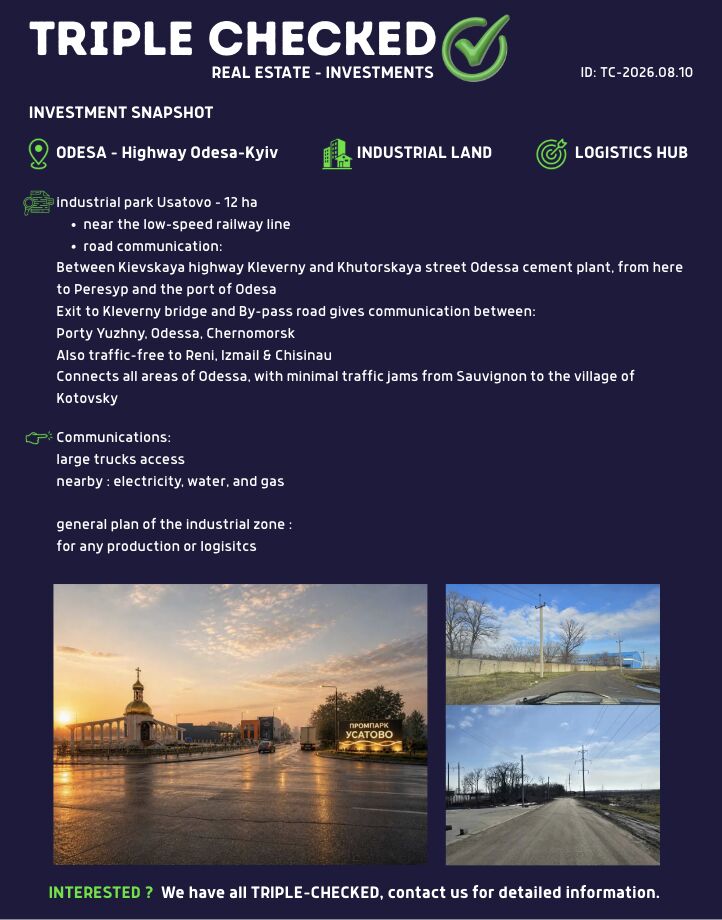
The investment case rests on a gap between present danger and future function. Of a site under regular Russian attack: "Today, this area is regularly targeted by russian attacks. Tomorrow, it becomes one of the most strategic logistics gateways on the Black Sea," with 100 hectares, deep-water access, rail connectivity and multi-cargo potential, and the instruction to secure strategic assets before reconstruction drives demand and valuations higher [6]. The same reasoning applies to 12 hectares of industrial land on the Odesa–Kyiv corridor with road access and nearby utilities, offered "at today's prices" against the question of what it will be worth when peace returns and Ukraine's logistics and industrial economy accelerates [3]. His summary of the mechanism: "Wartime prices can create opportunities that simply won't exist forever" [3], and "Huge opportunities are invisible until you think beyond today's headlines" [6].
He backs the urgency with transaction data rather than sentiment, reporting booming real estate activity with Mykolaiv up 67%, Kyiv 56%, Cherkasy 55%, Odesa 53% and Dnipro 50%, alongside median price rises of 9% to 22%, and concludes that anyone who had or still has a plan to invest hardly needs to be told it is time to decide [8].
On Odesa
Odesa is the gap he keeps pointing at in the reconstruction conversation. He describes it as "remarkably absent from many reconstruction & investment discussions" and insists it is not just another city but Ukraine's maritime gateway, a major logistics hub, a tourism powerhouse, and a strategic economic bridge to Romania, Moldova and the wider Black Sea region [13]. His argument for prioritising it is structural: reconstruction is not only about replacing what has been destroyed but about investing in the economic engines that will drive the country's future, and "Without a strong Odesa, there is no strong maritime economy. Without a strong maritime economy, Ukraine's long-term recovery becomes much harder" [13]. He allows that he may be missing something, while noting that after following countless conferences, investment announcements and reconstruction initiatives, "the relative silence around Odesa is difficult to ignore" [13]. It is also the place he wants visitors to reach, teasing one guest for finally getting past the West and Kyiv [5].
On accountability in reconstruction
He treats the reconstruction effort as a governance problem before it is a funding problem. "Ukraine doesn't need more promises. It needs more independent people on the ground," because while billions will rebuild roads, bridges and infrastructure, "Independent oversight will rebuild trust" [14]. Success, on his measure, will not be judged by the value of commitments announced at conferences but by how effectively those commitments are delivered, which makes accountability, transparency and daily understanding of the reality on the ground the operative variables [14]. He names the partners he sees sharing that vision, including Ukrtrade Capital, Challenger Research and Rebel [14]. The counterpoint is what he calls the reconstruction machine of summits, reports, consultants, NGOs and billions, most of it well-intentioned, and the reminder that rebuilding does not begin when peace is signed [12]. What he wants people to grasp is the country as it is, "Not the PowerPoint version" [12].
On Менше тексту
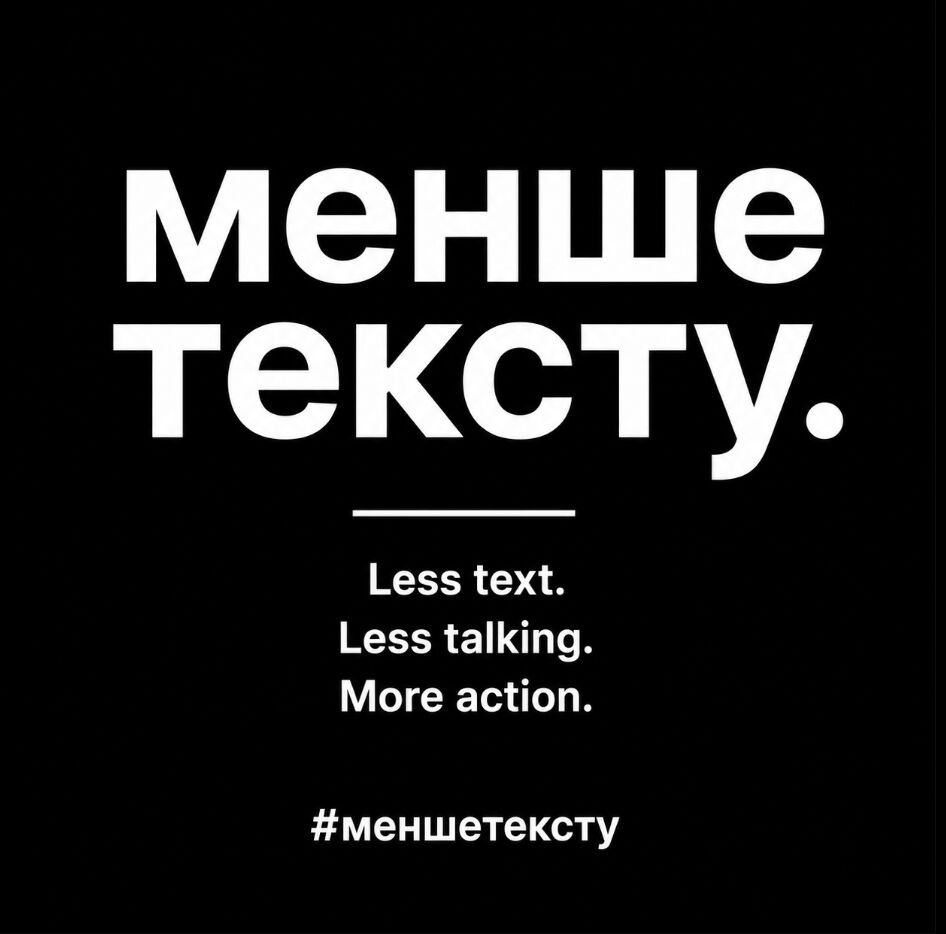
The cultural observation that underpins all of it is a Ukrainian phrase he has absorbed: "Менше тексту," literally less text, heard from parents facing a teenager's excuses, from police officers hearing why someone was speeding, and in boardrooms when too much talking leads to nothing [1]. He reads it as evidence that Ukrainians are people of action, a trait wartime has reinforced, because when decisions cannot wait, endless discussion becomes a luxury [1]. Set against that he lists what he sees circulating around Ukraine: handshakes, meetings, letters of intent, announcements, good intentions and a great deal of talking [1]. His preference is for partners who simply do what they say they will do, with no endless thinking, no meetings about the next meeting, no unnecessary delays, and his conclusion is that the West could learn something [1]. The same idea in cruder form: "Too much blabla, too little boomboom" [4 — see 5], and noise leads nowhere without actually showing up [5]. He is aware of the genre he is writing in and resists it, admitting he started one post three times because every version sounded like LinkedIn [12].
On the war as lived experience
His account of Odesa is domestic rather than strategic: civilian casualties from nighttime attacks, the nighttime curfew, and the psychological adaptation people make to continuous danger [15]. Air raid alerts appear in his writing as interruptions to an ordinary working day [12]. On the Russian side, he reads the blocking of social media and Google as Putin's attempt to maintain power and control over information, and he notes a revealing asymmetry: Russian citizens have protested the internet ban more than they protested the war itself, in part because so many businesses depend on the internet economically [15].
On the view from home
He also works the Belgian and Dutch end of the same argument, welcoming anything that might wake up his compatriots and pointing to the Dutch as setting a good example on many fronts and certainly on support for Ukraine [11]. He amplifies domestic industrial developments, praising Sol.One and Filip Verhaeghe for a Belgian drone factory opening in the Ghent port area as encouraging growth and forward-looking investment in Flanders [4], and endorses arrangements he reads as a win-win for everyone involved [10].
Takeaways
- Treat local partners as door-openers, not verifiers: "A Ukrainian partner can open doors. But only people on the ground can tell you what is really behind that door" [2].
- Separate sincerity from diligence before committing capital, because "good intentions are not due diligence" [2], and a consultant, translator, local team or investment deck does not replace being present [2].
- Verification before decision should cover four fronts: legal check, physical inspection, commercial assessment, and safety and risk review [9].
- The asset thesis is a timing thesis: "Wartime prices can create opportunities that simply won't exist forever" [3], and sites under attack today may be Black Sea logistics gateways tomorrow [6].
- The market is already moving, with transactions up 50% to 67% across Mykolaiv, Kyiv, Cherkasy, Odesa and Dnipro and median prices up 9% to 22% [8].
- Put Odesa on the reconstruction agenda as an economic engine, since "Without a strong Odesa, there is no strong maritime economy" [13].
- Judge reconstruction by delivery, not by announced commitments, and fund independent oversight alongside infrastructure: "Independent oversight will rebuild trust" [14].
- Adopt the Ukrainian working standard of Менше тексту, fewer meetings about the next meeting and more partners who do what they say they will do [1].
Media & appearances
- CHALLENGERYouTubeChallenging Geopolitics - Is Ukraine just a Battlefield?Guy De Smet discusses his firsthand experience living in Odessa, Ukraine since the Russian invasion, describing civilian casualties from nighttime attacks, the nighttime curfew, and how people adapt psychologically to ongoing danger. He also addresses Russia's blocking of social media and Google, characterizing it as Putin's attempt to maintain power and control over information, and notes that Russian citizens have protested the internet ban more than they protested the war itself, partly due to economic concerns about internet-dependent businesses.
In the news
- Менше тексту. Менше тексту literally means: less text. But in Ukraine, it means much more. You hear it everywhere. From parents listening to their teenager's excuses. From police officers listening to someone explain why they were speeding. And in boardrooms, when too much talking leads to nothing. Менше тексту. Less talking. More doing. After years of living and working in Ukraine, I have learned that Ukrainians are people of action. Wartime has only reinforced that. When decisions cannot wait, endless discussions become a luxury.
- UKRAINE IS THE BIGGEST OPPORTUNITY SINCE WWII. BUT ALSO THE BIGGEST TRAP.Provocative? Good. I mean it. Money and opportunity always attract people trying to take advantage of it. And let’s be honest: A Ukrainian partner can open doors. But only people on the ground can tell you what is really behind that door. This is not about distrust. There are many Ukrainians working incredibly hard, with the best intentions, to rebuild their country. But good intentions are not due diligence. A consultant. A translator. A local team. A
- This land is for sale today, at today’s prices. 12 hectares of industrial land, strategically located on the Odesa–Kyiv corridor, with road access and nearby utilities. Now ask yourself: What could this land be worth when peace returns and Ukraine’s logistics and industrial economy accelerates yet more? Wartime prices can create opportunities that simply won't exist forever. Triple Checked identifies and verifies these opportunities on the ground before you make an investment decision. Interested? We have the full, triple-checked
- https://lnkd.in/d6QiN_HX Bemoedigende groei en toekomstgerichte investering in Vlaanderen Kudos Filip Verhaeghe & Sol.One
- All the noise doesn't lead anywhere... ...without actually showing up. Too much blabla, too little boomboom. That is why I have a lot of respect for people who come, see, listen, and engage on the ground. Thank you Alexander Tebbe for your visit to Odesa. Finally, I got you further than the West & Kyiv ;) Beyond the very pleasant and constructive conversations, I appreciate your commitment, your openness, and your genuine drive to contribute through your projects with Crowd Ukraine Invest AG Having spent many years on the ground
- Huge opportunities are invisible until you think beyond today's headlines. Today, this area is regularly targeted by russian attacks. Tomorrow, it becomes one of the most strategic logistics gateways on the Black Sea. 100 hectares. Deep-water access. Rail connectivity. Multi-cargo potential. Secure strategic assets before reconstruction drives demand and valuations higher. #Ukraine #Reconstruction #Logistics #Ports #Infrastructure #Investments #CommercialRealEstate #BlackSea #UkraineBased #TripleChecked
- Kudos Halyna Yanchenko for the instantly regaining your "cool" !
- SOLD SOLD SOLD SOLD SOLD SOLD SOLDReal Estate transactions BOOMING in Ukraine. Mykolaiv +67% Kyiv +56% Cherkasy +55% Odesa +53% Dnipro +50% And with a significant rise in median real estate prices: +9% up to +22% IF you had, or still have, a plan to invest in Ukraine... Do I really need to explain that it's time to decide? #Ukraine #InvestInUkraine #UkraineInvestment #RealEstate #InvestmentOpportunities #UkraineReconstruction #TripleChecked
This page shows public professional information only, each fact cited. Is this you? send a correction, or ask for removal within 24 hours, no questions asked.