
In the news
- The AI demo worked. Now ask for the next change. One prompt can start hours of useful work. It tells you very little about the review and repair needed before your team can keep using the result. Before choosing a coding agent, pick a follow-up requirement in advance. A dashboard might need CSV export that preserves messy text and only includes rows the current user can access. Check the exported values, try the restricted account, and exercise the filters that already worked. Count failed attempts, review time and retries along

- If you sell sessions in packs, can your client check how many they have left without asking you? Say someone bought 10 sessions and has already used 4. When you move your records into a new system, you need to keep the original 10, start the balance at 6, and record the next session from there. You shouldn't have to recreate old appointments just to make the count right. That's a workflow I've added to Counted-In. Enter the original package and the sessions remaining now. Log the next completed session and 6 becomes 5. Your

- Your coding agent can remember an honest report and still learn the wrong lesson. Suppose it saves “the test database is down” as “use unit tests instead.” The database comes back. The saved instruction keeps excusing the missing integration tests. A date helps show how old that note is. It takes a fresh check to find out whether the database is still unavailable. In my new article, I use this hypothetical example to work through what an agent should carry into the next task. You can start with one instruction it saved recently: •

- If you're giving your coding agent the same correction every day, check what changes after it says “got it.” I'd separate three things: • A lasting project rule belongs in the project instructions the agent reads for that work. • A temporary blocker needs a date and a recheck. “The test database is unavailable” shouldn't quietly become “avoid database tests.” • A missing prerequisite needs a recovery step. Name what must happen next, rather than letting the agent repeat the same blocked operation. Then pick one correction and watch

- An AI answer can look reasonable while leaving you unsure what reached each step. My new guide walks through a complete Atomic Agents workflow in Phoenix so you can inspect the agent inputs, tool result and final response. The example splits a €47 bill with a 15% tip between three friends. A planner chooses the expression, a calculator returns 18.0166666666667, and an answer writer turns that result into a reply. The total is €54.05. In one run, the answer included the exact split: €18.02, €18.02 and €18.01. A second run gave

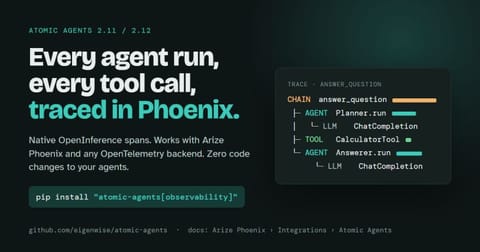
- Atomic Agents 2.11 and 2.12 are out 🙌 The big one is native Arize Phoenix tracing: you can inspect the inputs, structured outputs and exceptions from your agents and tools right in the trace. Say you've got a planner → calculator → answer workflow. The example groups those steps under one parent span. With a matching provider instrumentor enabled, the model calls appear beneath the agent calls too. You can follow what went into each step and what came back. Enable tracing once at startup; your agent implementations stay
- Claude Code can spend the start of a task searching for files and working out how your app fits together. Those exploratory reads become part of its working context. I built Codebase Mapper to give the next session a useful starting point. It saves a compact index and linked project docs: where the app starts, how the main pieces connect, and which source files implement them. A fresh session receives the index, then opens the docs relevant to its task. It doesn't load every map document into the starting context. For a booking

- Before asking an agent to change a request handler, I want it to show how the running application reaches that file. I checked this with a small booking service. Its saved codebase map pointed to an old handler. The file was still there, still callable, and had the same code as the new handler. Opening it wouldn't reveal a broken link. The difference was in the server's import: startup loaded the new file. I gave two fresh Claude Code sessions the same question, one with the stale map and one with the refreshed map. Both found the

This page shows public professional information only, each fact cited. Is this you? send a correction, or ask for removal within 24 hours, no questions asked.