
Overview
Ludwig Dumont is the founder and CEO of willow, based in Ghent. He has led Willow since May 2018, and in April 2025 he founded Will, an AI social media manager. He states expertise in SaaS sales, personal branding and social media.
Dumont was a fellow at Euronext between February and September 2025, and a fellow at BEyond Belgium from November 2023 to November 2024. He served as CSO at Veriflix from 2016 to 2018, and was a marketing advisor to CareConnect into.care from April 2015 to December 2020. From October 2015 to June 2016 he was head of the West Coast at the Belgian-American Chamber of Commerce.
Earlier, he spent three years at BNP Paribas Fortis, working in process and project management, then digital marketing and innovation, and finally corporate development until November 2015. He began his career as a management trainee at ORMIT in 2010, following traineeships at Vanheede Environment Group and Roularta Media Group.
He studied business and managerial economics at KU Leuven, graduating with a Master of Science in 2010, after secondary studies in economics at Klein Seminarie // College Roeselare.
Career history
- FounderWillow
Insights & ideas
The through-line
Across the material, Ludwig Dumont keeps returning to a single distinction: technology and distribution mechanics are neutral, and the real variable is human effort and substance behind them. He makes this argument about AI ("de technologie as such niet het probleem is, maar de manier waarop ze gebruikt wordt" [4]), about LinkedIn reach ("Nogal wat mensen hier willen graag dat hun posts gezien worden buiten hun eigen connecties" [2]), and about building a company itself, where he frames persistence and quitting as tools rather than virtues ("Persistence and quitting are both just tools" [13]). Early posts read as tactical myth-busting aimed at other operators; the later posts, arriving around Willow's eight-year mark and the Willow Create launch, turn more reflective, weighing what actually creates value versus what merely looks impressive [9][13].
On AI and substance
Dumont is skeptical of AI as a shortcut and insists that value has to be earned the same way it always was. "Posts zonder substantie hebben nooit gewerkt, ook niet in het pre AI tijdperk" [4], and he draws a sharp line between AI-assisted content and "AI slop," warning against "wegzetten van AI als het probleem" [4]. He applies the same skepticism internally at Willow: "Creating true added value with AI for customers is harder than we first thought it would be" [9], and he flags the temptation of "building 'cool AI stuff' that basically has very little to no added value" [9], noting he is "not vibe coding much these days" [9]. When promoting his own product he draws the same boundary publicly: "DON'T push the AI slop button, this is not AI slop" [1].
On persistence and quitting
Reflecting on eight years of building Willow, Dumont frames the hardest judgment call in company-building as knowing when to keep pushing and when to stop. "There is a balance to be found between trying hard to make something work and trying too hard to make something work" [13]. He rejects easy signals: "early surface signals are nearly worthless in both directions" [13], arguing instead that "the decision should hinge on durable fundamentals and on conditions you defined before you got attached" [13]. The cost of misjudging runs both ways, since giving up too soon means you "forever lose the option you didn't exercise," while giving up too late wastes time that "could have been dedicated to finding something new to work on that is actually working" [13].
On proof over hype
Dumont consistently backs claims with numbers rather than adjectives, whether talking about clients or about grit on the ground. On Nutra Health: "over 6,536 impressions, +85% on the previous quarter +74% engagement +22% follower count," with impressions up "97%" and engagement "277%" month over month once "Willow Create taking over the first draft" [8]. On Farrow: "5,500 posts published in the last 12 months," "774,792 organic impressions (+10.2%)," and "141,414 engagements (+60.7%)" over six years of partnership [12]. He treats client validation from experienced operators as meaningful signal, citing a 40-year recruitment veteran who was "genuinely impressed by the ease and content quality" of Willow Create and Will [11], and quoting a client directly: "This is a real step up from before" [15]. The same instinct for proof over polish shows up outside Willow, in his praise for two young entrepreneurs flyering by a Carrefour: "100 dagen flyeren aan de Carrefour = de motor van een jong bedrijf" [3], calling it "Exact de grit en mentality die we nodig hebben" [3].
From the stage
In interviews, Dumont explains the founding logic behind Willow that his written posts never spell out directly: most social media tools were "built by and for marketers, making them inaccessible to non-marketing professionals and small businesses lacking the expertise to use complex tools" [16]. He traces this gap to his own experience with "family business owners seeking social media guidance" [17], and describes Willow's deliberate focus on "professional service providers like accounting firms, law firms, and consultants whose expertise-driven business models benefit from social media presence" [17]. On go-to-market, he discusses acquiring customers "primarily through LinkedIn using defined ideal customer profiles and filtering to identify qualified leads in the professional services market (accountants, lawyers, consulting firms)" [18], a systematic targeting approach not detailed in any of the LinkedIn posts themselves.
Takeaways
- Treat AI as a tool whose value depends entirely on use, not on the technology itself: "Posts zonder substantie hebben nooit gewerkt, ook niet in het pre AI tijdperk" [4].
- Before building AI features, force a hard scoping exercise, since "it's easier than ever to spend resources on building 'cool AI stuff' that basically has very little to no added value" [9].
- When deciding whether to persist or quit on a venture, ignore early surface signals and instead set durable criteria before you get emotionally attached [13].
- Back every client or product claim with hard numbers rather than sentiment, as in the Nutra Health and Farrow case studies (+277% engagement, +60.7% engagement respectively) [8][12].
- Willow's product strategy is built specifically around professional service firms and non-marketers who are otherwise underserved by marketer-built tools [16][17].
- Customer acquisition can be run systematically through LinkedIn using tightly defined ideal customer profiles rather than broad outreach [18].
Media & appearances
- Mark VerheydenYouTubeSales Heroes Podcast Series - Episode 6 - Willow - Ludwig DumontLudwig Dumont discusses how Willow, a social media management solution he co-founded, acquires new customers primarily through LinkedIn using defined ideal customer profiles and filtering to identify qualified leads in the professional services market (accountants, lawyers, consulting firms).
- Fuse - Founders Guiding FoundersYouTubeEP. 83 A Fireside Chat with the CEO & Founder of Willow.co - Ludwig DumontLudwig Dumont discusses how Willow helps small and medium-sized businesses (SMBs) build strong social media presences, addressing a gap in the market where solutions typically cater to large enterprises instead. He explains that Willow focuses particularly on professional service providers like accounting firms, law firms, and consultants whose expertise-driven business models benefit from social media presence, and he shares that the company's origin came from his experience with family business owners seeking social media guidance.
- Peter SnauwaertYouTubeLudwig Dumont | What's On Your Mind? (Dutch/Nederlands)Ludwig Dumont discusses how Willow, the social media content tool he co-founded and serves as CEO of, was created to address the problem that most social media solutions were built by and for marketers, making them inaccessible to non-marketing professionals and small businesses lacking the expertise to use complex tools.
In the news
- The fact that VW is struggling is known and acceptable. It’s super hard for any old school ICE powered car brand these days. All fighting to survive. No big explanations necessary. What in my opinion is completely unacceptable, definitely for a company of this size and stature, is the fact that their CEO is completely invisible on LinkedIn. This is a moment for him to show presence and to communicate with the enormous audience of analysts, employees, shareholders, customers,…who are all active on this exact channel. His words can
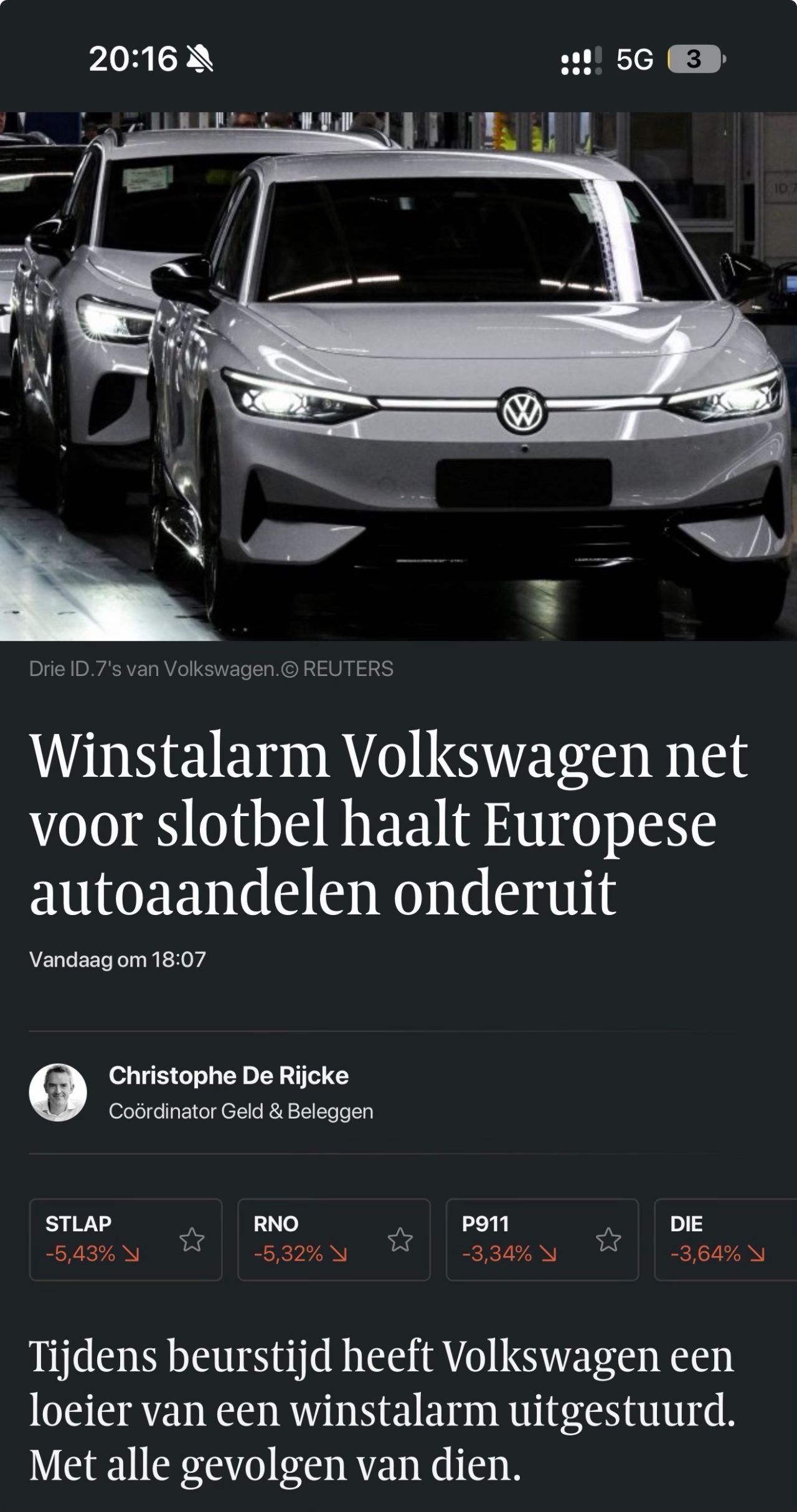
- Wat is de invloed van CEO-aanwezigheid op LinkedIn op de reputatie van een bedrijf? Nieuw onderzoek toont aan: het is vandaag een van de meest bepalende factoren voor vertrouwen en merkperceptie. - Volgens FTI Consulting (2025) is het CEO LinkedIn-profiel nu één van de drie belangrijkste digitale bronnen waarmee investeerders, klanten en toekomstige medewerkers bedrijven beoordelen: https://lnkd.in/e8Tt8BHv - 82% van jobzoekers checken de CEO’s online aanwezigheid vóór ze solliciteren (bron: SocialHP-Maximizing LinkedIn Engagement
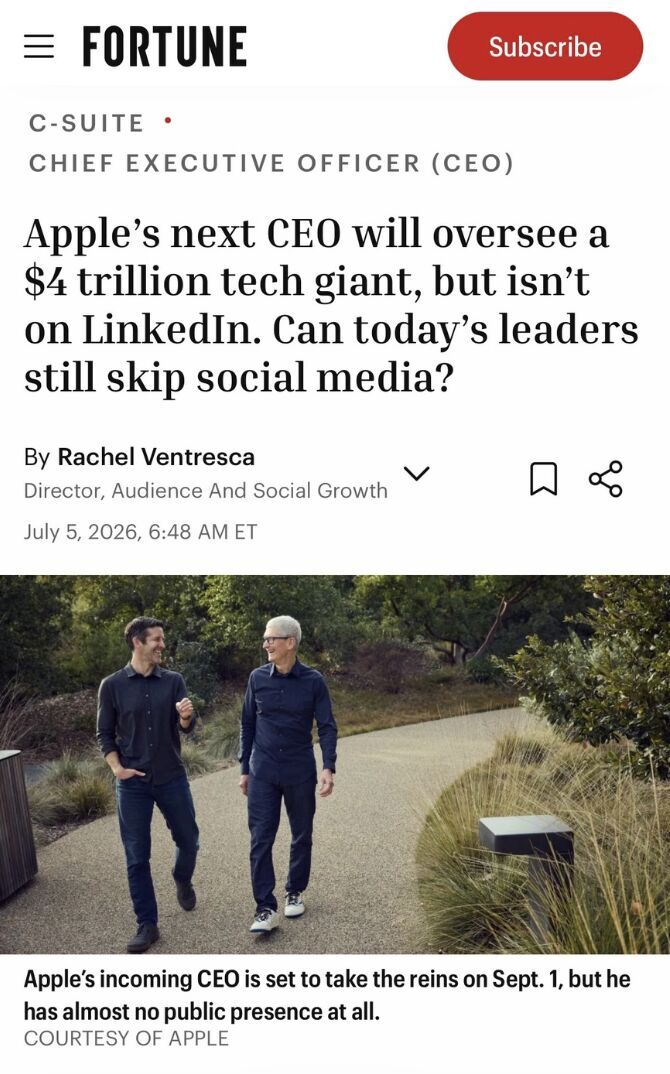
- P.S.: Siri AI werkt niet in Europa, Willow wel ;) Laat mij gerust weten als je wat meer te weten wilt komen over Willow.
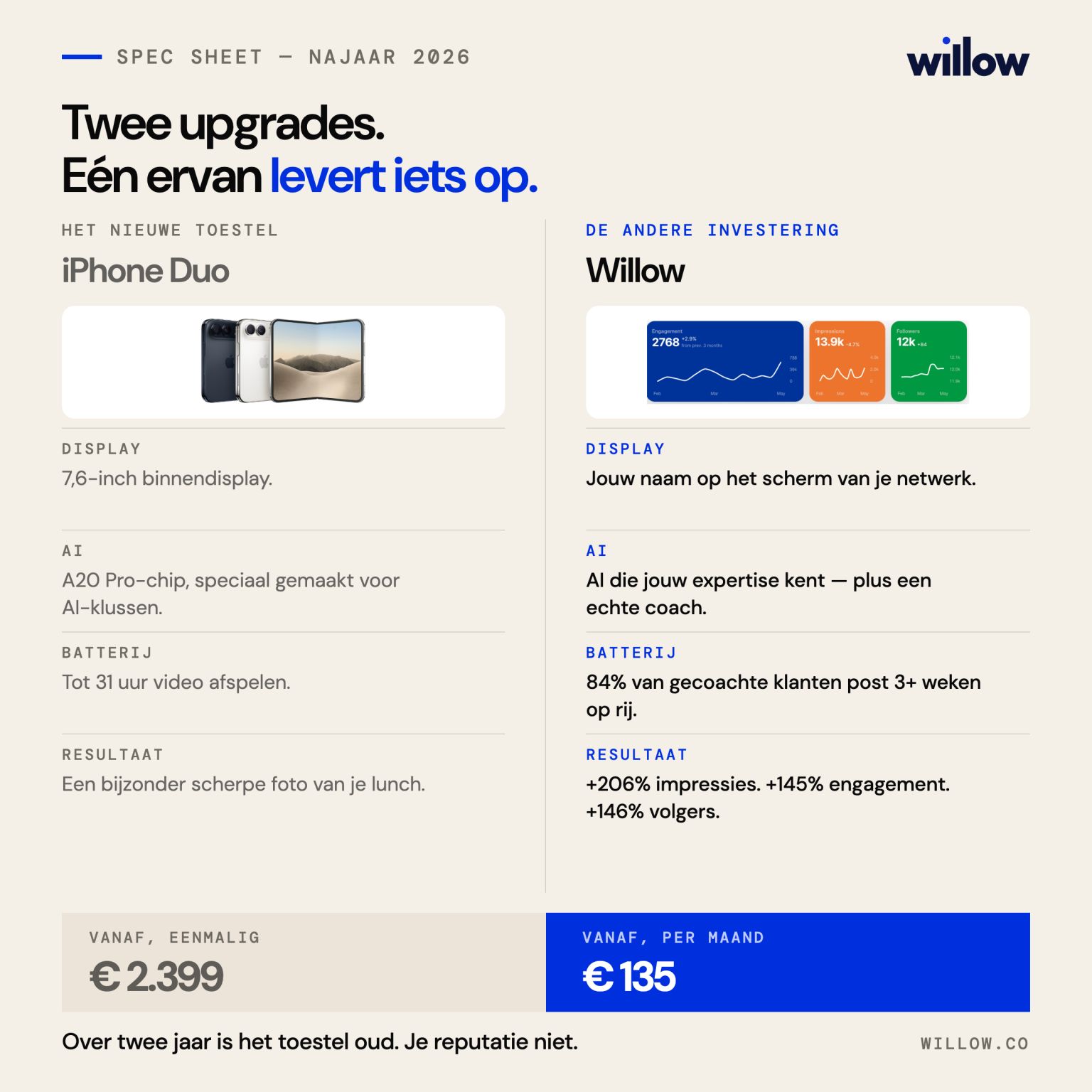
- Tijdens de talrijke gesprekken die we op wekelijkse basis voeren met partners en medewerkers is er een gedeelde uitdaging die persistent naar boven komt en die een gedeelde pijn lijkt te zijn binnen de contouren van het kantoor. 'Hoe kan ik de collega's helpen met het actiever worden op LinkedIn'. En het is niet dat er geen pogingen zijn ondernomen of dat het aan motivatie ontbreekt. Het belang van sociale media wordt ook nooit (of toch meestal niet) ondergewaardeerd. In de zoektocht naar gekwalificeerde medewerkers is LinkedIn
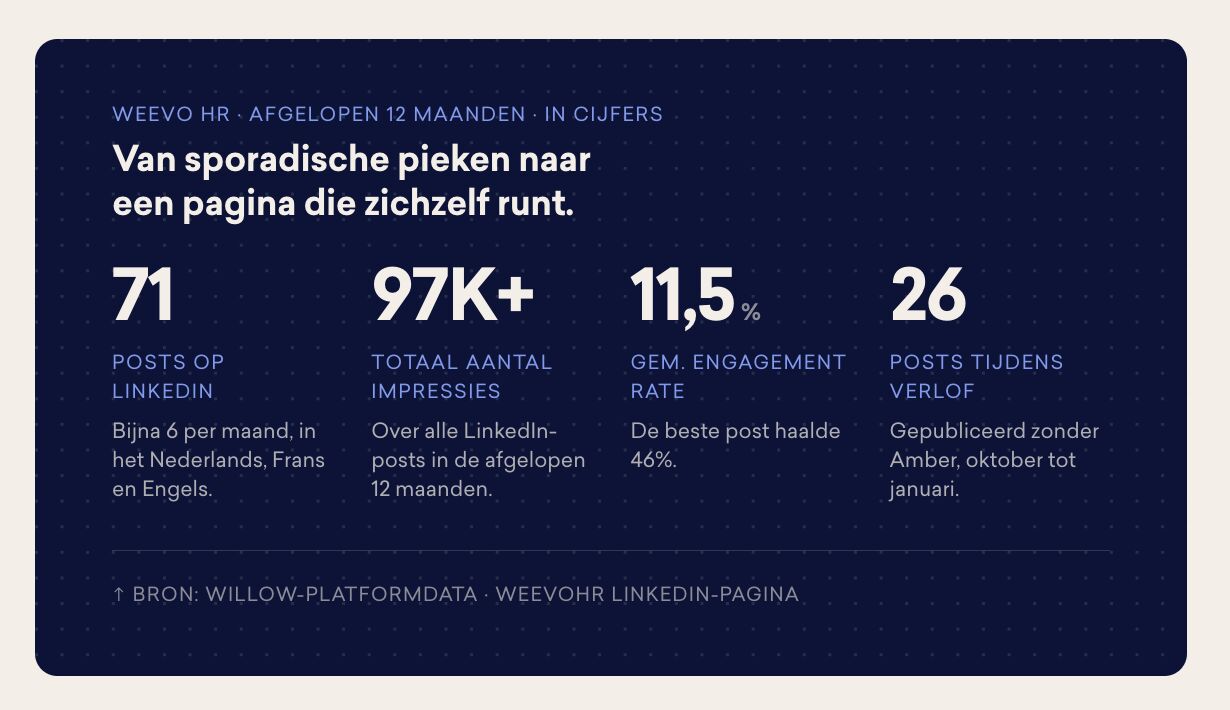
- Altijd super om te zien hoe we met willow het verschil kunnen blijven maken voor onze clients. En met een super mooie quote van Amber: "Zonder jullie zou er anderhalf jaar niets op LinkedIn hebben gestaan." Daardoor kan de vrijdag bij team Willow alvast niet meer stuk! Merci voor het vertrouwen en super goed bezig daar bij Weevo hr! Meer info over onze samenwerking hierzo: https://lnkd.in/eBf-DBf7
- Financiële stress als ondernemer – vroeg of laat maakt iedereen het wel mee. Vandaag had ik daar een eerlijk gesprek over, en het blijft me opvallen: het zegt niks over hoe goed je bent als ondernemer, integendeel zelfs. Doorzetten, bijten, telkens opnieuw naar oplossingen zoeken – dát is ondernemerschap. Je kiest bewust voor een moeilijk pad, vaak met meer onzekerheid dan comfort. En het vraagt moed om daar open over te zijn, zeker omdat het publieke beeld meestal anders is. Want laten we eerlijk zijn: de overgrote meerderheid van
- Tijdens mijn reis door Zwitserland kwam ik in een leeg restaurant terecht, samen met één andere klant: Norman. Hij, 88 jaar, alleen op reis, ik kwam te laat voor het eten in mijn hostel. Twee eenzame zielen, één spontane babbel, en de volgende avond zaten we samen aan het diner. Wat mij raakte: Norman is zijn hele leven taalleraar geweest, heeft over de hele wereld gewerkt en spreekt moeiteloos meerdere talen. Zelfs nu, na zijn pensioen, leert hij nog steeds nieuwe talen bij. Vooral zijn observatie over het belang van een goede

- Amazing cold call today by Bulent Ulug from a company called Crono 25 minutes of real conversation, didn’t feel scripted at all, genuine to the core and that kindness and smile in his voice are off the charts! He landed his demo. Great job Bulent. I do appreciate the hustle. And if you continue like this I’m sure a lot of others will do too! Cold calling is defo not dead if the people doing it are not zombies ;).
Related profiles
This page shows public professional information only, each fact cited. Is this you? send a correction, or ask for removal within 24 hours, no questions asked.