
Overview
Verwaest holds a master's degree in physics. He left to found Limecraft in 2010, where development of automatic speech recognition started in 2012 and subtitle generation from transcripts followed in 2015. VRT is Limecraft's partner in the STADIEM project on automated subtitling.
Maarten Verwaest is co-founder of Limecraft, a Ghent company that offers an online workspace for video teams with AI-powered workflows for transcription, indexing, subtitling and shot listing. He founded the company in May 2010 together with Nico Oorts and Dieter van Rijsselbergen and led it as CEO until 1 June 2023, when Joris Claes took over as CEO. Verwaest then became Executive Chair and Chief Revenue Officer, and his current title is Co-CEO and CRO. At the time of the handover Limecraft served over 115 customers, grew more than 10% per quarter and operated profitably. The company now reports 250+ customers in 50+ countries and 10,000+ monthly active users, and its automated subtitling won NAB Show Product of the Year in April 2019 and an LT-Innovate Award in June 2019. Limecraft raised €470,000 in angel funding in January 2013 from iMinds, Qunova and private investors with media backgrounds, and its total funding stands at $693K over 3 rounds. In 2021 Verwaest said the company deliberately avoided venture capital in favour of organic growth. By then its customers included BBC and Associated Press, with more than 80 clients, mostly in Europe. As founder, Verwaest directs corporate relations, financing and business development.
Insights & ideas
The through-line
Across the LinkedIn posts, one line of argument keeps resurfacing: technology, whether AI, a model, or infrastructure, is not the point of arrival. The workflow around it is. "It's the workflow, stupid." [3] and "the finish line isn’t when it compiles" [1] frame nearly every product post, from AAF handovers [7][14] to hybrid storage [2]. Over time this product-level conviction widens into a broader economic argument: the same distrust of quick technological fixes shows up in his skepticism toward "AI jobs apocalypse" alarmism [4] and in his critique of BigTech-BigMedia consolidation, where scale and access, not workflow, are what get concentrated [5][12].
On workflow over the model
The recurring claim is that AI and infrastructure investments fail unless they are embedded in the actual production process. "AI does not fix a fragmented workflow. If you add it to chaos, it will multiply the chaos." [10] He argues "the next breakthrough will not come from another model, but from properly embedding AI into the production workflow" [10], and repeatedly calls out tools that stop short: "This is where most allegedly 'AI-powered' workflows quietly hand the problem back to people." [7] The alternative he describes is "an intelligent workflow that identifies highlights, prepares the pre-cut and hands over an edit-ready, multi-track timeline directly to Avid" [14], which he ties back to the same principle stated flatly elsewhere: "the finish line isn’t when it compiles" [1].
On hybrid architecture
On infrastructure, he rejects the on-prem-versus-cloud framing outright: "There should be no hard choice between on-prem and cloud storage." [2] Instead, "proper architecture combines both to balance cost, performance and accessibility depending on the specifics of the workflow" [2], with the goal that "media and processing live where they make most sense, while control, automation and reporting remain central" [2]. The stated payoff is operational, not architectural for its own sake: keeping infrastructure "connected without accepting prohibitive storage and or egress cost" [2].
On market power and consolidation
Beyond product concerns, he applies the same suspicion of concentration to the media-tech landscape. Commenting on Hollywood consolidation, he writes that "competition is gradually being replaced by concentration, access by gatekeeping, and entrepreneurship by rent extraction" [5], and that "the effects of the collusion between BigTech and BigMedia are far stretching" [5]. On the proposed Paramount-Warner Bros merger, he is blunter about what he sees underneath the competitive rationale: "it doesn't like competition between BigMedia and BigTech; more like a gradual alignment of interests" [12], concluding it's "certainly becoming very cosy at the top" [12], while "producers and post-production facilities are expected to deliver more content, faster and with fewer resources" [12]. His underlying standard: "markets only work when power remains contestable and the winners are prevented from closing the door behind them" [5].
On AI and jobs
He pushes back against blanket protection of existing jobs from automation, calling it "'degrowth' dressed up as compassion" [4], and warns that heavy state intervention "usually produces its own unintended averse consequences - the famous cobra effect" [4]. At the same time he does not dismiss the disruption: "We must not ignore disruption. A serious discussion about universal basic income, wage insuran[ce]" [4] is where the thought is left open rather than resolved.
From the stage
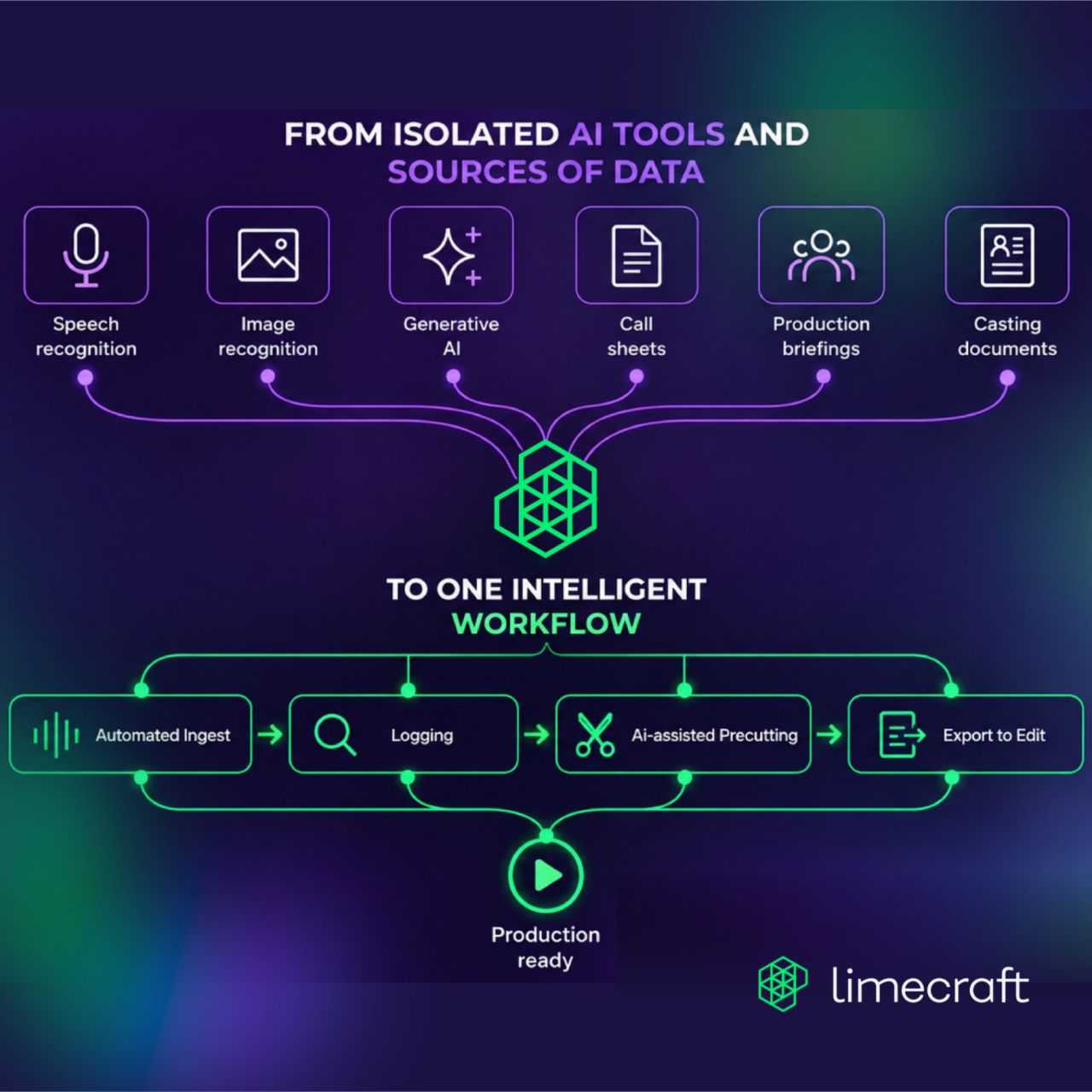
In interview settings he goes further into how the workflow philosophy translates into product and company strategy than the LinkedIn posts do. On differentiation, he describes Limecraft as production-oriented workflow software built on turnkey templates rather than a static archive system, integrating with existing on-premises infrastructure through a hybrid model instead of forcing uploads to the cloud [16]. On talent, he explains that Limecraft competes for AI and machine-learning hires against industries like fintech by leaning on the appeal of the media sector itself, using its work with top producers as a recruiting draw, and notes that demand for data science and AI talent currently outstrips supply [17]. On the mechanics of media intelligence, he describes incorporating pre-existing production data, such as casting documents and production reports, into AI engines to improve face and speech recognition accuracy, and insists this requires ongoing human oversight, an iterative process where journalists, documentarians and transcriptionists continuously guide the AI, rather than relying on unattended machine learning or generative AI [18].
Takeaways
- Treat AI output as only half the job: a workflow must still deliver edit-ready timelines, track layouts, markers and comments rather than a pile to reorganise manually [7][14].
- Design infrastructure as hybrid by default, not as an on-prem-versus-cloud choice, to control storage and egress cost while keeping control and reporting centralized [2][16].
- Keep humans in the loop for AI accuracy: face and speech recognition improve when journalists, documentarians and transcriptionists iteratively correct the system rather than leaving it unattended [18].
- Recruit AI and data science talent by leaning on sector appeal (media over fintech) and flagship client work, since supply of such talent lags demand [17].
- Be wary of both extremes on AI-driven job disruption: neither blanket job protection nor ignoring the disruption altogether is presented as sound governance [4].
- Watch for creeping alignment between BigTech and BigMedia interests in major mergers, since it can look like consolidation dressed as competitive necessity [12][5].
Media & appearances
- SlatorYouTube#59 Limecraft CEO and Founder Maarten Verwaest on AI-enabled subtitlingMaarten Verwaest discusses how Limecraft attracts talent in AI and machine learning by leveraging the media sector's appeal as a competitive advantage over industries like fintech, using the company's work with top producers as a recruiting tool. He also notes that demand for data science and AI talent far exceeds supply in the current market.
- LimecraftYouTubeMedia Intelligence Explained - Maarten Verwaest of Limecraft in conversation with Stan Moote of IABMMaarten Verwaest discusses how Limecraft's media intelligence approach incorporates pre-existing production data, such as casting documents and production reports, into AI engines to improve accuracy in face recognition and speech recognition tasks. He emphasizes that this system requires human oversight through an iterative process where journalists, documentarians, and transcriptionists continuously guide the AI to recognize specific words and images correctly, rather than relying on unattended machine learning or generative AI.
- LimecraftYouTubeOn the state of Asset Management services and how Limecraft makes the difference - interview by IABMMaarten Verwaest discusses how Limecraft differentiates itself in the crowded asset management space by offering production-oriented workflow software with turnkey templates rather than static archive systems, and by integrating seamlessly with existing on-premises infrastructure through a hybrid model that avoids forcing users to upload content to the cloud.
In the news
- Limecraft just released what I think is the most advanced application of AI for professional producers to date. Instead of being created in isolation, built for, and in close collaboration with some of our most forward-thinking producers, solving very real challenges in high-volume professional production. AI thereby assists the editorial process, while the creative decisions remain firmly with the professional. Interested? Check it out. We're exhibiting at IBC - International Broadcasting Convention (stand 7.D21). #IBC2026
- AskingForAFriend ;-) (No agencies please)
- Sharing with my network, welcome your support in this matter. We’re #hiring talented system engineers. Limecraft is growing fast. We’re bootstrapped, profitable, and building mission critical technology used every day by some of the most demanding media companies out there. To support our growth, we’re looking for exceptional Backend & Systems Engineers to join us in Ghent. Partially remote is possible, but we expect partially in-house participation as well. We believe that addressing though challenges doesn't work via slack and
- This is a bigger deal than it might look. As complex, high-volume entertainment formats represent an increasing share of the overall production budget, screening before the edit becomes critically important. Every decision you can make upstream means less unnecessary transcoding, less edit storage and, ultimately, less expensive edit capacity. The multicam player is about moving decisions upstream, where they are faster and considerably cheaper. The cheapest edit is the one you don’t need to make. 😉 Come and see it in action
- As Cédric correctly points out: the finish line isn’t when it compiles.
- There should be no hard choice between on-prem and cloud storage. Proper architecture combines both to balance cost, performance and accessibility depending on the specifics of the workflow. Limecraft Cloud Connector bridges the gap. More than "hybrid storage", it is the key enabler for a genuinely distributed architecture: media and processing live where they make most sense, while control, automation and reporting remain central. This design pattern enables scale. Some of the largest distributed media operations trust
- It's the workflow, stupid. (With all due respect to James Carville, I think the workflow often matters more than "the economy" 😉)
- AI jobs apocalypse” may make a compelling headline, but history suggests a more optimistic outcome. Labour markets have never been static. Agriculture gave way to industry. Industry created services. Computers eliminated entire categories of work while creating others nobody had imagined. In the light thereof, protecting every existing job from technological change isn't great governance, but "degrowth" dressed up as compassion. Heavy-handed government intervention usually produces its own unintended averse consequences - the famous
Related profiles
This page shows public professional information only, each fact cited. Is this you? send a correction, or ask for removal within 24 hours, no questions asked.