
Overview
Martijn Berghs is the CEO of etorch and is based in Genk. He co-founded E-Torch in February 2025. Since March 2024 he has also owned Event-IT Solutions and worked as a freelancer for To B-Seen.
Between March 2020 and March 2024 he was at Solita, where he was a senior integration consultant, took up the role of Azure tech lead in January 2022 and worked on the Partner Network Benelux from November 2020 to January 2023. He had previously been a business integration engineer at Integration.team from July 2016 to March 2020, and a business integration consultant at i8c from December 2011 to September 2019.
He has been a volunteer at Suikerrock since 2015 and a frontstage steward and all-round volunteer with ESC vzw since June 2013. For Stad Genk he was a staff member on Genk on Stage - factor J from 2010 to 2020 and a volunteer CP member from 2020 to 2024.
Berghs studied information technology at Hogeschool PXL, graduating in 2011, and returned there for a postgraduate degree as an artificial intelligence business architect in 2022. He gives his areas of expertise as agile methodologies, SQL, Azure API Management, Azure iPaaS and functional architecture.
Career history
In the news
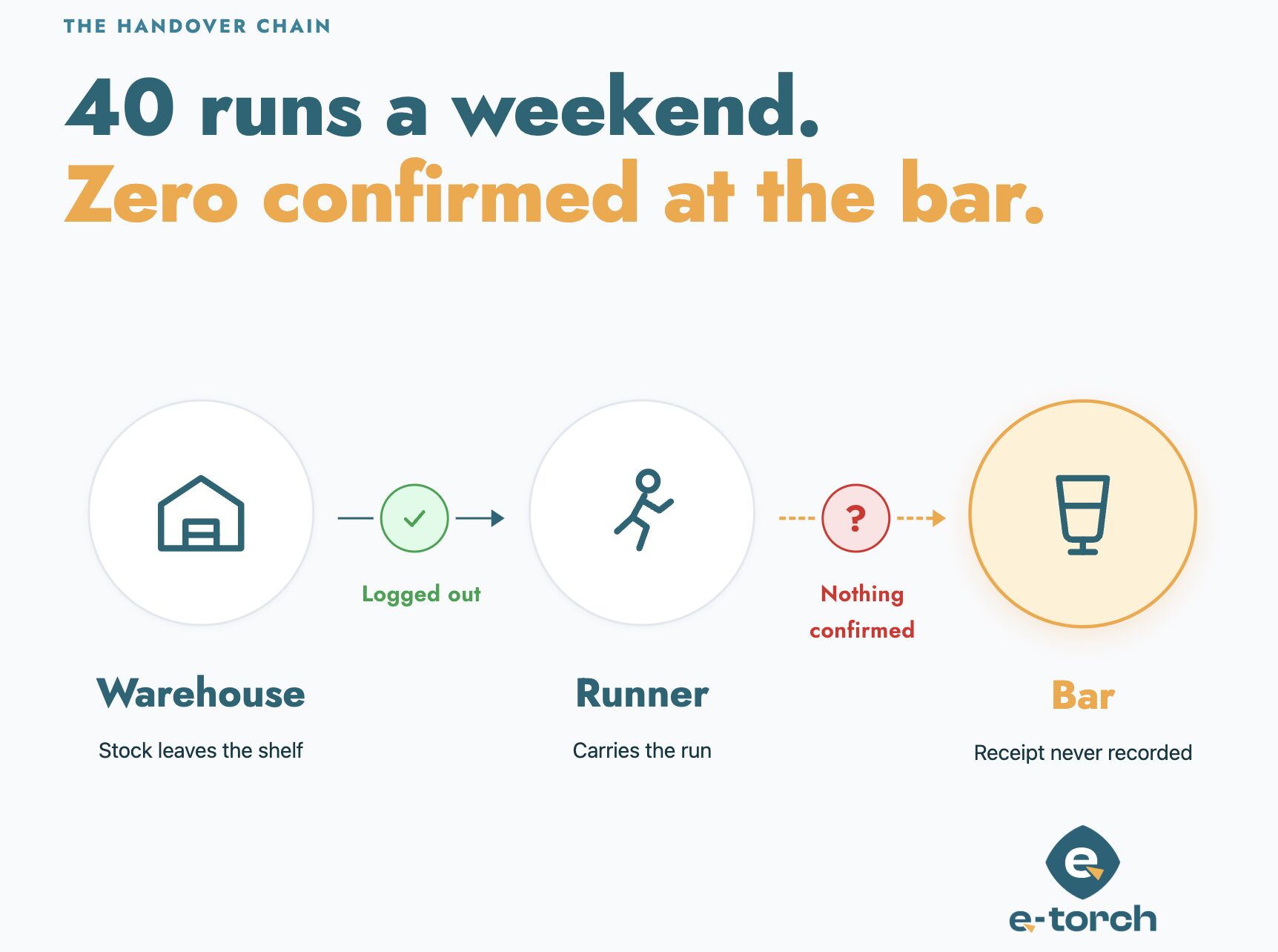
- Your runner does about 40 runs a weekend. Picks up stock from the warehouse. Drives or walks it to the bar. Drops it off. Goes back for the next one. How many of those 40 runs are confirmed at the receiving end? The warehouse logs what went out. The bar doesn't log what came in. So when the numbers don't add up on Sunday night — was it a wrong delivery? A short pick? A bar that distributed to another location without telling anyone? Nobody knows. Because nobody confirmed. We added one step to the process: the receiving bar confirms
- What a festival weekend actually looks like from the ops side. Friday, 10:00 > Warehouse stocked. Counts done. Locations confirmed. Everything looks good. Friday, 18:00 > First wave of visitors. Bars start selling. First restock request comes in 45 minutes earlier than expected. Friday, 22:00 > Three simultaneous restock requests. One runner on duty. Dispatch coordinating on radio. Nobody's writing anything down. Saturday, 11:00 > Closing count at Bar 4 doesn't match what was delivered. Nobody can explain the gap. Everyone
- You track what leaves the warehouse. > You track what arrives at the bar. To late But here's the movement almost nobody tracks: Bar 3 runs low on soda at 9pm. Bar 7 has surplus. A runner moves 10 trays across the terrain. No record. No confirmation. No update to either bar's stock count. It happens every weekend. And when you do the final reconciliation, you lose hours explaining the gap. Bar-to-bar transfers are the most overlooked source of stock loss at festivals. Not because people are careless. Because there's no system
- Cup return rates, reuse cycles, and waste reduction per visitor are crucial metrics, yet much of this data remains elusive. Cups leave the warehouse, with some returning clean, others dirty, and some not returning at all. The journey in between is often a matter of guesswork. Without tracking, you cannot report on a lifecycle. Our Reusables module addresses this gap by providing: → Tracking of every cup, glass, and plate across the warehouse, terrain, dirty collection and cleaning → Full transfer history with timestamps →
- I spent years in IT. Onprem integration projects, cloud migrations, data pipelines Then a friend asked me to help out with F&B logistics at a festival. I said yes. I spent the weekend watching stock move between warehouse and bars solely based on walkie calls, pen and paper. Status updates based on radio calls, papers in trays, a quick verbal note, etc. End of day stock counting took hours, restocks for next day go into the early hours. The week after the festival, hours lost in 'fixing' the mismatch in numbers and reality. 'This is
- Your team is coordinated, sort of. > WhatsApp groups with 40 people in them. > Radio calls nobody writes down. > Tasks assigned verbally and forgotten 20 minutes later. It works. Until it doesn't. During peak hours, things fall through the cracks. And after the event, you have no record of what was asked, who picked it up, or when it was done. We built a task module specifically for showday. Not for office projects. Not for ticketing systems. For the reality of a festival: fast, loud, understaffed, and always-on. → Assign tasks
- Your POS system works exactly as designed. It records every sale. It timestamps every transaction. It tells you what your customers paid for. What it doesn't tell you: → What left the warehouse → What the runner actually delivered → What quietly moved between bars at 11pm on Saturday That gap between what was sold and what actually moved, is where festival revenue disappears. Not through theft. Not through negligence. Just through a chain of handoffs that nobody is tracking in real time. We call it the POS gap. The good news: it's
- Just came off two back-to-back festivals. Same terrain. Different formats. Different crowds. Same operational patterns underneath. A few things you always see when you're in the warehouse during peak hours: The gap between what was dispatched and what was confirmed is bigger than anyone thinks going in. Restocks happen faster than any spreadsheet can keep up with. And the moment something goes wrong; a short delivery, a bar running dry, a crate that went to the wrong location. Everyone has a theory and nobody has a record. We were
This page shows public professional information only, each fact cited. Is this you? send a correction, or ask for removal within 24 hours, no questions asked.