
Overview
Peter Hernou is a Belgian business owner who founded aeralab in 2018, where he continues to run the business. In July 2026 he founded phmenu.studio, where he is creative director. His stated areas of expertise are product R&D, specialty coffee, chocolate drinks, coffee consultancy and barista training.
He has worked as a business specialist under his own name at www.peterhernou.com since 2007, and in 2012 he wrote the book Latte Arte. He has been a Callebaut Ambassador since January 2014, and in June 2014 the Speciality Coffee Association of Europe recognised him as The Passionated Educator 2014. He served as an MC and judge for the Speciality Coffee Association of Europe from 2007 to October 2021, and between October 2012 and June 2014 he wrote a column for CittA. Before that, from 2003 to 2007, he owned his own diner.
Hernou was Belgian Latte Art Champion in 2007, 2008 and 2009, and World Latte Art Champion in 2009 and 2010.
Career history

Insights & ideas
The through-line
Everything here circles one idea: twenty years of professional beverage knowledge should not stay locked inside the trade. PHMENU.STUDIO is described as taking "professional beverage know-how" and turning it into "tools you can actually use" [6], with the same library and the same workflow serving a home table and a hospitality business alike. The formulation repeats almost as a refrain: "One platform. Two different ways to use it. Choose what fits you" [8][11], or more simply, "One platform. Two ways to use it. For People @ Home. For Professionals in Hospitality" [15]. The claim is that the gap between the two is a gap of purpose rather than of standards, and that "20+ years of beverage expertise, translated into a platform built for creativity and control" [6] can serve both without dilution.
Over the run of the material the emphasis shifts from the library to what a person does with it. Early framing leads with recipes and knowledge [10][12]; later framing leads with the finished artefact and moves past inspiration entirely: "Ready for more than inspiration?" [2]. The sequence gets stated as a process, "Discover → Select → Design → Print" [1], and elsewhere as "Discover. Personalise. Create. Present" [2] or "Discover. Learn. Create. Enjoy" [3]. The direction of travel is from knowing a drink to serving it to somebody.
On knowledge as the foundation
The starting premise is stated plainly: "Every great beverage starts with reliable knowledge" [12], and "better beverage menus begin with better knowledge" [12]. That knowledge is presented as a curated library of 180+ professionally developed coffee-based recipes organised into structured categories, meant to support "both creativity and consistency" and to form "the foundation of every workflow" inside the platform [12]. The count is more often given as 185+ recipes spanning espresso classics, brewed coffee, chocolate creations, cold brew, nitro, cold creations, mocktails, cocktails, indulgent treats and creative signatures [5][13][14].
What matters is the level of detail. A recipe is not a suggestion but a complete working document: "From ingredients and setup to step-by-step preparation, professional tips and serving suggestions" [10], with each one bringing together "proportions, preparation, technique, presentation and pricing in one evolving knowledge library" [13][14]. The point of that completeness is confidence rather than novelty: "Explore new ideas. Learn the techniques. Create with confidence" [10]. The same body of expertise shows up in demonstration work under his own name, including "Café & Latte with Peter Hernou" [17], "Peter Hernou meets Callebaut (short version)" [16] and "Peter Hernou my World-championship" [18].
On the two audiences
For People @ Home the pitch is elevation without professionalisation: discover 185+ professionally developed beverages, learn them, personalise them and build a collection of favourites [8][13]. The audience is defined by ambition rather than equipment, "built specifically for People @ Home who want to bring professional beverage knowledge and presentation to their own table" [1], and every version of the message ends with the table itself rather than with the cup [3][13].
For Hospitality Professionals the same library is a starting point for a concept: "Select the drinks that fit your concept, refine the guest-facing copy, set your selling prices and build a branded professional beverage menu" [4], alongside cost control, ingredient and allergen management, complete menus and publication in print or by QR [8][11]. Where the home user wants an experience, the professional needs "reliable operational standards" [12]. The invitation is written to hold both readers at once: "Your next favourite drink — or bestseller — might already be waiting" [5].
On personalisation and ownership
The most insistent theme is that the output has to belong to whoever made it. "YOUR MENU. YOUR RULES" [7] is the compressed version; the fuller one is "Your menu. Your style. Your way to share it," covering "colours, fonts and layouts to descriptions, pricing, logos and presentation" [9]. Recipes are treated as material to be altered, not obeyed: choose what you love, follow the complete recipe and personalise it to your taste [5]. Even the professional path is framed as adaptation rather than adoption, selecting and adapting recipes to fit a concept [8][14].
The ambition behind personalisation is a specific feeling. A home drinks card should be one "that feels like your own" [1], and a menu should be "truly yours" [13][14] and "a presentation that reflects you or your business" [13]. Serving becomes part of the event rather than a step before it: "Style it, print it and make the moment yours" [4], and "make serving your favourites part of the experience" [9].
On the numbers behind the menu
Costing is treated as the unglamorous half of a good menu and given equal weight. Professionals are told to "Work with ingredients, quantities, costs, margins and selling prices — then style, publish and share your finished menu" [5], with the platform helping "structure the numbers behind it" and making "costing and pricing faster, more consistent and far less manual" [6]. The Control add-on is described specifically as "connected ingredient costing, margins, VAT and suggested selling prices" [4], and allergen management sits in the same operational bracket as cost control [8][11]. Creativity and arithmetic are presented as one job, not two, which is the sense of a platform "built for creativity and control" [6].
On the menu as the finished object
A menu is the deliverable, and the material is unusually precise about what that means physically. At home it is "a personalised, print-ready coffee menu" [1] with your logo, typography and layout, made for "a brunch, dinner, celebration or simply a better coffee experience at home" [1][9]. In hospitality it is "a fully branded guest-facing menu" that is published and kept accessible through a customised QR code [9], ready for print, online publishing and "your own Menu QR" [4][8]. The arc is summarised as "From your screen to the table. From your menu to your guests. Design it. Personalise it. Print it. Share it" [9].
On how the product is layered
The offering is built as a ladder, each step adding one capability. The Coffee Book Plan gives access to the 185+ worked-out recipes and the knowledge, techniques and inspiration behind them, pitched as "Your coffee book. Without the bookshelf" [3]. Coffee Book Plus adds selection, personalisation and design, taking "the experience beyond discovering recipes" so a collection becomes "your own coffee menu" [1][2]. Guest Menu expands a home creation "into a complete multipage guest menu with wine, food, desserts, your own items and custom sections" [4]. Pro Menu builds the branded professional beverage menu, Control adds the costing layer, and Full Menu extends a professional menu beyond beverages [4][14]. The stated status of the range is that "All plans are available" [11], announced, like the Friday posts, through the recurring character MiQ [7][11].
Takeaways
- Treat the recipe library as infrastructure rather than content: 185+ fully worked-out recipes covering proportions, preparation, technique, presentation and pricing are what make both creativity and consistency possible [12][13].
- Build one product for two audiences by keeping the knowledge identical and changing only the purpose: "One platform. Two different ways to use it. Choose what fits you" [8][11].
- Finish the job at the table. The workflow is not complete until a menu is styled and printed or published: "Discover → Select → Design → Print" [1].
- Give costing the same status as creativity, including ingredient costs, margins, VAT and suggested selling prices, to make pricing "faster, more consistent and far less manual" [4][6].
- Let people alter what they are given; the goal is a menu "that feels like your own" [1], summed up as "YOUR MENU. YOUR RULES" [7].
- Sell capability in layers, from a recipe book to a personalised home card to a branded professional menu with costing and full food and wine sections [3][4][14].
- For hospitality, remember the operational obligations alongside the design: ingredients, allergens, complete menus and a customised Menu QR for publication [8][9][11].
Media & appearances
- Peter HernouYouTubePeter Hernou meets Callebaut (short version)
- Peter HernouYouTubePeter Hernou my World-championship
- Peter HernouYouTubeCafé & Latte with Peter Hernou
In the news
- A new site is LIVE Taste. Menus. Tools. One place. Peter Hernou Studio — consultancy, training, menus, imagery, the systems behind the cup. PHMENU.STUDIO — coffee from the basics to the card. For home, and for the floor. Latte Arte — Best Coffee Book in the World. The publisher is gone. The author’s edition is back, from the author. EN / FR / NL. https://peterhernou.com
- Discover PHMENU.STUDIO for more
- Your business serves more than beverages. Now your PHMENU.STUDIO menu can too. The Full Menu Add-on expands PHMENU.STUDIO beyond its coffee-led beverage foundation, giving hospitality professionals the tools to bring their broader offering together in one complete menu. Add wine, food, desserts and additional sections alongside your beverage offering. Structure your menu across multiple pages and create a consistent presentation built around your concept and identity. Full Menu can be added to any PHMENU.STUDIO Professional
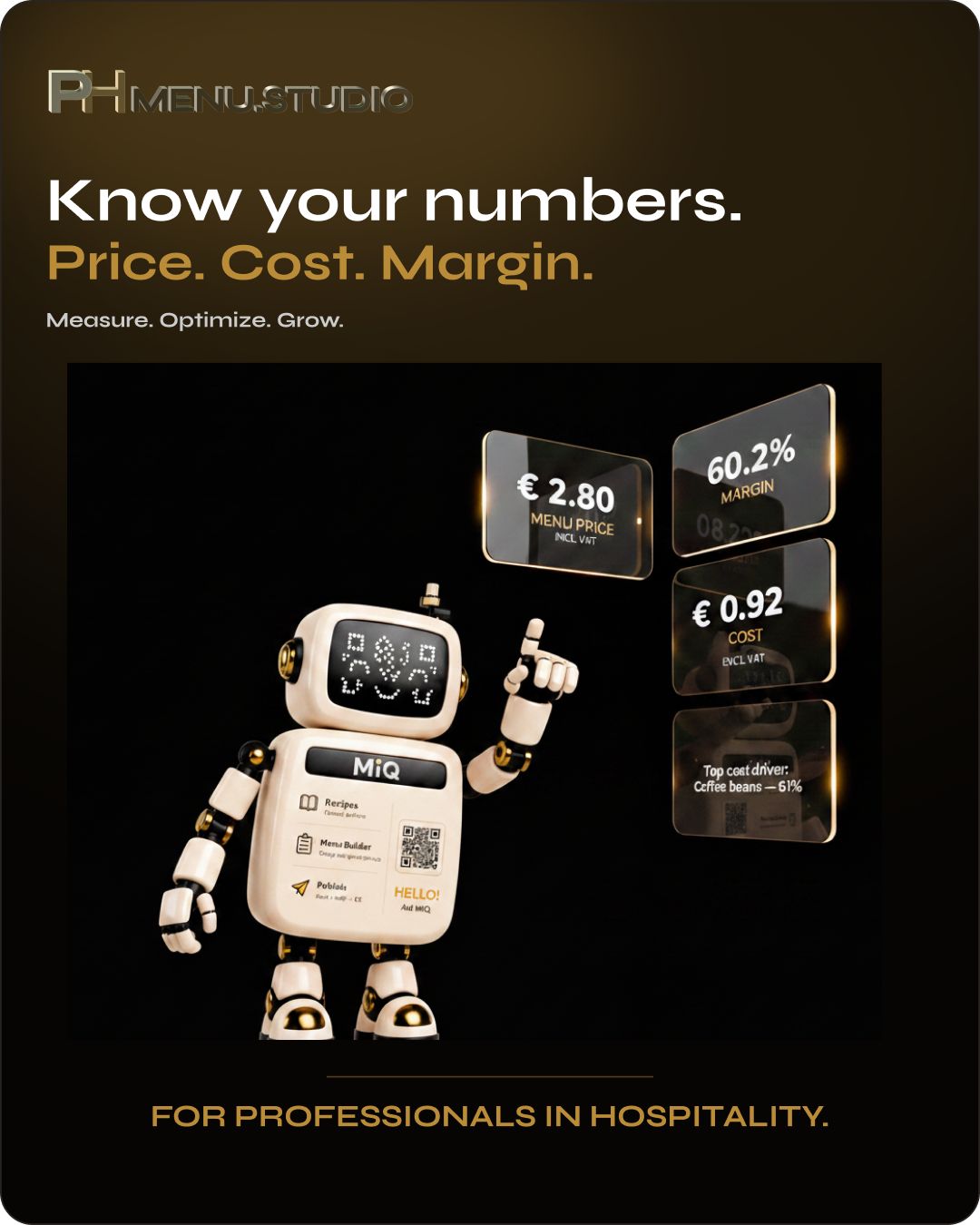
- PROFESSIONALS IN HOSPITALITY — 02 | CONTROLYou know what you charge for a drink. But do you know what you actually earn on it? A recipe can be perfectly developed and still be commercially wrong for your operation. Ingredient prices change. Add-ons cost money. Cup and glass size affect every serve. VAT and target margins differ. And your market, currency and language requirements may be different from those of the business next door. That is where PHMENU.STUDIO Control comes in. Enter your own ingredient costs — including sugar
- Know your numbers. Price. Cost. Margin. Meet the Smart Calculator behind Control. Powerful numbers. Made simple. Tomorrow, we’ll show you more. Can’t wait? Discover Control already at PHMENU.STUDIO #PHMENUStudio #Hospitality #MenuEngineering #FoodCost #Profitability
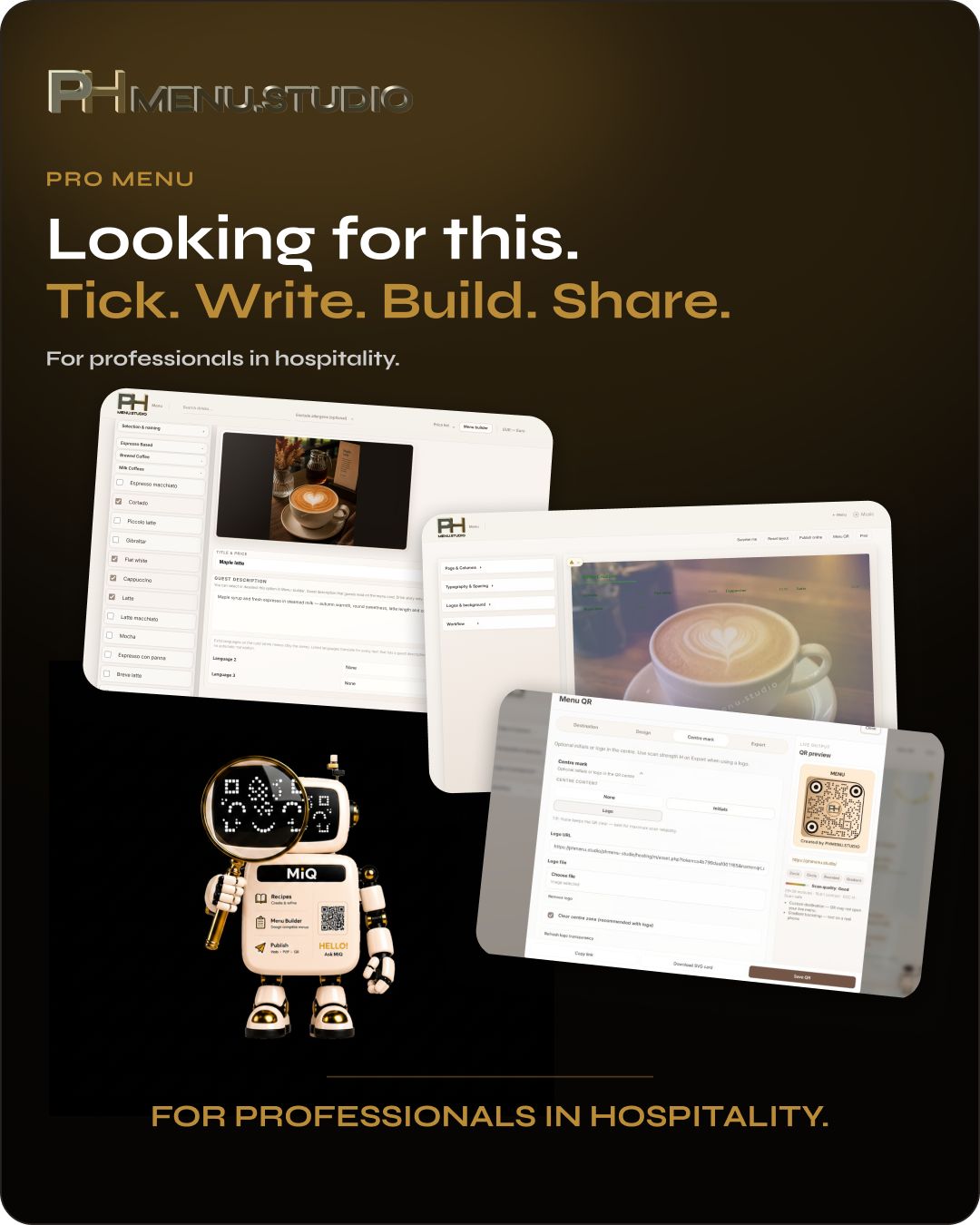
- PROFESSIONALS IN HOSPITALITY — 01 | PRO MENU A professional beverage menu shouldn’t start from an empty page. With PHMENU.STUDIO Pro Menu, the knowledge and recipes are already there. You turn them into the menu that fits your business. - Tick. Select what you serve and set your pricing. - Write. Add your own descriptions. - Build. Personalise and structure your menu. - Share. Publish it and bring it directly to your guests through your own QR menu. Tick. Write. Build. Share. It connects professional beverage knowledge with the
- Your beverage knowledge shouldn’t stop at the recipe. It should reach the guest. That’s the thinking behind PHMENU.STUDIO Pro Menu. Select the drinks you want to serve and set your pricing. Add your own descriptions. Build the presentation around your business. Then publish and share it through your own QR menu. Tick. Write. Build. Share. One workflow that takes professional beverage knowledge from recipe to service — without having to rebuild everything somewhere else. PHMENU.STUDIO | For Professionals in Hospitality. By Peter
- Turn every occasion at home into an experience worth sharing. With Guest Menu by PHMENU.STUDIO, create a beautifully designed menu for whatever you’re serving — drinks, brunch, lunch, dinner, desserts, wine or the complete experience. Bring everything together in your own personalised, multi-page menu. Choose your logo, typography, paper and layout, then print it ready for your guests. Built on Peter Hernou’s 20+ years of international hospitality expertise, PHMENU.STUDIO brings professional knowledge and presentation to your
This page shows public professional information only, each fact cited. Is this you? send a correction, or ask for removal within 24 hours, no questions asked.