Overview
Philippe Herman is Chief Executive Officer of immunochem, a role he has held since December 2019. He is based in Chaumont-Gistoux and works in antibody engineering and bioinformatics.
Between April 2019 and July 2021 he was a project manager at Ansers Analytical Services. Before that he spent a year as a postdoctoral researcher at ETH Zürich, from April 2018 to April 2019, and completed a postgraduate degree in protein engineering at the ETH Department of Biosystems Science and Engineering over the same period.
His earlier career was at the Université catholique de Louvain, where he carried out his master's thesis from September 2011 to September 2012, completed a PhD in biophysics on the force nanoscopy of staphylococcal adhesion between October 2012 and April 2016, and then undertook postdoctoral studies in biophysics until April 2018. He holds a bachelor's and a master's degree in bioengineering and biomedical engineering from the same university. In October 2021 he took a course in GMP basics and pharmaceutical design at aptaskil.
Career history

In the news
- Episode 10 : Same target, same hotspot, two designs: one you can trust, one you can't. Here is how to tell them apart. (🎥 Designing nanobody using AI Ep10 ) This quality check is the one I find the most convincing to actually watch. Take any of the shortlisted designs: the fold quality is consistently high, and the weakest fold in the set is barely distinguishable from the strongest one; that's the "thin spread" I mentioned in the last episode, made visible. Here on ChimeraX, in blue is our receptor, IL-7Rα, in red the
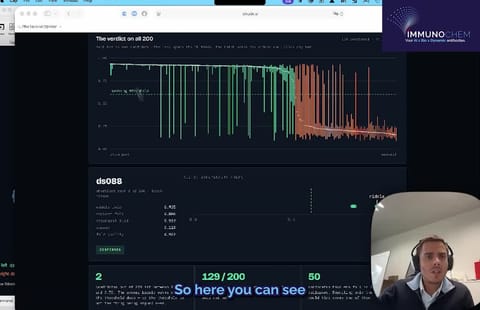
- Episode 9 : Don’t trust a single model. Let’s ask a second one that has never seen your design. (🎥 Designing nanobody using AI Ep9 ) After shortlisting 200 candidates and ranking them with specific metrics, we appreciate to bring in a second model, a different architecture, one that has never seen these designs before, to act as a neutral judge. It co-folds each candidate sequence with the target 25 times, independently. What we're looking for is the spread across those 25 runs. A design that folds the same way every time,
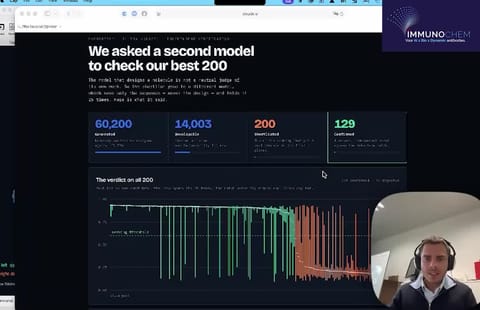
- Episode 8 : Will our14,000 candidates that survived developability filters actually bind? (🎥 Designing nanobody using AI Ep8 ) Once a design clears our developability filters, it still has to prove it can bind. At this stage we're down to 14,000 candidates, and we rank every one of them using confidence metrics straight out of the generative pipeline: ipTM, pLDDT, backbone RMSD, and ipSAE (a complementary way of reading interface confidence). What we were really checking is whether the model is confident that the nanobody docks
- Episode 7 : Let's run 9 developability filters before a single design earns a shot at the lab. (🎥 Designing nanobody using AI Ep7 ) Before a design earns a shot at the lab, it has to clear nine developability filters. The most stringent one, and the one that causes the most attrition, checks structural self-consistency: ▶️ we refold the designed nanobody in the context of the antigen 🛑 if the refolded structure drifts more than 2.5 angstroms from the original design, it's out. The others look at composition: ✅ no free
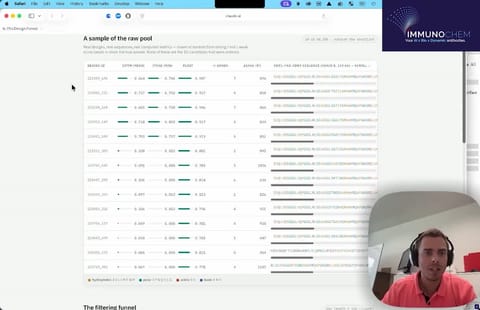
- Episode 6 : 60 000 sequences generated! But most of them are noise. Here's how you find the ones worth trusting. (🎥 Designing nanobody using AI Ep6 ) Generating a sequence that folds into the shape you want is one thing 👍 Knowing which ones are actually worth trusting is another. Not every one of the 60 000+ sequences we generate is a real binder, most of the pool is exactly the kind of noise you don't want to carry into the lab. So the next job is triage: rapidly filtering and eliminating the weak designs before they cost us
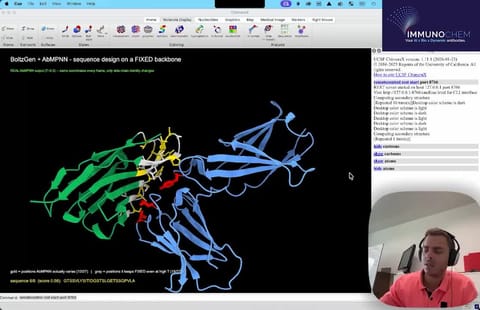
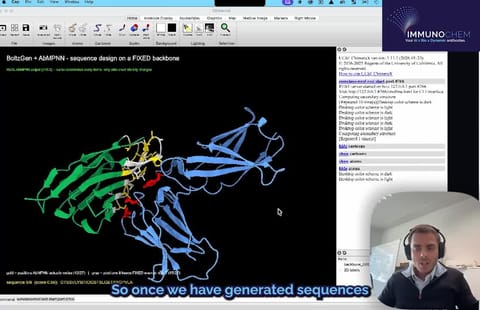
- Episode 5: Watch a nanobody sequence get built one residue at a time, live 🤗 (🎥 Designing nanobody using AI) This is what sequence generation actually looks like once you zoom in. In yellow, you can see the residues changing in real time as the model threads in a new amino acid at each position of the chain. Its not random!!! At every step, the network is optimizing the contacts against the residues we care about, the ones highlighted in red, the actual hotspot on our target. Every position is a small decision made in the

- Episode 4 : One backbone, one sequence? No: let's thread 60 000 sequences, 60 000 backbones. (🎥 Designing nanobody using AI) Once every candidate backbone has its topology, the next step is sequence design: for each backbone, we thread in one amino acid at every position of the chain. We do this for every topology we generated, which gives us roughly 60,000 sequences spread across 60,000 backbones. Thats the whole point of working at this scale: this level of diversity is what lets us actually explore the sites that matter for
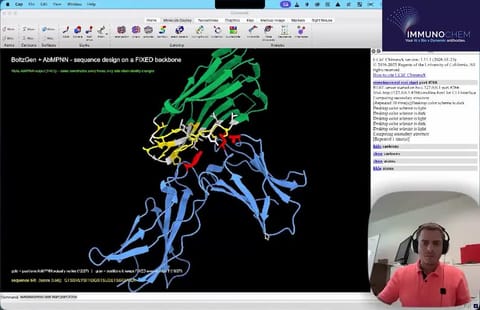
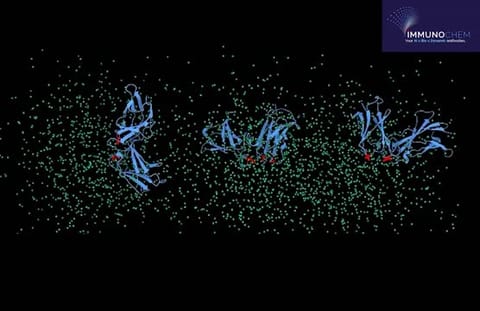
- Episode 3 : From noise to nanobody: how a framework becomes three candidate topologies around the target. (🎥 Designing nanobody using AI ) With the target defined and the framework selected, the pipeline moves to the step I find the most fun to watch: generating topology!😊 In the video, the receptor (IL-7Rα) is in blue, the hotspot were targeting is highlighted in red, and the green trajectories are the candidate backbones diffusing around that target site. Each run produces multiple topologies, three distinct ones in this
This page shows public professional information only, each fact cited. Is this you? send a correction, or ask for removal within 24 hours, no questions asked.