
Overview
Pirlot trained as a civil engineer and met his future co-founder Quentin Sizaire during those studies. He then worked in the energy sector on cogeneration, photovoltaic, biomethanisation and biomass projects, building both technical and financial experience. He is now managing partner of the company.
Pierre-Yves Pirlot is co-founder and managing partner of ECCO NOVA, a crowdlending platform based in Liège. He founded the company with Quentin Sizaire, whom he met at university during their engineering studies. Ecco Nova describes itself as the first crowdlending platform dedicated to the ecological transition. It finances renewable energy projects, high-performance real estate and sustainable SMEs. The platform has raised more than €128 million across 163 campaigns, with an average campaign size of €785,000, and counts 15,000 members. It raised €16.5 million in 2025. Its company number is 0649.491.214. Partners listed by the platform include Triodos Bank and Finance & Invest Brussels. Pirlot is a civil engineer by training. Before co-founding Ecco Nova he worked in the energy sector, where he developed technical and financial skills in cogeneration, photovoltaics, biomethanisation and biomass.
Career history

Insights & ideas
The through-line
Across these sources, Pierre-Yves Pirlot keeps returning to one idea: the visible parts of an investment (a rate, a headline figure, a press mention) tell you less than the structural work behind them. Whether he's discussing bank negotiations on second-rank security [1], the concentration hidden inside a "world" ETF [5], or the plumbing needed to turn a 19th-century newspaper building into a hotel [7], the pattern is the same: he pulls back the curtain on what actually determines whether a project works, and insists the technical, less visible layer is what matters most. Over time this has evolved from a single instrument in 2016 to, as the market imposed new constraints, "plusieurs autres" [13], showing a shift from simple crowdlending toward a more diversified structuring practice built to follow "les défis du marché" [13].
On structuring and financing
Pirlot is explicit that he does not personally negotiate financing terms, that is Quentin's and his team's job, but he supervises how those terms affect an offering's attractiveness and speed of fundraising [1]. He describes the growing difficulty banks have accepting "le second rang" and warns that compensating weak security with a higher rate "ne marche que jusqu'à un certain point," since expensive financing weighs on margins and on what a borrower can bear [1]. This concern with instrument design is structural for him: "En 2016, un instrument suffisait. L'évolution du marché nous a conduits à en construire plusieurs autres," citing a 450 basis point rate rise, a legal ceiling multiplied by sixteen, and regulatory shifts as the triggers, concluding "À chaque fois, la contrainte est arrivée d'abord. L'instrument ensuite" [13]. He notes that more than a quarter of ECCO NOVA's 160+ operations now fall outside classic subordinated crowdlending debt, the result of "six modes de structuration innovants" developed under Quentin Sizaire [13].
On choosing where to invest
A recurring theme is that people spend too much energy picking a project and not enough picking the platform or the category. "On passe beaucoup de temps à choisir un projet. Pas assez à choisir la plateforme," he writes, laying out five checks: agrément, méthode d'analyse, qualité de la documentation upfront, and qualité du suivi plus transparency in difficulty over time, adding "C'est moins visible qu'un taux, mais pas moins important" [2]. He extends this to asset classes generally, arguing "Le crowdfunding n'est pas une classe d'actifs. Il donne accès à plusieurs d'entre elles," describing it as "un canal plutôt qu'un actif" [14]. On the broader portfolio question, he reframes "Quel est le meilleur investissement ?" as "probablement mal posée," since an ETF, real estate, and direct project financing "n'offrent ni la même liquidité, ni le même horizon, ni la même visibilité" [10].
On real assets and what they actually finance
Pirlot repeatedly grounds abstract financial mechanics in concrete buildings and numbers. He highlights renovation over demolition, as in the Liège building that now houses "8 appartements et 200 places de vélo sécurisées" [3], and the Marseille hotel project converting a 1868 former newspaper headquarters, noting "Un bâtiment patrimonial rénové plutôt que démoli, dans une ville qui manque de chambres" [12]. He treats press coverage carefully, saying a Figaro mention "n'apporte évidemment ni validation du projet ni garantie de performance," but still values the external perspective it offers [8]. On pricing mechanics in fractional real estate, he notes that grouped acquisition "a ainsi permis d'obtenir un prix inférieur de 15 % au prix affiché à l'unité," while stressing that "la pédagogie" of explaining indirect ownership, exit scenarios, and performance drivers "en demande davantage" than the legal structuring itself [15].
On energy transition realism
Pirlot resists simple good-news framing on renewables. Reacting to the IEA report that renewables overtake coal in 2026, he writes "j'étais content, comme beaucoup," then adds that demand growth is accelerating and "les émissions du secteur électrique augmentent encore de 1 % en 2026," concluding "Les renouvelables progressent. La demande aussi. Les émissions, elles, ne baissent pas encore" [6]. He connects this to underinvestment in efficiency: "on y investit près de moitié moins que dans les renouvelables" [6].
Takeaways
- Before judging a crowdfunding project, check the platform's agrément, analysis method, and documentation upfront, and its follow-up quality and transparency during difficulties over time [2].
- A weaker security position (loss of second-rank guarantees) shouldn't simply be offset with a higher rate, since that raises borrower cost past a sustainable point [1].
- Crowdfunding is a distribution channel, not an asset class, since it can give access to private debt, real estate, or equity in unlisted companies [14].
- Renewables overtaking coal doesn't mean falling emissions, since demand growth can outpace the transition, and efficiency investment still lags renewables investment by nearly half [6].
- Grouped acquisitions in fractional real estate can lower purchase price (15% below unit list price in one case), but explaining the model to investors takes more work than the legal structuring itself [15].
- Instrument design follows market constraints, not the reverse, as shown by the shift from a single crowdlending instrument in 2016 to six structuring modes after rate hikes and regulatory changes [13].
Media & appearances
- The Podcast Factory Org (NPO)YouTubeRubrique KAYA : Pierre-Yves Pirlot - ECCO NOVA (FR)Pierre-Yves Pirlot discusses ECCO NOVA, a crowdfunding platform for citizen lending that he co-founded with Quentin, which has collected over 100 million euros for 120 sustainable initiatives in Belgium and the Netherlands since 2016.
- Ecco NovaYouTubeParole d'Expert Ecco Nova Pierre Yves PirlotPierre-Yves Pirlot discusses his background as a civil engineer who worked in renewable energy projects and became interested in project financing. He explains that Ecco Nova is a crowdfunding platform where citizens can lend money to sustainable and profitable projects, with the platform serving to connect citizens with entrepreneurs rather than developing projects itself. He also shares his vision for bringing citizens closer to decision-makers and reducing bureaucratic confusion by decentralizing certain governmental functions.
- TwistYouTubeParole d'Expert - Pierre Yves, Pirlot Ecco NovaPierre-Yves Pirlot describes his background as a civil engineer working in renewable energy, and explains how he and his co-founders created Ecco Nova, a crowdfunding platform where citizens can lend money to sustainable and profitable projects while maintaining independence in project analysis.
In the news
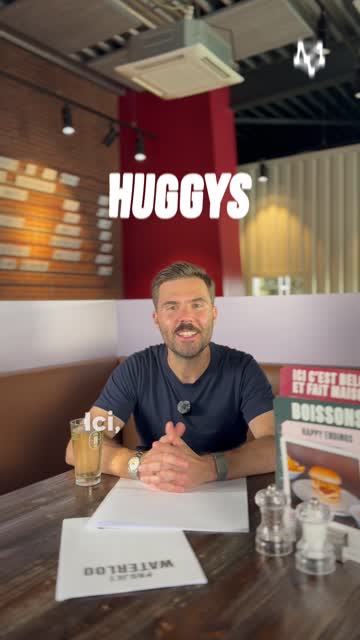
- Il y a des dossiers qu'on prépare avec un plaisir particulier. HUGGYS en fait partie. Quand on est Liégeois, on a forcément un souvenir du boulevard d'Avroy. Quatorze ans plus tard, ils ouvrent leur treizième restaurant, à Waterloo, et ils ont choisi d'en ouvrir le financement à nos investisseurs. La collaboration a été fluide de bout en bout, avec une équipe qui joue le jeu et qui comprend vite ce qu'implique une communication financière. Merci à Thomas Mémurlin, Roberto Navarro Guanipa et toute la team ! C'est aussi notre premier
- Il y a des dossiers qui ont une saveur particulière. HUGGYS en fait partie. Quand on est Liégeois, on a forcément un souvenir du boulevard d'Avroy. Quatorze ans plus tard, ils ouvrent leur treizième restaurant, à Waterloo, et ils ont choisi d'en ouvrir le financement à nos investisseurs. La collaboration a été fluide de bout en bout, avec une équipe qui joue le jeu et qui comprend vite ce qu'implique une communication financière. Merci à Thomas Mémurlin, Roberto Navarro Guanipa et toute la team ! C'est aussi notre premier dossier
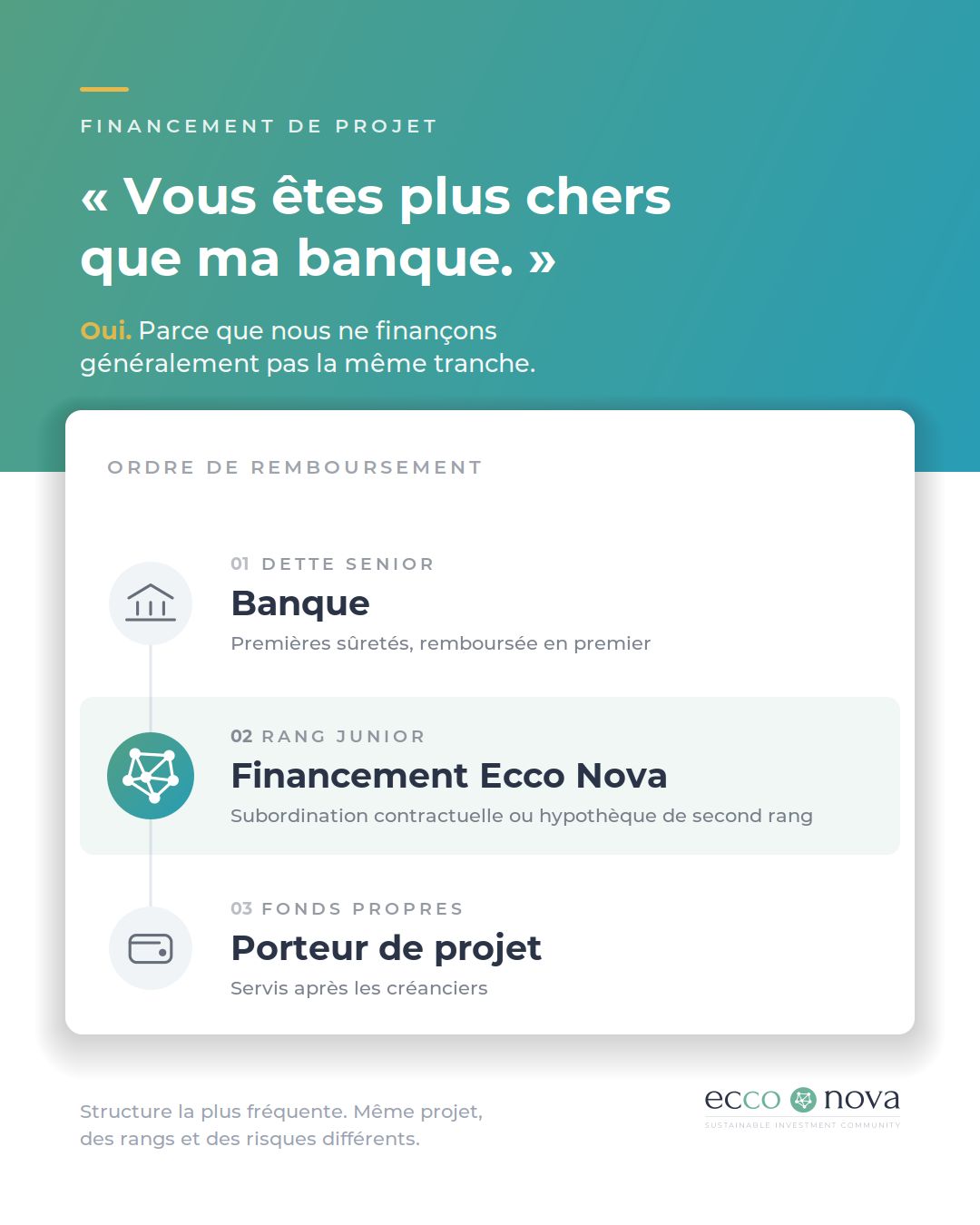
- Vous êtes plus chers que ma banque. » Oui. Parce que nous ne finançons généralement pas la même tranche. La banque intervient le plus souvent en dette senior, avec les premières sûretés. Notre financement vient ensuite, par subordination contractuelle (ou parfois avec une hypothèque de second rang). En cas de difficulté, la banque est remboursée avant les investisseurs. Juridiquement, notre financement reste une dette. Par son rang et le risque supporté, il se rapproche économiquement de quasi-fonds propres. Le bon point de
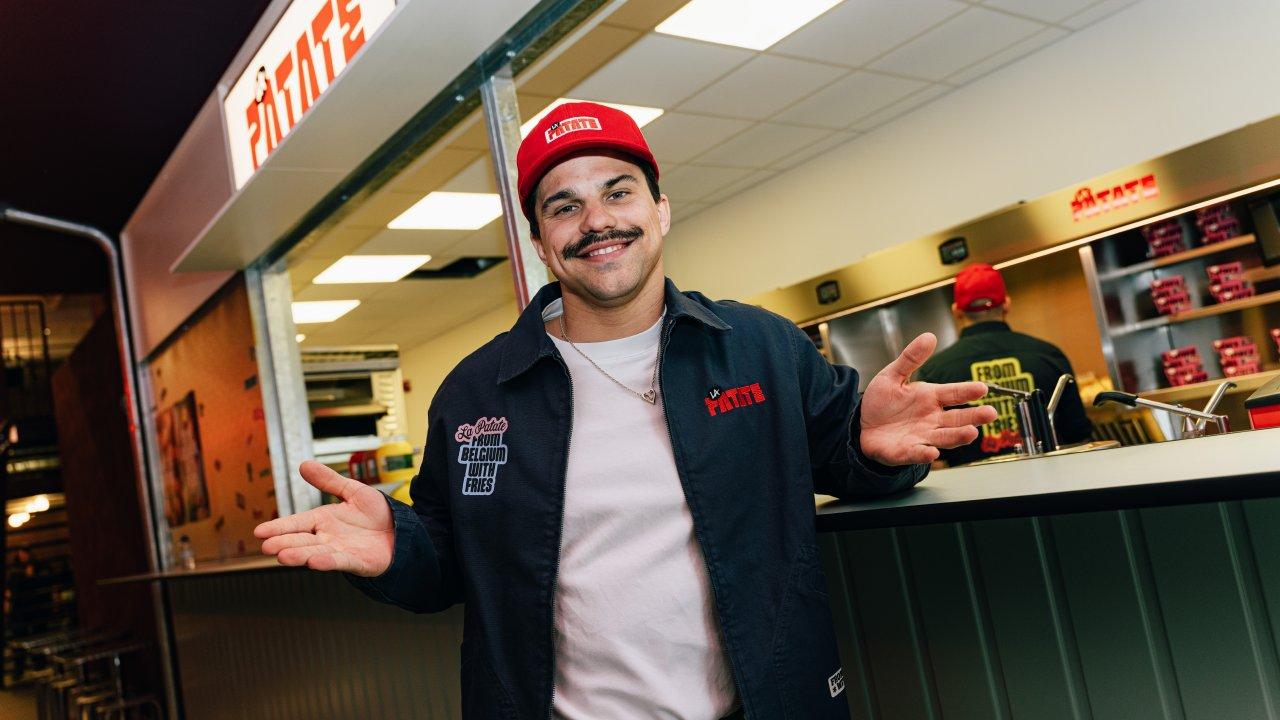
- Près de 500 investisseurs pour un million bouclé en une journée. Félicitations à Average Rob et à La Patate. Nous ouvrons dans quelques jours une campagne dans le même secteur, avec le prêt Coup de Pouce revu cet été. Leur montage combinait un crowdlending classique et un prêt "Win Win" (winwinlening), le mécanisme flamand. Le prêt Coup de Pouce en est le cousin wallon. Même idée des deux côtés : orienter l'épargne des particuliers vers les PME de leur Région, avec un avantage fiscal à la clé. Du circuit court appliqué au
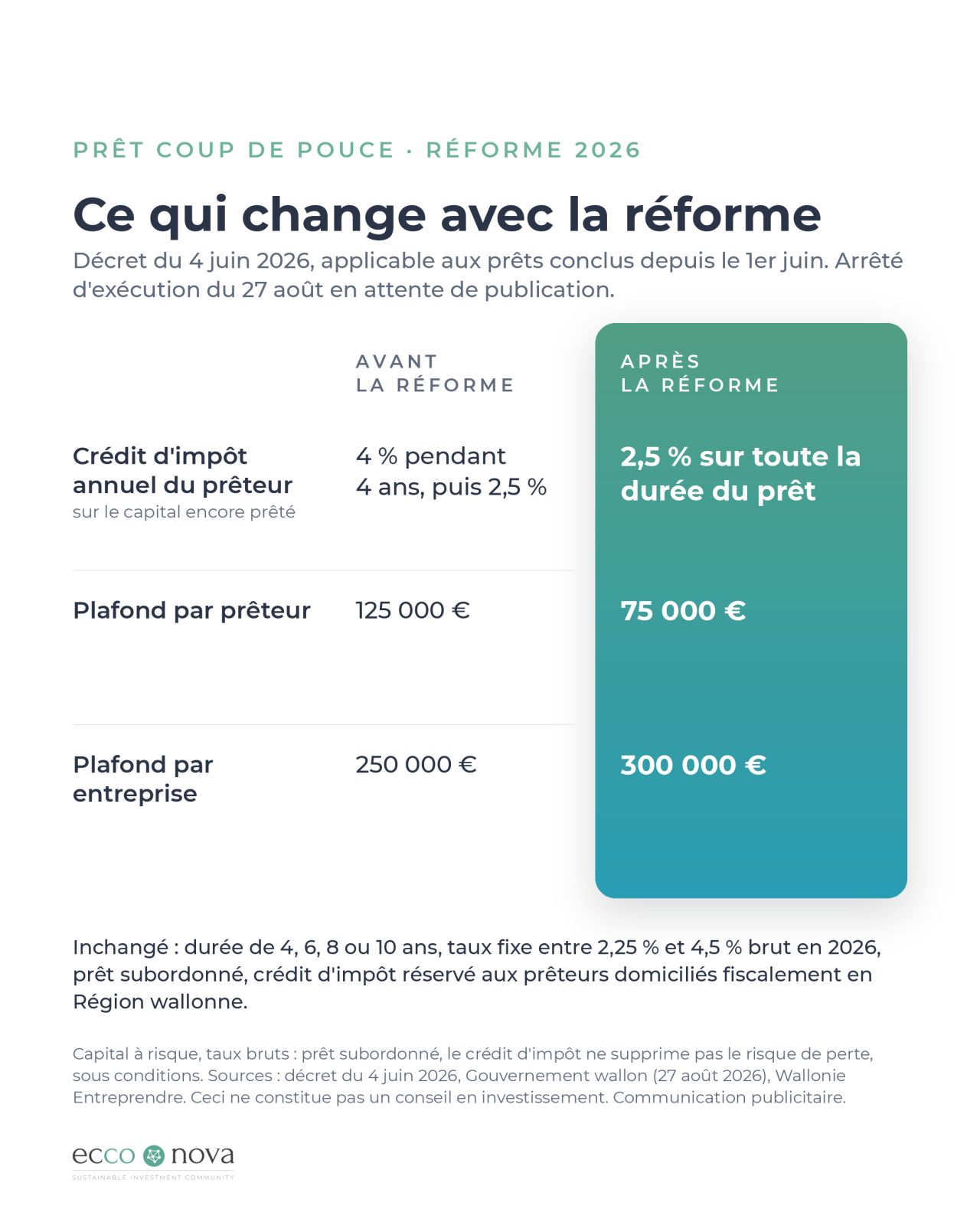
- Si vous êtes patron de PME en Wallonie, il y a un outil de financement à connaître : le prêt Coup de Pouce. ⤵️ La Wallonie le réactive et ramène le crédit d'impôt à 2,5 %. Comment ça marche : - Un particulier prête directement à une PME ou à un indépendant wallon, pour 4, 6, 8 ou 10 ans, à un taux fixe, entre 2,25 % et 4,5 % brut en 2026. - Le prêt est subordonné : si l'entreprise ne peut plus payer, le prêteur n'est remboursé qu'après les autres créanciers, banques comprises, à égalité avec les autres prêts subordonnés. - En
- Une plateforme comme la nôtre a deux clients : les investisseurs et les entreprises qui se financent. On parle beaucoup des premiers. Voici ce que disent les secondes, une fois leur campagne terminée. Bravo à l’équipe !
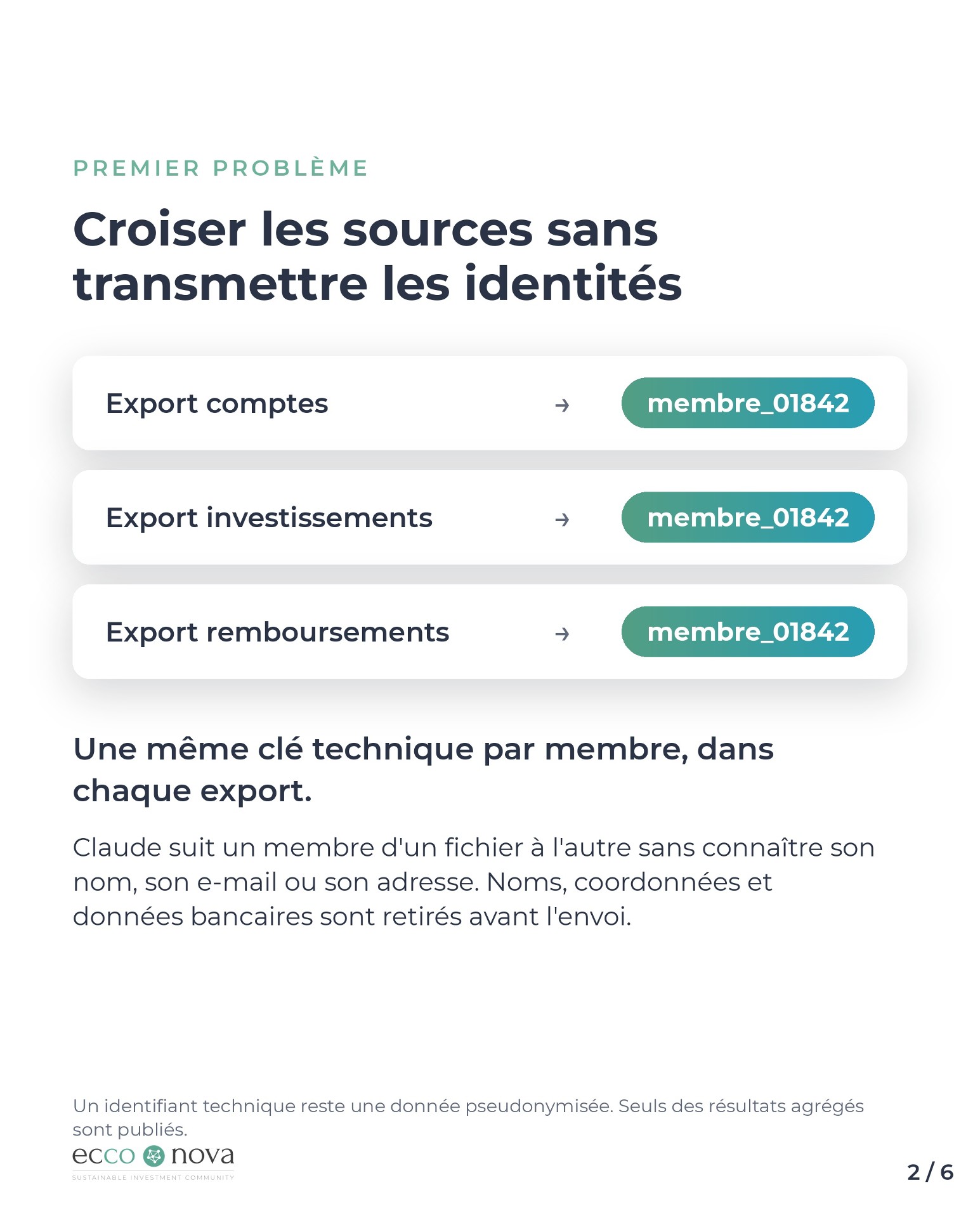
- Cet été, j'ai sorti dix ans de données du back-office d'ECCO NOVA pour les analyser avec Claude. 15 087 comptes créés entre 2016 et avril 2026, près de 47 000 investissements. Mon premier problème n'avait rien à voir avec l'IA : je devais lui donner de quoi croiser les sources sans lui transmettre ce qui identifie directement nos membres (noms, coordonnées, données bancaires). J'ai cadastré les colonnes, éliminé ce qui ne servait pas, hiérarchisé les sources, et remplacé l'identité de chaque membre par une même clé technique dans
- Bruno a rejoint ECCO NOVA très tôt. Il était notre deuxième employé. Il a aussi été l’un des premiers à nous quitter volontairement. Pas parce qu’il ne se sentait pas bien chez nous (n’est-ce pas Bruno 😄) mais pour partir vivre une année à l’étranger. Quelques mois après son retour, nos chemins se sont recroisés. Et Bruno a réintégré l’équipe. Dans cette vidéo, il explique son métier d’analyste. Un rôle qui ne s’arrête évidemment pas à décider si un dossier peut être présenté aux investisseurs : analyse, due diligence,


Related profiles

This page shows public professional information only, each fact cited. Is this you? send a correction, or ask for removal within 24 hours, no questions asked.