
Overview
Reginald Dewil is a co-founder of Penumbra, based in Leuven, a company he started in January 2025 and where he is chief executive. Since August 2023 he has also been a partner at PEOPLE EXPONENTIAL.
Before that he worked as an optimization consultant at Hatamoto from October 2022 to August 2023. He held several academic posts, serving as assistant professor in decision making in Industry 4.0 at KU Leuven from December 2019 to October 2022, and as assistant professor in operations and supply chain management at Vrije Universiteit Amsterdam during 2019. He was a post-doctoral researcher at KU Leuven from May 2017 to December 2018 and again from October 2014 to May 2016, with a period as an algorithm engineer at CONUNDRA in between. He had earlier been a research assistant at KU Leuven from 2009 to 2014, an analyst at Accenture from 2008 to 2009, and a process engineer at imec from 2006 to 2007.
Dewil earned a PhD in engineering from KU Leuven in 2014, following a master in industrial management, transportation and logistics there and a master in industrial sciences, chemistry, at Groep T - Internationale Hogeschool Leuven.
Career history
In the news
- Wrapping up the Tulip Operations Calling conference with one conviction reinforced: The easier software becomes to build, the more valuable it becomes to know what to build. Over the past days, I've had some great conversations with Tulip, system integrators and manufacturing professionals, heard compelling customer stories, and seen some exciting new capabilities. Implementation is getting faster. With increasingly powerful configuration tools and with the ability to define user interfaces through code, iteration cycles will only

- At Operations Calling today with one of my brothers Gerry Dewil ! :) Through PCG Smartfactory we already connect Penumbra's planning and scheduling with Tulip. What I like about that combination is simple. Tulip knows what is actually happening on the floor. The scheduler knows what should happen next. In most plants those two still live in separate worlds. The conversation I want to have here is about what comes after that. Where our agentic plans meet Tulip's roadmap, and what it takes to make that normal in everyday
- What happens at your plant when a rush order comes in? The answer tells you more about planning maturity than any factory tour. What I hear, in order of how often: - The planner squeezes it in somewhere and then looks at what broke. Costs half a day. - The rush order goes to the front and everything else moves back. Decided in minutes, and the cost arrives two weeks later in the form of other late orders. - People work overtime so nothing has to move at all. The most expensive option, and usually the one whose cost never gets

- Optimise one department and you move the bottleneck. That does not mean you solve it. This happens constantly. A department has an obvious problem, money gets spent, then that department runs better. However, this usually results in the fact that the overall lead time has barely moved. What often happens: that department now feeds the next step faster. The next step could not keep up in the first place. Basically, the queue was moved, not removed. What you need to do is look at the chain. Where is the real capacity constraint?
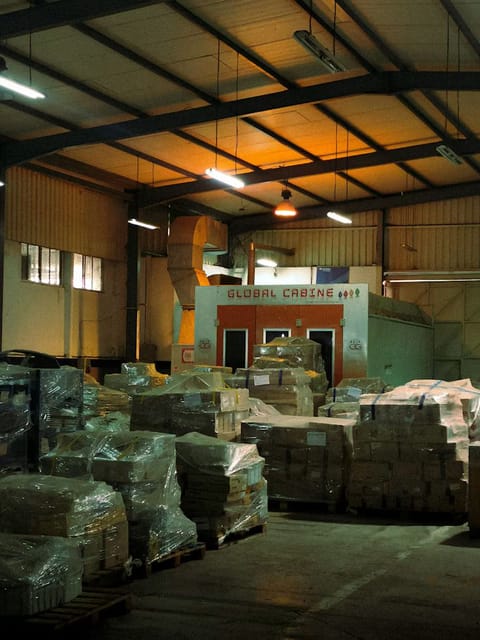
- How long does an implementation take with you?" Valid question that pops up in many initial meetings. Asked often with a hint of weariness in the voice. And rightly so. The industry standard is anywhere from three quarters to two years before anything usable is actually up and running on the shop floor. I’ve never understood why. Things don't have to move that slowly. We work in phases, starting with a single, clearly defined part of the operation and using the data that is already available, rather than attempting a complete

- First come first served is a commonly used scheduling rule. It’s also only optimal in a few select cases. In all others, it leaves value on the shop floor. I understand why it is so widespread. It’s easily explainable to the client, explainable internally, and nobody can accuse you of playing favourites. But being clear and organized is not the same as being effective. The cost: changeover times that could have been avoided because two similar orders were scheduled three days apart; machines sitting idle while ready-to-process work

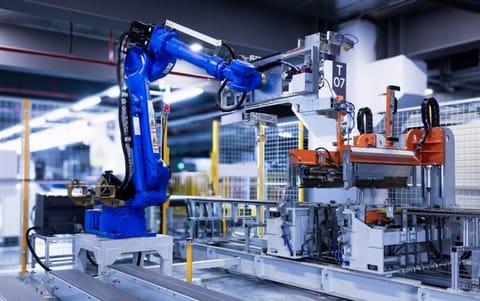
- A production schedule can look perfectly feasible on a spreadsheet and be impossible to execute on the shop floor. Human–robot cooperative work cells are a good example. At first glance, the scheduling problem seems straightforward: assign operations to workers and robots, determine their sequence, and minimize the cycle time. But the interesting part starts when resources have to cooperate. A robot may execute some operations independently. A human may perform others. Certain tasks require both at the same time. Suddenly, you are
- There is probably an Excel sheet next to your planning system. Most systems know the operations and the machines (and even that is not the case in all ERP systems), but not the details that determine what is actually possible. Which operator is allowed to operate which machine. Which mold is free. Which tool is in maintenance. Which two products must not follow each other without cleaning. That knowledge is in the planner's head and in a file on their disk. The system generates a plan, the planner massages it into something

Related profiles

This page shows public professional information only, each fact cited. Is this you? send a correction, or ask for removal within 24 hours, no questions asked.