
Overview
Forbes placed him and co-founder Aline Muylaert on its 30 Under 30 Europe list for Law & Policy in 2018. He has written on govtech and democratic participation in pieces published by Forbes and the World Economic Forum. The Obama Foundation named him a Europe Leader for its 2025-2026 cohort.
Wietse Van Ransbeeck is the chief executive officer and co-founder of Go Vocal, a community engagement platform for governments based in Brussels. The platform lets governments collect resident input through surveys, voting, mapping, participatory budgeting and ideation, and uses AI to analyse the feedback. It serves more than 600 governments and organisations across 20 countries, and cities using it include Oslo, Copenhagen, Vienna, Dublin, Seattle, St. Louis and Kansas City. British Prime Minister Keir Starmer used the platform to host an NHS dialogue that engaged over 100,000 UK citizens online. The company ran its first pilot with the city of Hasselt in 2016, raised $3 million in 2019, expanded to the United States in 2020 and became a certified B Corporation in 2022. On June 4, 2024 CitizenLab rebranded to Go Vocal; at that point the platform counted 5 million participants across 500 cities and more than 20,000 policy decisions. In 2026 the company acquired the French digital democracy company Open Source Politics and expanded to Australia and New Zealand. Van Ransbeeck appeared on the Forbes 30 Under 30 Europe list for Law & Policy in 2018 and is a 2025-2026 Obama Foundation Europe Leader.
Career history

Insights & ideas
The through-line
The single conviction underneath everything is that people trust institutions they can influence, and that the way to produce that influence is to make showing up easy. The evidence he keeps returning to is blunt: across OECD countries, only 22% of people who feel they can't influence decisions trust their government, while among those who feel they can, trust rises to 69% [11]. From that follows a plain design brief for government, summed up as the belief that "the distance between residents and government shrinks when showing up is made easy" [2]. Democracy, on this reading, is not a value to be displayed but a practice to be equipped, which is why he admires a presidential museum that sends visitors out knowing how to sign a petition, join community organizing or speak at a local meeting, treating them "as a participant, not a spectator" [2].
The shift over time is one of altitude and ambition. The early argument was about lowering barriers, particularly for young people, by meeting them on the smartphones they already carry rather than in town halls they never attend [15]. The current argument is about permanence and scale: engagement "only becomes useful when it stops being a series of projects and starts working as infrastructure: owned across departments, backed at the top, and still standing after the next election" [5]. Alongside that has come a widening frame, from single cities to European democratic infrastructure [12] and to the question of who controls AI systems that now reach more people than any parliament ever has [1].
On participation as infrastructure rather than projects
A platform used by one team for one consultation is a project; a platform used across an organisation is infrastructure. The benchmark he holds up is Salt Lake City, where fifteen departments now run their engagement through ShapeSLC, "giving residents a real say in the decisions that shape their city" [4]. The three tests he applies are ownership across departments, backing at the top, and survival past the next election [5]. The corresponding product ambition is equally practical: tools that help government leaders "get from a plan to outcomes residents can actually see" [5].
On why participation isn't yet at scale
The obstacle is political rather than technical, and he borrows Juncker's line to name it: "We all know what to do, we just don't know how to get re-elected after we've done it" [9]. His reading is that the willingness to govern more openly exists, and so does the political payoff, but the payoff stays invisible because the work of demonstrating it at scale to leaders has not been done [9]. That gap is why he treats the European Commission's decision to make citizen participation and civic technology a pillar of the European Democracy Shield as a real bet, and a recognition that strengthening democracy means building it with residents rather than only defending it [9].
On the quality of participation, not just the quantity
Asked whether citizen empowerment is the answer to historically low trust in UK government, his answer is "Yes, but" [11]. Yes, because influence is the single biggest driver of trust, and because people do not expect to win every time, they want to know their voice mattered [11]. But, because not all participation is equal: a statutory consultation or a survey is a different thing from genuine dialogue, co-design or shared decision-making [11]. The distinction matters most where communities are diverse and long-standing, which is the territory of Newham's People Power Places work and of co-designing public spaces with residents, children included [13].
On hybrid engagement and the offline voices that get lost
Digital participation has widened reach, but he argues the genuinely transformative shift is hybrid [10]. Much of the richest input still happens offline, in community meetings, paper surveys, workshops and everyday conversations between residents and staff in the field [10]. The failure is what happens next: offline input gets typed up by hand, analysed on the side, or quietly lost while the online data moves ahead in parallel, so "the voices that are hardest to reach end up the hardest to use" and high-quality data never reaches decision-makers [8][10]. The framing he prefers is that the challenge is no longer online versus offline, if it ever was, but connecting the two into one conversation [10], which means capturing every voice and making sense of them together [8], a case he has taken up publicly with Dembrane and Stad Oostende [8][10].
On what travels across borders and what doesn't
Working across 26 countries, with Italy joining after Switzerland and New Zealand [6], has taught him that "how little of the difficulty is local" [6]. Languages, legal frameworks and levels of institutional trust differ enormously; the hard part rarely does [6]. He also pays attention to how participation is staged: Modena launched Modena Partecipa not in a council chamber but in Piazza Sant'Agostino, the very square residents were being invited to redesign, with people standing in the space they were being asked to shape, which he calls a small choice about a venue and a good one [6]. He traces his own comfort with this to Belgium, where diversity read as richness and where overcoming differences meant learning to speak the language of the other, and inverts the usual saying: rather than making it anywhere despite Belgium, "we managed to build it because we started in Belgium" [7]. Fluency in adapting to international contexts is not to be taken for granted, and matters more than ever in a future he describes as European [7].
On scaling civic tech in Europe
He wants civic tech and digital participation platforms treated as essential democratic infrastructure, and welcomes Europe getting serious about scaling it under the European Democracy Shield [12]. Concretely, he pushed three recommendations for the shape of a European Civic Tech Hub alongside his Association Civic Tech Europe - ACTE colleagues, beginning with a cross-border procurement mechanism, building on research by mySociety and Sitra on how to mature and scale civic tech for greater impact [12].
On AI, reach and who holds the microphone
Over a billion people now talk to AI systems each month, and no parliament, broadcaster or international body has ever had standing two-way contact with that many humans at once [1]. Two things follow. First, these systems carry a specific cultural lens: frontier models compared against the World Values Survey Association hold values more secular and individualistic than those of any society on Earth [1]. Second, the same reach could run the other way, because the infrastructure to ask hundreds of millions of people the same question instantly already exists and simply isn't being used for that [1]. The risk he names is that a handful of companies end up holding the only microphone [1]. This is continuous with his longer-running interest in democracy's move into digital spaces, marked by moments like Obama's Reddit AMA showing technology enabling democratic engagement at scale [14], and with questions about how AI, community input and policymaking intersect in municipal practice [14].
On young people and the barrier problem
Rather than lamenting that young people don't come to town hall meetings, he argues for lowering the barrier to where they already are, which means smartphones [15]. The goal is digital infrastructure that lets local democracies function with young people actively involved, making it simple for young citizens to vote, set priorities and be heard [15].
On public servants and the people who do this work
He is consistent about crediting the unglamorous end of the job. City Hall is where budgets are debated, trade-offs are made, and slow decisions move a community forward, and above all where public servants show up every day, often without much recognition, because they care about the people they serve [4]. His view is that this service is not celebrated enough [4]. The same instinct shapes how he describes hiring: four open roles, different jobs but "same profile: changemakers with commercial talent", inside a fifty-person team of 20+ nationalities [3]. The stakes are stated in the same breath: every government won means thousands of residents gaining a real say in the decisions that shape their streets, schools and neighbourhoods [3].
Takeaways
- Use the influence-trust numbers as the argument for participation: 22% trust among those who feel they can't influence decisions, 69% among those who feel they can [11].
- Judge an engagement programme by three infrastructure tests: owned across departments, backed at the top, still standing after the next election [5].
- Treat offline input as first-class data. If workshop notes and paper surveys are analysed on the side or lost, the hardest-to-reach voices become the hardest to use [8][10].
- The blocker on scaling participation is political incentive, not capability. The payoff for governing openly exists but stays invisible, and demonstrating it to leaders is the unfinished work [9].
- Distinguish sharply between a statutory consultation or survey and genuine dialogue, co-design or shared decision-making. Not all participation is equal [11].
- Launch participation where the decision lives: Modena introduced its platform in the square residents were being asked to redesign, not in the council chamber [6].
- Reach young people through smartphones and simple acts of voting and priority-setting, not town hall meetings they don't attend [15].
- AI's reach is a democratic asset going unused: the infrastructure to ask hundreds of millions of people the same question instantly already exists [1].
Media & appearances
- Go VocalYouTubePublic Square: Conversations in Democracy (with Øyvind Tanum) – Episode 3Wietse Van Ransbeeck discusses his role as host of the Public Square podcast, introducing Øyvind Tanum as the smart city manager of Trondheim and framing the episode's focus on a Smart City Network built in Norway, municipal cooperation, and the intersection of AI, community input, and policymaking. He also briefly reflects on democracy's evolution into digital spaces, citing Obama's Reddit AMA as a pivotal moment where technology enabled new forms of democratic engagement at scale.
- Go VocalYouTubeWietse Van Ransbeeck (CitizenLab) on Youth & Technology in European ParliamentWietse Van Ransbeeck discusses the importance of lowering barriers to youth political engagement by leveraging technology, particularly smartphones, rather than relying on traditional town hall meetings that young people do not attend. He advocates for building digital infrastructure that enables local democracies to function with young people actively involved, and encourages making it simple for young citizens to vote, set priorities, and be heard.
- Go VocalYouTubePublic Square: Conversations in Democracy with Sadia Ur-Rehman & Amélie Pollet – Episode 5Wietse Van Ransbeeck hosts the podcast and introduces his two guests, Sadia Ur-Rehman and Amélie Pollet, who work on Newham's People Power Places program. He asks them about Newham's reputation for participatory democracy initiatives starting in 2018, the borough's diversity, and their personal experiences with community engagement, with Amélie describing her work in France co-designing public spaces with residents including children.
In the news
- A yes from leadership can get one engagement project moving. A real culture of engagement changes how the whole organization works. Yesterday, in Leading through listening, Danene Sorace and Wietse Van Ransbeeck explored what has to happen between political leaders and practitioners for community input to genuinely influence decisions. But building that relationship takes time. And for practitioners, a big part of the work is making the case internally, creating shared expectations, and getting more of the organization behind
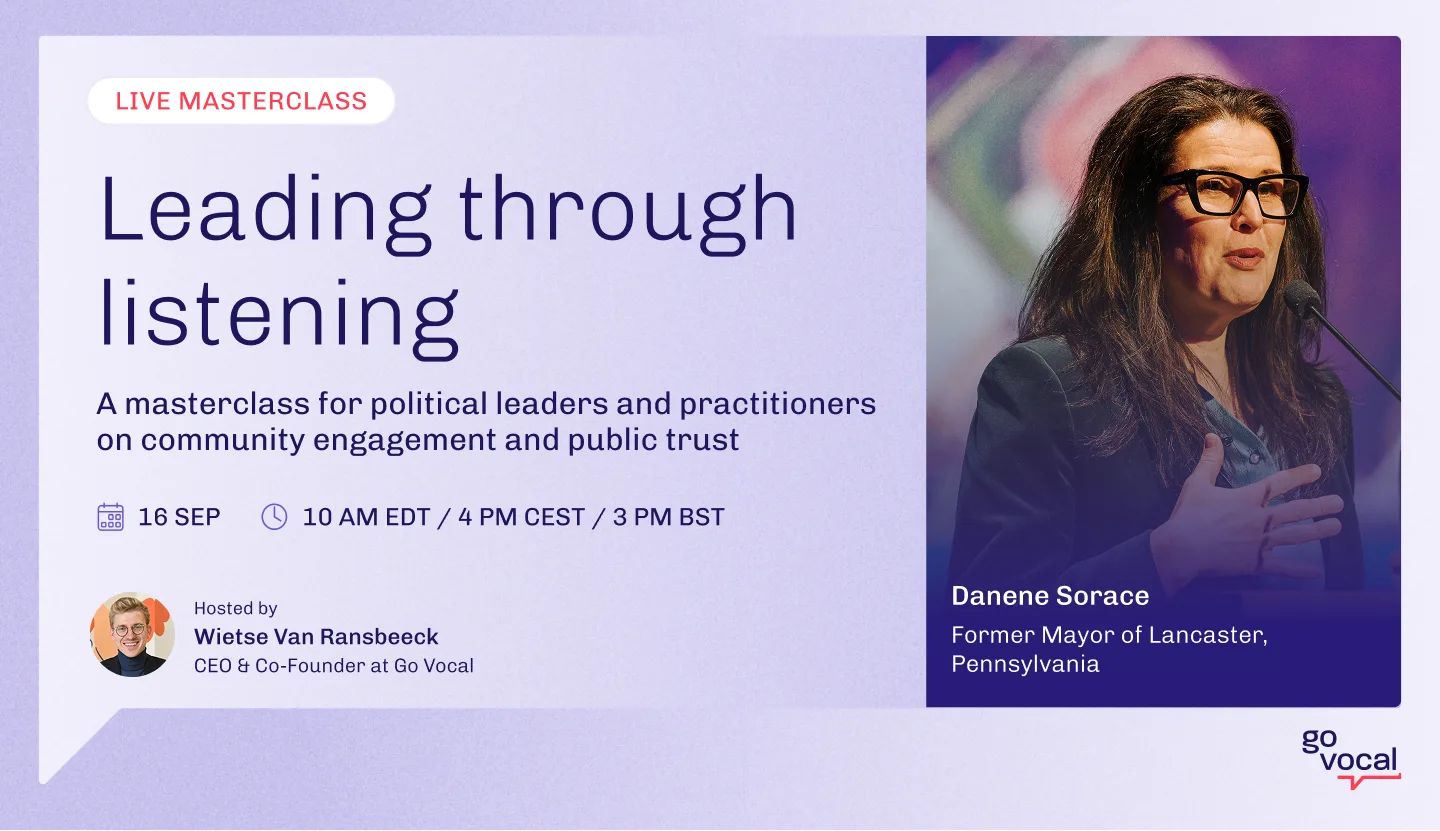
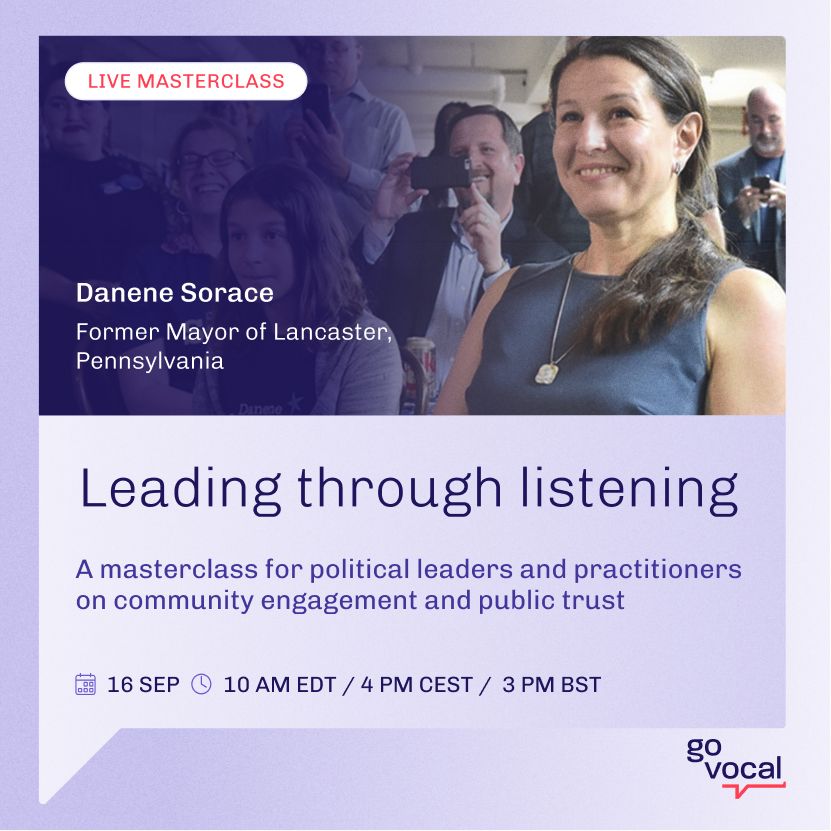
- Tomorrow a former two-term mayor answers questions public servants rarely get to ask their own mayor. Danene Sorace is that mayor. In Lancaster, Pennsylvania, she created an Office of Neighborhood Engagement that reported to the mayor's office. By the time she left, it had become a full city department, and it's still running. So if you're an elected official, join a peer explaining what she learned the hard way, what it cost her, and what it gave back. If you work for someone who does, this is a rare opportunity to get the
- Tomorrow, 200+ elected officials and practitioners will unpack why leadership support matters, what a strong approach to engagement looks like, and how it can pay off in better decisions and stronger trust. You can have a great engagement team and still struggle to make community input matter where decisions are made. And you can have leaders who genuinely want to listen, without giving their teams the space or mandate to do it well. That gap is exactly what we’ll unpack in 'Leading through listening', our upcoming masterclass with
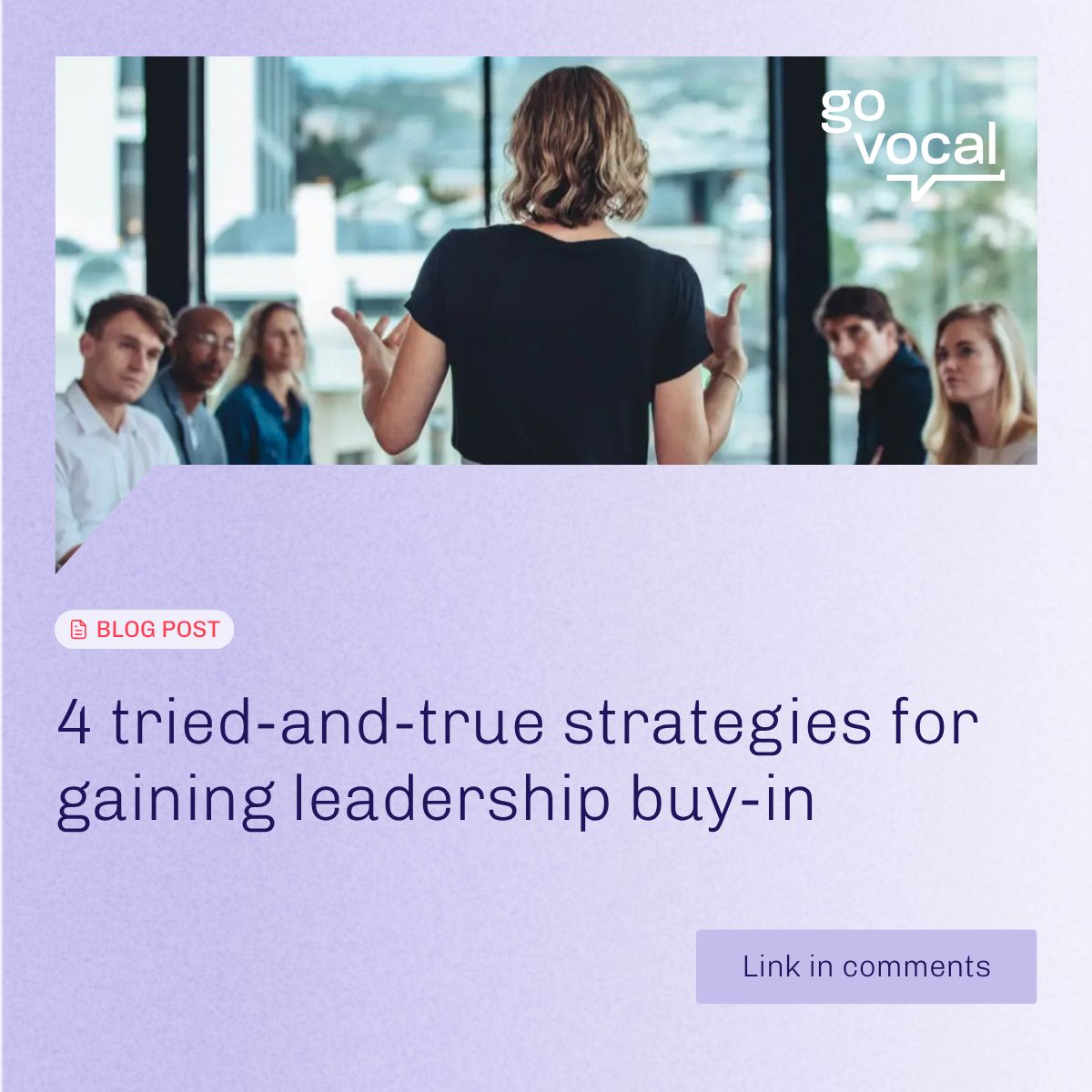
- In community engagement, getting the process right is only one part of the job. What happens around it matters just as much: when residents are brought in, how their input is used, and whether the people leading the organization are really behind the work. 👉 That leadership support can make a big difference. 👈 In our blog post, we share four practical ways to build it, with examples from local governments along the way. And later this month, we’ll pick up the same conversation in our "Leading through listening" masterclass with
- Leadership buy-in changes what community engagement can achieve. 👂 It gives teams the mandate to act on what they hear ⚖️ It helps resident input carry weight in decision-making 🔄 It helps close the loop, so communities can see what their participation changed But what does good leadership actually look like in practice? And if you’re a practitioner, how do you get your leaders on board? Former Lancaster Mayor Danene Sorace and Go Vocal CEO Wietse Van Ransbeeck will tackle both sides in our upcoming masterclass, with
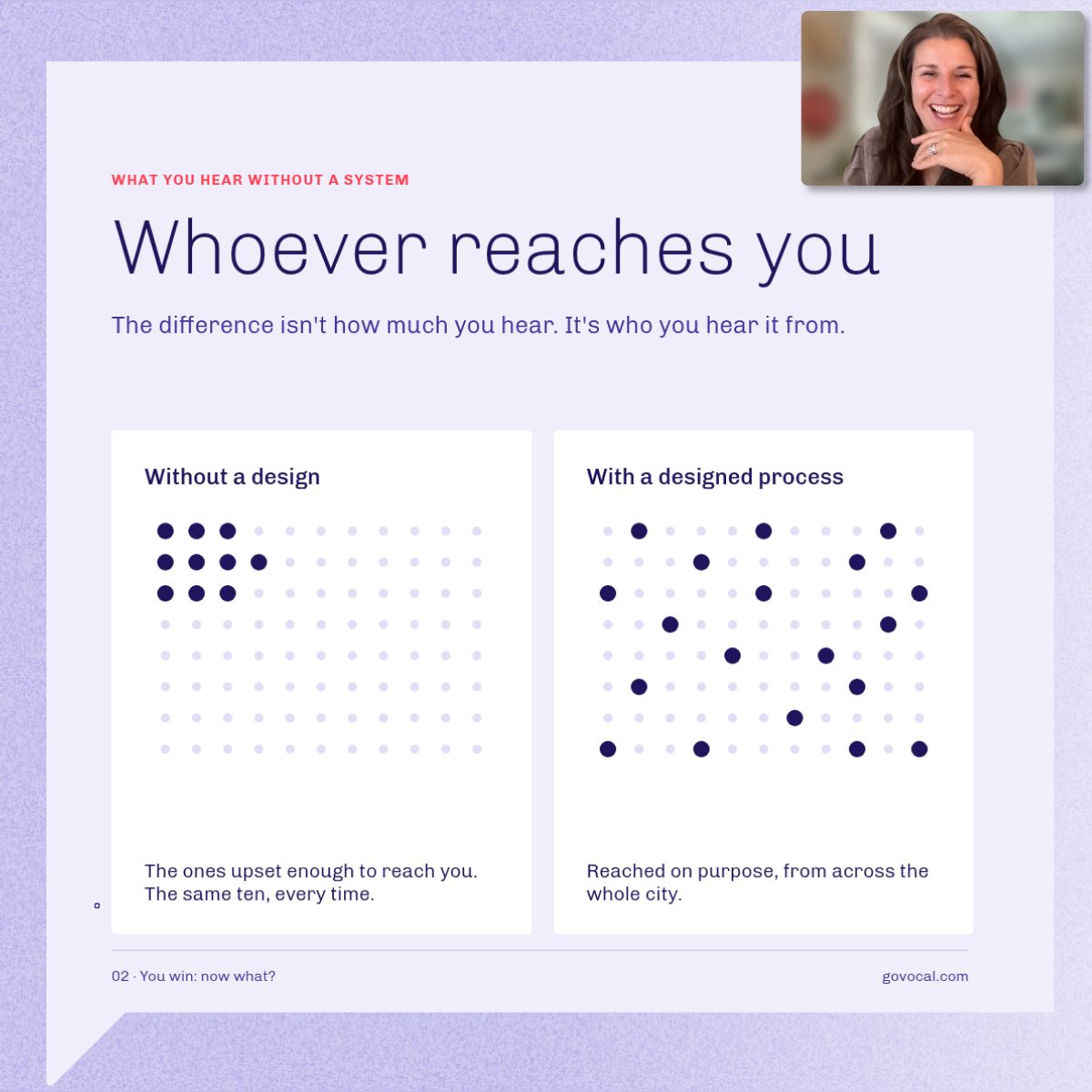
- Tiny design choices can ripple into major democratic consequences. For years the problem was the same everywhere: residents say a lot, decision-makers have very little time to hear it. AI changes that equation. Thousands of comments can now be turned into something a council or minister can actually read. But there's a catch. Someone, or something, has to decide what survives the compression. Beth Simone Noveck's new essay puts it well: 1,000 contributions ultimately become a one-pager, and that one-pager is not neutral. Which

- Listening starts from the top. But getting leadership to see the value of engagement is not always easy. Most practitioners I meet know exactly what they want to run. What they're missing is a mayor or council leader who backs it when it matters. That's why I'm looking forward to this one. Danene Sorace ran two terms as Mayor of Lancaster, Pennsylvania, and spent them institutionalizing engagement: not one-off consultations, but a way of working that outlasts individual projects and political cycles. I got an early look at her

- Public trust isn’t built by consultation alone. It also depends on whether residents can see that their leaders are listening, taking participation seriously, and acting on what they hear. 🗓️ On September 16, Go Vocal CEO Wietse Van Ransbeeck will sit down with former Lancaster Mayor Danene Sorace for "Leading through listening", a live masterclass on community engagement, political leadership, and public trust. They’ll explore what leadership buy-in actually looks like in practice, what leaders can do to create the conditions
Related profiles

This page shows public professional information only, each fact cited. Is this you? send a correction, or ask for removal within 24 hours, no questions asked.