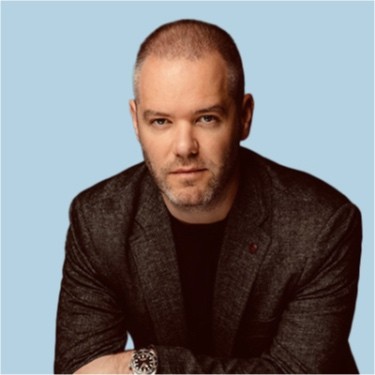
Dado Van Peteghem
Dado Van Peteghem co-founded Duval Union as the consulting and advisory arm of the broader Duval Union group, alongside Jo Caudron. Together they co-authored "Digital Transformation" in 2014, one of the first practitioner-oriented books on the subject in the Belgian market.
Beyond consulting, Dado built Social Seeder, an employee advocacy SaaS platform, and SpeakersBase, a platform for connecting event organizers with speakers. These ventures reflect a pattern of building tools that serve the professional services and knowledge economy.
He has delivered more than 150 keynotes internationally, positioning him as a practitioner-speaker who draws on both founder and consulting experience.
Insights & takeaways
Dado Van Peteghem's public output over the past months reads as a running commentary on the robotics and AI race, delivered mostly through weekly digest posts rather than long essays, but the pattern of what he chooses to highlight reveals a consistent worldview. He treats AI and robotics as a single continuous story, curating "My AI & Robotics weekly report with the latest updates" almost every week, positioning himself as a synthesizer of a fast-moving field rather than a single-issue commentator. This curatorial instinct is confirmed externally too: he was named among "11 tech experts every CIO should follow" by CIO Online, a recognition he received with visible pride, thanking "Maxime Vermeir, VP of AI Strategy of ABBYY for the mention" .
A dominant theme in his recent thinking is the physical, embodied turn of AI, specifically humanoid robotics. He tracks the competitive landscape closely, cataloguing "8 European Humanoid Companies to Watch" including NEURA Robotics, 1X, Wandercraft, Agile Robots SE, PAL Robotics, Oversonic, Engineered Arts and Pollen Robotics , and separately mapping "The AI race of the giants since the launch of ChatGPT in 2022" . He pairs this European survey with sustained attention to China, discussing on a podcast with Pascal Coppens "how China is building a dominant position in humanoid and industrial robotics," "why robot prices are dropping at an incredible speed," and "how world models and vision-language-action systems are powering the next generation of robots" . The throughline across these posts is that he sees robotics economics, especially falling hardware costs, as the accelerant that will make deployment real rather than theoretical.
Healthcare emerges as his preferred proving ground for this thesis. Commenting on UC San Diego's teleoperated surgery experiment with the Unitree Robotics G1 platform, he is careful to frame the near-term opportunity modestly and specifically: "The first wave of robots in healthcare won't be about replacing doctors but about filling the physical gaps around them," listing holding instruments, assisting in surgery, preparing rooms, fetching tools, supporting remote care, and "helping understaffed hospitals do more with less" . He adds that "cheap, portable surgical capability also changes the equation" , reinforcing his recurring cost-curve argument. This isn't incidental interest; he delivered what he called his "last keynote before the Summer about the potential of Robots in #Healthcare" , suggesting healthcare is a topic he is actively building expertise and public positioning around, not just observing in passing.
Alongside the hardware and economic angle, he engages with a more philosophical concern about AI's encroachment on distinctly human territory: emotional intelligence. He argues bluntly that "we're gradually becoming the 2nd most intelligent species in the world, it's a matter of time," and reframes the real uncertainty as whether humans will "also get beaten on the EQ level going forward, as machines are getting better and better at showing empathy and emotions" . His formulation of the paradox is sharp and quotable: "We humans feel emotions but don't show them very well. Computers don't feel emotions but they're getting great at showing them" . He follows this with self-directed skepticism rather than reassurance, asking "do we actually" have an edge, and whether "we are putting in enough effort to live up to that promise" . This willingness to question a comforting assumption, that humans retain an emotional advantage, marks a more reflective register than his usual roundup posts.
He also maintains a wry, skeptical eye toward AI hype and marketing, captured in his sharing of the line "Just say it's #AI if you don't want to buy it" , suggesting impatience with superficial AI branding even as he remains deeply engaged with the technology's substance. This tension, enthusiasm for genuine technical progress paired with mockery of empty AI-washing, runs through his selection of shared content.
Earlier material shows the roots of these current preoccupations in a longer-standing framework about organizational change. In a talk on corporate venturing, he argued that larger companies should let entrepreneurial teams "operate separately" while benefiting from scale, using "the metaphor of a speedboat operating alongside a mothership rather than being absorbed into it" 16. In an Inspiration Day talk, he grounded digital transformation in "organizational culture, process speed, and people rather than just technology itself," drawing on his family's publishing business being disrupted by the internet and gaming devices in the 1980s and forced to pivot into VHS and DVD 17. At the Chief Digital Officer Awards, he traced a historical arc from internet connectivity in the 1990s through social media in the 2000s to today's "ecosystem level" competition, urging leaders to "leave their buildings and step outside their industry bubbles to meet unusual people" 18. Read together with his current robotics and AI focus, the takeaway is consistent: he has long argued that technology forces organizational and cultural adaptation rather than being an end in itself, and his present-day tracking of humanoid robots and AI economics is simply this same argument applied to the newest, most physically consequential wave of technology.
Finally, his public presence also reflects a value he places on real-world connection over digital mediation, noting that "the best conversations aren't in meeting rooms or in video calls" after catching up "over fries" with friends Herman Konings and Klaas Fremaut to discuss "trends in food, tech and beyond" . Combined with his new role as curator of the "renewed and upcoming Digital First event" in Brussels , the overall picture is of someone who treats technology forecasting as inseparable from convening people, arguing that the ecosystem thinking he preached years ago in corporate settings still governs how he personally operates today.
Career
- TIAS School for Business and SocietyGuest Professor on AIOct 2024 – Present
- Imagin3 StudioCo-founderJan 2022 – Present
- The Future Club by Imagin3 StudioCo-FounderJan 2021 – Present
- Dado Van PeteghemInternational Keynote Speaker & AuthorJan 2010 – Present
- VRT SandboxStartup MentorSep 2020 – Aug 2021
- Wallifornia - Next Summit : July 6-8 2021Advisor/MentorSep 2020 – Aug 2023
- BothrsMember Board of AdviceAug 2019 – Apr 2023
- Chalhoub GroupMember Strategy CommitteeJan 2018 – Dec 2025
- Roularta Mediatech AcceleratorStartup MentorSep 2016 – Sep 2017
- Speakersbase.comCo-founderOct 2016 – Mar 2024
- ScoperniaFounding PartnerSep 2015 – Jun 2023
- ScoperniaCo-Author "Digital Transformation" BookAug 2014 – Jun 2023
Social Seeder#453factoryCo-founderNov 2012 – Nov 2024
- Internet Marketing SchoolLecturer Mobile MarketingMar 2011 – Mar 2014
- ScoperniaKeynote SpeakerJul 2011 – Jun 2023
- Stichting MarketingCongress Committee MemberJan 2011 – Dec 2011
- InSites Consulting#181factorySenior Knowledge ConsultantOct 2010 – May 2011
- InSites Consulting#181factorySenior Research ConsultantDec 2008 – Oct 2010
- InSites Consulting#181factoryResearch ConsultantDec 2007 – Dec 2008
- Mowa - Museum Of Weird ArtCo-founder2005 – Jun 2015
Ghent University#2schoolMaster after Master, Computer Sciences2007 - 2008
Arteveldehogeschool#20schoolBachelor, Journalism2000 - 2003
From public career histories · 23 entries
Media & appearances
3- 16talkLIFARE · 7y ago · 8:30 · 32 views
Dado Van Peteghem discusses how corporate venturing allows larger companies to work with startups and scale-ups to move faster and pursue digital transformation, rather than trying to integrate these agile partners into their existing structures. He emphasizes that successful corporate venturing involves keeping entrepreneurial teams separate while allowing them to benefit from the larger company's scale and resources, using the metaphor of a speedboat operating alongside a mothership rather than being absorbed into it.
- 17otherMontea · 8y ago · 46:37 · 342 views
Dado Van Peteghem discusses how digital transformation is fundamentally about organizational culture, process speed, and people rather than just technology itself. He illustrates this through his family's publishing business experience, describing how the internet and gaming devices disrupted their colorbook and comic album market in the 1980s, forcing the company to adapt by introducing VHS and DVD products.
- 18otherLuc Blyaert · 6y ago · 28:44 · 876 views
Dado Van Peteghem discusses how future competition will occur at the ecosystem level rather than among individual companies, tracing this shift from internet connectivity in the 1990s through social media in the 2000s to the current wave of organizational collaboration. He emphasizes that larger organizations need to partner more with startups and smaller companies, and advises attendees to leave their buildings and step outside their industry bubbles to meet unusual people and explore new collaborations.