
Overview
D-Carbonize was founded in mid-2021 in Brussels by Grégoire Talbot and Frederic John. Talbot had spent five years at IBM and founded Cockpit Group, which he sold to BDO in 2013; John, the co-founder, served as chief operating officer and is now listed as Product Owner & Co-Founder. In January 2026 Sébastien Leempoel, previously CEO of Riaktr and COO of Greenomy, took over as CEO. The company sells Carbon Cockpit, a carbon accounting platform covering Scope 1, 2 and 3 emissions, aligned with the GHG Protocol and the Bilan Carbone methodology. It offers a Scan mode that produces results in hours from a guided questionnaire and an Expert mode for audit-grade assessments in five to ten working days. The software is combined with consulting, energy audits, an academy and support for certifications such as B Corp, EcoVadis and SBTi. An initial €500,000 financed development. In January 2023 the company announced a €2 million round (€1.5 million equity, €0.5 million debt) from Finance&Invest Brussels, Invest BW, WaterLemon Ventures, Seeder Fund, Aisin and six business angels. Headcount grew from 10 in 2023 to 20 in 2024. Clients rose from more than 30 in 2023 to 300 active clients in 50 countries by January 2026, including Aperam, Luminus, Elia, Aisin, Alstom, Orange, Thales and UCB. A French office opened in Provence in 2024.
Funding history
- 2021-2022 Initial investment: €500,000 to develop the platform
- 2023 Seed round: €2M (€1.5M equity, €0.5M debt) from Finance&Invest Brussels, Invest BW, WaterLemon Ventures, Seeder Fund, Aisin and six business angels incl. Geoffroy De Cooman and Daniel Verougstraete
Stated facts & numbers
- Founded: 2021
- Headquarters: Brussels
- Founders: Grégoire Talbot, Frédéric John
- CEO: Sébastien Leempoel (since January 2026)
- Employees: 20 (January 2026)
- Product: Carbon Cockpit
- Customers: 300 active clients in 50 countries; incl. Aperam, Luminus, Elia, Aisin, Alstom, Orange, Thales, UCB
- Total raised: €2.5M
- Investors: Finance&Invest Brussels, Invest BW, WaterLemon Ventures, Seeder Fund, Aisin, business angels
- Certifications: B Corp, Solar Impulse Foundation, ABC
- Awards: 4YFN Pitch 2 Pitch winner, MWC25 (2025)
Key people

In the news
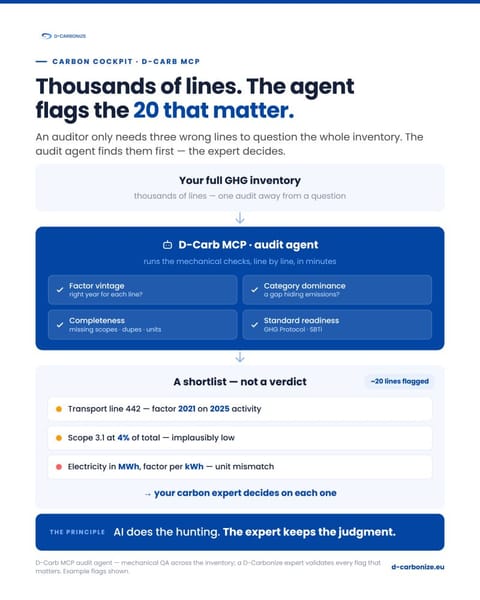
- A carbon inventory has thousands of lines. An auditor only needs to find three wrong ones to question the whole thing. That's the real risk in a GHG inventory. Not that the method is wrong, that a handful of lines quietly aren't. Finding them by hand means re-reading everything. Nobody does that four times a year. So we gave the Carbon Cockpit an audit agent, through the D-Carb MCP. You point it at an inventory and it runs the mechanical checks, line by line, in minutes: → Factor vintage: is every emission factor matched to the right
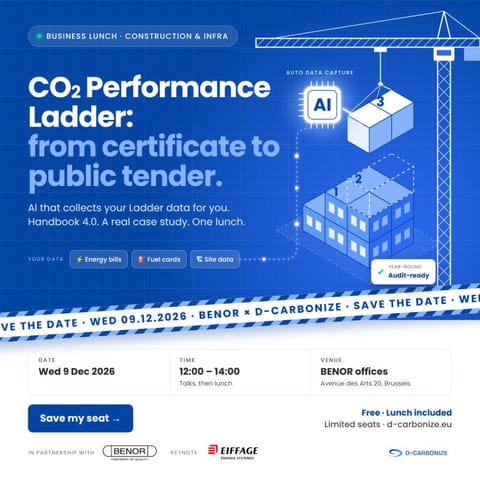
- Climbing the CO₂ Performance Ladder? Let AI carry the data. D-Carbonize × BENOR · Construction Business Lunch 🗓 Wednesday 9 December · 📍 BENOR offices, Brussels The operator of the CO₂-Prestatieladder België opens its doors to answer the question the whole sector is asking: what’s changing, and how do you turn it into an advantage? 🪜 Handbook 4.0: 3 levels instead of 5, ISO alignment, net zero 2050 at the top 🏗️ The field: Eiffage Énergie Systèmes - Belux, certified level 3 across three divisions, shows what it changed in
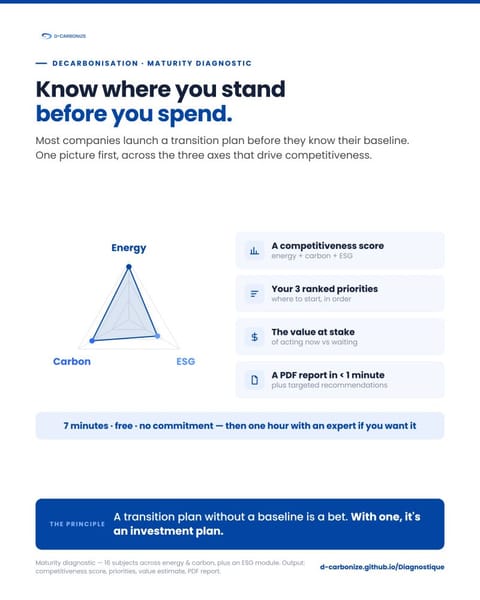
- Most companies launch a transition plan before they know where they stand. That's prescribing before diagnosing. The same reflex is everywhere: buy the panels, electrify a line, order a report, with no baseline. The result: actions that don't hit the biggest lever, a diluted budget, and no way to prove progress a year later. Before you act, you need one picture, across the three axes that actually drive competitiveness: energy, carbon, and ESG. So we built a self-diagnostic. 7 minutes, free, no commitment. → A competitiveness
- Bij een overheidsopdracht kan een CO₂-Prestatieladder-certificaat uw offerte 6 tot 10 % lager doen uitkomen, fictief. Dit is wat dat in euro's waard is. Het principe: voor de beoordeling past de aanbesteder een fictieve korting toe op uw offerteprijs, afhankelijk van uw niveau. U verlaagt uw prijs met geen enkele euro. U wordt gerangschikt alsof u dat wél deed. Een concreet voorbeeld. Opdracht van 2.000.000 €. Drie offertes dicht bij elkaar, enkele procenten verschil. → Uw offerte: 2.000.000 €. → Gecertificeerd (hoog niveau): de
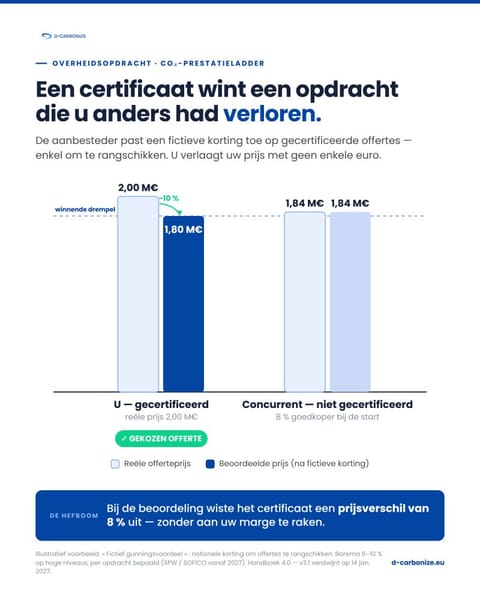
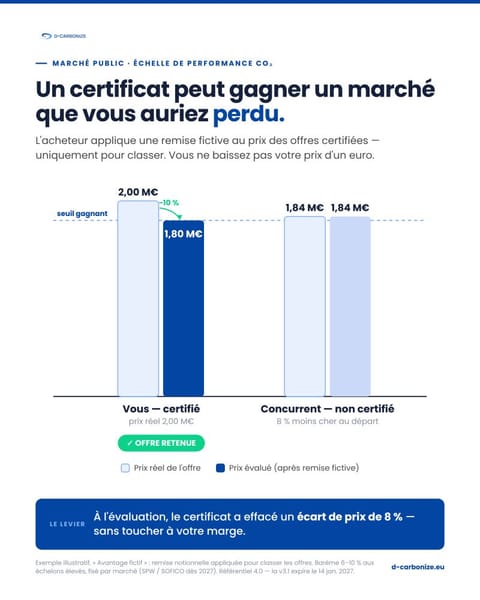
- Sur un marché public, un certificat Échelle de Performance CO₂ peut faire baisser votre offre de 6 à 10 %, fictivement. Voici ce que ça vaut, en euros. Le principe : pour l'évaluation, l'acheteur applique une remise fictive sur le prix de votre offre selon votre échelon. Vous ne baissez pas votre prix d'un euro. Vous êtes classé comme si vous l'aviez baissé. Un exemple concret. Marché à 2.000.000 €. Trois offres serrées, à quelques pourcents d'écart. → Votre offre : 2.000.000 €. → Certifié (échelon élevé) : l'acheteur l'évalue à
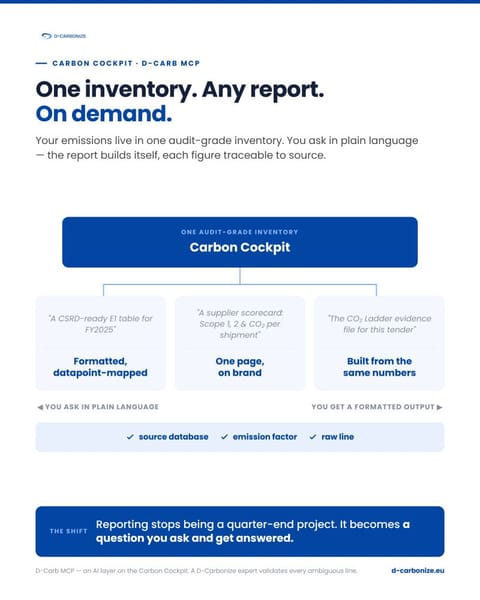
- Most carbon reports are built for one reader: the regulator. Then the bank asks for a different cut. The client wants another. Procurement wants CO₂ per product. And someone rebuilds the same numbers, by hand, four times a year. The report was never the problem. The copy-paste was. Your emissions already live in one place: the Carbon Cockpit. What changes with the D-Carb MCP is what you can do with them, in plain language, from the AI assistant you already use. → "Give me a CSRD-ready E1 table for FY2025." Formatted, mapped to the
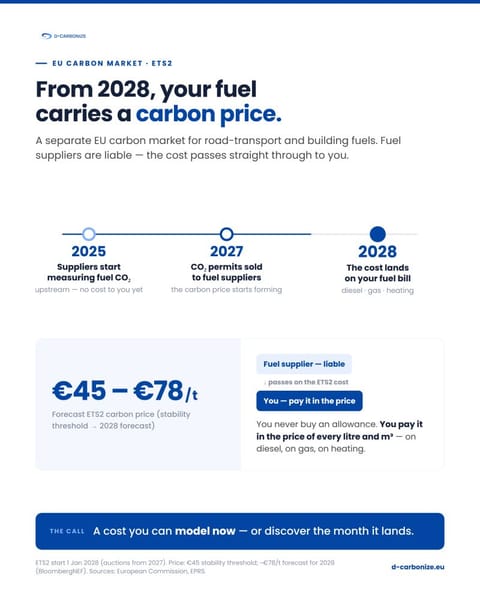
- From 2028, the fuel that moves your trucks and heats your buildings gets a carbon price. It's called ETS2, and it's the next line to hit your P&L. The short version: → A separate EU carbon market for road-transport and building fuels. → Fuel suppliers are the regulated party, but the cost passes straight through to you, at the pump and on the heating bill. → Start was 2027. It's now 1 January 2028. Auctions still begin in 2027. On 15-16 October, EU leaders are debating whether to delay it again. Italy and Czechia want more time;
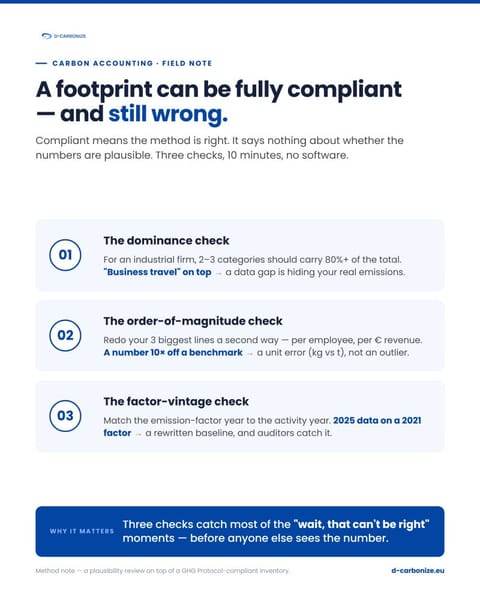
- A carbon footprint can be fully GHG Protocol-compliant and still be wrong. Compliant means the method is right. It says nothing about whether the numbers are plausible. Before you send any inventory to a client, an auditor or a bank, here are 3 checks we run every time. No software needed : 10 minutes, a calculator, and a bit of suspicion. 1) The dominance check. For most industrial firms, 2 or 3 categories should carry 80%+ of the footprint (usually purchased goods, energy, freight). If your biggest line is "business travel"

Something wrong or missing? Send an update. Fixed within 24 hours.