
Overview
ImmuneWatch offers a software platform that annotates the epitope specificity of T-cell receptor sequences, converting TCR repertoires into clinically actionable data. The company provides ImmuneWatch DETECT, which extracts therapy-, vaccine-, or pathogen-specific TCRs from TCR repertoires, available as a machine learning platform for on-premises deployment or through direct collaboration with ImmuneWatch.
Leadership & org chart

In the news
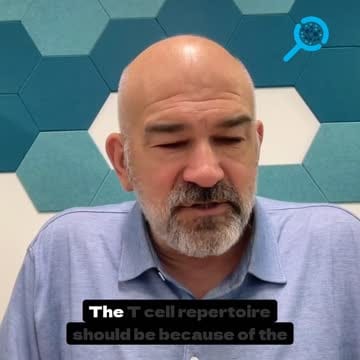
- Your immune repertoire should be a ledger of every disease you've ever had and all the diseases you have right now." That's Harlan Robins co-founder of Adaptive Biotechnologies Corp., on the Repertoire Room. He is also honest about the other half. It has been harder to read than anyone expected. The information is there, but getting it out takes a lot of data and better models. With machine learning, the field is finally making real progress. This is the problem we work on every day at ImmuneWatch. Figuring out which antigen a T
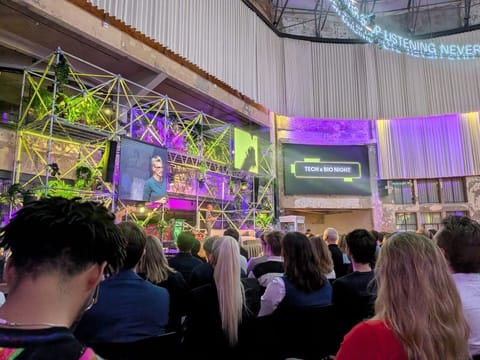
- Bringing both Biotech and the Tech industry together at the Tech x Bio night in Ghent was a smart move. It was interesting to see talks from argenx and Orionis Biosciences outside the "normal scientific conference" setting that I am used to. Vice-versa it was also inspiring to see the tech-talks from Aikido Security and TechWolf in their kind of "natural Wintercircus" habitat. It's now the second time that I see Jeroen Van Hautte 🐺 showing live Claude Code sessions and I love the style 😁 The ambition to scale globally from day
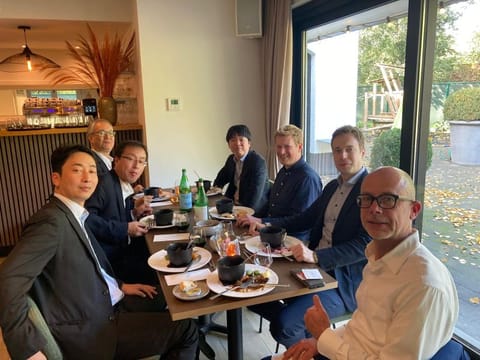
- Last week FIT - Flanders Investment & Trade invited a delegation from BIKEN Foundation, Japan over for a tour of Flanders. I was happy to learn that they wanted to stop by ImmuneWatch and learn more about how we use AI in vaccine development. It was an absolute honour to host the delegation headed by Prof. Yasuo Yoshioka as the BIKEN foundation is the legendary Japanese research institute behind the "Oka strain" that forms the genetic foundation for nearly every chickenpox vaccine used worldwide today. Thank you for the
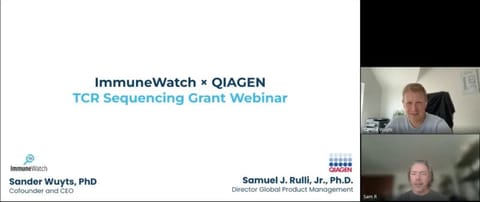
- Earlier this year Samuel Rulli, Jr., Tom Bosschaerts and myself where chatting on how ImmuneWatch and QIAGEN could collaborate a bit more intensively. How do we show the value of TCR sequencing + clustering & specificity analysis to those running clinical trials in oncology and autoimmunity? "Maybe a grant? Free sequencing and free analysis both for academia and industry" I think that we were all pretty quickly aligned as soon as someone said that. And so we went to work: - Wrote grant outline - Grant rules and how we would
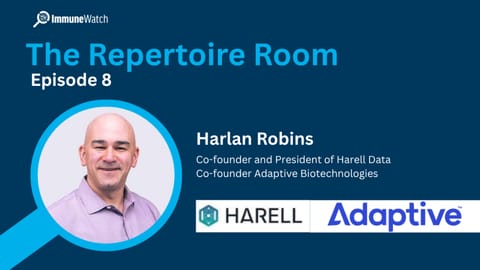
- Machine learning models for TCR-antigen and antibody-antigen binding need large, well-designed training sets. Much of the data that could provide them is proprietary, and making it public means the owner gives up its value. In episode 8 of the Repertoire Room, Harlan Robins, co-founder of Adaptive Biotechnologies Corp. and Harell Data, joins our CEO Sander Wuyts, PhD 🧬 to discuss how that gap could be closed. Harlan traces the path from the first high-throughput TCR sequencing runs at Fred Hutch, to Adaptive's clinical monitoring
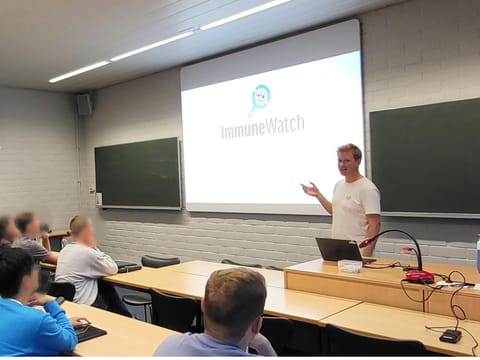
- Gave a guest lecture at uni yesterday! I was invited to share my experience on entrepreneurship to master students in Computer Science, Biology and Biomedical Sciences during a course on "Entrepreneurship and Innovation". In these kind of lectures I never focus on theoretical frameworks but instead gives lot's of examples on how I practically approached transitioning from scientist to entrepreneur. I remember that these real-life examples always inspired me as a student and I hope to achieve the same. The story roughly goes: 1)
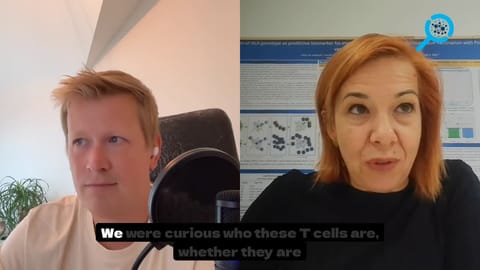
- Other immune assays couldn't answer this question." ImmuneWatch's analysis pipeline could 😎 That's Eniko Toke, PhD, CSO and co-founder of TREOS Bio, on the moment her team needed to know exactly which T cells were showing up in patient tumours after vaccination, and whether they were the ones the vaccine was designed to create. The answer came from TCR sequencing. ImmuneWatch's DETECT was trained on PolyPEPI1018-specific TCR sequences isolated from donor blood, then used to match those same sequences against T cells found inside
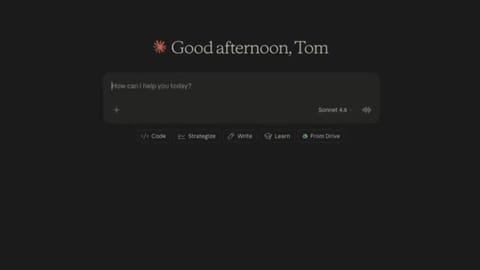
- Hey but have you checked whether any of these TCRs matches with a known TCR in the public space?" If you ever had this question and: - Needed 30+ minutes to find an answer to it - Had to ask a colleague because you needed some coding to get an answer - Were confused with the statistics reported to you (is this a match or something I can ignore?) Then check out our solution ImmuneWatch DETECT. You can smoothly integrate it in Claude or ChatGPT and just ask it to do the work for you. It takes less than 5 minutes and you are sure

Alumni
 Tom BosschaertsDirector of Operations
Related profiles
Something wrong or missing? Send an update. Fixed within 24 hours.