
Overview
Kannika is a production-validated Kafka data protection platform that enables backup, restore, migration, and cloning of multi-terabyte clusters. The platform offers disaster recovery with near-zero RPO, one-click self-service restore with granular control, and immutable audit trails for compliance.
Key people



In the news
- A backup with no topics looks exactly like a backup with nothing to do. Until this release, a backup that discovered its topics through selectors would retry a failed listing forever, without saying so. An unreachable or misconfigured event hub therefore looked like a perfectly healthy backup that simply had nothing to stream. Kannika 0.18.0 is largely about that class of problem: the failures that do not look like failures. Topic discovery now logs errors from the first attempt, retries for five minutes, then stops and reports
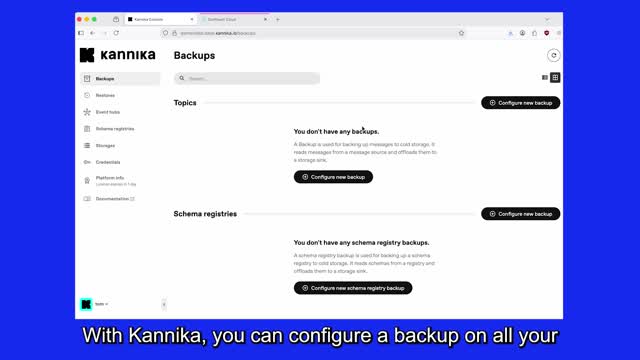
- How do you show an auditor that your Kafka backup actually works? 🧪 In this technical demo, Bryan walks through the relevant compliance requirements, shows how backup can be configured quickly, and explains how restore history, metrics and auditability support a stronger compliance posture. Useful for teams working toward NIS2, DORA or stronger operational resilience. #NIS2 #Kafka #OperationalResilience
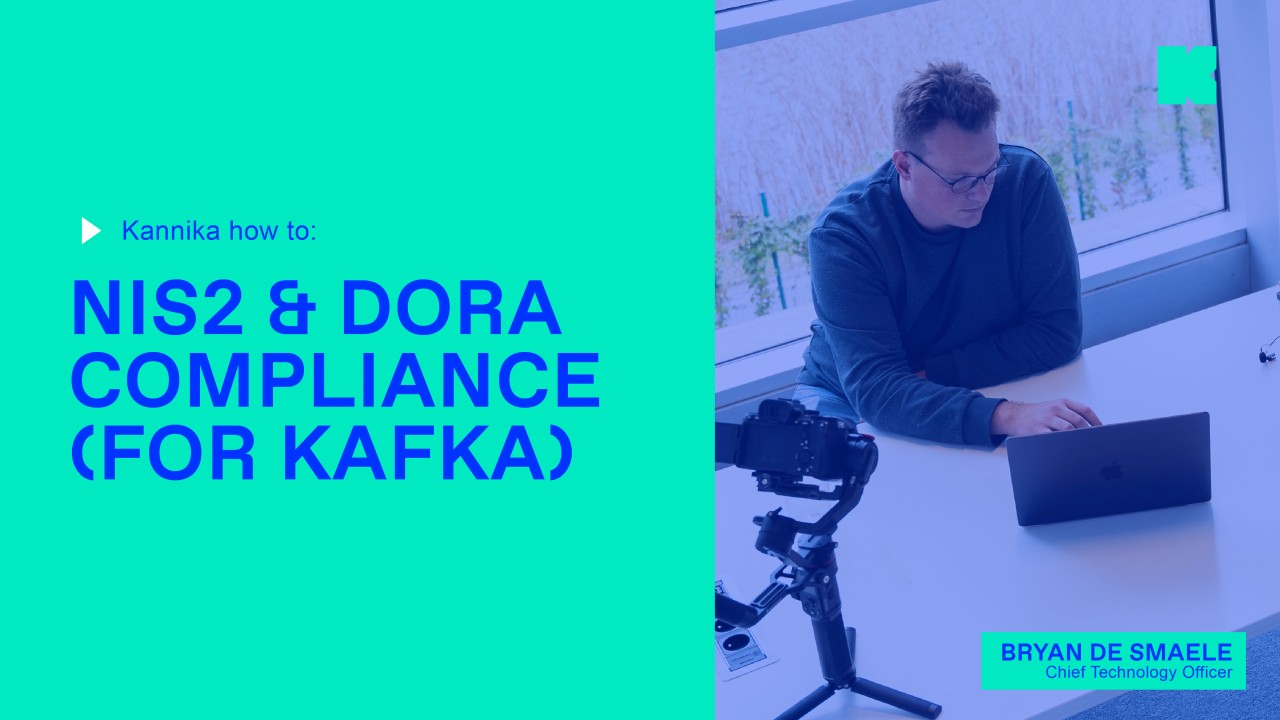
- NIS2 and DORA do not have to mention Kafka explicitly for Kafka to be in scope 🔎 In this clip, Bryan shows where backup, recovery and auditability requirements actually sit and why many Kafka environments leave a dangerous compliance gap open. A short technical view on a growing governance issue. #NIS2 #DORA #Kafka
- This is the disaster recovery question that actually matters: not "do we have a backup?" but "have we ever proven it works?" Michał Matłoka nails something we see constantly. Async replication quietly drops whatever has not caught up at the moment of failure, and failover plans that look solid on paper tend to fall apart the first time they are really run. Worth a watch for any technology leader who has never tested a live failover. 👇 #DisasterRecovery #Kafka #DataResilience #EventDrivenArchitecture #DataInfrastructure
- Let’s talk about everyone’s favorite topic: cloud bills. AKA: your heart attack at the end of the month 💸 Scaling your Event-Driven Architecture is great! There are plenty of performance gains, and the whole organization can benefit from it. But then the bill arrives. Traditional hyperscalers already charge a lot to store the event streams you need. But the worst part is that they charge you extra when you have to move or restore your own data after an attack. To give our customers a decentralized alternative, we decided to
- If your business depends on Kafka data, auditors will eventually ask how you recover it 🧾 In our latest blog, we explain where NIS2 touches Kafka in practice, why recovery proof matters, and what organisations need to demonstrate when backup and continuity come under review. Read the full blog here: https://lnkd.in/eiahCfjZ
- When one of EMEA's largest Confluent partners chooses you for Kafka backup, you know you're solving a real problem. 🙌 We're proud that SVA System Vertrieb Alexander GmbH Confluent's Enablement Partner of the Year trusts Kannika Armory for true point-in-time recovery, no vendor lock-in, and on-prem or SaaS deployment. As SVA's lead architect Axel puts it: Kafka replication isn't backup it copies your mistakes to every replica. Here's the full story 👇 https://lnkd.in/g3hsMnVh #ApacheKafka #KafkaBackup #DataProtection
- Let’s talk about a dangerous assumption in Event-Driven Architectures: thinking that replication is the exact same thing as a backup. (Spoiler: it’s really not). High availability is great for protecting your systems against hardware failure, but it does absolutely nothing against human error or data corruption. If a developer accidentally deletes a critical Kafka topic, that deletion is replicated instantly. Poof, gone! That’s why we recently decided to partner with Akave. While Kannika Armory safely extracts your data and

Something wrong or missing? Send an update. Fixed within 24 hours.