
Overview
Langwatch enables developers to run multi-turn simulations of AI agents, identify failure points, and implement automated release gates in continuous integration pipelines. The platform helps ensure AI agent reliability before production deployment.
Key people


In the news
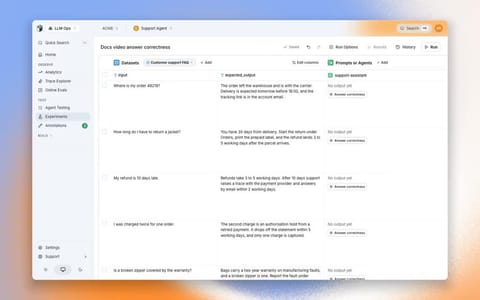
- Prompt changes often ship after someone reads three answers and decides it looks better. Experiments in LangWatch put a number on it. A support FAQ dataset runs through the prompt, an LLM judge checks every answer against the expected one, and the run ends with a score. Run the next version on the same rows and compare the two runs.
- Your AI agent worked in manual testing. Will it still hold up when someone tries to take control of it? In the second episode from this #AIWhereItMatters ADC Consulting conversation, Ron Kremer asked our co-founder and CTO Rogério Chaves where red teaming fits alongside tracing, guardrails and security services like Model Armor on Google Cloud. Rogério’s answer is to start by confirming the agent does what it was designed to do, and then red team it. In LangWatch, a simulated user takes on the role of an attacker, tries different
- What made that Claude Code run take so long, and cost so much? Connect Claude Code to LangWatch and every session shows each turn: the model requests, the tool executions and the tokens they used. You see where the tokens went, the call where the cache got rebuilt, and what each pull request cost in the end. Setup is one command: npx langwatch claude It works on Claude Max and Pro plans and on API keys. Codex, Copilot, Gemini CLI and opencode connect the same way, so you monitor them alongside your own AI agents in one LangWatch
- LangWatch tests AI agents before launch and watches them in production. A judge fails the agent that promises a simulated customer a refund before it checks the order. The Trace Explorer shows every step the agent took in production, and experiments score each prompt change before it ships. You catch the early refund promise before a real customer hears it.

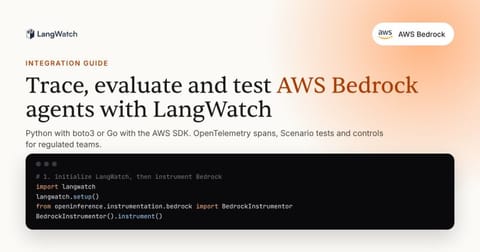
- Running agents on AWS Bedrock and still guessing what happened inside each call? Our guide gets Bedrock traces into LangWatch in a few lines of Python or Go. Most teams choose Bedrock so the models stay inside their own AWS account. The guide follows that logic all the way through, from the first span to the controls a compliance review will ask about. What it covers: → Python with boto3, using the OpenInference Bedrock instrumentor → Go with a native middleware for bedrockruntime, including Converse, ConverseStream and cache
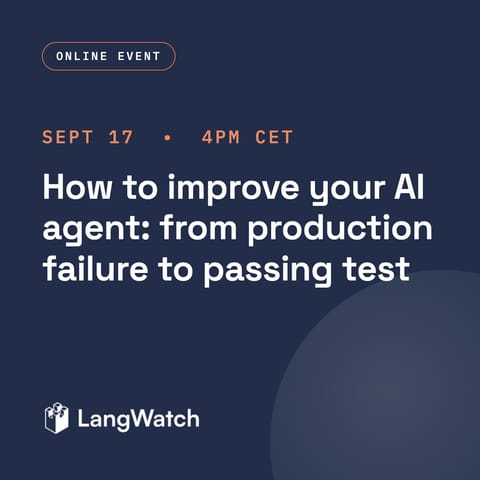
- We're hosting a live webinar on why your eval suite misses production failures, and what to do about it. Evals only catch what someone already wrote down. So in this session we take a real production trace, turn it into a scenario test, run it in CI so the same failure is blocked before deploy, and compare the fixed agent against the old one with the judge's reasoning on screen. For engineers and product teams shipping AI agents who have tracing in place and still hear about failures from users first. Built on LangWatch
- LangWatch August Update is out - check our new Prompt Optimization with our Agent Langy, updates on Evals, and the Gateway.
- Can you list every AI agent running in your company right now? Not the approved ones. The running ones. We asked AI platform, finance, and technology leaders at global enterprises what they actually need to govern AI agents. Different companies, different entry points, and they converged on the same six requirements: Observability: "why did the agent answer that?", answerable by a manager Governance: a living agent inventory with owner, model, and change history Centralization: one pane over every agent, built or bought FinOps: cost

Something wrong or missing? Send an update. Fixed within 24 hours.