
Overview
Launched in November 2013 by Arnaud Huret and Patrick De Schutter as part of ContactOffice Group, which has operated an online collaboration platform since 1999, Mailfence provides a privacy-focused email suite protected by Belgian privacy law. The platform includes encrypted email, calendar, document storage, and contact management.
Mailfence uses true OpenPGP end-to-end encryption processed in the user's browser, meaning private keys never leave the client. Belgian privacy law requires a court order from a local judge before any information can be disclosed, providing a legal privacy layer above and beyond what GDPR mandates in practice. The company donates 15% of revenues from its Ultra plan to the Electronic Frontier Foundation and European Digital Rights.
Mailfence operates without external VC funding, relying on subscription revenue from its paid plans. It competes with Proton Mail and Tutanota in the privacy-first email segment, differentiating itself through Belgian legal jurisdiction and the breadth of its integrated collaboration features.
Key people


In the news
- Google just rewrote one of its oldest privacy promises. Until October 16, its privacy policy said that Gmail, Drive, and Photos content would never be used to personalize ads. The updated policy makes an exception for anyone who connects those apps to Personal Intelligence, its opt-in AI feature in Search and Gemini, according to The Verge and Android Authority. It’s opt in today. But once your inbox becomes an advertising signal, who’s the customer? 🔗https://lnkd.in/e-bmH_uE #Privacy #DataProtection #DeGoogle #Mailfence

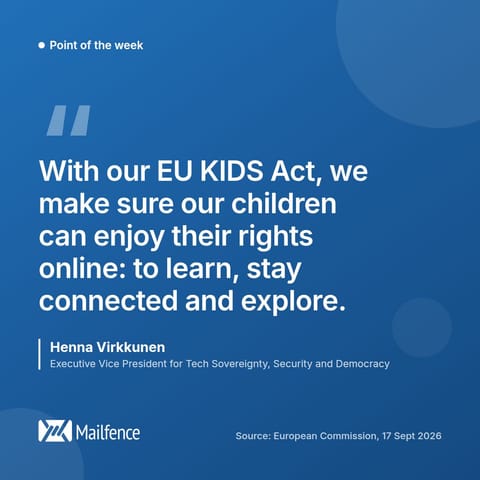
- With our EU KIDS Act, we make sure our children can enjoy their rights online: to learn, stay connected and explore.” Henna Virkkunen, Executive Vice President for Tech Sovereignty, Security and Democracy That’s an important goal. Children should be able to learn, connect, and explore online without being exposed to harmful design or unsafe digital environments. The EU Kids Act aims to make that possible by strengthening platform responsibilities, introducing age-based access rules, and requiring services to be safer by design.
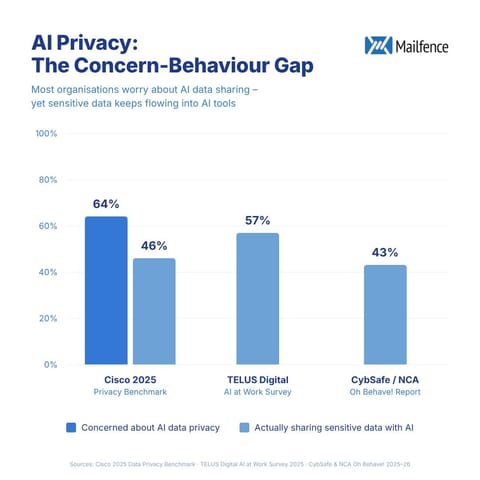
- 64% of organizations worry about accidentally sharing sensitive information with AI tools. Nearly half admit to putting personal or nonpublic data into them anyway. The gap shows up among workers, too. 57% of enterprise employees who use GenAI admit to entering sensitive information into public AI assistants, and 68% use personal accounts to do so. 43% of workers say they’ve shared sensitive work information with AI without their employer’s knowledge. Worry alone doesn’t change behavior. Where your data lives does. Sources:
- A federal court just said your car can legally record your texts. This month in privacy & cybersecurity: → Meta ordered to pay $25B over Cambridge Analytica → Capcom breach exposes 11.7 million accounts → EU greenlights AI training without consent → AI cracks Chrome in six days for $40K → California bans AI emotion tracking at work +8 more in the full newsletter Your car, your glasses, your data. October made clear that every connected device is a potential surveillance tool. 🔗 https://lnkd.in/e-bmH_uE #Privacy #Cybersecurity
- PHP2Shell: Is your email account at risk? Two critical PHP vulnerabilities (CVE-2026-109618 and CVE-2026-109619) can allow attackers to execute code on vulnerable servers without authentication. The good news: Mailfence: Secure and Private Email is not affected. Our service does not rely on PHP, so these vulnerabilities do not affect Mailfence accounts or the data they contain. Following the disclosure, we reviewed our systems and relevant third-party dependencies. For organisations running PHP-based applications, the priority is

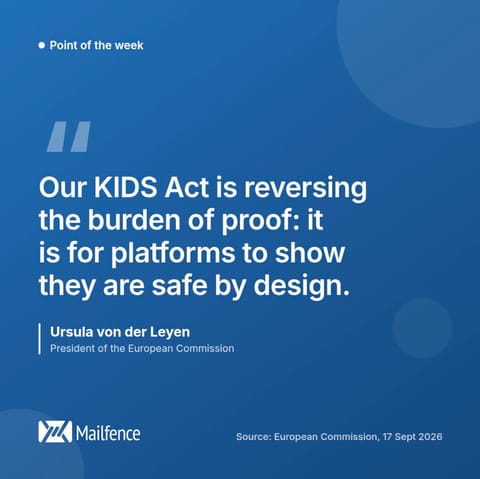
- On September 17, the European Commission proposed the EU Kids Act, a plan that could significantly change how children access social media across the EU. Under the proposal, children under 13 would not be allowed to have personal social media accounts. Kids ages 13 and 14 could use supervised accounts with limited features, while independent accounts would be allowed starting at age 15. The proposal would also require platforms to address addictive design, limit tracking-based personalization, and build safety into their services
- Most people assume they're talking to a machine. A proposed class action filed on 16 September alleges that under Project Lily, outside contractors hired through staffing firms read real ChatGPT conversations, summarised what users wanted, and scored the model's replies. The complaint, which draws on 404 Media's reporting, says OpenAI's privacy policy never mentioned these reviewers. The allegations are unproven. Worth asking before your next prompt: who else might read it? 🔗 https://lnkd.in/expXcrFH #Privacy #Cybersecurity
- One contact's emails never arrive. Everyone else does. That's rarely "the internet". It's usually a narrow issue between two accounts: a filter rule, a category tab, or a sender whose SPF, DKIM, or DMARC records are broken. Quickest first check: send yourself a message from a different account. If it lands, your inbox is fine. Filters decide a lot before you open anything. How much control do you really have over yours? 🔗 https://lnkd.in/eEfMJBWr #Privacy #Cybersecurity #EmailSecurity #Business #Mailfence

Related profiles
Something wrong or missing? Send an update. Fixed within 24 hours.