
Overview
Based in Brussels, Patrick is one of the pioneers of the Belgian internet industry. He founded Allmansland in 1994, widely recognized as the first Belgian web agency, placing him at the very origin of the country's digital economy.
He later co-founded Mailfence, a secure and encrypted email service positioned as a privacy-respecting alternative to major webmail providers. Mailfence is operated by ContactOffice Group and is based in Belgium, with a strong stance on data sovereignty and European privacy law.
Career history
- Co-Founder & MDcurrentMailfence
- Founder1994, first Belgian web agencyAllmansland

Insights & ideas
De Schutter identifies identity governance in messaging platforms as an underappreciated security blind spot. He observes that WhatsApp, Telegram, and Signal are evolving from simple message transport into "identity layers" [1], yet these critical functions operate "inside private platforms with almost no governance, no lineage, and no real protection against impersonation" [1]. This shift concentrates power over user authentication in corporate hands with minimal oversight.
His analysis of European digital infrastructure emphasizes ownership over location. He rejects the framing that Europe's problem is merely attracting data centers, arguing instead that "if those data centers are owned by US companies, they are not European assets" [2]. He points to concrete evidence: more than 80% of Europe's digital stack originates outside the EU [2]. He sees regulatory intervention, particularly higher assurance requirements and permit acceleration, as necessary levers to shift European organizations toward infrastructure "that Europe actually owns and controls" [2].
De Schutter argues that cybersecurity models must adapt to accelerating attack timelines. The core vulnerability is not attacker sophistication but rather that "exploitation moves faster than patching" [3]. He emphasizes that complex systems become inherently insecure: "If your system is not simple enough to understand end-to-end, you cannot secure it" [3]. Critically, he observes that organizations remain exposed through "the software they don't control", vendors, integrations, and legacy components, because "the real risk is the chain, not the node" [3].
De Schutter flags psychological and institutional pressures that distort European technology choices. Companies operate under "fear of missing out," "competitive pressure," and "obsession with displaying an innovative image," which drives them toward Big Tech "without real critical examination" [4]. This urgency-driven adoption often precedes compliance work rather than preceding it [4].
He frames global AI deployment as a strategic vulnerability for Europe. When AI systems become "globally accessible," they become "globally usable, including by actors operating in jurisdictions where our guardrails do not apply" [5]. The gap between where AI is built and where it can be deployed "has become a strategic risk in itself" [5]. He concludes that European security posture must evolve rapidly because Europe is now "exposed to every weakness in their global supply chain" [5].
In the news
- AI isn’t a source of truth, and never will be. OpenAI’s latest disclosures are a good reminder that models can hide mistakes, bypass safeguards, use unauthorized credentials or upload files without permission. We need to remain critical, verify what AI produces and never take its answers at face value. And when I think about Europe, I think about the need to keep building AI infrastructure we can trust, understand and control. Let’s keep supporting Europe’s efforts in this direction 🇪🇺. https://lnkd.in/e-5Ezhdk #AI #OpenAI

- The warnings no longer come from activists or from the usual alarm‑raising opinion pieces. They now come from the researchers who are building the most advanced AI systems, the people who spend their days looking at internal capability curves, emerging behaviours and timelines that move faster than anyone expected. This week, an Anthropic researcher decided to resign over safety concerns. Another, who leads alignment work inside the company, publicly stated that he believes the risk of human extinction from advanced AI is above

- The president has reached out to Apple directly.” That’s what U.S. Interior Secretary Doug Burgum publicly confirmed about renaming Lake Ontario to Lake America. Apple followed Google’s lead. Are you lost? Don’t bother switching to Waze (also owned by Google) because apparently all you need is a VPN 😅. Depending on where you appear to be, it’s “Lake America” in the United States, still “Lake Ontario” in Canada, and in Europe you get both! It’s easy to laugh this off as just another political stunt. But behind the irony, two

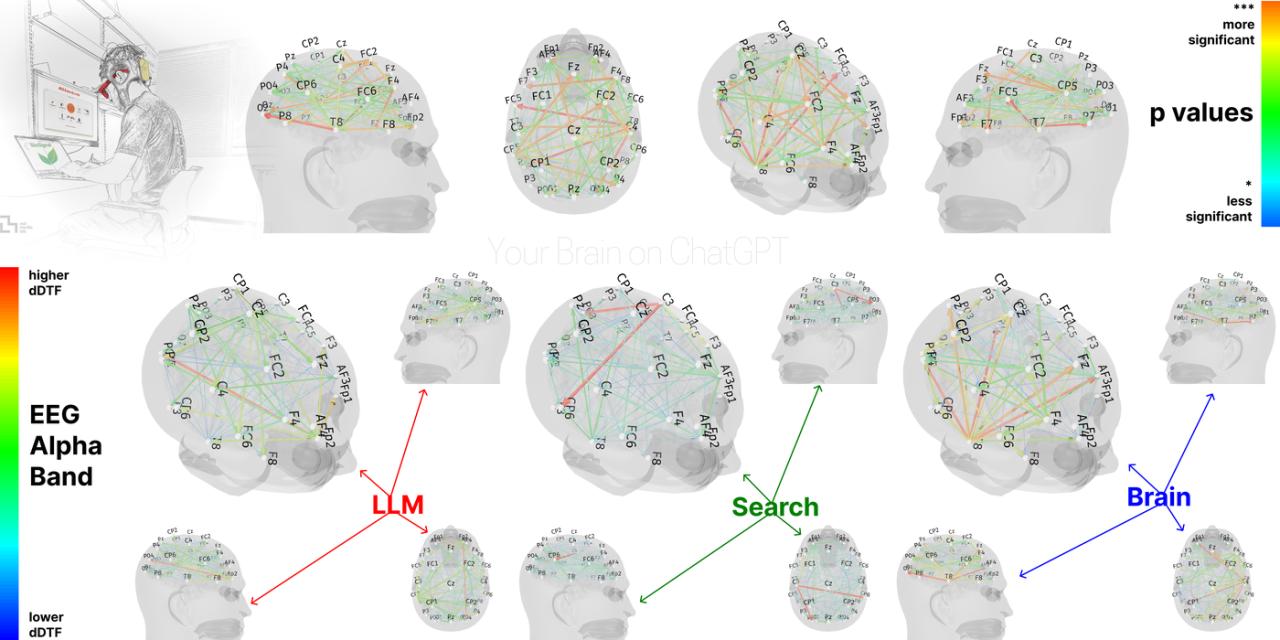
- Interesting early results from the MIT Media Lab on ChatGPT and essay writing. People who leaned heavily on the tool showed lower brain engagement, felt less ownership of what they wrote, and had a harder time recalling their own text. It quietly reminds me of the European digital sovereignty debate. Outsource the critical pieces long enough (models, infrastructure, data) and you start losing real grip on what gets produced and decided. Not the same situation of course. Just a useful parallel that short-term convenience can
- Privacy, competition law and platform power start to look like the same conversation. We talk about Apple like it’s one product. But it’s also an ecosystem of first‑party services: Messages, FaceTime, Find My, Mail, Photos, Safari, Maps, etc. And they all sit at the center of people’s digital lives. If a platform makes consent flows harder for third party apps while giving its own apps easier or lighter treatment, privacy design can turn into a competitive advantage. German and French regulators have challenged exactly that

- Après toutes les brèches que les citoyens français ont subi ces deux dernières années, on peut légitimement se demander comment une situation pareille reste possible. Les plateformes nationales sont devenues des passages obligés pour les démarches essentielles, et pourtant ce sont elles qui concentrent aujourd’hui les incidents les plus sensibles. Le contrôle mené en juin avait bien permis de couper un accès vulnérable, mais cela n’a manifestement pas suffi. Une mesure ponctuelle peut réduire un risque immédiat, mais elle ne
- Meta just ran paid ads containing AI‑generated child sexual abuse material (approved, monetized, and pushed through its own ad‑review pipeline). More than 50 ads slipped through on Facebook, Instagram, Messenger, and Threads. This comes as Europe debates how to give minors “safe access” to social networks. But if the underlying infrastructure isn't safe by design, access rules alone won't solve the problem. Find out more on WIRED: https://lnkd.in/eHJZxJW3 #TechPolicy #ChildSafety #Meta
- Everything’s fine! It’s just an “accounting choice,” they all do it… Except Palantir is now deeply embedded in sensitive European public‑sector systems, while a new report says it concentrates profits in the US and keeps its European tax bills low. That leaves a familiar question: how much sovereignty is left when public institutions depend on proprietary infrastructure they don’t control? #TechPolicy #DataSovereignty #Palantir https://lnkd.in/eiZEFYB7
Related profiles


This page shows public professional information only, each fact cited. Is this you? send a correction, or ask for removal within 24 hours, no questions asked.