
Overview
Founded on the principle of ensuring high-quality medical treatment access, MicroPort develops and manufactures medical technologies with a focus on patient-centric innovation. The company operates in over 100 countries and 20,000 hospitals worldwide, with R&D and manufacturing facilities across China, United States, France, Italy, and Dominican Republic. MicroPort provides solutions spanning 12 key therapeutic areas, impacting millions of patients globally.
Key people
In the news
- It’s a privilege to be part of the Cancer Research Horizons ecosystem and to see the incredible work highlighted in this year’s Annual Review. We’re particularly grateful to the CRH team for believing in AiM Medical Robotics and investing in our vision to bring precision robotics and real-time MRI together to advance the treatment of brain cancer. Your support has been an important part of our journey as we work to translate this technology toward the clinic. Thank you to the entire team for your partnership, your belief in the
- Thanks for the feature on AiM Medical Robotics in this week's newsletter! We really appreciate the support of the LSI community. And, proud of all of the amazing progress and successes of the team.
- A major milestone for AiM Medical Robotics - we are proud to announce that AiM has been awarded a $2M Phase II NIH SBIR grant from the National Cancer Institute (NCI), to advance MRI-guided robotic treatment of brain cancer. 🚀 🚀 🚀 The NCI-supported program, "Intraoperative MRI-Guided Neurosurgery Robot for Enhancing Ablative Treatment of Brain Cancer," led by AiM Co-founder Gregory Fischer and long-time collaborator Nobuhiko Hata, will advance AiM’s MRI-compatible robotic platform for precision delivery of ablative brain
- We are thrilled to announce the appointment of startup veteran Andrew Aberdale as our new President and Chief Financial Officer! He will be working alongside our Founder & CEO Gregory Fischer to support commercialization of AiM's dynamic image guided neurosurgery robot. Andy brings over three decades of operational and financial leadership, including 20 years dedicated exclusively to scaling early-stage ventures. With a track record of guiding two companies public on the NASDAQ and NYSE and orchestrating four high-value private
- We would like to thank the HBS Alumni Angels of NY for their continued confidence and support in AiM and our mission to improve neurosurgical treatment for Parkinson's disease patients and others in need of precision intracranial delivery of therapeutics. Harvard Business School, HBS Alumni Angels of Greater New York
- Most surgical procedures answer one question at the end: Did it work? In stereotactic neurosurgery, that question isn't really answered on the day of the case. The post-op scan confirms the lead's position relative to the skull. Whether it's in the right spot within the brain often only becomes clear during programming, sometimes months later, when the therapy doesn't respond the way it should. In engineering, that sequence has a name. Open-loop. The decision is made once, executed, and verified afterward. Closed-loop is the
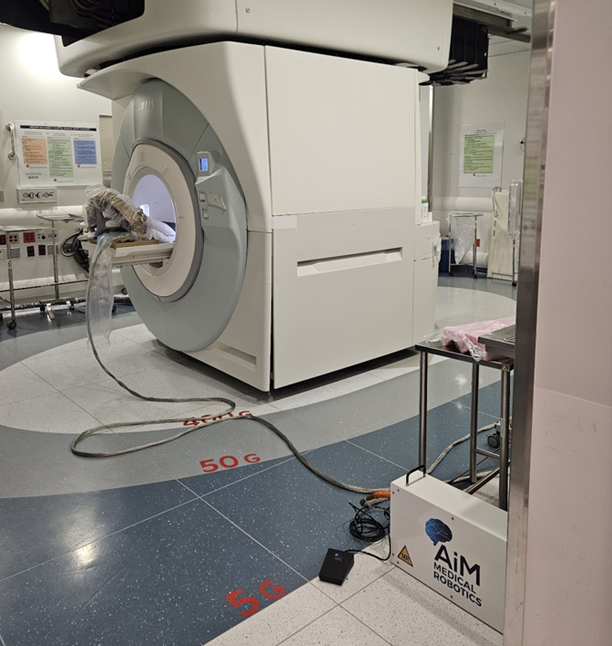
- Most image-guided surgical robots arrive at a hospital with a tower, facility modifications, and a capital ask that runs into the millions. AiM's platform is designed to be readily and rapidly setup and operated in any MRI suite or OR including standard diagnostic MRI scanners (the ones radiology uses every day). No new room. No structural modifications. No imaging vendor lock-in. For a hospital, that changes the conversation adoption becomes a procurement decision. For a hospital network, one platform can move between sites as
- The case for intraoperative MRI confirmation in DBS has been clear for years. The question has always been operational: Can the workflow actually run that way? We've spent the better part of a decade answering yes. AiM's robot aligns inside the bore, on live MRI. The surgeon replans against the brain as it is during the case, not against the pre-op scan. Verification happens before the patient leaves the suite. The plan, the placement, and the verification are one continuous workflow. That capability has been validated in cadaver



Something wrong or missing? Send an update. Fixed within 24 hours.