
Overview
Optioryx offers AI technology that integrates with existing warehouse management systems to improve their capabilities. The company operates in the information technology and services sector, focusing on supply chain and logistics optimization.
Key people

In the news
- Ready for ICT&Logistiek? Come find Optioryx in Hall 9, at booth A060. Register here (for free) 👉 https://bit.ly/4ijVUzZ 🗓️ 3rd - 5th November (next week!) 📍 Royal Dutch Jaarbeurs, Utrecht Come by, we'll show you what warehouse optimization tech we’re working on. #yourwarehouseonsteroids #warehouseoptimization #ICTLogistiek #LogisticaNext

- Happy to welcome Mark Soetens on board!
- After almost 3 decades working for logistics service providers (DB Schenker, (now DSV - Global Transport and Logistics, ID Logistics Benelux, ID Logistics and Movianto (now Yusen Logistics), I’ve moved sides! I’ve joined Optioryx, a company building the next generation of warehouse optimization software, as a warehouse optimization business developer. I’ve always been passionate about the most efficient ways to run a warehouse. I know the challenges in a warehouse, and I’ve spent years on continuous improvement. Now I get to

- Most slotting work is one decision repeated: which SKU goes in which location, for whatever goal you slot for (most commonly, it's travel distance). You can make that decision in 3 ways without reorganizing the whole warehouse. (1) Re-slot in idle time 🔁 At the end of a shift, give operators a list of moves: which SKUs to swap and how many (5, 10, 50 or 100, whatever fits the time). Fast movers and items ordered together come first, ranked by impact. Picking gets faster over the next days and weeks. (2) Slot at replenishment 📥
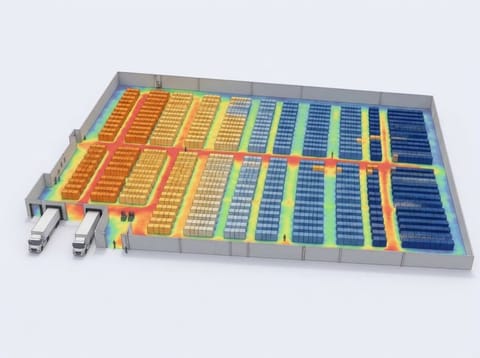
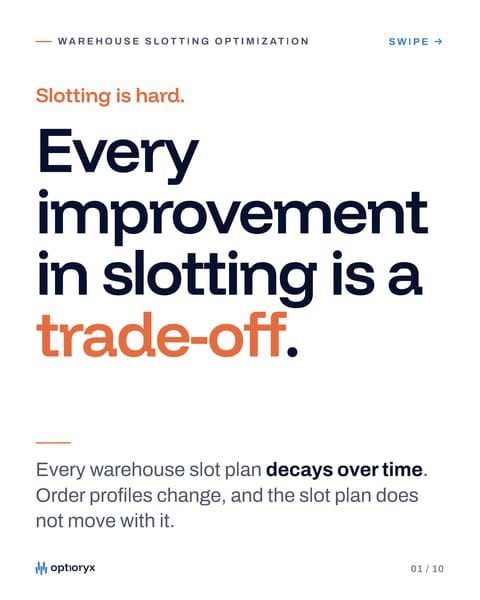
- A distribution center slot plan decays as the order profile changes. You can only adapt if you see it happening. That means using your data: what moves fastest now, what gets picked together, and where your pickers walk, where congestion builds up, etc. You feel it most in peak season, Black Friday especially, when the slotting plan has to be right. Do you handle slotting in one of these ways? ☑️ Slotting was done once ☑️ The plan lives in Excel ☑️ ABC slotting is the only method ☑️ Your WMS 'does it' but has no map of your
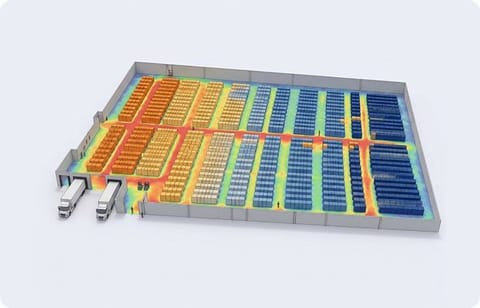
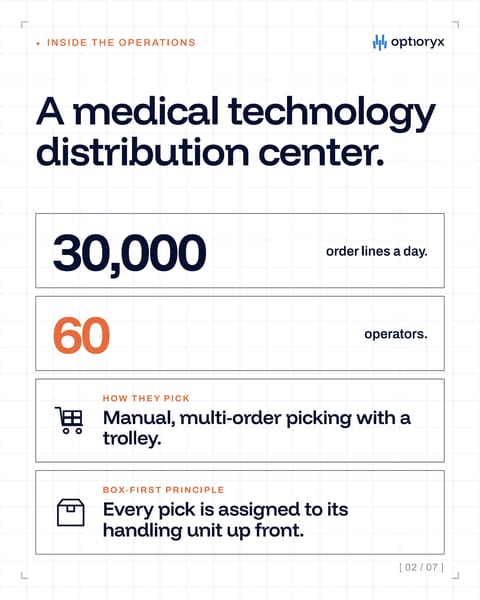
- A med tech distribution center's (well-known) WMS already handled the clustering and the pick sequence. But routes were created based on static business rules and the classic pick snake sequence. Now they run Optioryx optimization in the background of their WMS, clustering orders onto each trolley and solving 3D packing to fit different box sizes on multiple different trolley shelves. Swipe through to see what changed on the trolleys and routes. More on how it works 👉 https://bit.ly/4yuhecS
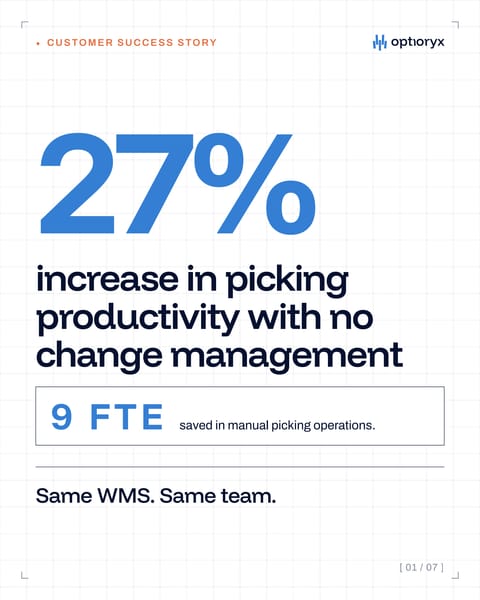
- 27% higher picking productivity. Same WMS, same team, same process. A MedTech distribution center picking 30K order lines a day with 60 pickers was using a well-known WMS. Its routes came from static rules and the classic pick snake, but they were longer than they needed to. Pulse now runs on top of that WMS and optimizes in the background, clustering orders onto each trolley, while applying 3D packing to fit different box sizes on multiple different trolley shelves. See what it would do on your own order data. 👉

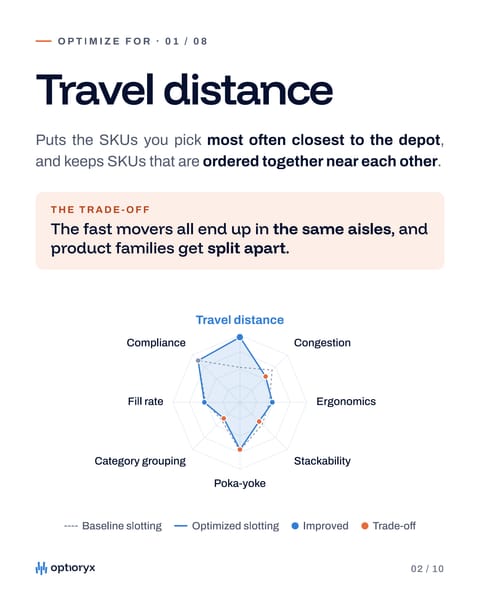
- A warehouse slot plan built for one goal, like travel distance, pays for it somewhere else. Put all your fast movers close together and pickers walk less. But then they end up in the same aisles at the same time, so congestion goes up. A good slot plan doesn't max out one goal. It balances travel distance against congestion, stackability, ergonomics, and other factors, and stays within your compliance rules. See what trade-off each optimization comes with. 👉 Every warehouse weighs these goals differently. Tell us which goal your

Alumni 1 went on to found or lead
 Dries MaertensLead Software Engineer→Founder & Lead Software Engineer at Codingi
Related profiles
Something wrong or missing? Send an update. Fixed within 24 hours.