
Overview
Sequesto develops an agentic OS platform built to support commercial teams in their operations. The company focuses on software development solutions that leverage autonomous agent technology.
Key people
In the news
- You send the request on Monday. A polite nudge on Wednesday. By Thursday, you are drafting the section yourself, because the person who actually knows the answer has a client escalation and a project deadline, and neither of them is your tender. The instinct is to chase harder. But the request reached them as an add-on, at short notice, with no owner, no deadline of its own and no consequence for slipping. Chasing does not change any of that. Jo Hillman's reframe is that the bid writer was never supposed to receive finished prose
- Every bid writer has had the same moment of doubt. Not about whether the AI writes well, because it does. About whether the thing it just produced still honours something you told it two hours and thirty pages ago. Usually you move on, because checking costs more time than you have, and it has been fine so far. That holds on short work. It stops being fine on the long, multi-session tender, which is also the one you can least afford to lose. Jo Hillman sets out three questions worth putting to any non-purpose-built solution before
- Nobody plans for the timeline to be impossible. A one-week clarification window. A liability clause that needs proper legal review. SMEs delivering live client work at the same time. Stack the governance milestones on top of one another and the sum stops working before any writing has begun. None of that is a planning failure. It is what happens when a fixed external deadline meets internal dependencies that were never designed with bidding's compression in mind. Jo Hillman on what actually closes the gap, including a
- A response is only as strong as what stands behind it. Where the answer came from. Who approved it. One record that still holds when a client asks six months later. James orchestrates. The specialist agents execute. Your team sets the direction and gives the final approval. Your document returns complete, in the format it arrived in. Simay Aydin Kartoglu on the questions security teams bring her, and what a defensible answer actually takes. Link in the comments. Every response, handled. The final word, yours.
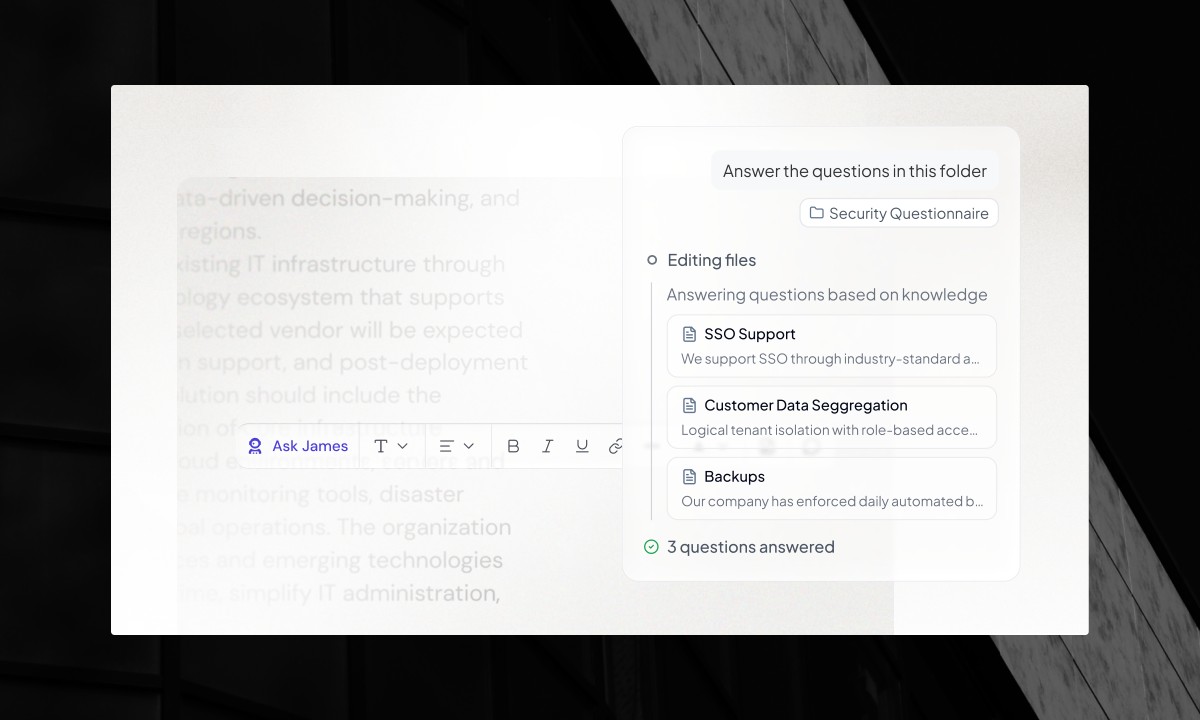
- Bids, tenders and questionnaires almost always arrive with a form attached. Word, Excel, or, more often, a PDF. Hundreds of tick boxes alongside everything else that needs completing, and no reliable way to get the right content into the right place. It is one of the jobs a tender team dreads, and it usually lands with someone senior enough to be certain the answers are right. In the SEQUESTO aOS, you drop the form in, and James reads every field, pulls the company, legal and compliance details from your Knowledge Hub, and
- Most high-growth bid teams have centralised their knowledge. Far fewer (can) make it accessible to everyone who actually needs it. That gap is not a technology problem. It is a governance problem. When organisational knowledge sits in one place but only a handful of people know how to reach it, even experienced bid writers fall back on what they can find fast: last quarter's answers, a colleague's inbox, a version of the boilerplate nobody has reviewed in eighteen months. The submission still goes out. The risk goes with it.
- In bid and tender work, the response is only half the job. The other half is being able to prove how you got there. Who approved this claim. Which version is final. Where this number came from, and whether it is still true. When a bid is challenged, or an auditor asks, "we think it was right" is not an answer. You need the trail. This is the part most AI quietly skips. Bolt a general-purpose tool onto your process and it generates fast, then leaves you holding output you cannot trace, scattered across documents and people, with
- Most bid teams' stacks aren't missing a tool. They're missing the system that connects them. Word. SharePoint. A general-purpose AI. A legacy RFP platform nobody uses. The stack keeps growing. The coordination doesn't. That's the gap the SEQUESTO agentic Operating System closes: not another tool on the pile, but an agentic OS that the whole bid operation runs on. One governed system, eight layers, from intake to submission. Model intelligence, connected knowledge, specialist agents, and configurable, flexible workflows reinforce

Backers
Smartfin
Belgian VC firm focused on tech and deep tech, founded and led by Jurgen Ingels.
Related profiles
Something wrong or missing? Send an update. Fixed within 24 hours.