
Overview
Founded in 2017 by Valeri Potchekailov and co-founders Brik De Maeyer and Gregory Claeyssens, StoryChief was built out of the founders' five years of experience running a marketing agency. They observed firsthand the fragmentation and inefficiency of managing content across channels, teams, and tools, and built StoryChief as the single source of truth for content marketing operations.
The platform covers the full content lifecycle: strategy, editorial calendar, collaborative writing, AI-assisted content creation, multi-channel distribution (social, email, CMS), and analytics. It serves content teams at startups and mid-sized companies, primarily in the US and Europe.
By 2024, StoryChief had 5,000 customers across 70 countries and 27 employees. The company raised EUR 3.4M in 2022 from Capricorn Partners (via the Capricorn Digital Growth Fund), with participation from existing investors Peak and several angels. Total funding is approximately EUR 7.5M across multiple rounds.
Funding history
- SeedSeptember 2018
- SeedJanuary 2020
- EUR 3.4M roundJuly 2022Capricorn Digital Growth Fund (lead), Peak, angel investors
Key people

In the news
- A competitor showed up in an AI answer. What can you learn from the page that was cited? Start with one question your buyers actually ask. Open the AI answer and the competitor page it references. Then make a short note of: 1. The question the page answers clearly. 2. The examples, product details, or evidence it includes. 3. What a buyer might still need to know after reading it. Now look at your own site. Do you already have a page that answers the same question? If so, you may be able to improve it with a direct answer, an
- Working on a page you’d like AI answers to cite? This checklist can help with the edit. □ Write down the buyer question you want the page to answer. □ Put a clear answer near the top of the page. □ Add a real example, a useful comparison, or evidence from your team’s experience. □ Check that product details, figures, and sources are still accurate. □ Link to related pages that help the reader take the next step. □ Look at the AI answer again. Which pages does it cite, and what do they explain well? You don’t have to tackle every
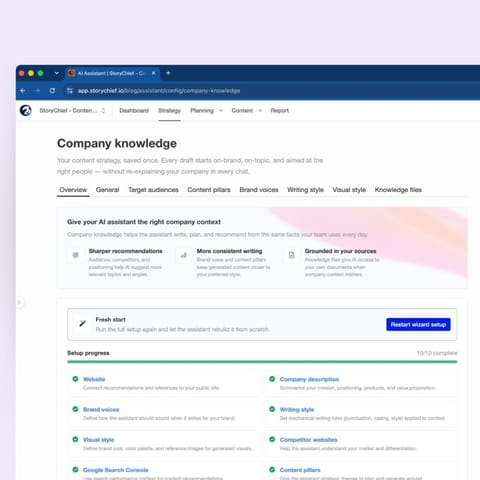
- New to StoryChief? Here’s one useful way to spend your first 10 minutes. Open AI → Company Knowledge and add your website. Check the company description it helps create, then edit anything that doesn’t quite sound like your business. Add one target audience. Think of the person your next piece of content needs to help. Then add one content pillar: a topic you want your team to cover consistently. If you have a page or post that sounds like your brand, use it to start a brand voice. Review the result before you save it.
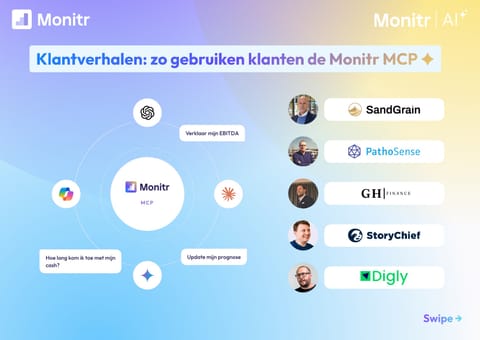
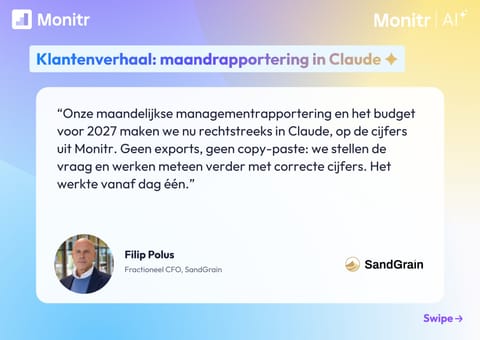
- Elke maand je P&L exporteren en in een AI-tool plakken? Vijf klanten doen het anders. Met de Monitr MCP werkt Claude rechtstreeks op hun cijfers in Monitr. Geen exports, geen copy-paste, altijd de actuele cijfers. Wat ze ermee doen: → Filip Polus (SandGrain B.V.) maakt de managementrapportering en het budget 2027 rechtstreeks in Claude. → Valeri Potchekailov (StoryChief - Content Marketing Platform) controleert tijdens de closing of alle kosten in de P&L staan en werkt de prognose bij met Stripe-data en de salespipeline. → Bert
- Want a practical way to work on AI visibility over the next 90 days? Here’s a plan you can adapt to your team. Days 1–30: Pick 5–10 questions your buyers ask before choosing a solution. Check the AI answers. Note where your brand appears, which pages get cited, and which competitors show up. Save a baseline so you can compare later. Days 31–60: Choose two or three gaps worth fixing. If you already have a relevant page, update it with a clearer answer, current information, and a useful example. If you don’t, brief one new page
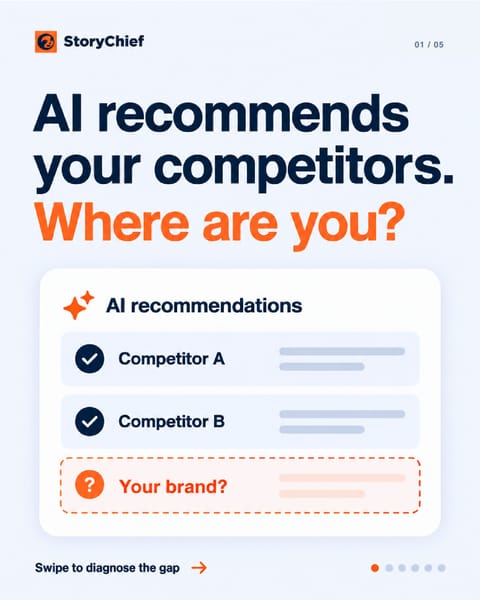
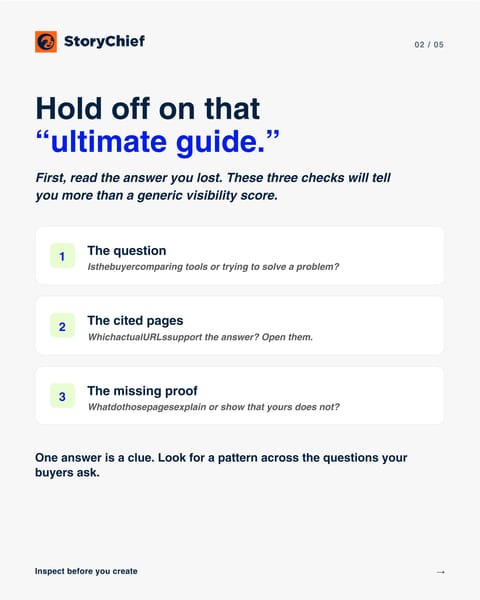
- You ask an AI tool the question your buyer would ask. It recommends three competitors. Your brand doesn’t even make the footnotes. Tempting response: commission a new “ultimate guide” by Friday. Slower, better response: inspect the answer. What did you actually ask? “Which tool should I choose?” needs a different page from “How do I solve this problem?” Which pages got cited? Look at the pages, not the logos. Maybe the answer leans on comparison pages. Maybe it leans on specific examples your site doesn’t have. Do you already answer
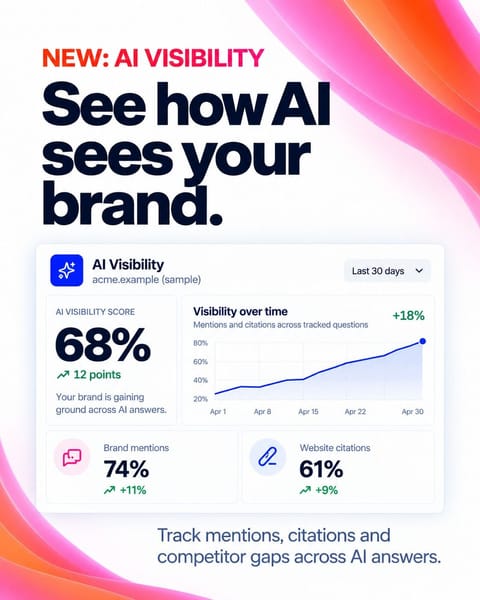
- Is AI recommending your brand? 👀 Buyers are asking ChatGPT and other AI tools which products to choose, which providers to trust, and which brands belong on their shortlist. Now you can see if your brand makes the cut. Introducing AI Visibility Tracker, now available in StoryChief. 🚀 It shows you: ✓ Where AI mentions your brand ✓ Which pages it cites ✓ Which competitors appear instead ✓ What your team can do next Track your visibility across ChatGPT, Google AI Overviews, Gemini, Copilot, and Google AI Mode. Then turn missed
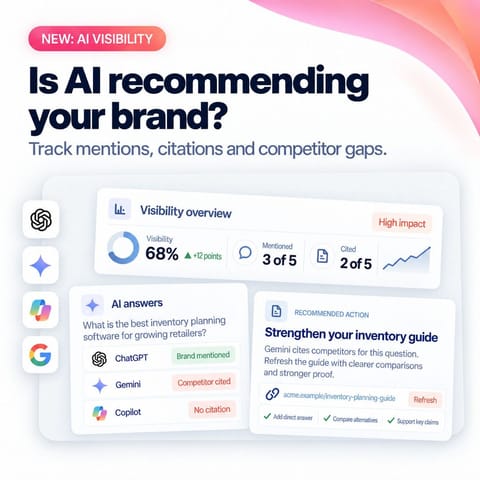
- The best AI visibility question is not, “What is our AI visibility score?” It is, “How are we showing up in the questions our buyers are already asking?” AI Visibility Tracker starts with your business context, audiences, focus topics, and competitors to suggest the questions worth tracking. From there, you can see where your brand appears in AI answers and where your content needs improvement. ✔️ Good AI visibility starts with asking the right questions. 🚀 #AIVisibility #ContentStrategy

Alumni 1 went on to found or lead
 Christophe GeudensNLP Data Engineer→Co-Founder & CTO at Prismos
Backers
Capricorn Partners
Leuven-based VC with EUR 300M+ AUM, investing in cleantech, digital, health, and fusion technology with over 30 years of experience.
Related profiles
Something wrong or missing? Send an update. Fixed within 24 hours.