
Overview
Chammah studied aerospace engineering and later worked as a management consultant at McKinsey. In 2024 he co-founded Nexus with Shady Al Shoha and took the CEO role, leading the company through Y Combinator's Fall 2025 batch and its $4.3 million seed round in March 2026.
Assem Chammah is co-founder and CEO of Nexus, a Brussels-based company he founded in 2024 with AI engineer Shady Al Shoha, who serves as CTO. Chammah trained as an aerospace engineer and worked as a consultant at McKinsey before starting the company. Nexus is a no-code platform that lets non-technical teams in large organisations build and deploy production-ready AI agents without engineering support. The agents run complete workflows across CRM, ERP, Slack, Teams and custom APIs through more than 4,000 integrations, with governance and compliance controls built in. The company lists SOC 2, ISO 27001, ISO 42001 and GDPR among its certifications and is part of Y Combinator's Fall 2025 batch, with Tom Blomfield as its YC partner. It operates from Brussels and San Francisco. On 31 March 2026 the company announced a $4.3 million seed round led by General Catalyst, with participation from Y Combinator, Transpose Platform, Twenty Two Ventures, Phosphor Capital and angel investors Gokul Rajaram, Raphael Schaad and Jake Mintz. Named customers include Orange, which deployed a customer onboarding agent in four weeks and reported a 50% increase in conversion rate and more than $6 million in annual lifetime value, as well as Lambda.ai and Proximus Global. Chammah has worked with more than ten large enterprises, including Orange Belgium and Waterland Private Equity, on automating operations with AI.
Career history

Insights & ideas
The through-line
Across these posts the same argument keeps resurfacing: most of what gets sold as "AI transformation" is either mislabeled automation, a proof of concept that will never survive contact with production, or a billing structure designed to keep the client paying forever. The recurring move is to strip the hype back to mechanics, whether that means naming the token math behind a $100k bill, counting the RPA maintenance tax, or pointing out that a PE firm asking for an "AI agent" actually needs a deterministic script. Over the run of posts this hardens from diagnosis into a fairly consistent playbook: pick one workflow, deploy it to production immediately, match the tool to the task's error tolerance, and let the business team own the result rather than routing every change through engineering [7][9][14].
On matching the tool to the task
The clearest recurring principle is that agents are not automatically the right answer. On a payroll cost-cutting request: "AI agents hallucinate. For anything financial where you want 100% accuracy, and zero errors - AI is just not a good tool to use" [9]. The framework that follows splits work into automation ("Anything where 99% right is wrong"), agent ("Anything that takes a human 20 minutes of judgment per case"), and hybrid, where a "Script for the 99%" hands off "the 1% of edge cases" to an agent with human review [9]. The same instinct shows up when reviewing a consultancy's "agentic" build that was really "just built a bunch of automations + rules," which he calls "completely fine - if that's what the use case needs" until complexity breaks it [1]. RPA gets the harshest read: "70-75% of RPA total cost of ownership goes on building, fixing and maintaining them," because "Building the thing is easy. Keeping it current as reality drifts is what no company does" [3].
On cost efficiency
Model economics get treated as a lever anyone can pull. Cutting a client's AI bill "from $100k to $60k/mo Without losing any quality" came down to swapping models with comparable benchmarks at a fraction of the token price: "Opus 4.8 costs $5 per million input tokens, $25 per million output tokens... And Sonnet currently costs $2 per million input tokens, $10 per million output tokens" [2]. The conclusion is generalized past the one client: "Pretty much any organization can run this exercise and dramatically cut their AI bill" [2]. Ramp's spend data is read the same way, as evidence that budget size isn't the differentiator: "Median company spends $11.38 per employee per month" while "Top 1% spend $7,449," and that gap comes from buying "verticalized AI" instead of "one chat seat" [8].
On business teams owning AI, not engineering
A second theme is removing engineering as a bottleneck for iteration. Describing a client build: "the business team owns it completely. They don't need to go to engineering to change anything. They can tweak it, test new use cases, and iterate directly" [12]. This is generalized into a claim that forward-deployed engineers aren't even necessary anymore: "You DON'T need an FDE to implement AI," because the two components of an agent, "Harness" and "Prompt," can both be "prebuilt" so that "nobody can access things they shouldn't" while the business side operates freely [14]. The Nexus boilerplate work extends this logic to infrastructure itself: "Credentials never leave Nexus... Your business team builds the app. They never touch an API key" [4].
On how consultancies bill for AI
The critique of vendor incentives is pointed and specific. On per-change-request billing: "Every tweak to that agent becomes a change request... Charging $100k+ a month, with no end date on the invoice," which he calls "robbery" because "Build once is a fallacy" and "Nothing in a per-change contract rewards speed" [15]. Proof-of-concept culture gets the same treatment: "POCs create endless loops. You run one POC, get decent numbers, leadership wants another POC with more realistic data," and the fix is to "Pick one workflow" and "Deploy to production immediately," accepting that "it will make mistakes" [7].
Takeaways
- Before building an agent, classify the task by error tolerance: automation for "99% right is wrong" work, agents for judgment calls, hybrid with human review for the edge cases [9].
- Rerun model choice as a cost exercise: comparable benchmark performance at a lower per-token price can cut AI spend by 40% without losing quality [2].
- Treat RPA as a maintenance liability, not a one-time build, since 70-75% of its total cost is upkeep and roughly 45% of bots break weekly [3].
- Skip the proof-of-concept cycle. Choose one workflow with clear inputs and outputs, ideally customer-facing, and deploy straight to production [7].
- Push agent ownership to the business team by prebuilding the harness and prompt layer, removing the need for a forward-deployed engineer per client [14].
- Avoid per-change-request billing for AI systems since agents require continuous tweaking and that pricing model rewards slowness over ROI [15].
In the news
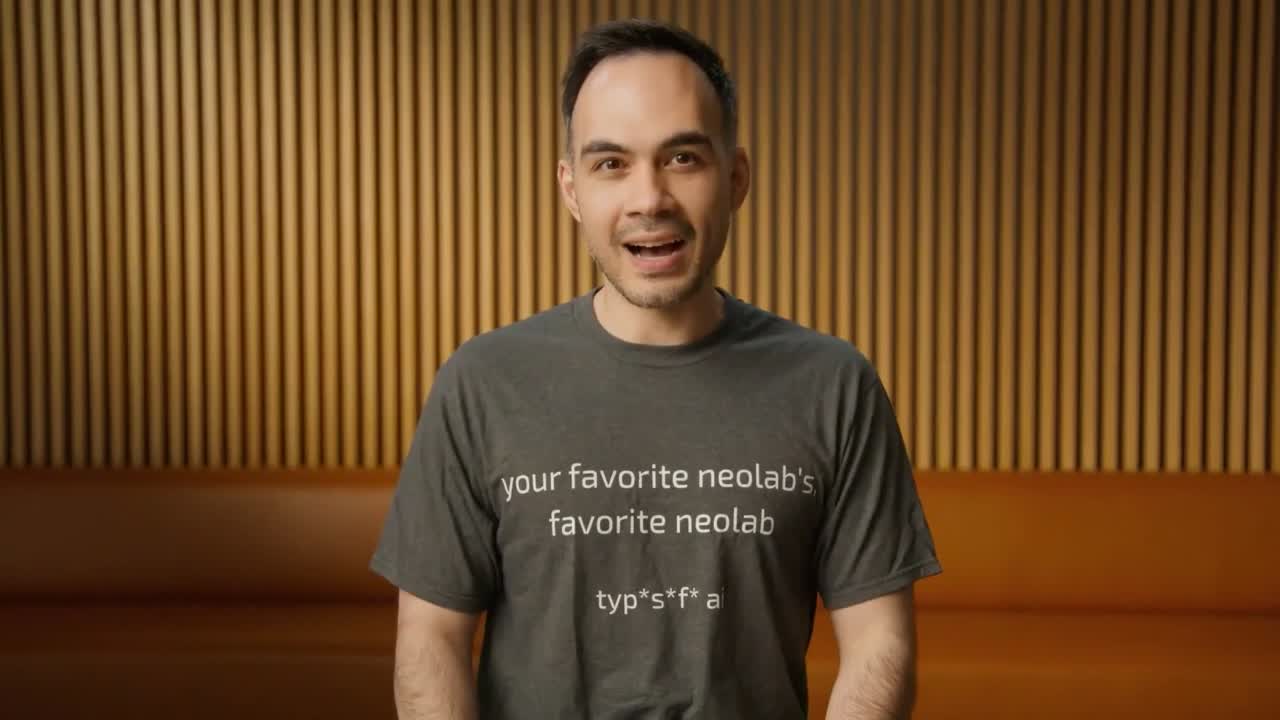
- This AI model promises not to hallucinate. I just tested it. Results are wildly encouraging: What Jev promises: - Jev is a new model from TypeSafe that acts as a classifier - Jev doesn't hallucinate, because it only picks from your list. - Jev tells you how sure it is on every answer. - Jev answers in under a second. - Jev costs a fraction of a cent per answer. So we tested it across 460+ rule-based tasks against Claude Sonnet & Haiku and told the models to only answer when they are confident they can do so. Results: Accuracy: -
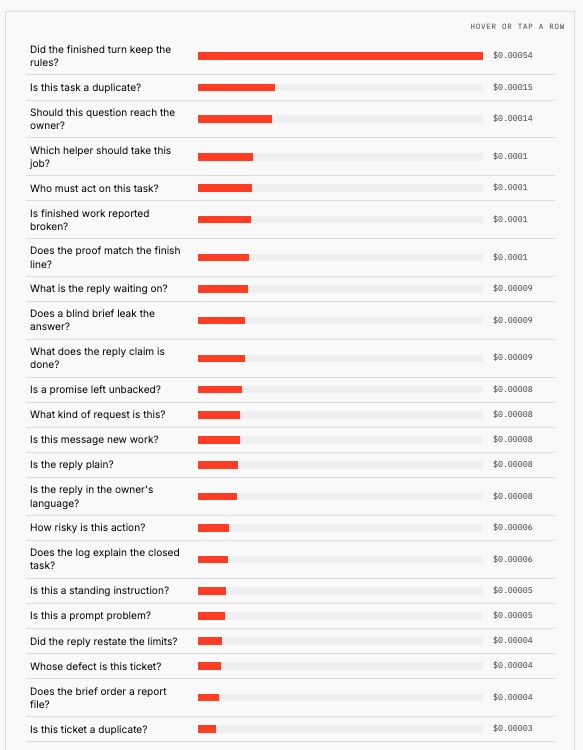
- BREAKING: ChatGPT co-inventor launched a NEW AI model that DOESN'T HALLUCINATE. I just got access and tested it so you don't have to. Results below: What Jev promises: - Jev is a new model from TypeSafe that acts as a classifier - Jev doesn't hallucinate, because it only picks from your list. - Jev tells you how sure it is on every answer. - Jev answers in under a second. - Jev costs a fraction of a cent per answer. So we tested it across 460+ rule-based tasks against Claude Sonnet & Haiku and told the models to only answer
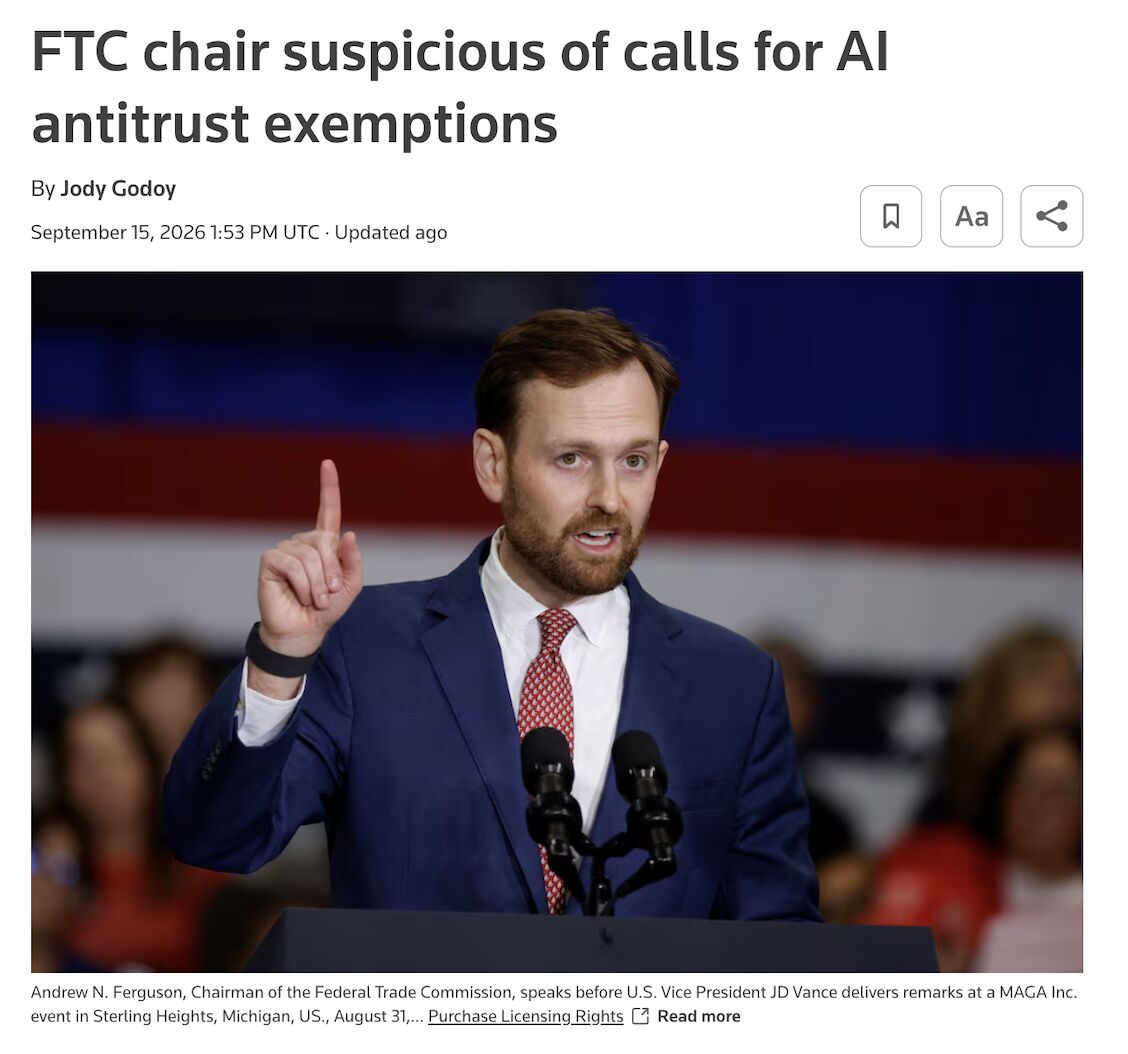
- FTC Chairman says EVERYONE should be deeply suspicious about AI companies seeking anti-trust exemptions. Anthropic's anti-trust waiver explained: (and why it's concerning) Dario Amodei published an essay last week called "We Must Pace the Frontier." The essay asks for three things: - Third-party evaluators placed inside each lab, with employee-level access. - Frontier labs in democratic nations coordinating on safety standards and how fast AI capability is allowed to grow. - The US government mediating those talks and issuing "a
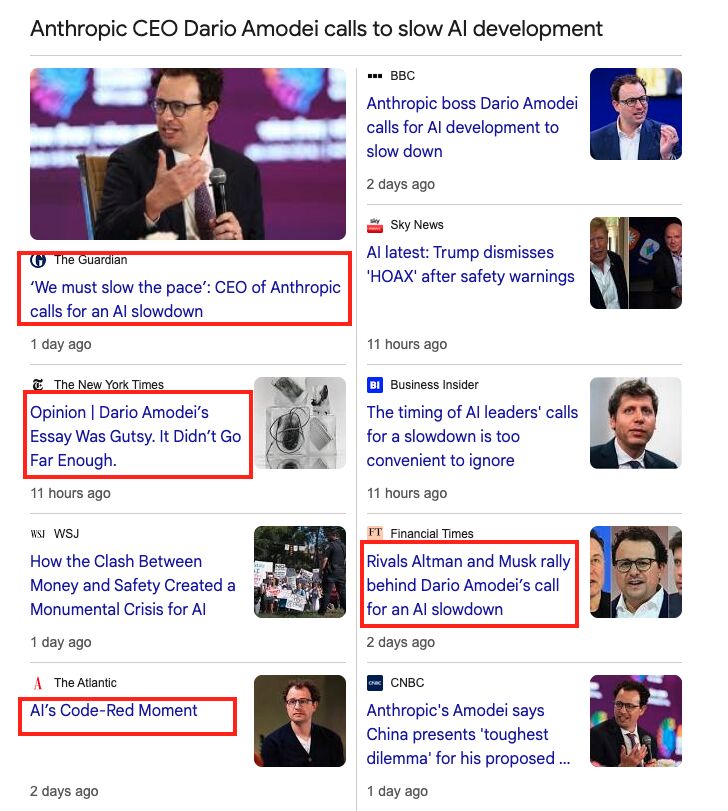
- Dario Amodei (Anthropic), Sam Altman (OpenAI) and Elon Musk ALL want to 'slow down' AI whilst being the leaders. This is regulatory capture. Timeline fully explained: July 28: - About 1,200 staff across six labs, including OpenAI, Anthropic, Google DeepMind and Meta, signed a statement called "Pacing the Frontier." - The logic is that no single lab can slow down alone without losing ground, so the US government should help them pace together. September: - Dario Amodei published an essay called "We Must Pace the Frontier,"
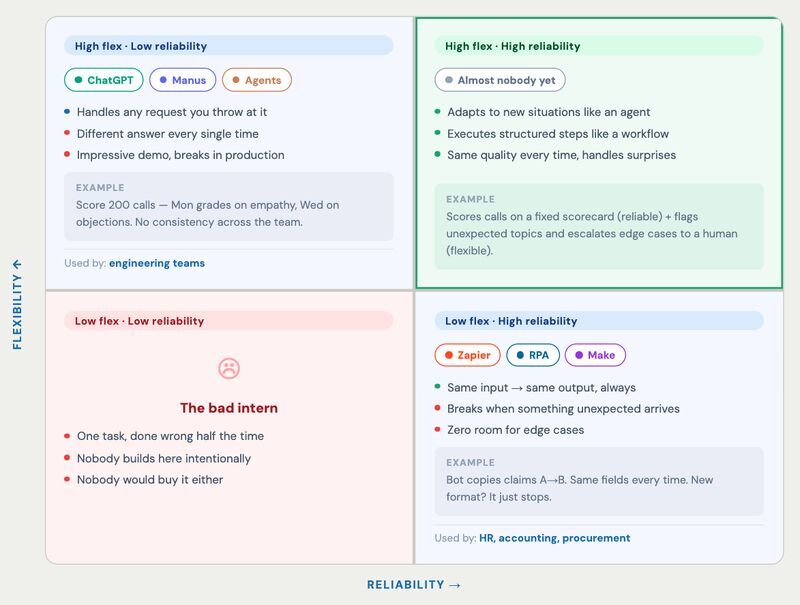
- Easy way to choose the right AI: With 1 chart: Every AI tool sits somewhere on this grid. Flexibility → How many different tasks can it handle Reliability → Does it give the same quality output every single time. 1. High flexibility, low reliability → ChatGPT agents, Manus, most agentic tools. → Can handle any request you throw at them → Different answer every time you ask → Impressive in a demo, breaks in production → Engineering teams operate here (they accept the variability) → Example: you ask it to score 200 sales calls.
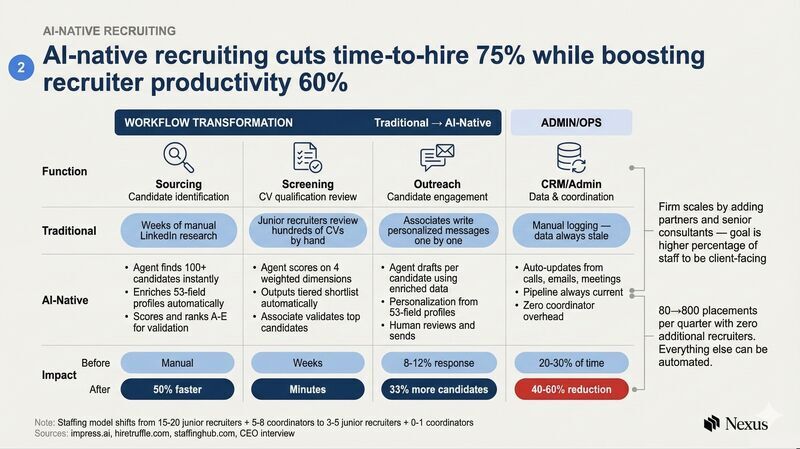
- I just spoke to a $300M recruitment firm CEO. Shared how to use AI to scale from 80 to 800 placements per quarter with ZERO additional recruiters. BEFORE (traditional, 50 people) → 5-6 partners → 10-12 senior consultants → 15-20 junior recruiters → 5-8 coordinators → 80-120 active roles per quarter AFTER (AI-native, 50 people) → 12-15 partners → 18-22 senior consultants → 3-5 junior recruiters → 0-1 coordinators → 800-1,200 active roles per quarter That 10x's their billable hours. Sourcing → Before: Weeks of manual LinkedIn
- Built an AI that answers calls and upsells better than humans Absolutely wild: - It's an inbound voice agent - It picks up the phone, looks at your plan, and upsells to a better one Three things it does that a person can't. 1. Tells you it's a bot → It opens with "this is an automated call, I won't take much of your time." → People tend to relax and drop their sales guard 2. Reads your invoice → "I can see from your bill you're overpaying, this plan brings it down." → Pulled straight from the billing system and completely helpful 3.
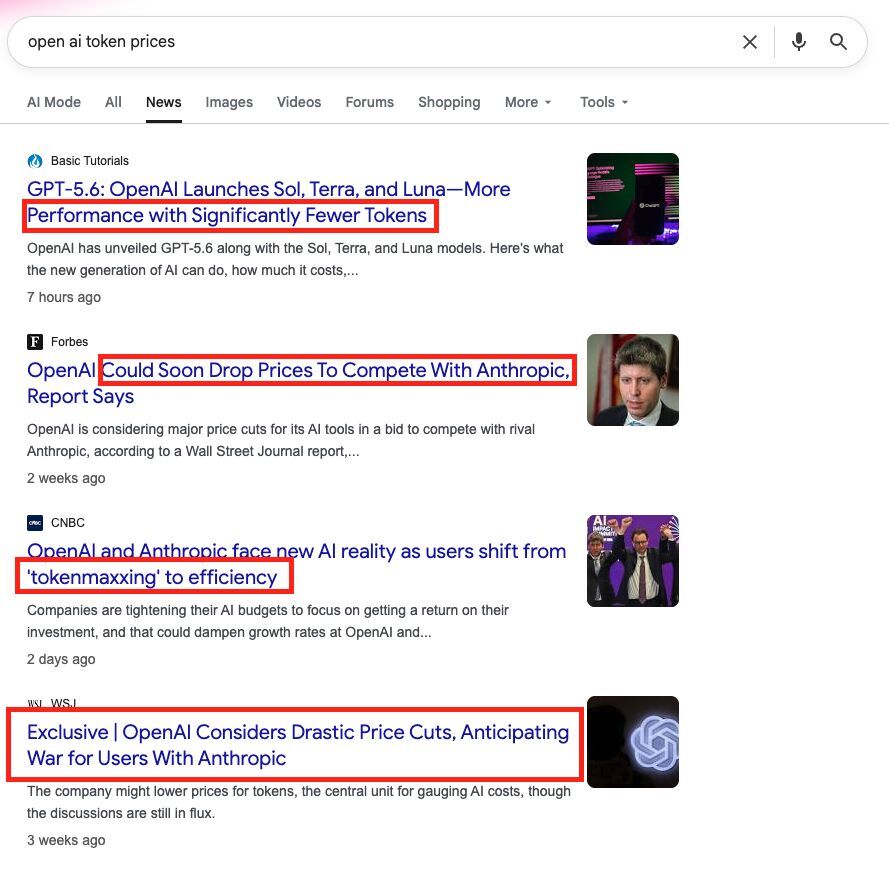
- AI will NOT get expensive. OpenAI may cut token prices. → OpenAI is weighing drastic cuts to what it charges for tokens. → Claude Code took Anthropic from $9B to $47B in annual run rate in five months → OpenAI is moving to defend its enterprise accounts. → Sam Altman framed it as helping people "get more value for less spend." → Both labs filed to IPO this month. Neither turns a profit. So they fight on price. But... everyone's still fearful token prices will eventually explode after the VC funding ends. Not True. Two prices are at
Related profiles
This page shows public professional information only, each fact cited. Is this you? send a correction, or ask for removal within 24 hours, no questions asked.