Overview
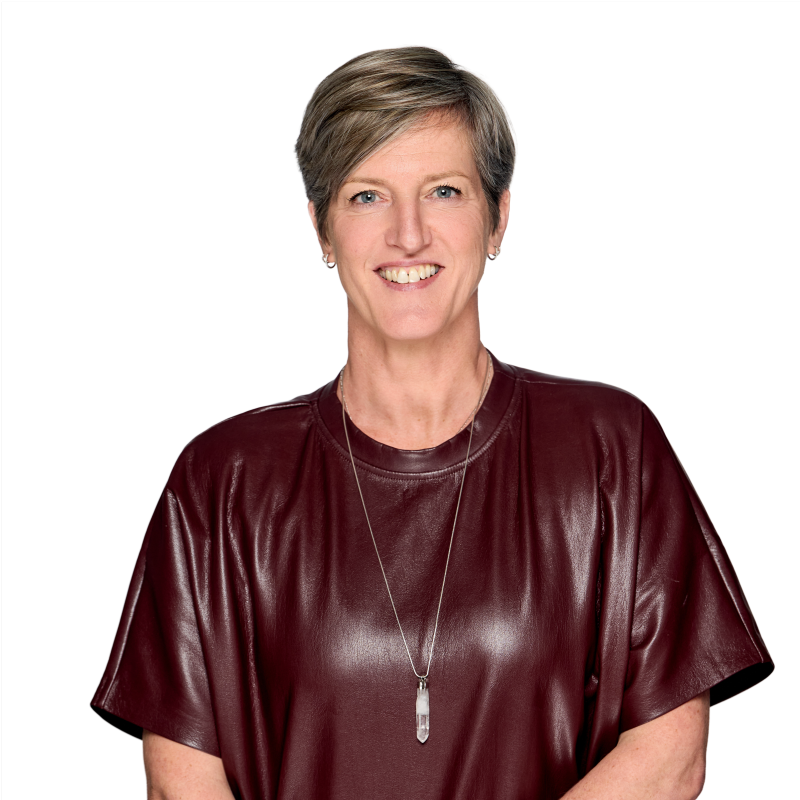
Beatrice de Mahieu was appointed Deputy CEO and Vice-President of the Board at finance&invest.brussels effective February 2026. She began her career in 1999 working for major telecommunications and technology companies including Telenet, Microsoft, and Lagardere. From 2011, she worked as a mentor and investor for technology and social impact startups. Between 2018 and September 2025 she was successively CEO of Co.Station Belgium (coworking and innovation hub) and CEO of BeCode, the social impact coding and reskilling organisation. She also sits on the board of Proximus and serves on the advisory board of Veolia Belux.
Career history
- Telenet, Microsoft, Lagardere1999 onwardsstrategy and Digital Transformation
- Mentor and investor for tech and social impact startups2011
- CEO2018-2021Co.Station Belgium
- CEO2021-2025BeCode
- Deputy CEO2026 onwardsfinance&invest.brussels
- Board memberProximus, akkanto, Miles Ahead advisory board


Insights & ideas
The through-line
Almost everything de Mahieu says circles back to the same conviction: the value that matters most is the value nobody photographs. It is the four years of non-dilutive support and family money that precede the Series A everyone applauds [8]. It is the talent sitting outside the traditional education and employment system, waiting for someone to build an alternative path to it [13][15]. It is the judgment and empathy that survive when a machine can answer faster than you can [4]. She is consistently interested in the part of the story that gets edited out, and consistently sceptical of the version that gets celebrated.
The second, quieter through-line is a refusal to accept forced choices. She refuses to choose between a recomposed family of six children and entrepreneurship [2]. She holds an extroverted professional life alongside an introverted need for solitude and nature [14]. She insists that inherited identity is neither something to repeat nor something to rebel against, but "raw material" to be transformed [6]. Where others see a trade-off, her instinct is to look for the terms on which both things can be true at once.
On what the funding photo leaves out
Her sharpest argument about entrepreneurial finance is a rewind. A room, a Series A of several million, a photo, applause, a press campaign, and everyone treats it as the beginning of a story when in fact "C'est la dernière image" [8]. Wind it back and the chain appears: the seed round a few months earlier, where the risk has finally become legible and investors, finance&invest.brussels among others, co-invest; the pre-seed two years before that, with almost no revenue and a fragile proof of concept, the death valley where the first backers often have a familiar face, family and friends who "croient davantage dans la personne que dans les chiffres"; and, three years back, innovation support that is non-dilutive, takes no shares, demands no return, and buys nothing more than "le droit de chercher et de se tromper" years before the first euro of turnover [8]. The implication is that the visible moment is underwritten by a long stack of invisible ones, and that public and non-dilutive money is doing work at the stage where nothing looks investable yet.
She is equally direct about the structural friction facing founders. Brussels, she argues, "has a choice. Remain the city of regulation. Or become the capital of European ambition" [11]. EU-INC interests her less as a legal instrument than as a signal: "To founders: build here. To talent: stay here. To investors: wake up" [11]. She concedes a pan-European company structure "will not solve everything," but it removes one absurd barrier, "27 markets pretending to be one" [11]. Two consequences matter to her: "the next European champion should not have to leave Europe to become global," and investors "should not wait for founders to move to Delaware before taking them seriously" [11]. Policy papers are not where she expects this settled. "The future of Europe will not be written only in policy papers. It will be built by founders" [11]. Alongside the financing argument sits the operational one she keeps returning to: the gulf between corporates and startups, and the classic trap that catches the first-time founder [2].
On Brussels and the perception gap
Her position on the city is stated as a correction rather than a complaint. "Bruxelles n'a pas un problème de talents. Elle a un problème de perception" [12]. The entrepreneurship is already there, in tech, in horeca, in the neighbourhoods, small projects growing and larger ones alongside them [12]. That is also why the Walloon mobilisation resonates with her rather than provoking regional rivalry. Seven hundred people gathering in Wavre to launch WALLONS-Y!, an initiative of Pulse Foundation, AKT, L'Écho and Wallonie Entreprendre, struck her as an attempt to put entrepreneurial spirit back at the centre of a region's future by getting businesses, schools, researchers, civil society and public authorities talking to each other [9]. What she took from it was that "Wallonia, Brussels, Flanders - the fire is the same," and that "the only question worth asking is how we spread it to as many people as possible" [9]. Hence her improvised extension of the slogan: "Wallons-y. Bruxellons-y. Flandrons-y. Let's just go" [9].
On talent nobody is looking for
The inclusion work rests on a straightforward diagnosis of where the tech skills gap actually is: among people who have been disadvantaged by traditional education and employment systems, who can be recruited, trained and placed in tech roles inside companies [15]. She describes training programmes of four to seven months for vulnerable populations in the job market, with an annual dropout rate of 4%, a number that carries the argument on its own about whether these learners lack motivation [13]. The organisation has trained more than 4,200 people since 2017 across several cities, and works on both fronts at once, inclusion of new entrants and upskilling of people already employed [15].
The origin of this conviction is personal rather than sectoral. Her own daughter's learning differences taught her to recognise talents that standard systems do not score, and pushed her toward building alternative educational pathways [13]. That is of a piece with her move out of corporate and startup environments into impact work [13], and with a decade spent at Telenet and then Microsoft before she left it all at the birth of her third child, on the timing of which she is dryly self-aware [2].
On FOBO and what AI cannot take
Her contribution to the AI debate is deliberately off the usual axis. "AI isn't making us obsolete. We're making ourselves obsolete" [4]. What she names is not job loss and not productivity but FOBO, the Fear Of Becoming Obsolete [4][5]. The mechanism is psychological and self-inflicted: "The moment we start believing that faster automatically means better, we stop trusting our own thinking. We prompt before we reflect. We check with AI before we trust ourselves. We outsource uncertainty instead of learning from it" [4]. That, she says, is the real hidden cost of fast intellect [4].
The evidence she offers is domestic. Ten years of being six children's "Google, their therapist, their Wikipedia," and then an evening scrolling the family's ChatGPT history and finding all her old questions there, asked to a machine instead of to her [5]. The rebuttal arrived in the same register: a son calling from Barcelona just to hear her voice [5]. The conclusion she draws is that the things making us valuable were never speed of answer. "Our value lies in our judgment. In our empathy. In our shared history. In our courage to sit with uncertainty. In our ability to make meaning" [4]. She compresses it into a line worth keeping: "You cannot prompt wisdom. And we were never meant to be information delivery systems, even if we pretended to" [4].
On leadership that admits the strain
She talks about difficult career moments plainly, the ones where "you feel alone, a little lost, somewhat down, and desperately searching for direction," and says the game-changer for her has always been finding people who helped light the way, some passing through briefly and leaving a lasting mark, others staying [10]. Her account of what leadership costs is unsentimental: it "sometimes means walking on eggshells" and sometimes "walking barefoot over hot coals"; it means moving forward "with impostor syndrome as an unwanted passenger"; it means feeling you have to be flawless simply to be taken seriously [10]. Then come the choices nobody prepares you for, chief among them whether to pretend to be strong or dare to admit otherwise [10]. Her answer, stated as a career-long principle, is to stay authentic and to treat people with kindness and integrity, which she frames in practical terms as the way to sleep peacefully at night [14].
The same refusal to perform shows up in how she manages herself. The professional role demands extroversion; her need is for solitude and nature, and she restores herself outdoors, walking with her dog [14]. Her cooking follows the same logic, intuitive, driven by taste and smell rather than learned technique [14].
On family, roots and being a good ancestor
She is openly interested in inheritance as a question rather than a given. "How much of who we are is shaped by our parents?" she asks, describing a childhood spent "in a state of almost constant rebellion," shown well-marked paths and making it her mission to leave them [6]. But she rejects the binary that follows: we are not destined "either to repeat or to rebel" [6]. What parents pass on is "not a ready-made identity, complete with an instruction manual and guarantees," but raw material we can "digest," "knead, transform, and even transcend" [6]. Her formulation of the balance is that "our roots form the foundation of who we are, but they do not determine the span of our wings," and that parents are "just one chapter, essential of course, but not definitive" [6].
That private question scales up into the one she treats as the organising theme of a whole day of ideas: how to be good ancestors [1]. The programme she describes maps the territory she cares about, human dignity against the odds, the climate of 2049 experienced here and now, the intelligence of the living world, shareholding done differently and the company that includes, finance in service of another world, thirty years alongside the Kogis and another way of inhabiting the world, and music as a common horizon [1]. The thread she pulls out of it is a four-part verb list: "Réparer - Régénérer - Réinventer - Reconnecter," with blind spots revealed and certainties shaken [1].
On kindness observed in the field
Fifteen days in Sri Lanka with eight people, six children between 17 and 25, a van, a driver and a guide, produced the observation she keeps returning to: "I have never been in a kinder country" [3]. She is precise about why it counts. Living conditions are hard, tourists are an obvious source of income, and yet not once did she feel "taken for a ride, or sized up, or handled" [3]. Her tally is deliberately flat: "Rich people: kind. Broke people: kind. The man who owned less than my hand luggage: kind. Just kind" [3]. She spent the trip trying to work out where it came from, and something clicked walking into a Buddhist temple [3]. She calls it the best trip of her life, and notes she has had a few [3]. On the practicalities she is blunt: do not drive yourself, unless your idea of a holiday involves a bus, a tuk-tuk and a cow arriving at the same intersection from three different directions [3].
On knowing when to hand something on
The closing of Chill Living Wines, the wine shop she and Pierre opened in Tervuren six years earlier, is the clearest statement of her attitude to endings [7]. The idea was simple, "a place to meet, taste and discover authentic, living wines, and the people who make them," and it became a community of curious, generous, "slightly wine-obsessed humans" [7]. She is candid that a side business is not a light thing: running a small shop with a team "is a beautiful thing. It also asks a lot - more than you imagine before you're in it" [7]. What made the exit right was succession rather than exhaustion. Kathleen Van den Berghe MW, Master of Wine, owner of Château de Minière and Château de Suronde, wants to build a real wine experience in her own village, and de Mahieu's verdict is that "we couldn't have dreamed of better hands" [7]. The doors close with a smile [7].
Takeaways
- Read a funding announcement backwards: the Series A is "la dernière image," preceded by seed co-investment, a pre-seed death valley funded by people who believe in the person more than the numbers, and non-dilutive innovation support that buys only "le droit de chercher et de se tromper" [8].
- Treat EU-INC as a signal rather than paperwork. It will not solve everything, but it removes "27 markets pretending to be one," and no founder should have to reach Delaware before investors take them seriously [11].
- The city's constraint is narrative, not human capital: "Bruxelles n'a pas un problème de talents. Elle a un problème de perception" [12].
- A 4% annual dropout rate across four-to-seven-month programmes for people the labour market has written off is the strongest available argument that the talent was there all along [13]; over 4,200 people trained since 2017 across multiple cities [15].
- Guard against FOBO by noticing the reflex: "We prompt before we reflect. We check with AI before we trust ourselves. We outsource uncertainty instead of learning from it" [4].
- Value now sits in judgment, empathy, shared history, tolerance of uncertainty and meaning-making, because "you cannot prompt wisdom" [4].
- Leadership includes impostor syndrome "as an unwanted passenger" and the pressure to be flawless to be taken seriously; the useful response is honest conversation with people who have faced the same, plus authenticity and kindness as a working standard [10][14].
- Inheritance is material, not destiny: "our roots form the foundation of who we are, but they do not determine the span of our wings" [6].
- Hand a venture on while it is still healthy. A side shop "asks a lot - more than you imagine before you're in it," and the right successor makes closing a smiling decision [7].
Media & appearances
- MicrosoftbeluxYouTubeBEyond the Tech with Marijke | SEASON 2 EP. 2 | Béatrice De MahieuBeatrice de Mahieu, CEO of Bcode, discusses how her organization provides digital and technology skills training to vulnerable populations in the job market through programs ranging from 4 to 7 months in duration, with a notably low 4% annual dropout rate. She explains her career transition from corporate and startup environments to impact-focused work, and describes how her personal experience with her daughter's learning differences inspired her to recognize diverse talents and create alternative educational pathways.
- Cécile from Together Women RiseYouTubeComment Concilier Réussite ET Bienveillance avec Béatrice de MahieuBeatrice de Mahieu discusses how she balances her extroverted professional requirements with her introverted need for solitude and nature, finding restoration through spending time outdoors and walking with her dog. She also explains her creative approach to cooking and nutrition, which she describes as intuitive and based on taste and smell rather than learned technique, and she emphasizes the importance of remaining authentic throughout one's career while treating others with kindness and integrity as a way to sleep peacefully at night.
- co:lab by CrescoYouTubeClosing the Tech Skills Gap: Insights from BeCode CEO Béatrice de MahieuBeatrice de Mahieu discusses BeCode's mission to address the tech skills gap by recruiting and training people who have faced disadvantages in traditional education and employment systems, then placing them in tech roles within companies. She emphasizes BeCode's focus on both inclusion and upskilling existing employees, noting the organization has trained over 4,200 people since 2017 across multiple cities.
In the news
- Ça pourrait être pire. » C'est la phrase qui me met le plus hors de moi quand on parle de Bruxelles. Je l'entends partout. Dans les dîners, les conseils d'administration, les couloirs d'événements. Prononcée par des Bruxellois, avec un petit haussement d'épaules et un sourire d'excuse. Et à chaque fois, ça me hérisse. Ajoutez à ça le Bruxelles bashing ambiant - il paraît qu'ici on ne fait plus rien d'innovant, qu'il ne sert plus à rien de venir s'y installer - et vous obtenez le combo parfait. Deux manières de baisser les
- finance&invest.brussels has a new Supervisory Board. And we have the honor of welcoming Olivier Vanderijst as its new Chair, Juan Benjumea as Vice-Chair and eight amazing new members (see below). Now let's talk about the least sexy word on LinkedIn. Governance. Stay with me. It matters more than you think. Our job is to invest where others hesitate. When a bank says “too early” or “too risky,” we ask: “What would make this work?” Risk is part of what we do. But it’s calculated risk, because the money we invest comes with trust

- We tend to think mentoring is a one-way relationship. One has experience. The other comes to learn. One gives. The other receives. But the best mentoring relationships I’ve experienced don’t work that way. A mentor brings perspective, experience and lessons learned. A mentee brings fresh eyes, unexpected questions, new energy and sometimes challenges assumptions you didn’t even realize you had. And both bring something even more important: the courage to say “I don’t know.” That’s when mentoring becomes more than advice. It becomes

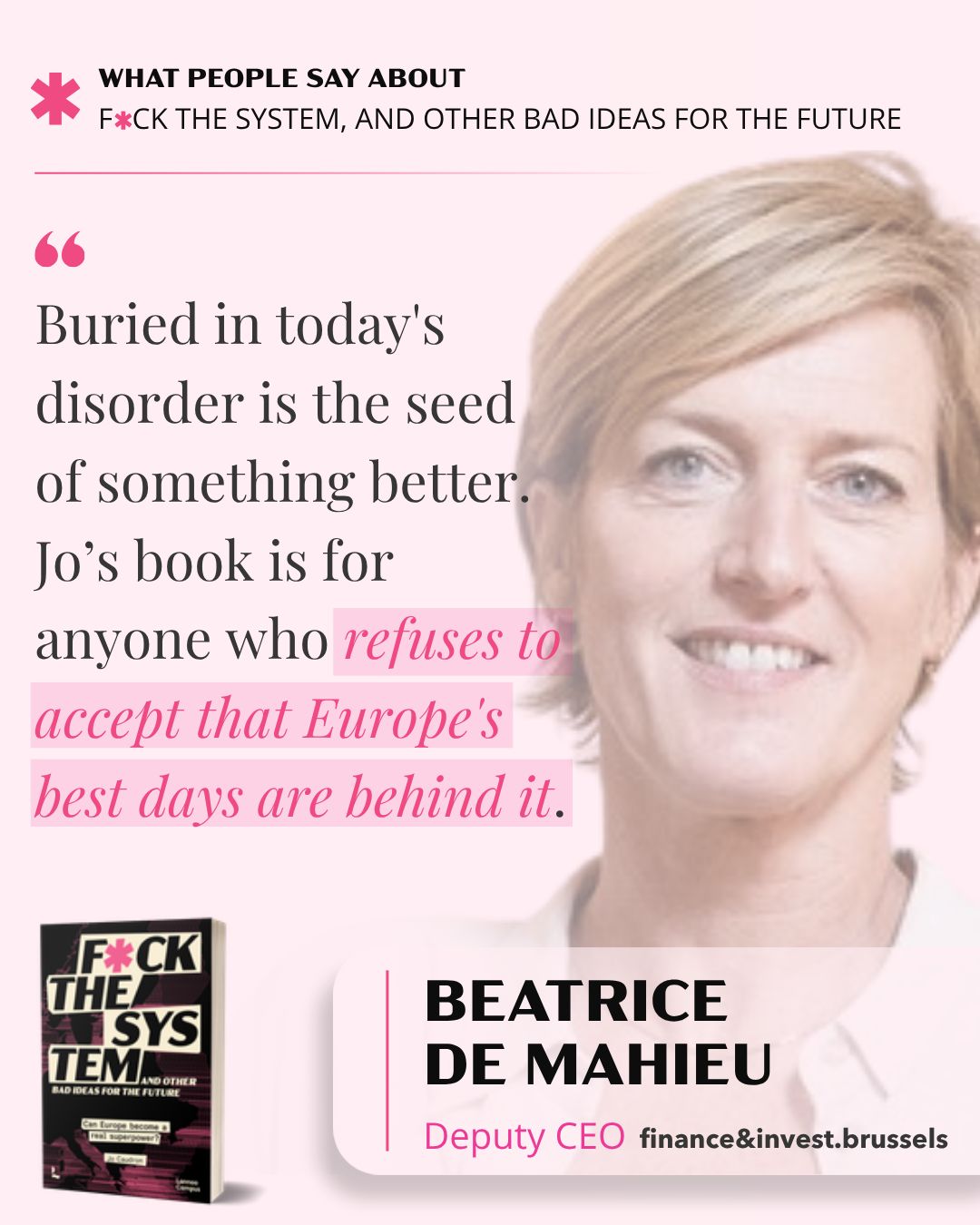
- Fuck the system, and other bad ideas for the future" by Jo Caudron is not a comfortable read. It's a call to stop asking permission and to build something better instead of quietly complying. If you’ve ever felt the system wasn’t quite built for you (and, as a self-proclaimed “rebel with a cause,” I certainly have 😉 ) this book tells you: you were right. Now do something about it. Read it. Then decide what you're going to change. 💪 Jo Caudron
- Beatrice de Mahieu is one of the people who decide which companies in Brussels get funded. She has built a startup hub, led BeCode, and spent fifteen years listening to people promise a future. Beatrice is a hard audience for a book about hope in Europe, so her reaction means a lot to me. Thank you Bea for these kind words 🙏 The book is now available in Dutch and in English. Check it out: https://lnkd.in/eNirUTnX
- Avant de fermer LinkedIn pour le week-end… j’ai un CDO à vous demander. 😉 Ou plutôt : un nom de CDO. Celui ou celle qui ne se contente pas de parler digital, data ou IA, mais qui transforme vraiment. Les process. Les expériences. Les équipes. L’organisation. Cette année, j’ai le plaisir de faire partie du jury des CDO of the Year Awards 2026 et j’ai envie de découvrir celles et ceux qui, derrière les buzzwords, font réellement la différence. 👉 Vous êtes CDO ? Osez candidater. 👉 Vous en connaissez un(e) remarquable ? Taguez-le/la

- For years, I was Google. I was Wikipedia. I was the doctor, the nutritionist, the therapist, and on good days the love coach. Six kids. Three mine, three my partner's. A house full of noise and criminal grocery bills. Mum, why do birds fly ? Mum, why is the moon following the car ? Mum, where does the sun go at night ? Mum, will I ever fall in love ? Every question came to me. Before bedtime, in the car, at the dinner table. I loved it. Then one evening I was cooking, and I opened our family ChatGPT account. The one we had set up

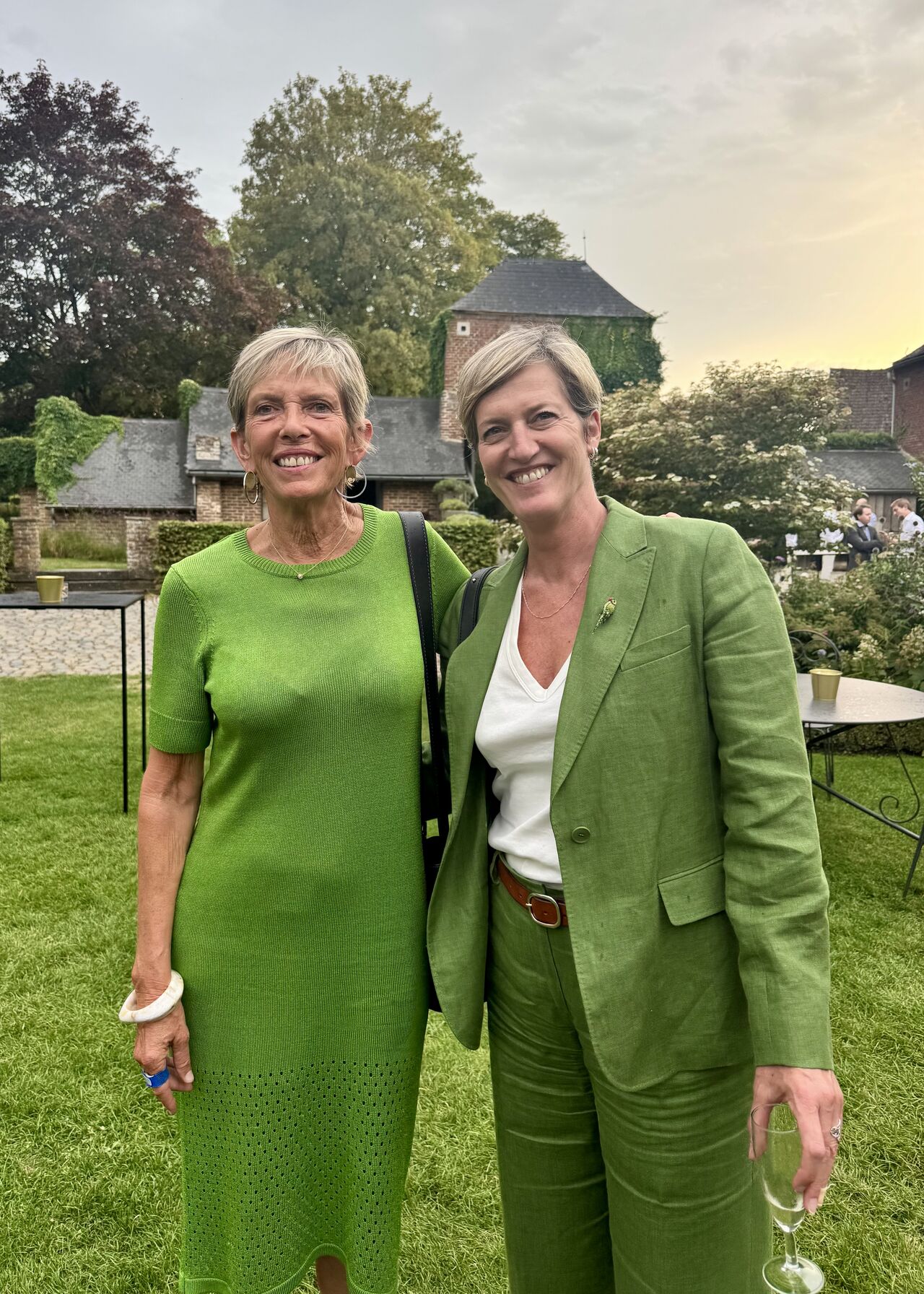
- Vert par conviction, pas par coïncidence. 😉 « Par-delà nos horizons »: Une journée entière. Profondval. L’Université d’été Trans-mutation. Et une question, en fil rouge, qui donne son sens à cette couleur : comment être de bons ancêtres ? Un thème porté par des orateurs et artistes d’exception: - Denis Mukwege. La dignité humaine, envers et contre tout. - Nathanaël Wallenhorst. Le climat de 2049, ici et maintenant. - Emmanuelle Pouydebat. L’intelligence du vivant, sous un autre jour. - Bénédicte Foucart. L’actionnariat autrement.
Related profiles


This page shows public professional information only, each fact cited. Is this you? send a correction, or ask for removal within 24 hours, no questions asked.