
Overview
Benjamin Joyeux is a co-founder of Unetix, a payments intelligence platform for online merchants. The founding team also includes Nick Dobson, who is chief executive and co-founder, and David van der Plicht, co-founder. Unetix unifies payment data from multiple providers, automates reconciliation, monitors performance and supports optimisation of payment operations. It works as a read-only intelligence layer and does not process or hold funds. The product is organised into modules named Summary, View, Monitor, Analyze, Compare, Metrics, Alerts, Optimize and Co-pilot, with Simulate and Customer listed as coming. Compare benchmarks a merchant against more than 500 merchants. Integrations cover providers including Stripe, Adyen, Checkout.com, Braintree, Klarna, PayPal, Global Payments, Paysafe, Shift4, Rapyd, Ecommpay and Payplug. Pricing is monthly and includes a free plan. Unetix operates as an unincorporated company under the laws of the Netherlands and is managed and represented by NJD Consult Limited, a company registered in England and Wales under number 13756624.
Career history

In the news
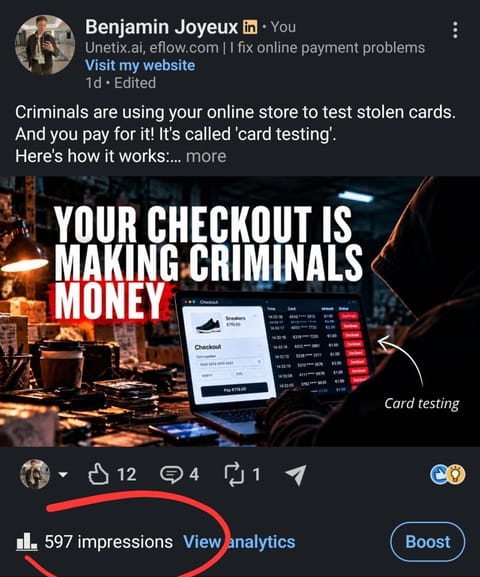
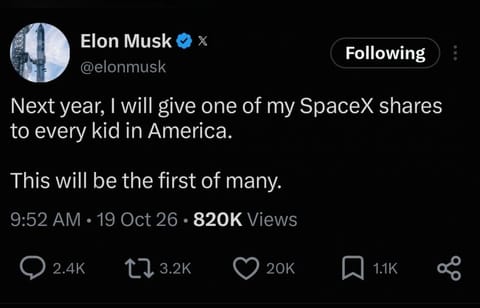
- I tried educational posts I tried funny posts Just talk about Elon Musk instead 😂 Yesterday, I posted 3 times on Linkedin. Here are the results: 1. Criminals testing stolen cards • 597 impressions • 60 minutes of work • Useful insights for online merchants 2. Complaining about my backlog • 58 impressions (!) • 10 minutes of work • Funny and relatable (at least I thought so) Pretty sure LinkedIn didnt appreciate the reference to Christ and blood. 3. Screenshot of Elon's post on X • 121.460 impressions • 1 minute of work • Nothing
- Me complaining about the backlog to the colleague who handled everything while I was on a business trip.

- 72 million * $146 per share = $10.5 billion Or a way for Elon Musk to get every kid in America interested in space exploration and investment (and to turn the new generation of flying car drivers into fans)!
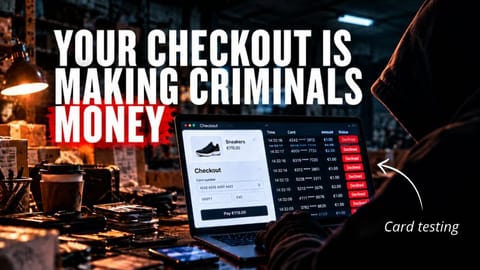
- Criminals are using your online store to test stolen cards. And you pay for it! It's called 'card testing'. Here's how it works: 1. Criminals obtain stolen credit card details There are several ways to do this. In 2018, hackers injected malicious code into British Airways' website and app. When customers entered their payment details to book flights, the hackers secretly captured the information. Around 380,000 transactions were affected. You might also be aware of the fake deliveries. You receive a text supposedly from UPS
- I've been in Payments for 12 years. And I still learned a lot from this podcast. New to the industry? Watch this 👇 Not in one shot though... This 3:36:25 podcast might scare you away! The Acquired episode about Visa is one of the best introductions to how our industry actually works. Dee Hock's story is my favorite: Hock was a relatively unknown banker. He was running the credit card program at a regional bank in Seattle. He came up with a crazy idea: convince Bank of America to surrender control of its fast-growing but

- You can now hire someone to scam online stores. It's called Refund-as-a-Service. And it's real! Here's how it works: 1. You buy a product online 2. You hire a professional refund scammer 3. They convince the merchant to refund 4. You keep the product and pay them a commission You can find these scammers on marketplaces, TG groups, or online forums. Some even operate like legitimate businesses, with customer reviews and 24/7 support. According to a recent investigation, they charge between 12% and 40% of the refund amount!

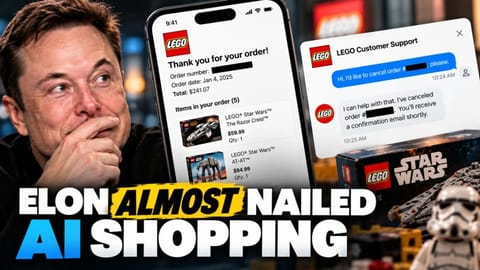
- Elon Musk showed us the future of AI shopping Then made a rookie mistake.. All this buzz over a $241 Lego order! Here's what happened: Elon asked Grok to find the most fun Lego Star Wars sets and order them. Grok did the research, picked 5 sets, placed the order using his Amex, and even offered to track the delivery. Elon proudly shared a screenshot of the order confirmation with his 242 million followers. Small problem: the screenshot included his shipping address, billing address, order number, and partial credit card details. The
- Shopify just paid $100M for Shop(.)com. Just as AI threatens to make websites obsolete. What do they know that we don't? The story of Shop(.)com goes back more than 2 decades. In 2003, the domain reportedly changed hands for $3.5 million. Fast forward 23 years, and Shopify has now acquired it for an alleged $100 million. That's a staggering 2,757% increase. If confirmed, it would break the publicly reported record for a domain sale, surpassing AI(.)com, which reportedly sold for $70 million earlier this year. The deal, however,

This page shows public professional information only, each fact cited. Is this you? send a correction, or ask for removal within 24 hours, no questions asked.