
Overview
In this Connexi podcast, Bert Marievoet walks through the three pivot points of his career: leaving the safety of De Persgroep in 2014 to open Twitter's Belgian office, starting his influencer marketing agency Native Nation in 2016 after being laid off when Twitter shut most European offices, and selling it to SBS in October 2019 — only for COVID to gut the activation-heavy revenue and for SBS's lack of ambition to push him out. He shares hard lessons on hiring for skills, hiring operational profiles to complement his visionary style, and making expectations 'crystal clear' when selling your company because contracts alone leave room for conflicting interpretations. Today he runs web3 fund Moonbag and is building One Of Us, a 'LinkedIn for web3 communities', having just closed a seed round in a very difficult funding climate. He closes with the mindset lesson that both your worst and your best days pass, referencing the 2021 bull market and subsequent crash.
Talks about
- Exits
- Branding
- Fundraising
- Pivoting
- Co-founder dynamics
- Creator Economy
- Product-market fit
- Mvp Minimum Viable Product
- Fake It Till You Make It
- Entrepreneurship
- M&A
Insights & ideas
The through-line
Every story Bert Marievoet tells circles back to the same instinct: he does not want to be a number inside a big machine, he wants to make something that did not exist before. He left a well-paid Twitter job precisely because being "a number among 4,000 people" in a golden cage felt unfulfilling, and he is explicit about the motive: "Ik wil eigenlijk niet blijven een groot bedrijf groter maken. Ik wil iets creëren, iets maken from scratch. Dat was echt de drang om te gaan ondernemen." [2] What he was drawn to was less the business than the atmosphere around it: "Was ik wel op een gegeven moment heel hard gecharmeerd en gebeten door die echte vibe van ondernemers, dat is zo electricity bijna als je daar rondloopt." [3]
The second through-line is temperamental rather than strategic. He has been rich on paper and has lost a great deal of money, and the lesson he draws is that neither state is permanent or as extreme as it feels in the moment. "In 2021 waren op papier allemaal miljonairs... twee jaar later is het ook van ja, ook de beste momenten gaan voorbij." [3] Around that sits a discipline he applies to himself: get the ego out, move fast when the evidence changes, and be suspicious of tidy narratives, including the borrowed leadership parallels people extract from a World Cup [1].
On leaving the slow tanker
He saw the platform shift before his employer did. At De Persgroep he warned leadership that Facebook and Google would eat into HLN's advertising revenue, and leadership laughed it off in the belief that brands would always need premium, brand-safe environments. That refusal to take the threat seriously was a key reason he left what he calls the slow tanker [3]. The corporate pattern repeated after the exit: SBS never had real ambitions for Native Nation post-acquisition, partly because Telenet oversight made the culture defensive, and he left after asking the obvious question of why they had acquired the agency at all [3].
On making your own job
The move that changed his trajectory was a single email. While he was being headhunted by Facebook and holding a contract offer, he cold-contacted Twitter's VP Europe and effectively created his own job opening Twitter's Belgian office [2][3]. His own verdict on it is flat and unromantic: "Dat is een gewegd mailtje dat heel veel in beweging heeft gezet." [2] The contrast he draws with what came after is about accountability rather than talent. "Bij Twitter kun je veel permitteren, dat mislukken en niet verkopen en die targets niet halen... die echte eindverantwoordelijkheid, dat kun je niet vergelijken met ondernemen binnen een veilig kader." [3]
On selling ambition before you can deliver it
Native Nation scaled to €3M recurring revenue by consistently taking on more work than it could handle: selling ambitious campaign ideas first and working out execution afterwards, a controlled version of fake it till you make it [2]. He describes the rhythm with real affection: "Toffe campagnes bedenken, die verkopen en dan eigenlijk naar elkaar intern zeggen: hoe gaan we deze doen? Was elke keer gelukt." [2] The cost of that pace shows up elsewhere in his account of the same period: "Ik heb echt kapot gewerkt, echt kapot gewerkt. Die eerste 6 maanden denk ik sliep ik 3 uur per nacht." [3]
On hiring and giving away shares
The recruiting mistakes came from trusting his own network and past titles rather than demonstrated skill. Hiring people on the basis of what they had done in classic media produced bad hires and high rotation, and his correction is blunt: in an early-stage startup you hire for actual skills [3]. He also learned to bring in an operational counterpart early, someone obsessed with timesheets and structure, because as a visionary business developer he had neither the passion nor the skills for operations [3]. On equity he is deliberately open-handed, both as a way to attract people before there is salary to pay them and as a matter of principle: "Ik ben altijd al van het principe geweest dat je samen met goede mensen iets heel groot kunt maken als je daar niet gierig in zij in aandelen" [2], the reasoning being "liever een kleiner stuk van een grote taart" [2].
On exits, earnouts and expectations
The exit itself carries two hard lessons. The first is structural: selling 100% of the shares while receiving only 70% of the cash meant COVID wiped out the remaining 30% earnout, once Native Nation's activation-driven revenue fell 70-80% [2]. The second is human. Even with lawyers on both sides, interpretation disputes surfaced six months later, which is why he insists on taking emotion out of the negotiation and on going beyond the contract: "Verwachtingen staan niet in een juridisch document. Dat ge de verwachtingen crystal clear kunt maken." [3]
On raising money after a successful exit
A successful agency exit buys no free tickets when you raise for a tech startup. Investors questioned who would build and lead the product, since he had earned no track record in apps, and the seed round was much harder for it [3]. His reading of early-stage investing is that it is a bet on people: investors back the team rather than the product, because a strong team can pivot when market conditions change, and a solo founder can barely raise money at all [2].
On founder-product fit and pivoting without ego
He puts a stage before the one everybody talks about: "Je hebt zoiets als een founder product fit ook. Nog voordat je product market fit hebt, de stap daarvoor is eigenlijk de founder product fit." [2] The lesson was expensive. His first two Beam co-founders quit a week after the Web Summit launch because they no longer felt the product, which forced a restart [2]. Pivoting well then demands two things, in his formulation: "Er is geen plaats voor ego en twee: snel durven schakelen." [2] The customer is ten times more important than your own opinion, and the real risk is muddling along for years until the window closes rather than switching fast [2].
On monetizing knowledge and the awkwardness of charging
Beam is pitched in one line: "Als ik 15 seconden heb zeg ik altijd: het is een OnlyFans voor slimme mensen." [2] The market opening, as he reads it, is that platforms become victims of their own success. Once LinkedIn passed a billion users its signal-to-noise ratio collapsed, which is the gap Beam aims at as an algorithm-free, follower-first knowledge platform where experts monetize through paid calls, webinars and PDFs at a 15% platform fee [2]. The deeper problem it solves is cultural rather than technical: a booking link with a price attached removes the uncomfortable "transfer me €200 first" conversation, and he found that taboo around charging for your time is as strong in the US as in Belgium [2]. The same US-first logic drove One Of Us, which deliberately ignored Belgium because 70-80% of the potential audience sits in the US [3]. For any new social or networking product the binding constraint is the cold start problem: attention is finite, so you need an outstanding reason for someone to spend time on yet another app [3].
On losing money and learning faster
"Ik heb fantastisch veel geld verloren." [2] Wagmi Beer is the clean case study: US state-by-state alcohol licensing blocked exports, while competitors were shipping beer labeled as something else, and the takeaway is to research regulatory constraints before launching rather than after [2]. He does not claim that repetition makes entrepreneurship easier. What it changes is metabolism: you learn faster from mistakes, waste less money, and mainly get quicker at detecting what is blocking your progress [2].
On surviving the cycle
Twice-daily 20-minute transcendental meditation was his survival mechanism through the chaotic solo-founder phase, on the claim that 20 minutes recuperates as much as hours of sleep [2]. He also resists outsourcing his thinking: "In plaats van ChatGPT te consulteren, zet ik mij hier voor het raam en ik kijk naar buiten een half uur en ik probeer te voelen." [2] The perspective he keeps returning to is symmetrical and unsentimental: "Uw slechtste dagen gaan voorbij en uw beste... daar moet je gewoon van bewust zijn dat er ook terug slechte dagen komen. Het is een oneindig iets" [3], and "Niks is nooit zo erg dan dat je het inschat. En omgekeerde is niks vaak zo fantastisch als dat je het inschat." [2] The timing of it all is mostly outside anyone's control, as in the moment he was two days from handing in his resignation and his second son arrived three weeks early [3].
Takeaways
- Founder-product fit precedes product-market fit: two Beam co-founders quit a week after the Web Summit launch because they no longer felt the product, forcing a restart [2].
- Structure your exit around cash, not headline price: selling 100% of shares for 70% cash left a 30% earnout that COVID erased when activation revenue dropped 70-80% [2].
- Contracts do not capture expectations. Get emotion out of the negotiation and make expectations crystal clear, because interpretation disputes surfaced six months after the sale despite lawyers on both sides [3].
- Hire for demonstrated skills rather than past titles, and bring in an operational counterpart early if you are a business developer with no appetite for structure [3].
- Be generous with equity: it is how you recruit strong people before you can pay them, on the principle of a smaller slice of a much bigger pie [2].
- A successful agency exit gives no free tickets with tech investors, who will ask who is going to build and lead a product you have no track record in [3].
- Check regulatory constraints before you launch: Wagmi Beer died on US state-by-state alcohol licensing that blocked exports [2].
- Pivot fast and without ego, treating the customer's view as ten times more important than your own, rather than muddling on until the window closes [2].
In the news
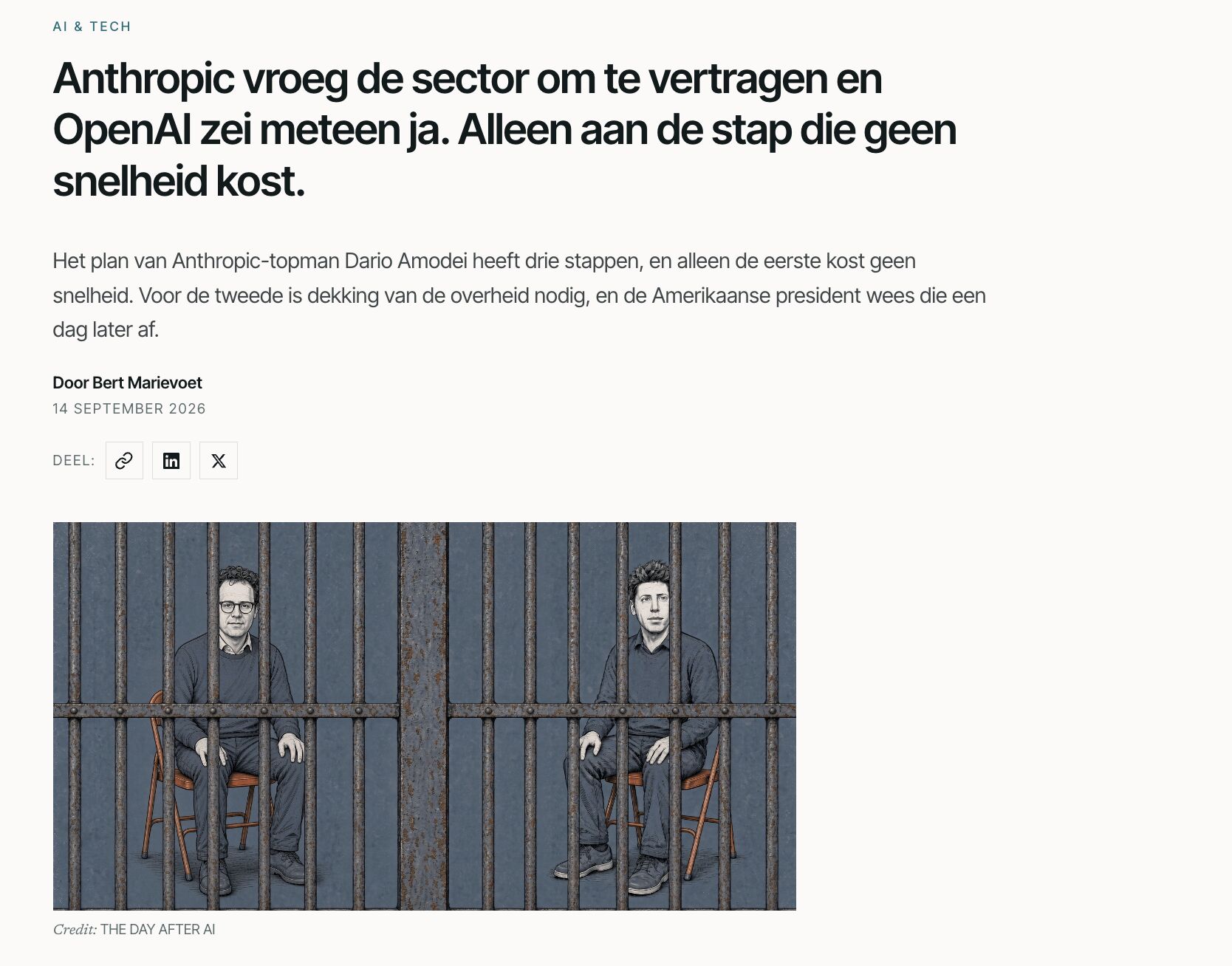
- Dario Amodei legde afgelopen zaterdag een plan van drie stappen op tafel om het tempo van AI-ontwikkeling te verlagen. Binnen een dag zeiden Sam Altman en Elon Musk ja, en allebei op stap één. De krantenkoppen maakten er een sectorbreed akkoord over vertragen van. Ze hebben toezicht toegezegd, en dat is iets anders. Stap één laat externe evaluatoren permanent binnen, en Anthropic bindt zich daar eenzijdig aan. Altman schreef op X dat OpenAI hetzelfde zal doen. Musk hield het op drie woorden: Dario is right. Stap twee, waar de
- Randomly came across a compilation of Johnny Depp interviews with David Letterman this weekend on Twitter. In one of them, they are talking about Transcendence, a movie about an artificial intelligence growing out of control of its human creators(haven't seen it, any good?). The movie came out in 2014. This same weekend, headlines around the world are reporting that two of the leading AI companies are considering slowing down their own models out of concern of AI getting out of control. It was only a bit over 10 years ago when we
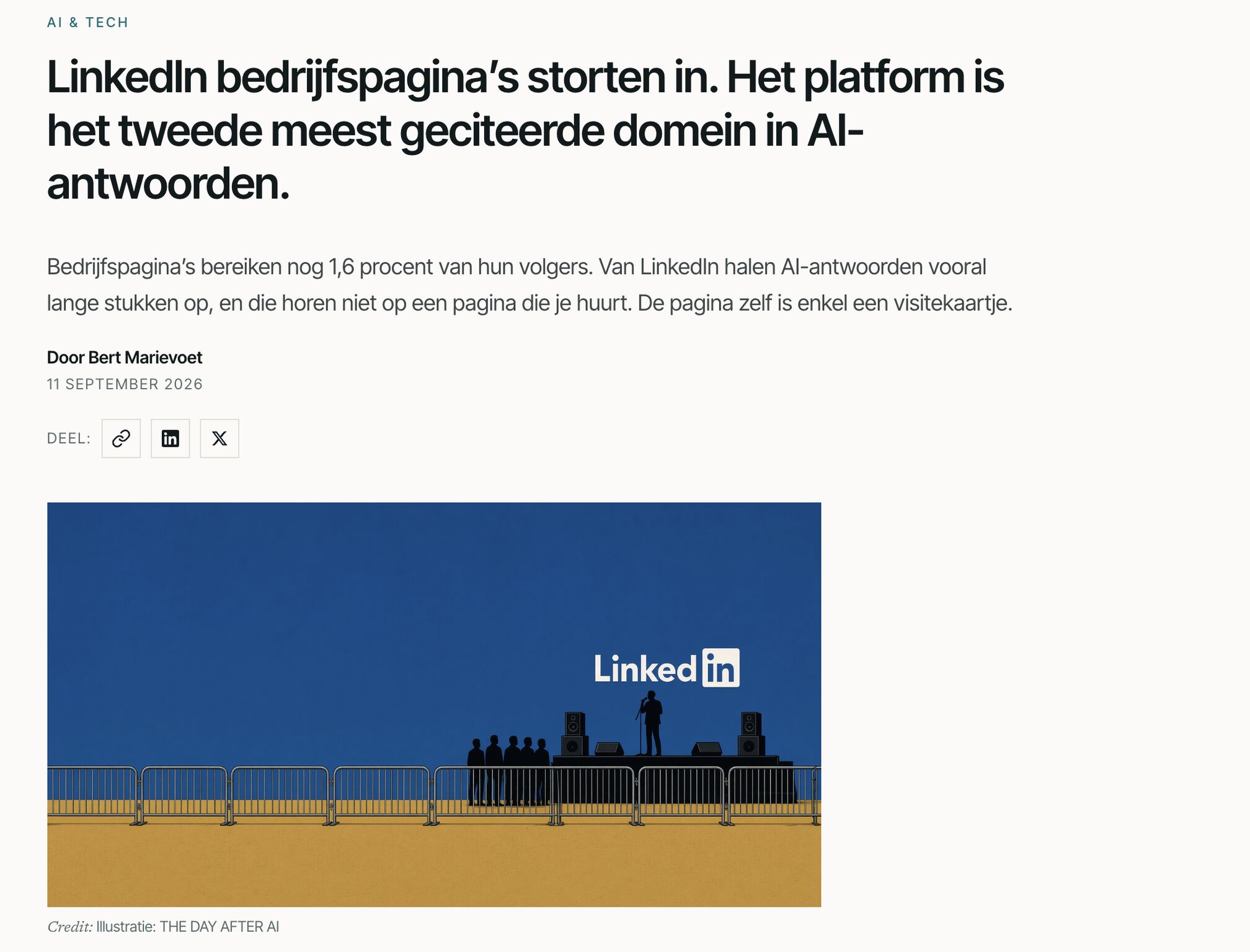
- Semrush legde 325.000 prompts voor aan ChatGPT, Google AI Mode en Perplexity en vond LinkedIn na Wikipedia als meest geciteerde domein van het internet. Een LinkedIn-bedrijfspagina bereikt intussen 1,6 procent van haar eigen volgers. De berichtgeving las dat eerste cijfer als goed nieuws voor wie op LinkedIn publiceert. Het rapport zelf zegt iets anders zodra je vraagt wie er dan geciteerd wordt. Vijf jaar geleden haalde zo'n bedrijfspagina nog 7 procent. Socialinsider zag de engagement rate van die pagina's dit jaar stijgen, maar
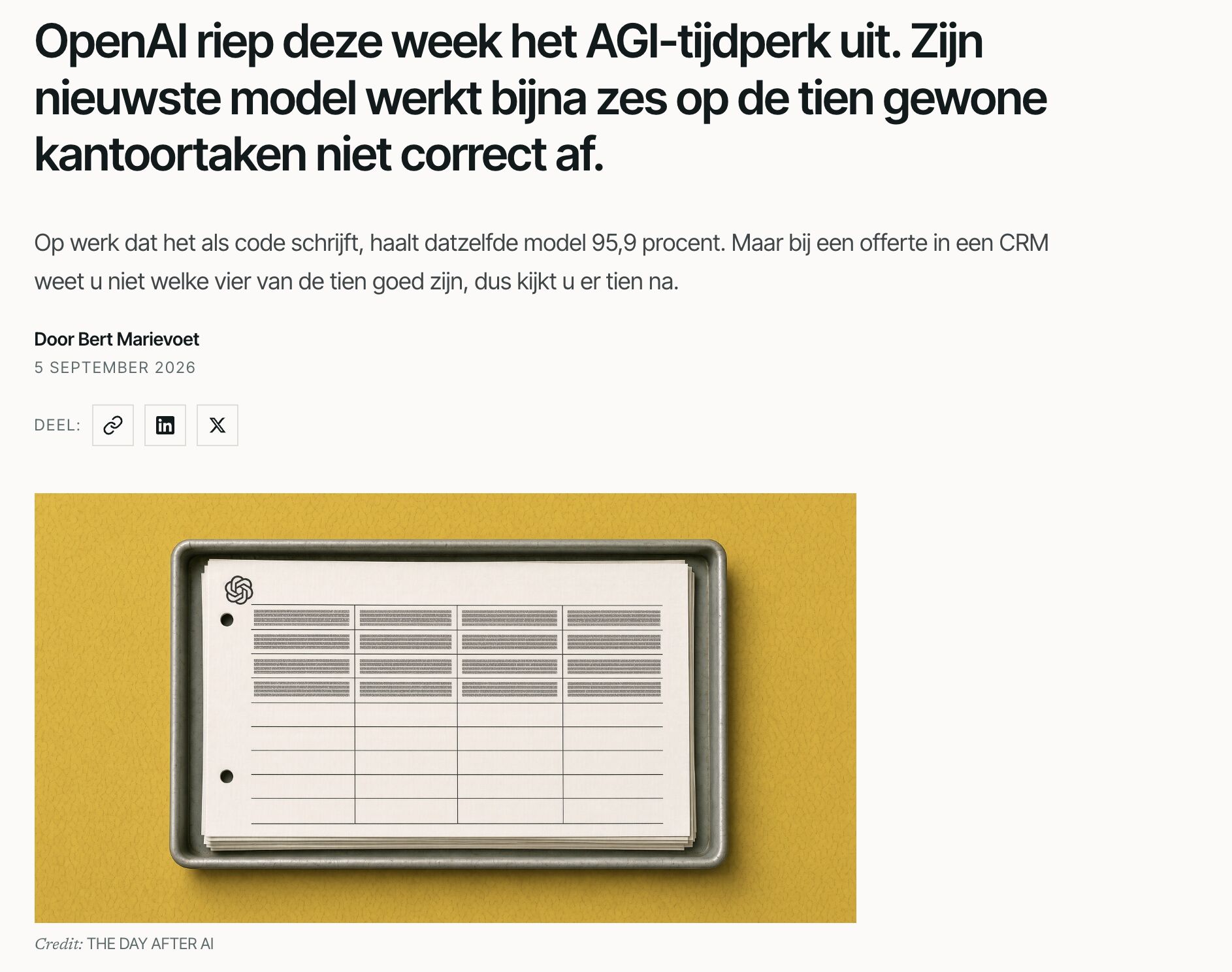
- Greg Brockman, president van OpenAI, sloot de lancering van GPT-6 Astra op 3 september af met "welcome to the AGI era". Op diezelfde lanceringspagina staat dat het model vier van de tien gewone kantoortaken correct afwerkt. De kranten schreven over het aanbreken van het AGI-tijdperk, ook De Tijd. AGI staat voor artificial general intelligence, wanneer een systeem ontstaat dat zowat elke taak aankan die een mens op kantoor doet. Het interessante is dat OpenAI het tegencijfer zelf publiceerde. Het automatiseringsbedrijf Zapier
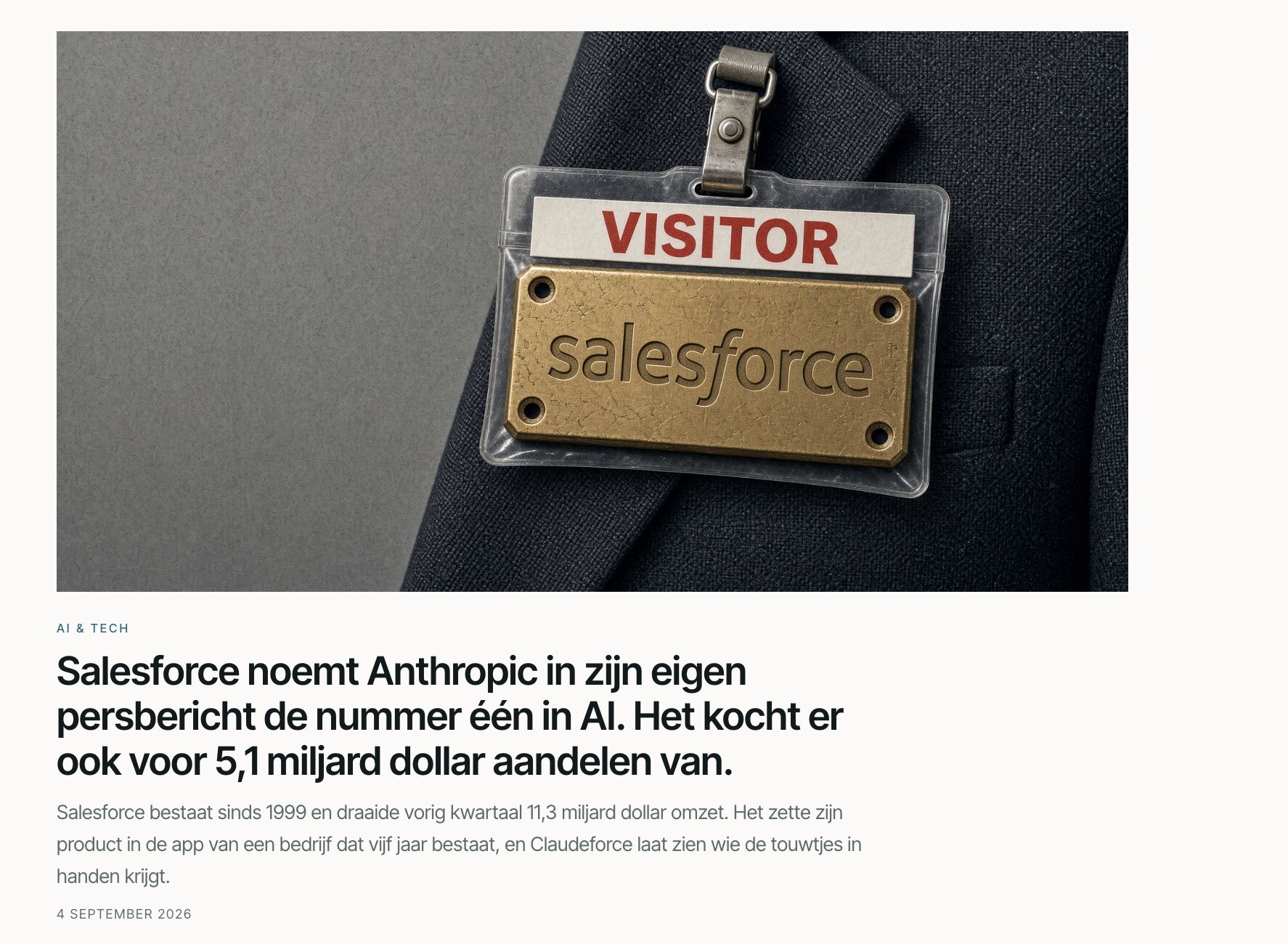
- Salesforce zette op 26 augustus zijn CRM in de app van Anthropic. Het bezit er ook voor 5,1 miljard dollar aan aandelen van, bijna de helft van zijn volledige strategische portefeuille. De berichtgeving las dat als een partnerschap tussen twee sterke spelers. Het interessante zit in wie zich naar wie toe bewoog. Anthropic bestaat vijf jaar en bouwt geen CRM, geen ERP en geen boekhoudpakket. Salesforce bestaat sinds 1999. De titel van hun gezamenlijke persbericht luidt "The #1 AI Meets the #1 AI CRM", en de nummer één in AI is daarin
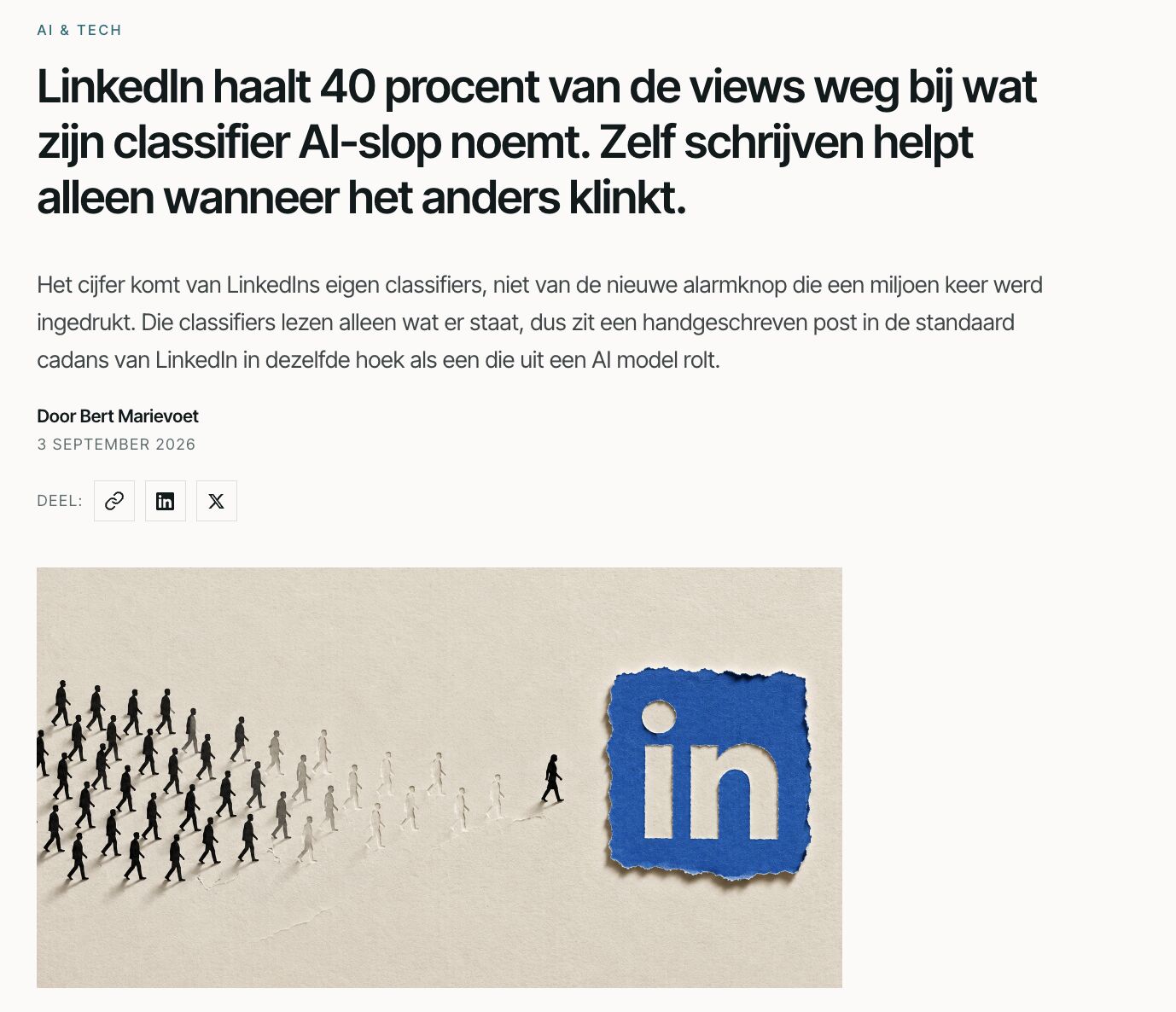
- LinkedIn zag drie weken na de lancering 40 procent minder views op wat het als AI-slop classificeert. Dat cijfer komt van hun eigen classifiers en niet van de alarmknop die maar liefst een miljoen keer werd ingedrukt. Dat wist niemand tot Moneywise het aan een woordvoerder ging vragen. Zowat alles wat ik las, zag de move van LinkedIn als een bestraffing voor wie teksten uit een model plakt. Maar de classifier weet niet waar je tekst vandaan komt. Pangram Labs scande tussen april en juni ruim een miljoen posts en kwam voor
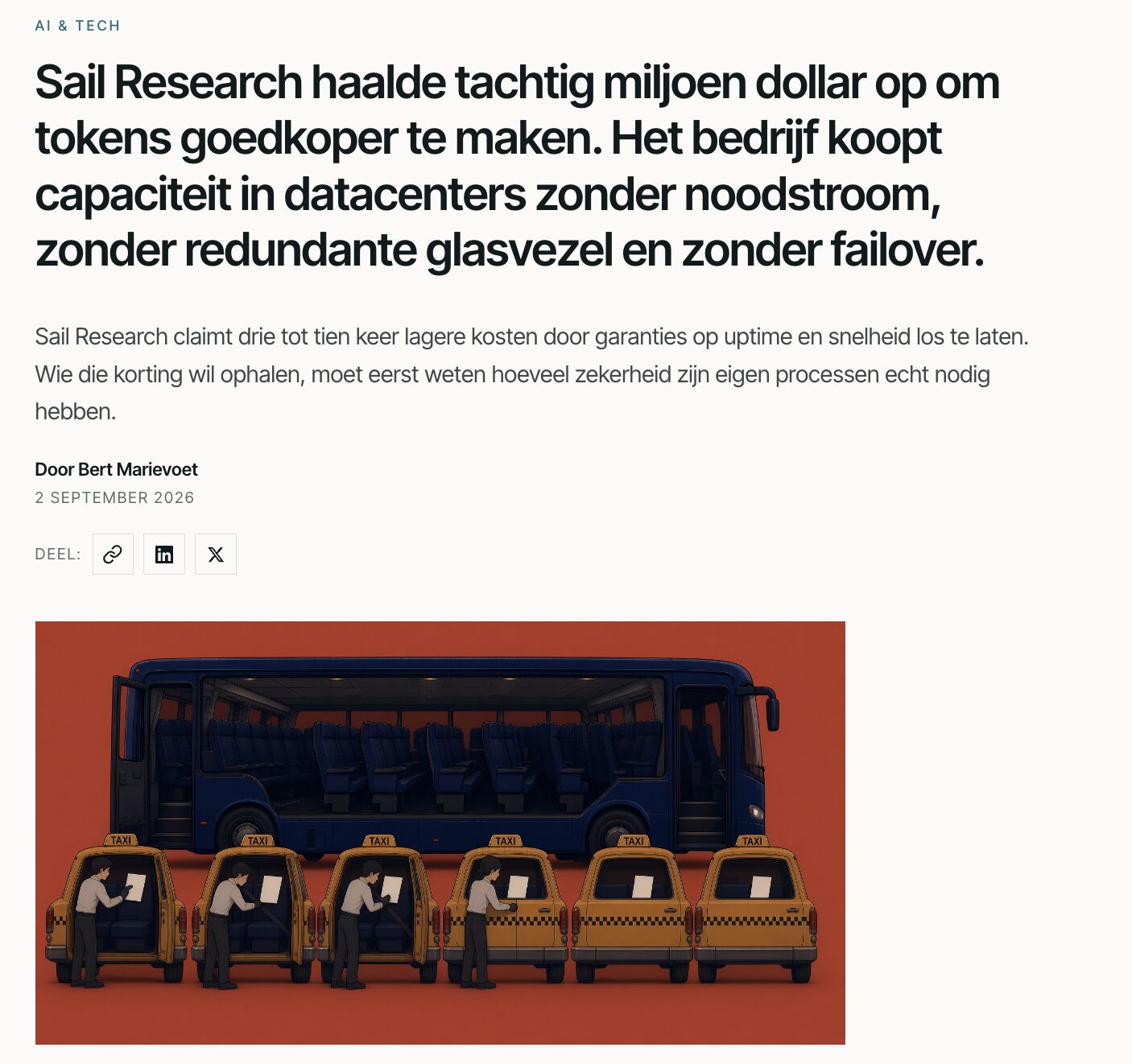
- Sail Research haalde in juni tachtig miljoen dollar op om tokens goedkoper te maken. Oprichter Neil Movva zegt daarvoor zelfs datacenters te willen gebruiken die richting 95 procent uptime mogen zakken. Het interessante zit in wat er uit het contract verdwijnt. Kleiner Perkins en Sequoia stapten in op een waardering van 450 miljoen dollar. Klanten melden aan Fortune drie tot tien keer lagere kosten. Anthropic rekent vandaag al de helft van de gewone prijs voor zijn Message Batches API, met dezelfde modellen. De korting komt uit
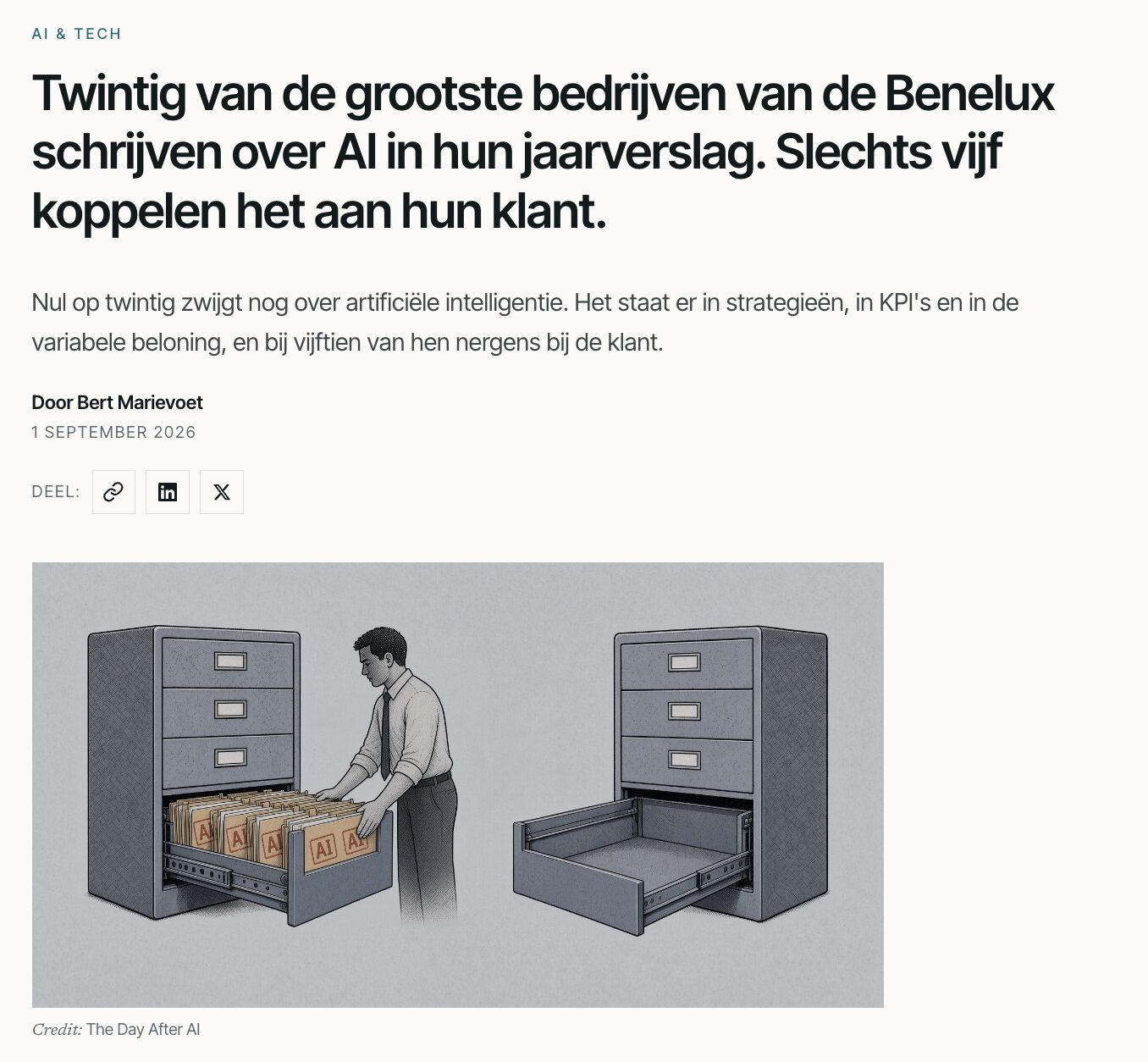
- Deze zomer lag zowat iedereen uit mijn netwerk op een ligstoel (ok, of zat op een fiets of stapte door de bergen). Ik heb amper vakantie genomen, want drie weken wegblijven voelde dit jaar duur. Wat ik wel heb gedaan is veel tijd doorgebracht rond BBQ's en naast padelterreinen. Het viel mij op hoeveel vrienden en kennissen van mijn leeftijd nogal bewust de ogen sluiten voor al het AI-nieuws. Uit angst, maar ook omdat het vaak gewoon niet duidelijk is of het hen persoonlijk of professioneel gaat raken. Ook uit mijn gesprekken voor
Related profiles


This page shows public professional information only, each fact cited. Is this you? send a correction, or ask for removal within 24 hours, no questions asked.