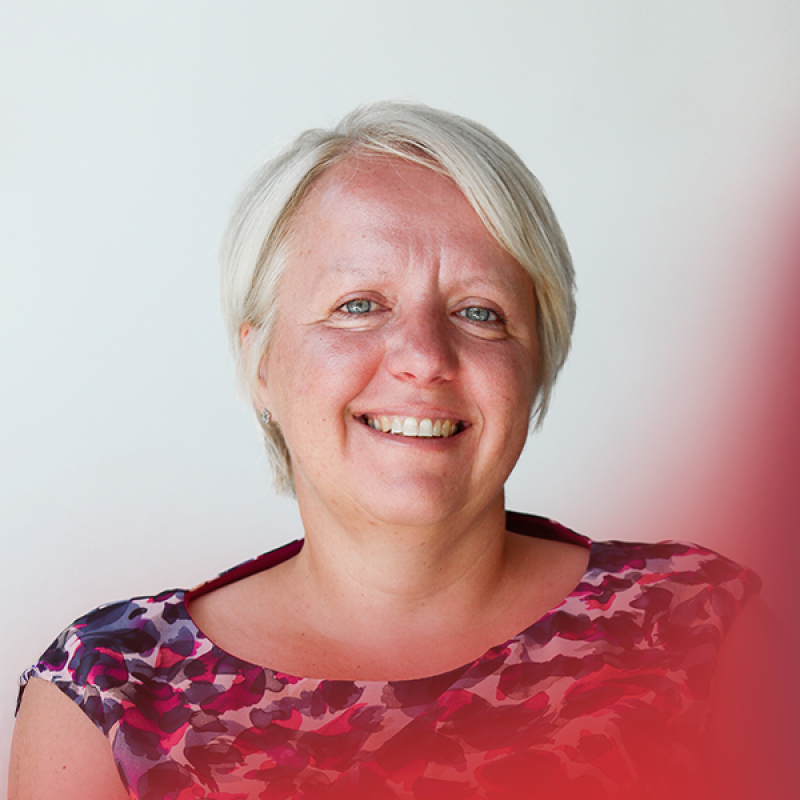
Talks about
- Entrepreneurship
- Fundraising
- Venture Capital
- Bootstrapping
- Pricing strategy
- Co-founder dynamics
- Female entrepreneurship
- B2B SaaS
- Career
- Founder mindset
- Resilience
- Belgian tech ecosystem
Career history
- FounderArtion
Insights & ideas
The through-line
Almost everything Van Der Steen says comes back to one idea: the brakes on a business are usually fitted by the founder, not the market. The metaphor she reaches for twice is the same one, a fast car held back by its own driver, "Dit is op de snelweg rijden met tegelijkertijd een voet op de gaspedaal en een voet op de rem, en het liefst nog de handrem mee aangetrokken" [2], and later, more compactly, "We zagen het potentieel, alleen reden we met een Ferrari op de autostrade met onze voet op de rem" [1]. The braking forces she names are never demand or competition. They are underpricing, refusing co-founders, bootstrapping too long, and a fear of being pushed aside. Her ambition, expressed as a conviction rather than a hope, is that capital is abundant and the constraint is on her side of the table: "Ik heb een overtuiging dat er massa geld is in de wereld, dat ik alleen de juiste manier moet vinden om het aan te trekken" [1].
The shift over time is from solo to collective. She left fifteen years in government for a consultancy that, in hindsight, she calls a job she gave herself, and the corrective in her later account is explicit: the one thing she would change is "de belemmerende overtuiging dat je het alleen beter kunt" [1]. Closing the funding round reads to her as the end of that phase, "Het voelt als de stuwmotoren die eindelijk ingang gestoken zijn aan ons raket, en nu zijn we full gas aan het gaan" [2].
On leaving a safe job and how she weighs risk
Her risk calculus is a single question: what is the worst that can happen? Applied to a tenured civil service post, the worst case was returning to work as an engineer, which made the leap feel safe rather than reckless [2]. The exit itself she describes in physical terms, "Het voelde als een bevrijding, als buitenkomen uit de gevangenis en frisse lucht inademen" [2]. She also rejects the idea that the fifteen years were a detour. Building an independent environmental enforcement department in Ghent over a decade was in practice a mini-enterprise inside government, with hiring, network-building and negotiating, and it was that work which revealed her entrepreneurial nature to her after the fact [1]. Other entrepreneurs later convinced her that the civil service background is a selling point, not a handicap: making the jump demonstrates daring, decisiveness and domain expertise [2]. The engine underneath is a flat refusal of hierarchy of talent, "Als iemand anders iets kan, dan kan ik dat ook" [2].
On finding the idea in the job you already did
Both businesses came out of enforcement work rather than ideation. As an inspector she found that 99% of non-compliant entrepreneurs simply did not know what they were supposed to comply with, which is a market for unburdening rather than a market for policing [1]. The consultancy's differentiator was the part of her history that looked most awkward: having inspected and even shut down companies turned out to be the USP, because clients wanted someone who knew exactly how the inspector thinks [1]. The SaaS insight is the same observation moved one layer up. Nobody googles for inspection-management software, yet almost every company is wrestling with Excel to track mandatory inspections, a boring and unserved compliance niche with essentially no competition, and that absence of competition is precisely what intrigued investors because it looked too good to be true [1].
On why services do not scale and SaaS does
The consultancy, however profitable, was a pure intellectual service in a saturated market with little evolution, and it did not scale [2]. Seeing what a software company looked like from the inside, on a visit to Silverfin, converted the frustration into a target: "Ik dacht: zoiets moet ik hebben, daar kan ik de wereld mee veroveren, dat is schaalbaar" [2]. Periodic inspections gave her the recurring revenue mechanic she needed to build that model [2]. The intermediate step matters as much as the destination. Hiring her first employee was the moment consulting became a business, because it freed her time to actually be an entrepreneur, and it exposed what solo independence had really been: "Vrijheid, dat is niks, vrijheid alleen. Eigenlijk heb ik mezelf gewoon een job gegeven. Ondernemen moet toch meer zijn dan dit" [1].
On pricing as a mindset problem
She moved from hourly billing to fixed project pricing after roughly nine or ten months, on the reasoning that an hourly rate cannot capture the value of expertise [1]. Her generalisation from that is one of her sharpest lines: "Ik ben er wel van overtuigd: uw pricing groeit mee met de mindset van de founders" [1]. Founders systematically undercharge until they take their own added value seriously, and the consequence lands on the client side, "Je kunt niet verwachten dat uw klanten u serieux nemen als je uzelf niet serieux neemt" [1].
On raising too late, and raising smart
Her clearest regret is timing. Bootstrapping Artion for too long braked growth severely, forced the founders to choose which invoices to pay, and made team building impossible even though the market potential was visible; she would raise far earlier a second time [1][2]. When they did raise, roughly €800K from VCs including Entourage, closed in April 2024, finding money was not the hard part [1][2]. What they were hunting was specifically smart money: investors with SaaS expertise willing to advise between board meetings, because all three founders lacked SaaS knowledge, and they said so openly from the first VC meeting rather than performing competence they did not have [1].
On how the fundraising dance actually works
She treats investor behaviour as choreography rather than judgement. Nearly every investor opens sceptically as a test or tactic, and several flipped completely inside the same conversation [2]. The ingredients that survive that treatment are a strong story, a financial plan, a pitch deck and resilience against rejection [2]. On leverage, she was transparent that several VCs were competing and that they knew of each other, on the pragmatic ground that concealment is foolish in Belgium's small investor world where everyone talks anyway [1]. The role-switch after closing surprised her most: the hard-to-get posture disappears entirely, "I haven't seen that investor since" in the case of one, while Pieter-Jan simply behaves as an entrepreneur-partner, which was initially disorienting [1]. Her practical instruction for first-timers is to bring professionals into the room fast. After the first overwhelming VC meetings they immediately hired a financial specialist and a lawyer who knew the game, which she calls crucial [1].
On co-founders and knowing your own weakness
Her initial refusal to take on co-founders came from a fear that more experienced entrepreneurs would keep her small and push her out, a "stomme angst" she had to work through [2]. What replaced it is a deliberate use of complementarity: knowing that her biggest weakness is starting things and not finishing them, she surrounds herself with people who love finishing, which the funded team finally makes possible [2]. The same logic governs how she treats feedback on a new idea. Expect a hundred sceptical reactions, and understand that a single enthusiastic believer, in her case Jean-Michel Teerlinck, is the game changer that makes the no's forgettable, while the scepticism itself still gets folded into the business model [2].
On being interrupted after two words
She encountered sexism for the first time in investor conversations, in an ego-driven male environment where she would be cut off after two words [2]. Her conclusion is deliberately two-sided: men should give women the floor, and she also has to literally claim her own podium [2].
On winning, quitting, and letting go of the company
Her definition of resilience is short-cycle rather than heroic: "Na 5 minuten staat ge op en ge gaat gewoon door. Dat is voor mij wel echt ondernemen" [2], and "Het is niet omdat je een keer valt dat je daarom moet blijven liggen" [2]. That coexists with a willingness to stop, "Trek er snel de stekker uit, stopt en springt" [1], and with an unusual definition of the upside, "Je gaat maar kunnen winnen als je kan verliezen" [2], where "Winnen is voor mij elke dag blij zijn dat ik 's morgens wakker word" [2]. The same detachment applies to the company itself. She explicitly does not treat Artion as her baby but as a project she intends to exit successfully and hand to others within ten years [2]. The daily register she keeps is one of curiosity: "Ik zeg vaak van: ik ben zo een beetje Alice in Wonderland... elke dag is dat weer een dag vol verwondering" [1].
Takeaways
- Test a risky decision by naming the actual worst case; hers was going back to work as an engineer, which made leaving a tenured civil service job feel safe [2].
- Mine your previous job for the idea. Enforcement work showed her that 99% of non-compliant companies simply did not know the rules, and that the thing they were all failing at in Excel was tracking mandatory inspections [1].
- The unserved, boring niche with no competition is a feature, and the absence of search volume is not the absence of a market [1].
- Move off hourly billing once expertise, not time, is what you are selling; "uw pricing groeit mee met de mindset van de founders" [1].
- Raise earlier than feels necessary. Prolonged bootstrapping meant choosing which invoices to pay and blocked hiring while the market opportunity sat there unclaimed [1][2].
- Be explicit about what you do not know when courting investors; naming a SaaS knowledge gap is how you select for investors who will advise between board meetings [1].
- Hire a financial specialist and a lawyer who know the game before you negotiate a first round, and be open about competing offers rather than concealing them [1].
- Hire against your own weakness. If you start things and do not finish them, staff the finishing [2].
This page shows public professional information only, each fact cited. Is this you? send a correction, or ask for removal within 24 hours, no questions asked.