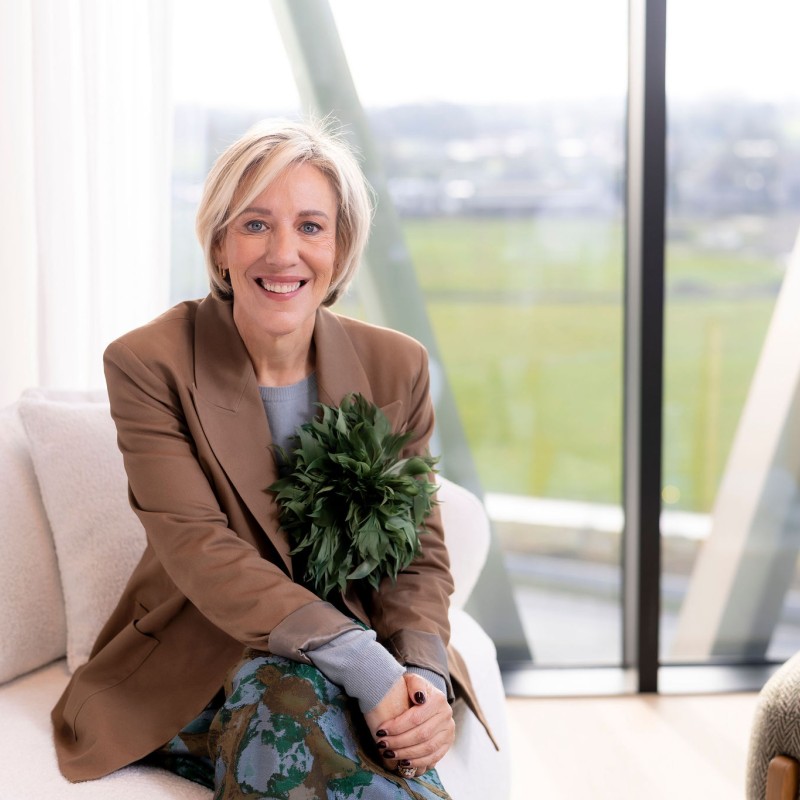
Overview
Conny built House of HR into a major European HR services group. Based in Flanders, she is recognized as one of Belgium's most successful entrepreneurs, combining operational leadership with active investing and ecosystem engagement.
Through House of HR and COFORMACO, Conny oversees investment and entrepreneurial activities across HR, services, and related sectors. She is also an active voice in Belgian business and leadership circles.
Talks about
- Personal development
- Founder mindset
- Entrepreneurship
- HR tech
- Private equity
- Female entrepreneurship
- Scaling
- Company culture
- Employee Ownership
- Exits
- Family Office
Insights & ideas
The through-line
Everything Conny Vandendriessche says circles back to hunger: the belief that ambition, appetite and discipline, not capital, are what build large companies, and that all three are currently in short supply. She is blunt that the Flemish environment has softened the people in it: "We zijn hier super verwend. Hier heb je Vlaio, je hebt imec, je krijgt bijna het geld langs je oren gesmeten. Ik denk dat we te weinig honger hebben om grote bedrijven te bouwen" [2]. The same diagnosis returns in her reading of sales, of financing and of the investor scene, where the scarce resource is never cash: "Geld is er genoeg in de wereld. Het is vooral advies" [2].
The second, quieter thread is knowing when your own usefulness ends. The energy that builds a company is not the energy that manages it, and she treats self-knowledge about that transition as a founder's final act of discipline rather than a defeat: "De beste golden tip is loslaten, echt loslaten, en volledig vertrouwen" [2]. Her account of Accent is bookended by two men telling her she would fail, starting with her father: "Voor de tweede keer in mijn leven hoor ik een man zeggen van: het gaat helemaal mislukken met jou. Eerst mijn papa die zei: ik geloof niet in u" [2].
On the positive dictionary
At Accent's founding the company wrote a "positive dictionary" that banned negative words and replaced them: 'problem' became 'challenge', 'personnel' became 'medewerkers' [2]. The reasoning is arithmetical rather than sentimental. One employee bringing a problem is manageable; hundreds doing it every day is corrosive. "Als je één medewerker hebt die zegt probleem... en je hebt 100 medewerkers of 500 en die zeggen allemaal 'Ik heb een probleem', 's avonds ja dan ben je echt depri. Wij wensen dat niet, wij hadden een uitdaging" [2]. Language, in this account, is an energy management system for a company at scale.
On hiring for a blank slate
Accent deliberately hired half its people straight out of school and avoided recruiting from other staffing firms, on the view that industry veterans arrive already shaped by another company's culture and are hard to mould to Accent's DNA [2]. That choice only works if you invest behind it, so every employee was trained two days a month, from soft skills through to elevator pitches. Nothing was left to chance, and that completeness is precisely what made the model replicable office by office [2].
On hunters and farmers
She is sharply critical of what has happened to commercial behaviour: "Sedert covid zijn we die hunting mentaliteit kwijt geraakt. We zijn precies allemaal farmers" [2]. Cold calling, in her view, is done far too little today, and easy government money reinforces the complacency [2]. Her own conception of selling starts where most people stop: "Het is echt leuk als een klant begint te zeggen met neen. Dat is de uitdaging om die om te turnen naar ja" [2]. That posture had a reputational cost she reports without apology: "Mensen noemden ons, in plaats van assertief, soms agressief commercieel" [2].
On financing on your own terms
Two rules govern her approach to banks. Open a credit line, a straight loan, while business is good and you do not need it, pay the reservation fee for the peace of mind, and repay what you draw so the bank can see the line is not exhausted [2]. And never sign a personal guarantee. She never did, as a matter of principle, and advises entrepreneurs never to do so, even though banks have asked for it as standard for thirty years [2].
On growing oil-slick style
For its first ten years Accent built no headquarters at all. Every euro of cash went into opening offices, expanding "olievlek-gewijs", region by region, with the whole team moving along [2]. The result she reports plainly: "Wij verdubbelden onze omzet om de twee jaar" [2]. Her division of labour with her co-founder is summarised in one line: "Ik zeg altijd: hij droomde het en ik deed het" [2].
On private equity and skin in the game
The founders went looking for a private equity partner for reasons that had nothing to do with the cheque. They wanted to be challenged, and they wanted a referee who could keep the two founders in balance [2]. Under Naxicap she built employee ownership into the structure: one in ten employees became a shareholder through a separate vehicle, and the management of every acquired company had to buy 30% of their own company so that they carried real skin in the game [2].
On letting go
Handing over to an external CEO was a physical act as much as a legal one. She moved to an office two kilometres away and refused to intervene when employees rang to complain, telling them to take it up with the new CEO directly, because anything else undermines the successor [2]. She frames the timing as a question of talent running out rather than age: founders who stay past sixty or sixty-five without having built a second life find the separation dramatic, and at some point the company needs managers rather than entrepreneurs [2].
On investing and what not to expect
As an investor she opens by telling founders explicitly what they should not expect from her, because the recurring disappointment with business angels is inflated expectations about a network that will supposedly open doors [2]. Behind that sits her conviction that advice, not money, is the binding constraint [2]. With We Are Jane she found it surprisingly hard to source female-run companies above €1 million EBITDA; the fund screens roughly 150 companies a year and only one or two reach deep due diligence [2]. She remains present in the ecosystem she criticises, including at SuperNova [1].
On AI coming for the white collar
Decades of optimisation went into blue-collar work. This time is different: "Met artificiële intelligentie wordt voor de eerste keer de white collars aangevallen, de bediende. We gaan echt verschieten wat dat er op ons afkomt en het gaat zeer vlug" [2]. She is applying it inside her own house, where an internal chatbot at House of HR already replaces part of a twenty-person support desk, and she notes that displacement has started, though more slowly than she expected [2].
Takeaways
- Ban negative vocabulary deliberately: replace 'problem' with 'challenge' and 'personnel' with 'medewerkers', because hundreds of daily complaints drain a company's energy at scale [2].
- Hire roughly half your people straight from school and avoid competitors' veterans, then train everyone two days a month so the model can be replicated office by office [2].
- Open a straight loan while business is good, pay the reservation fee, repay drawn amounts so the bank sees unused headroom, and never sign a personal guarantee [2].
- Put cash into new offices rather than a headquarters; Accent built none for ten years and doubled revenue every two years [2].
- Take private equity for the challenge and for a referee between founders, not for the money, and make acquired management buy 30% of their own company [2].
- When you hand over, leave physically and refuse to take complaint calls, or you undermine your successor: "De beste golden tip is loslaten, echt loslaten, en volledig vertrouwen" [2].
- Tell founders up front what you will not do for them; inflated expectations about a business angel's network are the standard disappointment [2].
- Expect AI disruption to hit white-collar roles first and fast, and start replacing internal support functions before it is forced on you [2].
In the news
- La femme d'affaires Conny Vandendriessche a lancé une bouée de sauvetage à 30 millions d'euros à Paul Gheysens (Ghelamco)L'entrepreneuse spécialisée dans les ressources humaines a accordé un prêt de 30 millions d'euros au propriétaire de Ghelamco, juste avant une échéance cruciale l'année dernière. En échange, elle a obtenu une garantie sur la villa de Saint-Tropez.
L'Echo Entreprises · 28 Jul 2026
- Great vibes at SuperNova! ✨
- Conny Vandendriessche investeert in audioverhalen voor kinderen24/03 De onderneemster en investeerder Conny Vandendriessche, vooral bekend van House of HR, heeft met haar family office geld gestopt in Kroots. Dat is een Brusselse start-up die zich toelegt op audioverha...
De Tijd Media & Marketing · 24 Mar 2026
Related profiles
This page shows public professional information only, each fact cited. Is this you? send a correction, or ask for removal within 24 hours, no questions asked.