Overview
In this Connexi podcast, Daan De Wever, founder and CEO of cloud communications company Destiny (founded 2008, ~300 people across Belgium, the Netherlands and France), walks through three turning points in his life. He recounts quitting school without a diploma, working in construction as a topographer thanks to people who believed in him, and how that shaped his belief in hiring on drive rather than diplomas. He explains how surviving the 2008 crisis — after taking over loss-making assets from a bankruptcy — taught him to keep investing through downturns, to bring in leaders better than himself (an external CEO he learned from until 2015), and to put the company above his own ego. Finally, he reflects on how the Corona lockdown exposed the physical toll of his adrenaline-fueled travel schedule and taught him the value of slowing down, balance and gratitude for having choices.
Talks about
Insights & ideas
The through-line
One conviction organises everything Daan De Wever says: the ceiling on a company is almost always the person running it. Most SMEs stay small not because the market or the sector lacks potential, but because the entrepreneur cannot let go and cannot admit what they are not good at [2]. His own answer is to subordinate himself entirely to the business, "Ik als bedrijfsleider is ondergeschikt aan het bedrijf... het bedrijf komt altijd op de eerste plaats" [2], and to refuse standing still: "Status quo is nooit een optie" [2].
The second half of the position is that movement without listening is worthless. Excellent products still fail commercially when the company stubbornly refuses to hear the market; ideas have to be tested and adjusted when they don't work [1]. What has shifted is the tempo. Where the instinct was always to push forward, being forced to slow down led him to consolidate rather than accelerate, and to question which of his hectic patterns were ever necessary [2].
On ego and surrounding yourself with better people
Taking over Destiny's assets out of bankruptcy in 2008, he knew nothing about telecom and said so, then deliberately brought in an experienced external leader he learned from until 2015, a move he calls one of his most important decisions [2]. He frames it as a repeatable discipline rather than a lucky hire: "Omringen met mensen die beter zijn in hun vak dan jezelf... ik heb dat echt heel bewust gedaan" [2]. The corollary is the diagnosis he applies to stalled SMEs, where the blockage is the founder's inability to release control and name their own gaps [2].
On listening to the customer
His teenage events company failed by copy-pasting a Leuven concept into another region without listening to local customers, and he treats that as the founding lesson of everything since: "Luister naar je klant... niet alles is perfect gewoon kopiëren, ge gaat moeten durven aanpassen" [2]. The same rule now governs operating Destiny across Belgium, the Netherlands and France, where the portfolio cannot simply be implemented identically in each market [2]. It generalises beyond geography, since companies with genuinely excellent products still fail commercially when they refuse to listen and adjust [1].
On strategy versus execution
He is untroubled by competitors knowing what he plans: "Van mij mag iedereen mijn strategie kennen... het gaat over executie" [2]. Strategy is not the differentiator; execution and the appreciation of customers are, which is why he shares his openly [2].
On happy versus engaged employees
He draws a hard line between the two. Happy employees enjoy their work; only truly connected employees understand the strategy and act on it to build the company [2]. That distinction sits directly under the open-strategy position, since a workforce cannot act on a plan it has never been told.
On hiring for drive rather than diplomas
He dropped out without a diploma and was given a chance anyway, and hires accordingly, on drive and motivation rather than credentials [2]. His observation is that people without diplomas or from difficult social contexts often work harder because they have something to prove [2]. He is also clear-eyed about the privilege underneath his own trajectory: "Wij hebben het geluk dat we keuzes kunnen maken. Er zijn heel veel mensen die die keuze niet hebben" [2].
On managing by numbers and missing the transition
Companies steered purely on financial KPIs are managing on the past, because today's numbers describe yesterday [2]. His example is the traditional telephone-exchange integrators who ignored the cloud transition for a decade and are only now being hit by it, a lag no financial dashboard would have flagged in time [2].
On crisis, long-term investment and sustainability
In a crisis the instinct to cut costs has to be resisted, or at least matched: keep investing in the long term and think hard about how customer behaviour will change in the new normal, rather than only trimming [2]. He defines sustainability for a company as the balance between long-term vision and investment on one side and short-term financial performance on the other, and points to an airline sector that barely made money even in a record year like 2019 as an example of what fails that test [2].
On growing too fast and slowing down
A customer-centricity consulting exercise produced an unintended result: instead of customer insights, employees reported that they lacked tools and structure because the company was growing too fast, which taught him to consolidate before taking the next step [2]. The personal version came with lockdown, when the halt to an extreme travel rhythm revealed its physical toll; he began sleeping through the night, felt fitter than in years, and started consciously questioning which trips and hectic patterns were actually necessary [2].
Takeaways
- The limit on most SMEs is the entrepreneur's inability to let go and admit weakness, not the market or the sector [2].
- Hire people better than you at their craft, deliberately and as a system, as he did by bringing in an experienced telecom leader after buying assets he did not understand [2].
- Publish your strategy if you like; it is not the differentiator. "Van mij mag iedereen mijn strategie kennen... het gaat over executie" [2].
- Never copy a working concept into a new market unchanged; adapt it to local customers, or repeat the mistake that killed his events company [2].
- Happy employees are not the goal; engaged employees who understand the strategy and act on it are [2].
- Financial KPIs describe yesterday. The integrators who ignored the cloud shift for ten years are the proof of what dashboards miss [2].
- In a downturn, keep investing for the long term and model how customer behaviour will change, instead of cutting alone [2].
- Fast growth without tools and structure breaks people; consolidate before the next step [2].
In the news
- A great conversation with Daan De Wever in Trends, discussing how AI is reshaping the communications industry and why Dstny is evolving to stay ahead. From intelligent communication solutions to digital colleagues and European digital sovereignty, the future of business communications is changing fast. Read the interview and discover how Dstny is helping businesses navigate the next wave of innovation: https://lnkd.in/erC6s5pX #AI #AIwaysOnCommunications #Dstny #Innovation
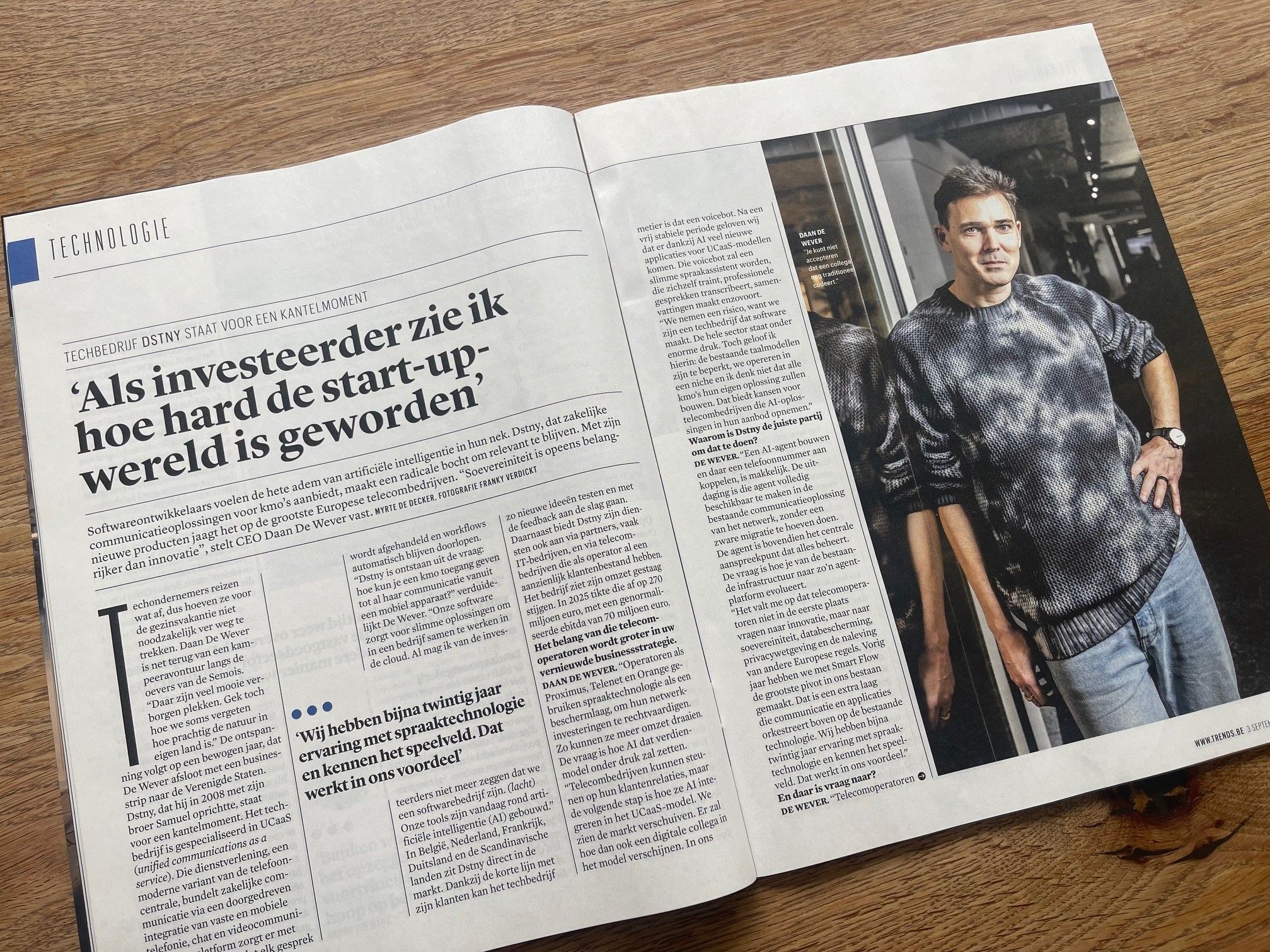
- Daan De Wever (CEO Dstny): ‘Als investeerder zie ik hoe hard de start-upwereld is geworden’Softwareontwikkelaars voelen de hete adem van artificiële intelligentie in hun nek. Dstny, dat zakelijke communicatieoplossingen voor kmo’s aanbiedt, maakt een radicale bocht om relevant te blijven. Met zijn nieuwe producten jaagt het op de grootste Europese telecombedrijven. "Soevereiniteit is opeens belangrijker dan innovatie", stelt CEO Daan De Wever vast.
The post Daan De Wever (CEO Dstny): ‘
DataNews · 4 Sept 2026
This page shows public professional information only, each fact cited. Is this you? send a correction, or ask for removal within 24 hours, no questions asked.