Overview
Kaan A is the founder of nerai, a company he started in May 2019, and is based in Belgium.
He joined the Republic of Turkey Prime Ministry in 2004 as a strategic intelligence analyst, a role he held until 2010, and was operations manager there from April 2010 to June 2014. From March 2014 to May 2019 he was strategic operations manager at the Prime Ministry of Turkiye.
He holds a Bachelor of Science in International Relations and Affairs from Orta Doğu Teknik Üniversitesi / Middle East Technical University, which he completed between September 1998 and June 2003, and a master's degree in international affairs from Penn State University, studied between 2013 and 2015.
Career history

Insights & ideas
The through-line
Across these posts the recurring claim is that geopolitical risk categories that used to be tracked separately, sanctions, maritime security, energy flows, supply chains, are now moving together and have to be read as one system. This starts as a platform pitch in late July, when the language is about building NERAI Strategic Insights Hub to turn "fragmented global signals into structured, quantified and actionable intelligence" [10] and to give leaders "the clarity to distinguish noise from meaningful signals" [9]. Over August the same conviction gets applied to specific cases rather than stated in the abstract: Hormuz transit decisions folding in flag exposure and sanctions risk [1], Kuwait's exposure as a spillover receiver [2], the Saudi-Türkiye-Pakistan alignment tested against export-control constraints [4], and EU sanctions moving from listing individuals to disrupting networks [11]. The shift is from asserting that risks are converging to demonstrating, week by week, where that convergence is actually showing up.
On convergence of risk
The core idea, repeated almost verbatim across posts, is that "geopolitical risk, sanctions exposure, maritime disruption, supply-chain vulnerability, energy security and regional instability are no longer separate risk categories" [10]. He returns to this when describing Hormuz and the Red Sea: "these are no longer separate issues" [14], and reframes sanctions work the same way, noting that "sanctions risk is no longer a niche compliance issue" and now "sits at the intersection of trade, shipping, ownership structures, maritime exposure, insurance, routing decisions and broader geopolitical risk" [15]. Looking at a single 24-hour news cycle spanning Iran, Korea and Lebanon, he draws the same conclusion: "the common thread is not simply escalation. It is the growing interaction between diplomacy, sanctions pressure, military posture and physical security risk" [3].
On forecasting method
He is explicit that the value of a forecast is not the headline number but its trajectory: "the most important signal in a low-probability forecast is not the number. It is the direction of travel" [5]. His stated method rests on "weighted conditional pathways" that show "how a situation most plausibly breaks, with probabilities you can position against," paired with "a 60-day watch list" of triggers to track leading indicators "instead of reacting to headlines" [7]. He applies this literally, scoring a vote with "three weighted pathways (65 / 25 / 10)" [7], and elsewhere describes a crisis as "severe, but still bounded" [13] while adding his own hedge that his "reading is more concerned than the base case" [5], showing he treats the model's output and his own judgment as distinct inputs.
On maritime chokepoints
Hormuz and adjacent corridors are his most concrete recurring case. He argues "a chokepoint does not need to close completely to become strategically and commercially disruptive" [12], and tracks how the strait's operating environment is degrading: "Hormuz is becoming a more conditional operating environment" where "regulatory discretion, vessel profile and political exposure are becoming part of the commercial calculus" [1]. He treats specific incidents as behavior-changing events, writing that "the Minoan Dignity fatality changes behaviour" [1], and consistently flags Hormuz disruption as "the key commercial and maritime transmission channel" in the broader US-Iran dashboard [13].
On sanctions design
He frames current sanctions policy as a structural shift rather than a scaling-up of the same tool: "sanctions are moving from entity-level pressure toward network disruption," with "the objective... no longer only to list individuals or companies" [11]. On the compliance side, he pushes back on the idea that a clean screen equals safety: "a clean sanctions screen does not always mean a low-risk transaction" because "authorities do not look only at lists and codes" but also at "product sensitivity, ownership, routing patterns, end-use concerns, trade-flow anomalies" [6].
Takeaways
- Treat Hormuz transit as a compound decision involving flag exposure, insurance and detention risk, not just naval security, especially after crew-casualty events like the Minoan Dignity fatality [1].
- Watch Kuwait as the leading indicator for whether Gulf instability is spreading beyond Iran and Israel, given its role as the network's strongest net risk receiver [2].
- In forecasting, weight the direction of travel over the raw probability, and pair scenario odds with a 60-day list of concrete triggers to act on before headlines catch up [5][7].
- Do not rely on a clean sanctions screen alone; factor in routing patterns, ownership structure and enforcement history since regulators do [6].
- Read the EU's 21st Russia sanctions package as evidence that sanctions strategy is shifting from targeting entities to disrupting entire circumvention networks [11].
- Assess new alignments like the Saudi Arabia-Türkiye-Pakistan defence grouping by distinguishing political commitment from institutionalised alliance, since export controls and technology-transfer issues can stall the transition [4].
In the news
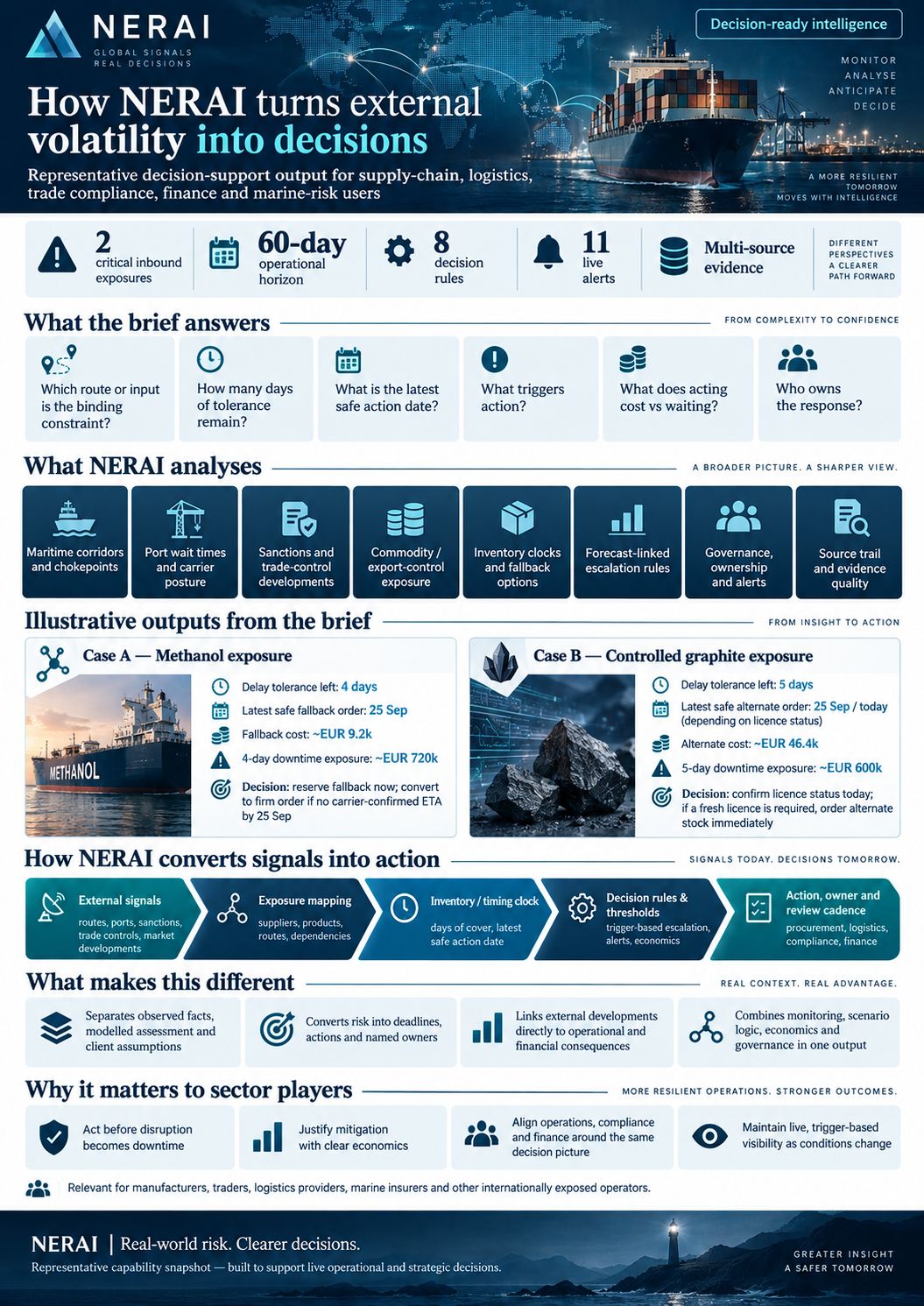
- Over the past few weeks, we’ve been pushing NERAI further in one direction that I think matters a lot: turning external risk into an actual decision. A lot of intelligence products are still very good at telling you that something is getting worse. A corridor is disrupted. A port is congested. A sanctions environment is tightening. A geopolitical indicator is deteriorating. That information is useful — but for operators, procurement teams, logistics teams, insurers, compliance teams and finance leaders, it is still only the
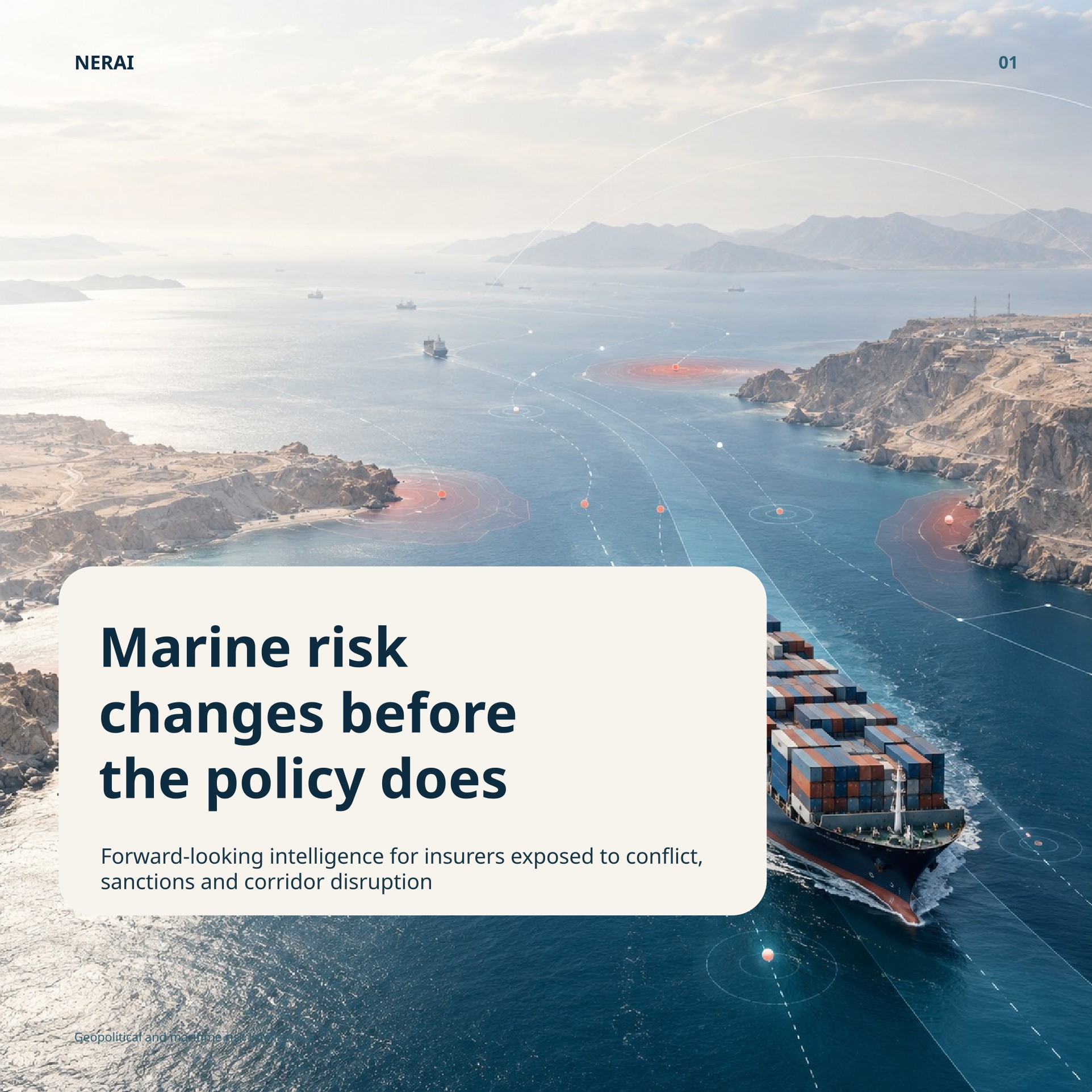
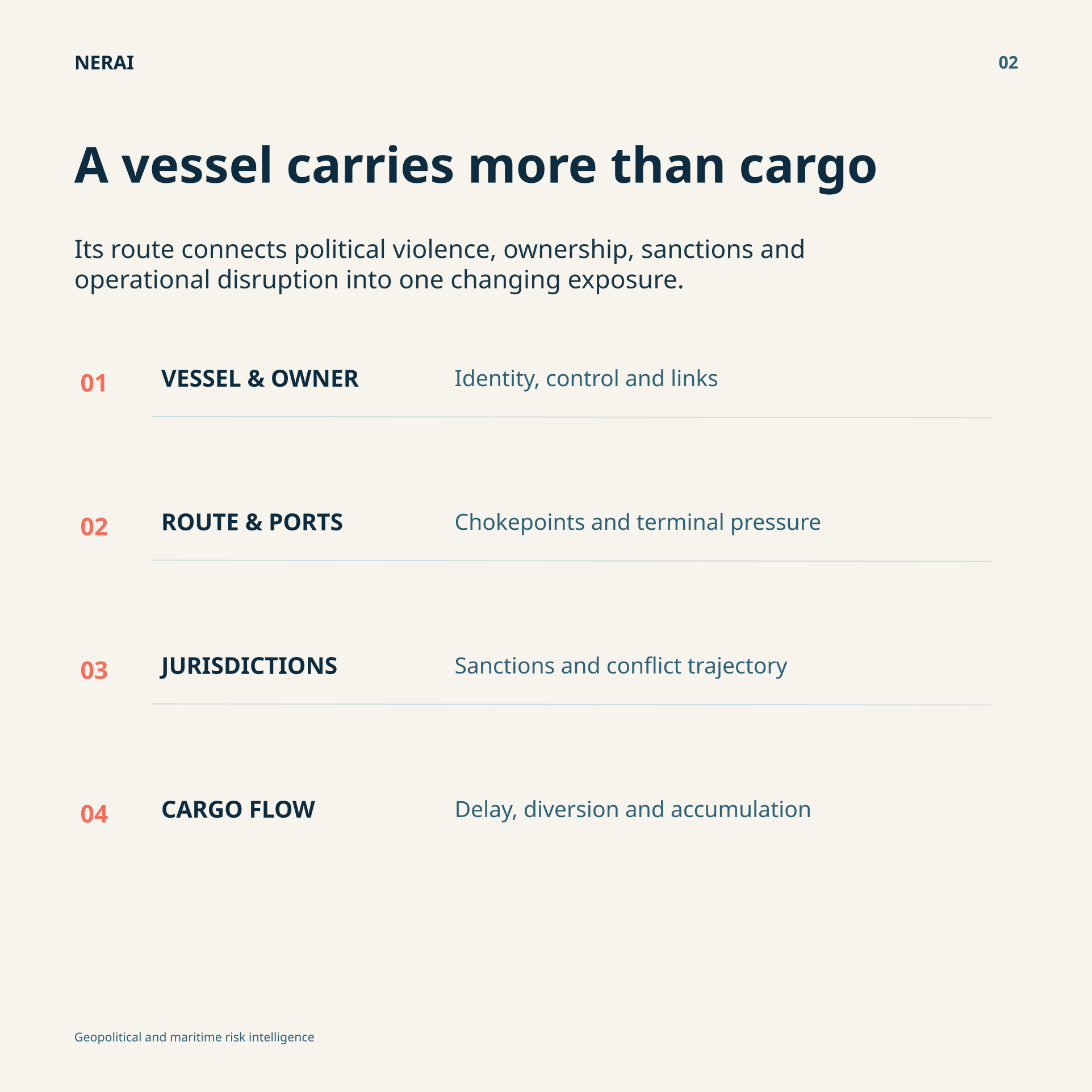
- A vessel may pass every screening check today and still enter a very different risk environment tomorrow. For marine insurers, the harder questions sit beyond the current vessel status: How could conflict or sanctions alter its route? Where might port congestion, chokepoint disruption or rerouting concentrate insured value? Which ownership, jurisdiction or trading links could create future exposure? How could these risks evolve over the next 3, 6 or 12 months? NERAI connects geopolitical developments with vessels, ports, corridors
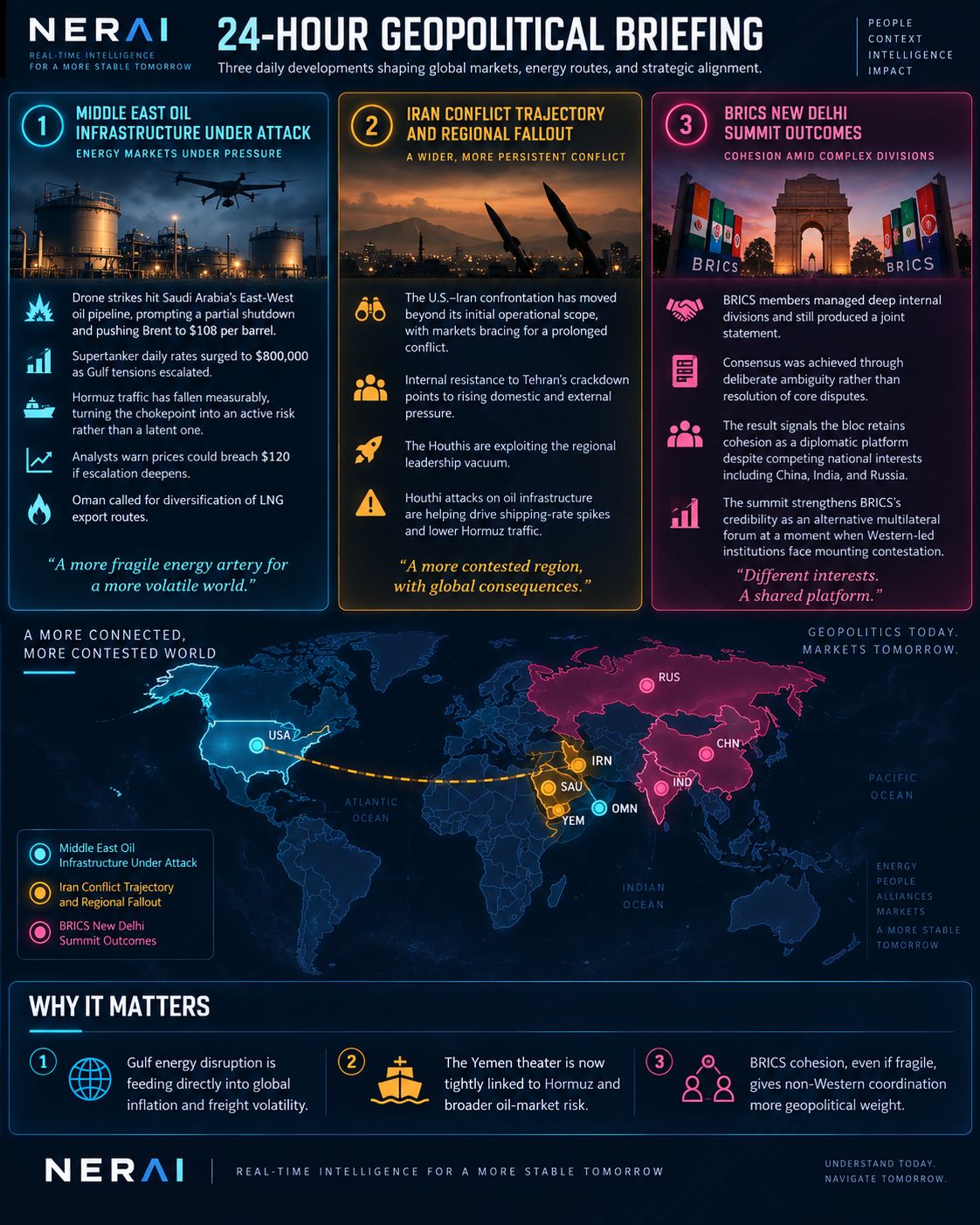
- NERAI 24-Hour Geopolitical Briefing Three developments stand out in today’s global risk picture: 1. Middle East oil infrastructure under attack Pressure on Saudi Arabia’s East-West oil pipeline, rising tanker costs and weakening Hormuz traffic are reinforcing the view that Gulf energy disruption is no longer a temporary market shock. 2. Iran conflict trajectory widening The U.S.–Iran confrontation is moving beyond its initial operational scope. At the same time, domestic pressure inside Iran and Houthi activity in Yemen are
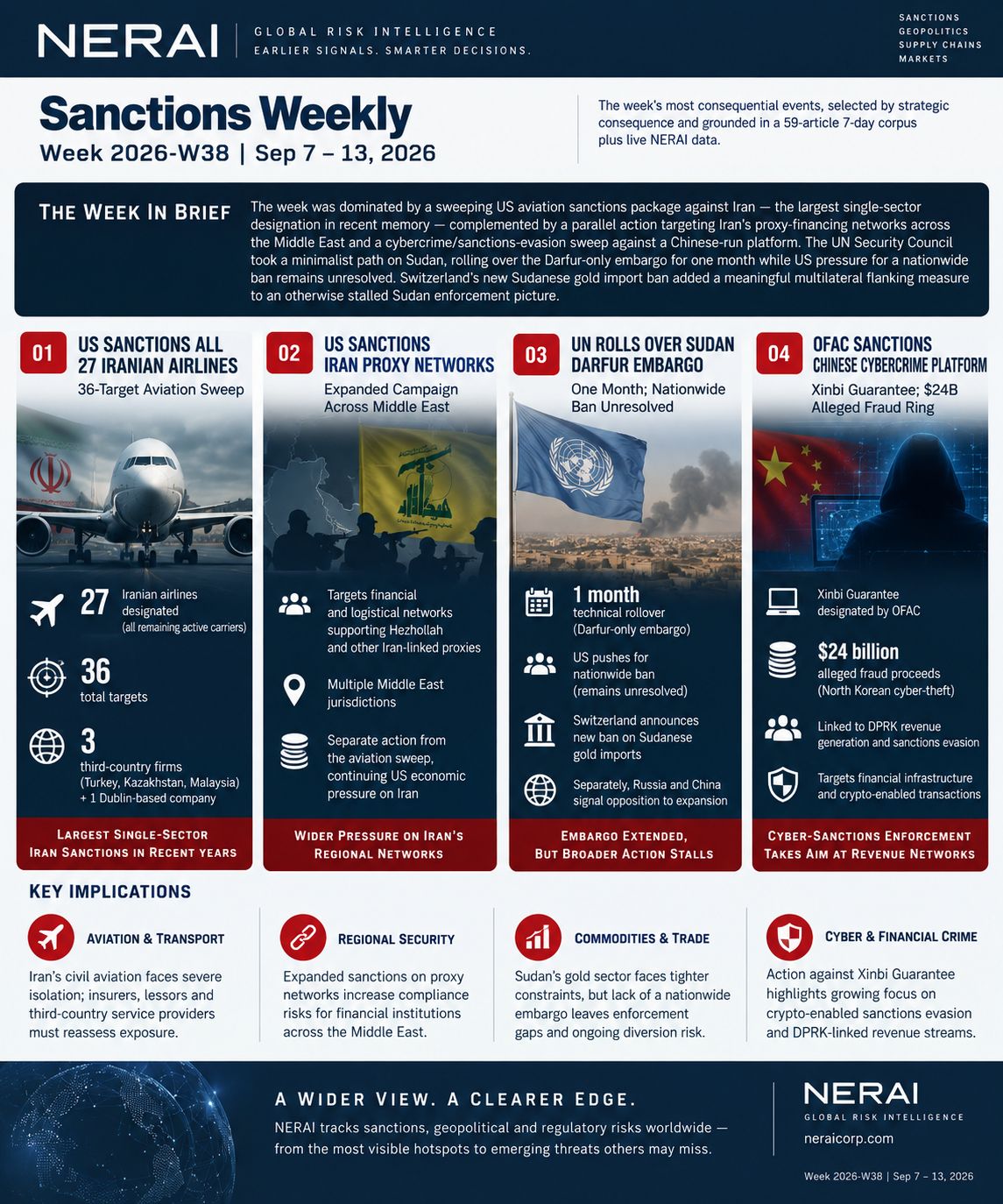
- This week’s sanctions landscape was defined by a widening pressure campaign against Iran, alongside important developments in Sudan and cyber-enabled financial crime. The most consequential developments included: - a sweeping U.S. aviation sanctions package targeting 27 Iranian airlines and 36 entities - a separate U.S. action against Iran-linked proxy financing and logistics networks - a one-month rollover of the UN Darfur arms embargo, while a broader Sudan-wide ban remains unresolved - OFAC action against Xinbi Guarantee,
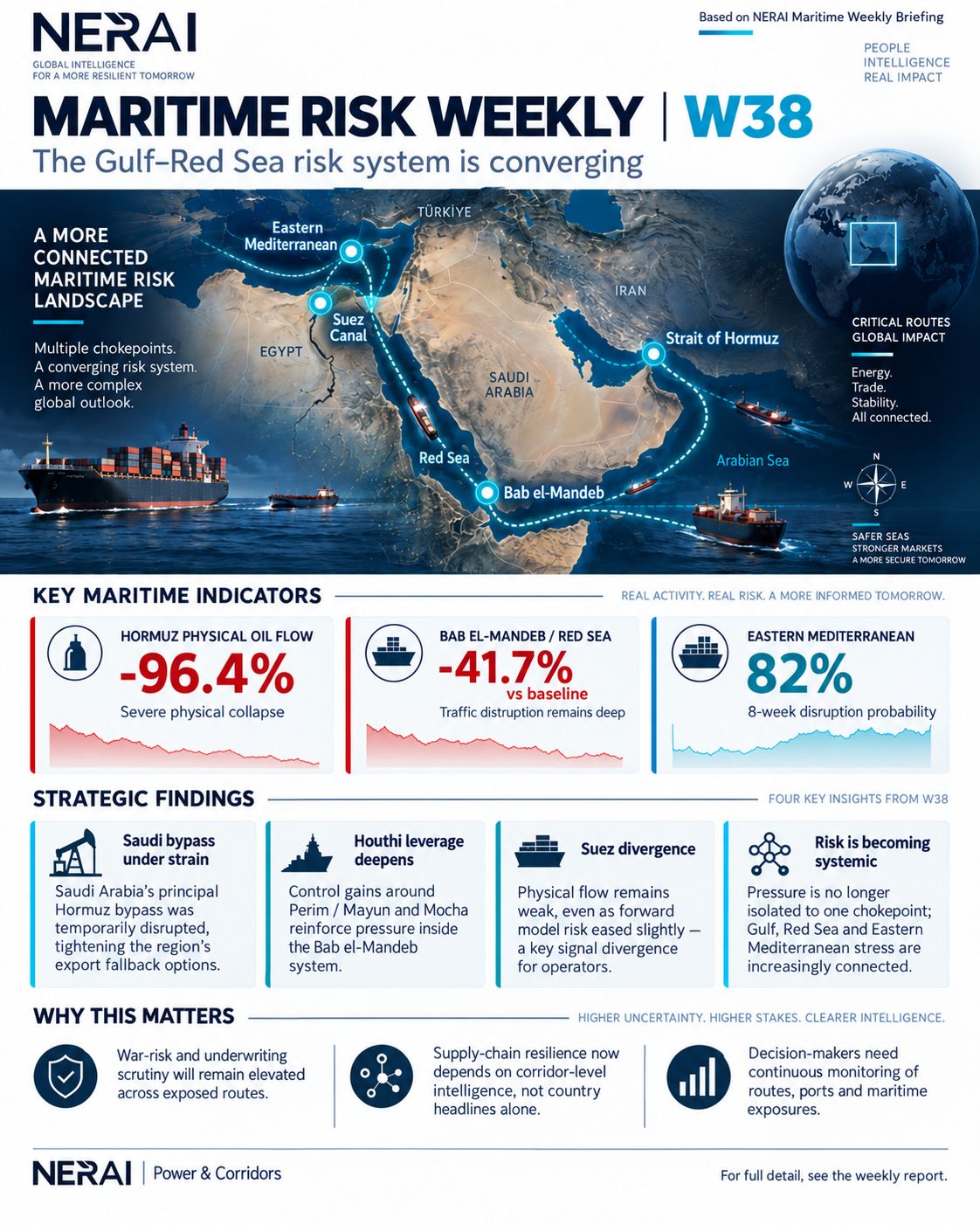
- This week’s NERAI Maritime Weekly highlights a widening convergence of pressure across the Gulf, Red Sea and Eastern Mediterranean. Three signals stand out: Strait of Hormuz physical oil flow: -96.4% vs baseline Bab el-Mandeb / Red Sea flow: -41.7% vs baseline Eastern Mediterranean 8-week disruption probability: 82% The important point is not any one number in isolation. The strategic concern is that multiple corridors are now being stressed at the same time. Saudi Arabia’s principal Hormuz bypass has been disrupted. Houthi
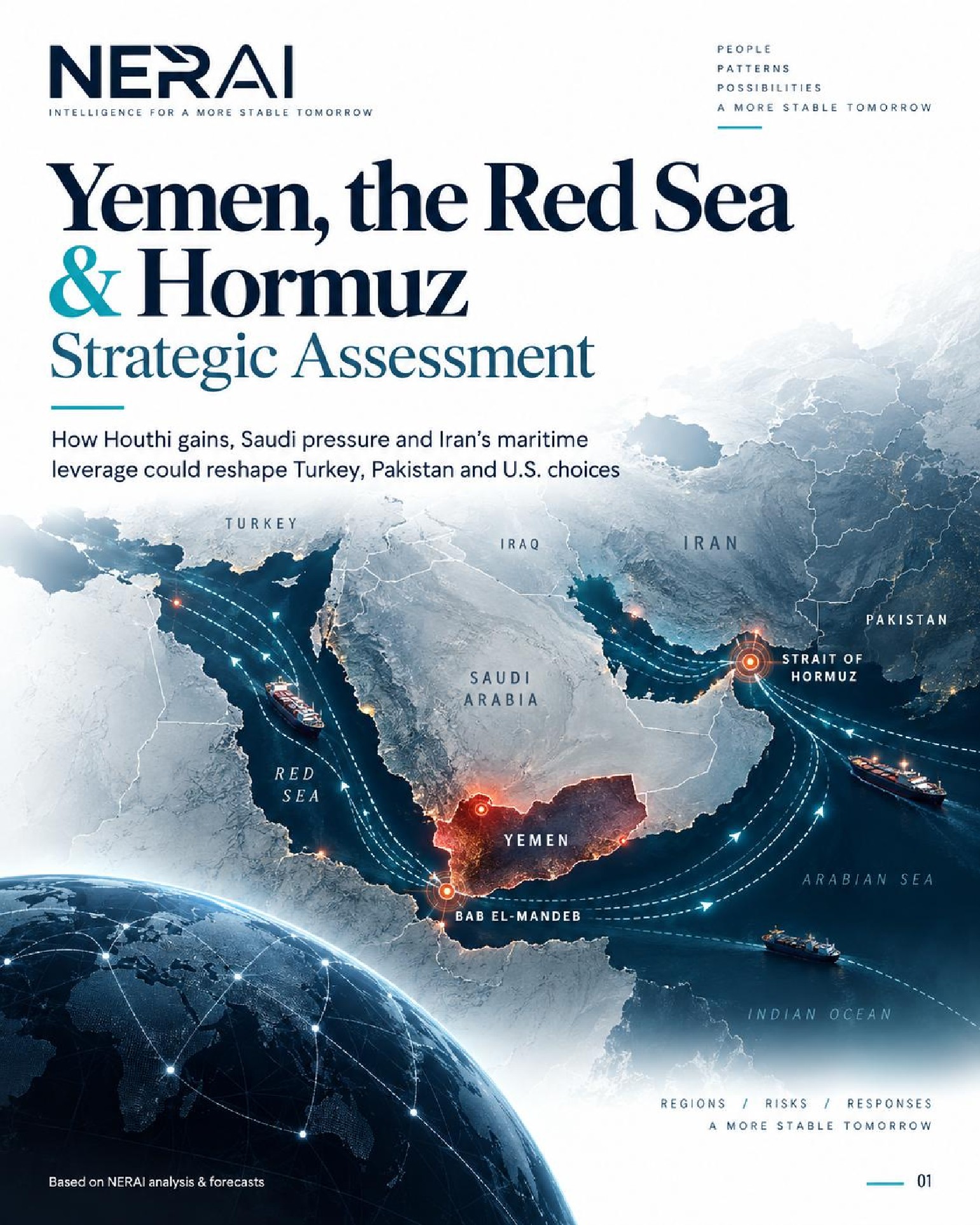
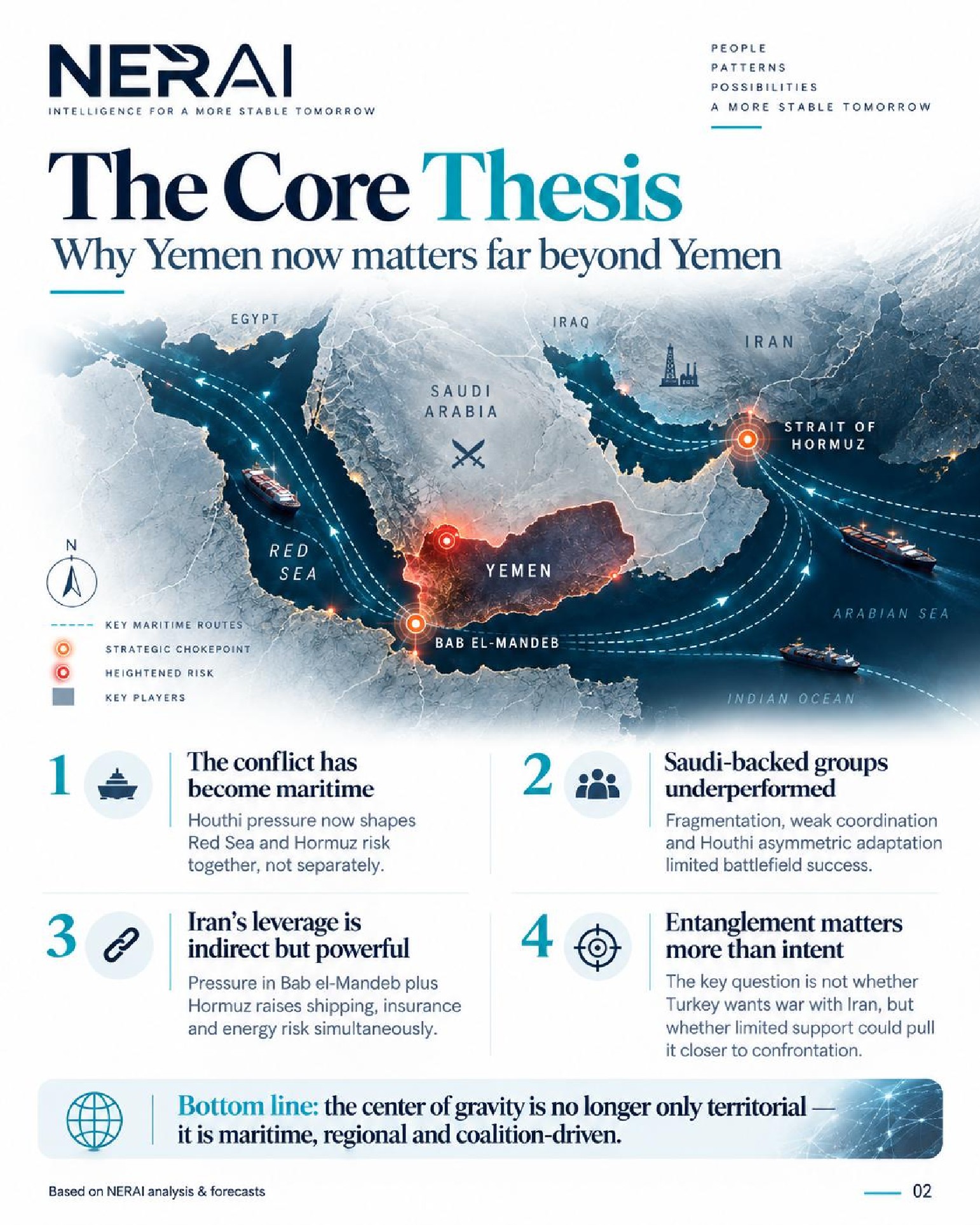
- Recent Houthi gains have increased pressure around Bab el-Mandeb, while the continuing disruption around Hormuz has created a two-chokepoint problem stretching across the Gulf and the Red Sea. For Saudi Arabia, this is not simply a Yemen issue anymore. It is a strategic problem involving energy infrastructure, maritime access, deterrence and the credibility of its regional security partnerships. The Makkah Joint Defence Agreement also changes the equation. Türkiye and Pakistan are no longer just external observers. The
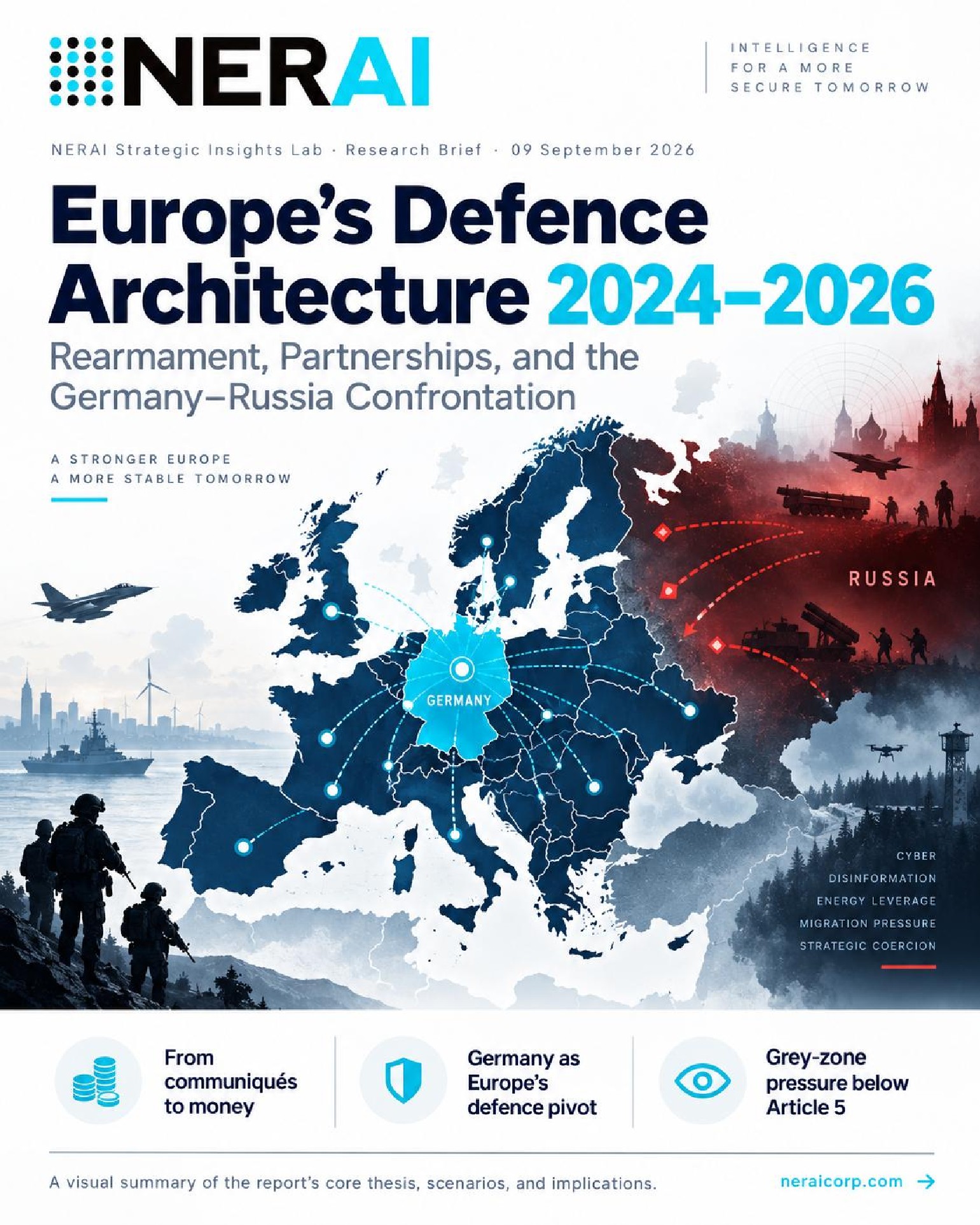
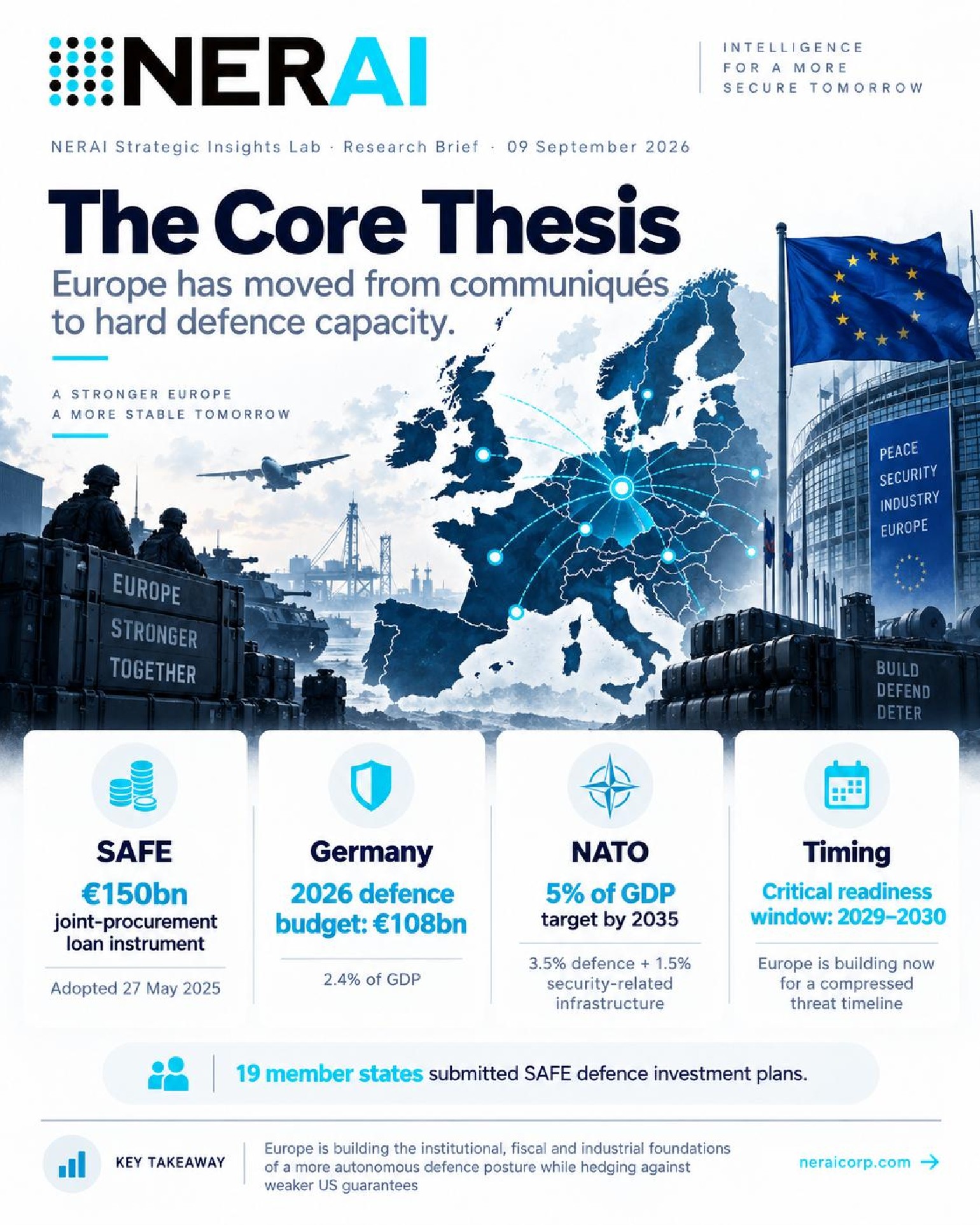
- Europe’s defence architecture is changing faster than many companies, investors and policymakers are pricing in. Our latest NERAI research brief argues that Europe has moved beyond declarations and into structural rearmament: new fiscal instruments, industrial capacity, force-generation targets and a more autonomous defence posture. At the same time, Germany is becoming the central pressure point in the confrontation with Russia — not through open war, but through sustained grey-zone pressure below the Article 5 threshold. The
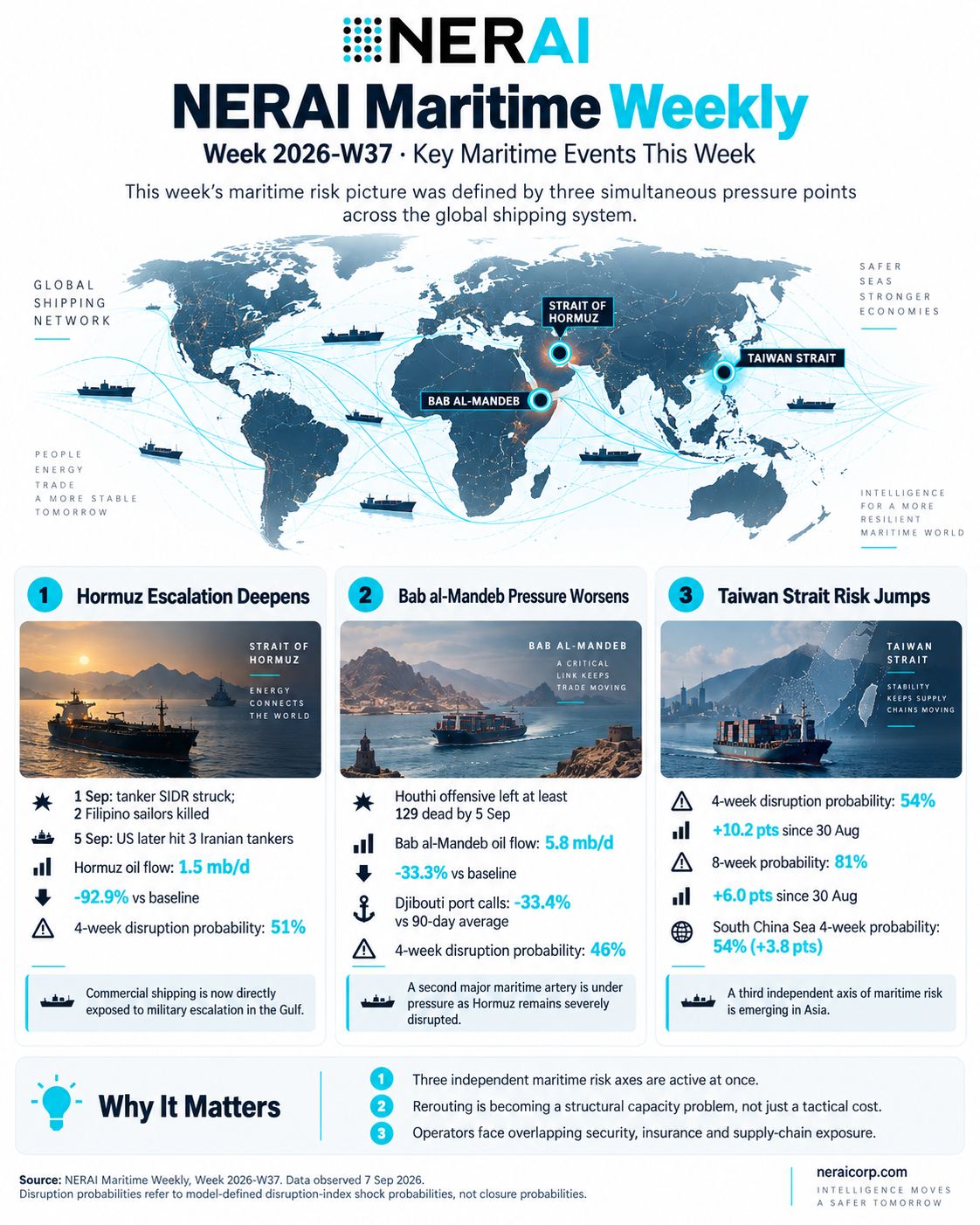
- This week’s maritime risk picture is being shaped by three simultaneous pressure points across the global shipping system. Strait of Hormuz disruption remains severe. Bab al-Mandeb pressure has worsened further. At the same time, NERAI’s forward model shows a sharp rise in Taiwan Strait disruption risk. The important point is not any one chokepoint in isolation. It is the overlap. When multiple maritime corridors deteriorate at the same time, rerouting becomes more than a cost issue. It becomes a capacity, insurance and supply-chain
This page shows public professional information only, each fact cited. Is this you? send a correction, or ask for removal within 24 hours, no questions asked.