
Overview
Margot Wuillaume is the CEO and co-founder of ebloom, based in Brussels. She co-founded eBloom in September 2019 and has led it since. Since January 2023 she has sat on the Advisory Board of Hub.Software at lifetech.brussels, and she has been a laureate of Réseau Entreprendre Bruxelles since July 2022.
Earlier, she was an associate consultant intern at Bain & Company from February to April 2020. At LSM Conseil she worked as a business developer from June 2016 to June 2017 and then as quality manager until June 2018, and in May and June 2018 she held a quality management internship at Pulso Europe.
She studied at the Université catholique de Louvain from 2014 to 2017 as an ingénieur de gestion, then completed a master's degree at the Louvain School of Management in ingénieur de gestion with a major in entrepreneurship (CPME) between 2017 and 2019. In 2018 she also studied at Universidad EAFIT.
Career history

Insights & ideas
The through-line
Across LinkedIn posts, interviews and a podcast, Margot Wuillaume keeps returning to one idea: employee engagement is not a soft add-on but a measurable, strategic lever, and the human side of transformation (AI, pay transparency, leadership) is what determines whether change actually works. In the earlier interview and podcast material she frames this through eBloom's product logic, connecting companies to their employees' sentiment via pulse surveys [11][13]. In her more recent 2026 posts the focus widens: she applies the same lens to AI adoption in HR [4][6][7], to pay-transparency legislation [5], and to the definition of engagement itself [10], consistently landing on the same conclusion, that tools and policies fail without people-management investment and manager support.
On engagement
Wuillaume treats engagement as genuinely hard to pin down rather than a buzzword with a fixed definition. Asking her own team to complete three prompts about engagement, she found "Aucune réponse n'est revenue deux fois. Pas une seule !" with answers like "Aligné(e)", "Responsable", "Impliqué(e)", "Entreprendre", "Construire" [10]. Her takeaway is that "on croit parfois qu'il existe une définition toute trouvée" but the diversity of answers reveals "toute la complexité du sujet" [10]. She links this directly to management practice, noting that "on demande aux managers de cultiver l'engagement au quotidien" without always giving them the right tools [10]. She also connects engagement to performance in blunter terms, describing eBloom's pitch to a Brussels minister as "on sait que quelqu'un d'engagé est performant" [3].
On AI in HR
Wuillaume's position on AI is that adoption is already ahead of readiness. She cites Belgium ranking in "le TOP 5 européen de l'adoption de l'IA en entreprise" while warning of "un vrai décalage entre la vitesse de déploiement des outils et l'accompagnement humain qui va avec" [4]. She frames AI as "une opportunité business énorme. Et en même temps, un défi humain colossal," and warns that "sans cadre clair, l'incertitude s'installe, les résistances montent et l'impact sur la productivité reste... nul," pointing to a Gallup finding that "89% des dirigeants mondiaux ne voient aucun effet de l'IA sur la productivité de leur entreprise" [7]. Practically, she structures the response around three levers: "Développer une vision claire," "Outiller les managers," and dialogue with teams [4]. Her collaborator Pierre's line that "on n'investit jamais assez dans le people management" [6] operates as a kind of thesis statement she adopts for the whole AI conversation.
On managers as the pivot point
A recurring claim is that middle managers, not executives or legal teams, absorb the practical weight of workplace change. On pay transparency, she argues the real front line is clear: "Pas les juristes. Pas les ministres. Vos managers de proximité !" [5] because employees already "lisent la presse, ils connaissent leurs droits" and are asking questions in the hallways before policy catches up [5]. She warns against what she calls, referencing her own book, the "Leader Nostalgique," who looks "dans le rétroviseur plutôt que par le pare-brise" hoping the status quo holds [5]. The same instinct appears in her AI framework, where equipping managers is one of the three named priorities because "ce sont eux qui font le pont entre la techno et les équipes" [4].
From the stage
In interview settings Wuillaume goes into operational detail that the LinkedIn posts don't cover. On the Beci interview she explains eBloom's core mechanism as pulse surveys rather than traditional annual satisfaction surveys, designed to capture authentic daily sentiment and let companies respond to problems quickly [11]. In the podcast "Métro, boulot, finito," she describes how the software turns participatory feedback into dashboards that management teams use to understand workplace dynamics and build solutions collectively [13]. On hub.brussels she addresses IT recruitment specifically, explaining that eBloom hires junior developers out of computer science schools through internship programs to test both skills and personality fit before offering permanent contracts, and that software companies have a recruiting edge over service companies because candidates can see the concrete project they'd be working on [12].
Takeaways
- Treat engagement as multidimensional rather than a single metric: an internal exercise produced a completely non-overlapping set of answers from her own team [10].
- When rolling out AI, prioritize three levers: a clear vision employees can own, equipped managers, and ongoing dialogue with teams [4].
- Don't assume tool deployment equals results: 89% of leaders worldwide report no measurable productivity effect from AI, per the Gallup data she cites [7].
- Route sensitive policy communication (like pay transparency) through frontline managers, since employees are already informed and asking questions before official channels respond [5].
- In IT hiring, use internships to test both technical skill and personality fit before converting to permanent contracts [12].
- Build feedback systems on frequent pulse surveys rather than annual satisfaction surveys to capture authentic, real-time sentiment [11].
Media & appearances
- BeciYouTubeeBloom, l'évaluation continue du bien-être de vos employésMargot Wuillaume discusses eBloom as a digital sentiment collection tool that allows employees to provide regular feedback on their professional experience, helping companies understand what motivates their staff and how they feel at work. She explains that eBloom uses pulse surveys rather than traditional annual satisfaction surveys, enabling companies to capture authentic daily sentiment, respond to problems quickly, and demonstrate to employees that their feedback is valued.
- hub.brusselsYouTubeRecruter dans l'IT, le conseil de nos startups - Interview de Margot Wuillaume d'eBloomMargot Wuillaume discusses eBloom's approach to recruiting IT professionals, explaining that they hire junior developers from computer science schools through internship programs to assess both skills and personality fit before offering permanent contracts. She notes that software companies have an advantage in recruitment because candidates understand the specific project they'll work on, unlike service companies with variable assignments.
- Métro, boulot, finito ! le podcastYouTube25. Instaurer une culture du feedback positive avec Margot Wuillaume, co-fondatrice chez EbloomMargot Wuillaume discusses how ebloom, the startup she cofounded, helps companies establish a feedback culture and more engaging leadership by connecting organizations to their employees' needs. She explains that ebloom's software enables companies to implement participatory feedback mechanisms, ask employees questions about their professional experiences, and present this data on dashboards for management to understand workplace dynamics and develop solutions collectively.
In the news
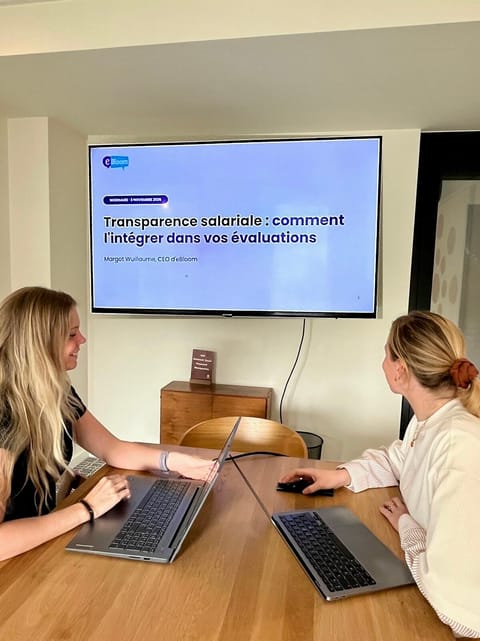
- Vos collaborateurs pourront bientôt voir le salaire de leurs collègues ? Quand on parle de transparence salariale, c’est une question qui revient souvent. La directive européenne devait être transposée en Belgique pour juin 2026. La loi se fait attendre, et en attendant, beaucoup d’idées reçues circulent. C’est pourquoi Louise Charlier et moi sommes en train de préparer un webinaire condensé pour apporter beaucoup plus de clarté à la situation. 📅 Le 3 novembre à 11h30, je prends 30 minutes pour faire le point avec vous : ✅ ce qui
- Comment est-ce qu’on en est arrivé là ? De quelques traits de crayon sur un papier en 2019, à un outil qui collecte des milliers de ressentis de collaborateurs chaque semaine. Entre ces deux moments, il y a eu 2000+ jours de développement. Quelques nuits blanches avant des déploiements ☕ Plus de 1000 idées reçues, triées, débattues (et parfois rangées dans un tiroir, désolée à ceux qui attendent encore leur bouton préféré 😅). Et surtout, des séances de définition produit avec nos clients, qui ont façonné l’outil autant que
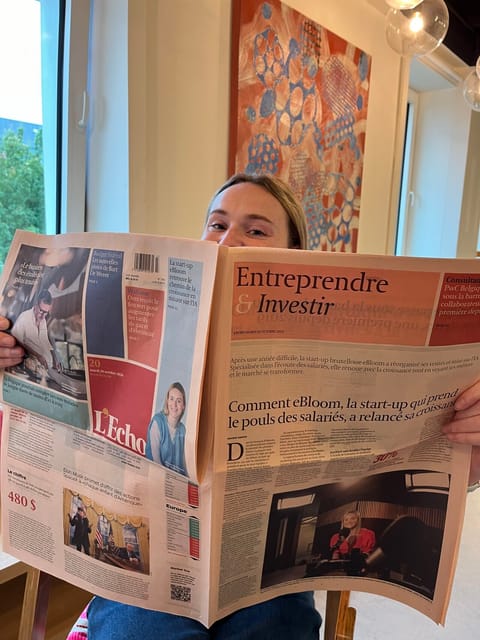
- Altercation très drôle avec mon libraire ce matin 😅 Il a été surpris autant que moi en découvrant L'Echo du jour. Je vous avoue que tenir ce journal entre mes mains m’a fait quelque chose. Pas pour la photo en couverture. Enfin… un peu quand même 🫣 Mais surtout pour ce que ça m’a obligée à faire : m’arrêter. Quand on construit une boîte, on a toujours le nez dans le guidon. Le prochain client, le prochain recrutement, la prochaine fonctionnalité, le prochain problème à régler (il y en a toujours un). On regarde devant, tout le
- The Future of Tech is Female is BACK! And it's taking over Brussels. 💜⚡ From 19 to 27 November, BeCentral becomes a vibrant meeting point for entrepreneurs, tech professionals, founders, investors, students, changemakers and curious minds ready to shape what's next. 7 days. 20+ events. One shared ambition: opening more doors for women in tech and entrepreneurship. 🔥 Bold conversations that challenge the status quo. 💡 Hands-on workshops to build new skills. 🚀 Inspiring founders sharing real stories. 🤝 Meaningful

- Il y a 7 ans, eBloom n’était qu’un mémoire universitaire. Voici ce qui s’est passé ensuite 👇 Une première année en montagnes russes, et encore aujourd’hui, celle qui m’a le plus marquée : - Démarrer un SaaS sans aucune compétence technique. - Se prendre le covid en pleine face 3 mois après le lancement et voir s’annuler, un par un, les 10 rdv qu’on avait fièrement réussi à booker. - Aucune rentrée financière, aucun budget à investir. On se débrouille comme on peut. Mais aussi : 💬 Les premiers ressentis de collaborateurs
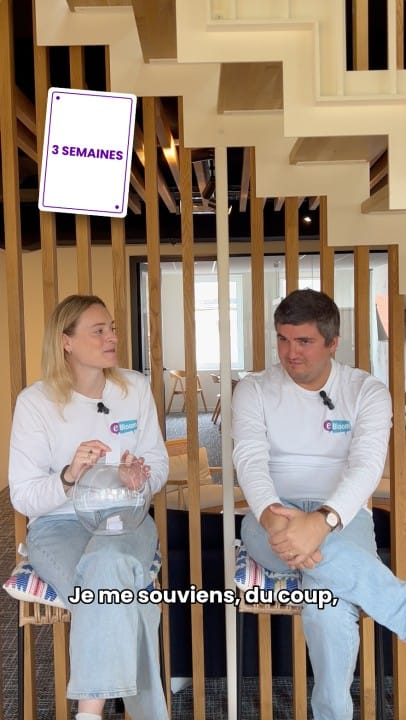
- Si je ne soulève pas la bouche d’égout, ça ne sent jamais mauvais. » Voilà ce qu’un dirigeant m’a répondu en 2019. 🙃 Force est de constater qu’à l’époque, le marché était encore peu ouvert au feedback continu en entreprise. L’écoute des collaborateurs, ça ressemblait à ça : Une grande enquête tous les 3 ou 5 ans. 120 questions. Et des résultats que les équipes ne voyaient presque jamais. L’engagement ? Un “nice to have”. Le genre de sujet qu’on reporte au trimestre prochain. Et puis, il y avait ceux qui avaient déjà tout
- Si je ne soulève pas la bouche d’égout, ça ne sent jamais mauvais. » Voilà ce qu’un dirigeant m’a répondu en 2019. 🙃 Force est de constater qu’à l’époque, le marché était encore peu ouvert au feedback continu en entreprise. L’écoute des collaborateurs, ça ressemblait à ça : Une grande enquête tous les 3 ou 5 ans. 120 questions. Et des résultats que les équipes ne voyaient presque jamais. L’engagement ? Un “nice to have”. Le genre de sujet qu’on reporte au trimestre prochain. Et puis, il y avait ceux qui avaient déjà tout
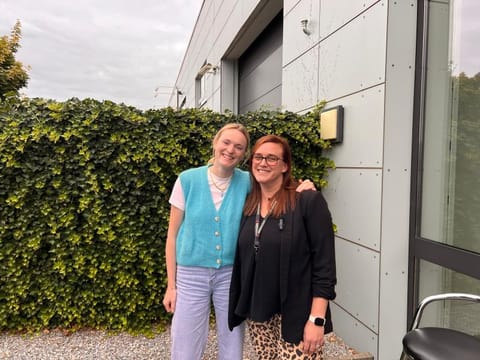
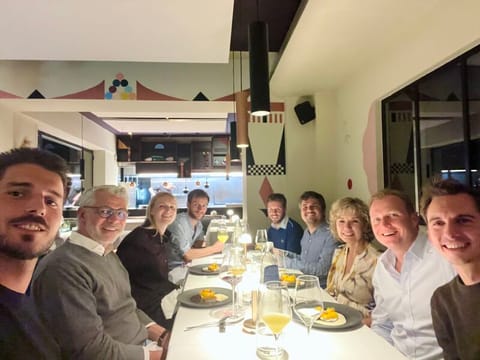
- On ne serait pas là sans eux. Je pense que le plus beau cadeau qu’on puisse recevoir en tant qu’entrepreneur, c’est d’être entouré de personnes comme celles-ci. Coachs, advisors, mentors… on peut les appeler comme on veut. Ce sont ceux qui sont toujours là : 👂 pour écouter nos doutes 💼 pour partager leur expérience 💬 pour nous conseiller 🙌 ou simplement pour nous taper sur l’épaule quand c’est nécessaire Ce matin encore, on se retrouvait pour notre Advisory Board trimestriel. Et comme à chaque fois, je suis ressortie de
Related profiles

This page shows public professional information only, each fact cited. Is this you? send a correction, or ask for removal within 24 hours, no questions asked.