Overview
Olivier Mangelschots is the founder of odum, a role he has held since March 2018, working as a fractional CIO. He is based in Gent and states expertise in digital transformation, enterprise architecture, IT strategy, ERP implementations and business process improvement.
Before founding odum he was at Deloitte, where from October 2015 to February 2018 he worked on digital accountancy, vision and strategy, and from January 2016 to February 2018 on business control and technology. He joined Deloitte through its 2016 acquisition of Orbit One, where he had spent two decades: as a system administrator and developer from December 1995, as project and IT manager from January 1999, as managing director from October 2002, and as owner and managing director from July 2008 until May 2016. His first role on record was as webmaster at Cyberk@fee in Gent from September 1994 to November 1995.
He completed a People Manager programme at Vlerick Business School in 2003, management and recruitment training at U-Man in 2005, a VMWare ESX Server course at Logix in 2008 and a Mini-MBA in Entrepreneurship at Innotek in 2011 and 2012. In 2018 he took the Transformational Presence Leadership and Coach Training at the European Center for Transformational Presence, followed by the Professional Coach Training Program at Coaching The Shift in 2018 and 2019.
Career history

Insights & ideas
The through-line
One idea runs through everything: somebody has to sit in the architect's chair, and in most mid-sized companies that chair is empty. The diagnosis is not laziness. "Het probleem is niet dat KMO's niets doen. Ze doen voortdurend iets — brandje per brandje, tool per tool. Wat ontbreekt is iemand die uitzoomt" [2]. Left unattended, the result is predictable: "Wie is de architect van jouw bedrijf? Als niemand die rol opneemt, groeit de spaghetti vanzelf" [7]. The same observation is what prompted the founding of odum.digital after the sale of a previous software development company to Deloitte: owners of businesses with 25 to 500 employees lacked a digital vision and leaned too heavily on IT integration partners, so decisions were taken without a holistic view [14].
The role that fills the empty chair is deliberately not the one people expect. "Dat is wat we bij Odum doen. Niet de brandweer. De architect die weet welk blok eerst mag" [10]. And the ownership question is framed a step higher than IT governance usually puts it: the question is not who owns the IT department but who owns the digital future, because "een lege stoel stelt geen vragen" [11].
On why "we willen digitaliseren" is not a strategy
Digitalisation is treated as a presenting symptom rather than a plan. "'We willen digitaliseren' is geen strategie. Het is een symptoom. De vraag eronder is: wat wil dit bedrijf eigenlijk worden? Wie die vraag kan beantwoorden, heeft het moeilijkste al gehad" [9]. That ordering, business intent first and technology second, is what the fractional CIO work is built on: designing the IT landscape and then selecting the technology and the implementation partners, including the ERP choice [4].
The same discipline applies to AI. The interesting question is not capability but foundation: "AI versnelt wat er is. Dus de eerste vraag is niet wat AI kan, maar wat jullie eronder hebben staan" [5].
On the system that still just works
The most dangerous piece of a KMO's landscape is not the broken one. "Het gevaarlijkste systeem in een KMO is niet het systeem dat kapot is. Het is het systeem dat nog net werkt" [10]. Directions then see only two moves, replacing everything, which is unfeasible, or carrying on, which is comfortable until it is not. The third way is sequencing: "Je haalt de toren niet omver. Je vervangt hem blok voor blok, in een volgorde waarin hij blijft staan" [10].
The reason companies keep choosing option two is structural rather than stubborn. A KMO is an operating machine, and a transformation lands on top of that machine, carried by people who have never done one before, so it gets postponed [6]. What is striking is not that firms keep going but what it costs to get out later: "elk jaar uitstel maakt de weg eruit duurder. Er bestaat een punt waarop je er niet meer op eigen kracht geraakt. De meeste directies weten niet dat dat punt bestaat, tot ze eroverheen zijn" [6].
On focus as speed
The brake on digital maturity is misdiagnosed as money or people. "De grootste rem op digitale maturiteit in een KMO is niet budget of talent. Het is alles tegelijk willen doen" [8]. The maturity model says pick one discipline; experience in KMO trajectories suggests something more pragmatic, pick one discipline at a time. Eighteen months of customer experience, covering e-commerce, CPQ and customer service, and only then operational excellence with ERP, WMS and MES [8]. The conclusion is stated flatly: "Focus is geen beperking. Het is snelheid" [8].
On staying close to the standard
Choosing consciously does not mean hunting for everything outside the suite. Usually the opposite [3]. Four rules of thumb for anyone working with Odoo: stay as close to the standard as possible and use the modules as intended, because that is where the strength of the suite sits; dare to integrate externally where a domain is strategic and outgrows the suite, a Shopify for a serious B2C webshop, an MES that goes beyond what Odoo can handle; limit customisation, because "moet je modules zowat herprogrammeren en weet niemand nog hoeveel werk erin zit, dan ben je waarschijnlijk verkeerd bezig"; and pick an Odoo partner who supports that vision and has experience with such integrations, since not every partner is equally strong there [3]. The advice comes with an explicit independence statement: the team implements no Odoo and takes no commission from any vendor, it only draws the architecture [3].
On the implementation gap
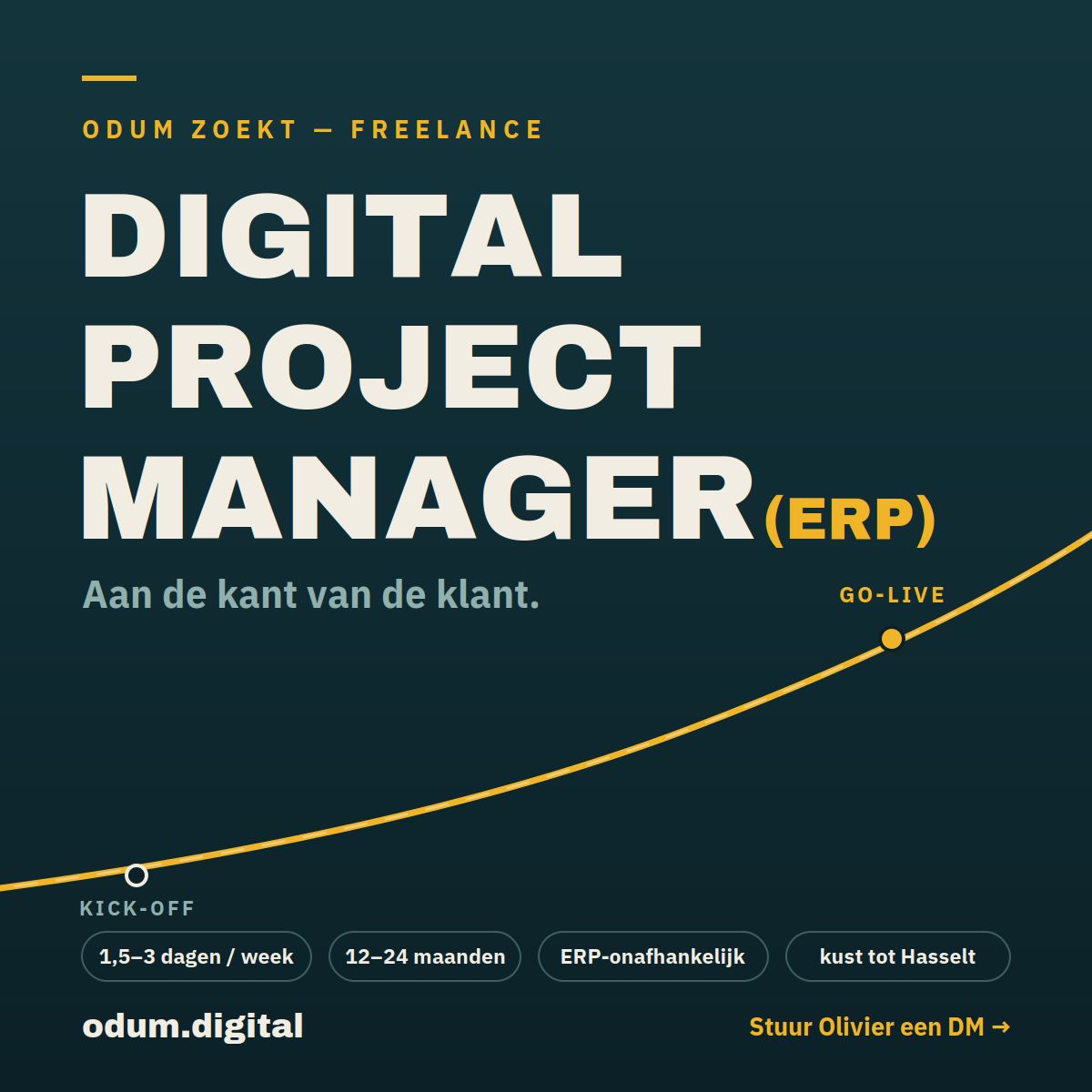
Designing the landscape and picking the partner is where most advice stops, and where the real problem starts. At many clients there is nobody internally who can carry a large and complex implementation, so that role is filled from outside, on the client's side of the table [4]. The shape of the job is specific: one and a half to three days a week per client, typically over trajectories of twelve to twenty-four months, guarding scope, guiding key users from old to new, pulling the data migration along, coordinating test phases, and leading go-live and adoption [4]. In practice the person becomes the client's super key user, owning change management, coaching and internal communication [4]. This capacity is built as a network of independent experts rather than a payroll [4].
On what to outsource and what to keep
For mid-sized companies of 25 to 500 or more employees, the bottom layer of IT infrastructure is largely standardised across industries, which makes complete outsourcing the sensible default, while business-specific applications need a different treatment [12]. The corresponding advice to IT partners is to standardise that layer and operate it efficiently across many customers [12]. One thing stays inside: in larger organisations, internal coaching roles are worth keeping so users get help with productivity tools [12].
On accountancy firms and staying relevant
For accounting firms the transformation rests on three pillars. First, internal efficiency, doing more with the resources already there. Second, the customer experience and the way service is delivered, including client portals and onboarding journeys. Third, and hardest, strategic repositioning: honestly evaluating whether today's services will still be relevant in three to five years, in markets that are moving quickly [13].
On the tools you think in
For more than twenty years OneNote was the brain, starting when it was still a file on a PC, long before the cloud, holding notes, research, transcripts, syntheses, deliverables and SOPs [1]. The whole of ODUM.digital moved to Notion four years ago, and he was the last one across, pulled in by Hans Nissens [1]. What the move bought was collaboration rather than storage: sharing a single page with a client without login trouble, working with Microsoft, Google or anything else, where OneNote forces you to share an entire notebook, all or nothing [1]. Once clients are on the page they participate, so a process analysis is walked through together with inline comments until there is an approved version, with no rounds of email [1]. Databases sit alongside pages, so a market study of sixty WMS systems becomes one page per record, fields at the top, notes and subpages underneath, viewable as a table, a board or filtered per client [1]. And navigation works like a wiki, linking to a page or a colleague with @ [1].
Takeaways
- Ask who owns the digital future, not who owns the IT department; an empty chair asks no questions and the spaghetti grows by itself [7][11].
- Treat "we want to digitalise" as a symptom and answer the question underneath it, what this company actually wants to become [9].
- Before asking what AI can do, look at what is standing underneath it, because AI accelerates whatever is already there [5].
- Replace the tower block by block in an order that keeps it standing, and act early, because every year of postponement makes the way out more expensive until you can no longer get there under your own power [10][6].
- Pick one discipline at a time, for example eighteen months of customer experience before touching ERP, WMS and MES [8].
- With Odoo, stay close to the standard, integrate externally only where a domain is strategic and outgrows the suite, limit customisation, and choose a partner who backs that approach [3].
- Budget for a client-side project lead on ERP implementations, one and a half to three days a week over twelve to twenty-four months, owning scope, key users, data migration, testing, go-live and adoption [4].
- Outsource the standardised infrastructure layer entirely, but keep internal coaching capacity in larger organisations for productivity tools [12].
Media & appearances
- BOLD AwardsYouTubeBOLD TALKS: Olivier Mangelschots on Restoring Digital Clarity, Strategy & Building Tech That EnduresOlivier Mangelschots discusses how he founded odum.digital after selling his previous software development company to Deloitte, identifying that mid-sized business owners (25-500 employees) lacked digital vision and relied too heavily on IT integration partners, resulting in decisions missing a holistic view.
- ODUM.digitalYouTubeTrends & opportunities for IT infra service providers (3/6)Olivier Mangelschots discusses the trend of outsourcing IT infrastructure completely for mid-sized companies (25-500+ employees) because the bottom layer is largely standardized across industries, while business-specific applications require different approaches. He argues that IT partners should standardize and efficiently operate infrastructure across multiple customers, though he keeps internal coaching roles for larger organizations to help users with productivity tools.
- ODUM.digitalYouTubeHoe relevant blijven als accountancy firm? Olivier Mangelschots | ODUM.digitalOlivier Mangelschots discusses three fundamental pillars of digital transformation for accounting firms: internal efficiency (doing more with existing resources), improving the customer experience and service delivery (including client portals and onboarding journeys), and strategic repositioning (evaluating whether current services will remain relevant in 3-5 years as markets evolve rapidly).
In the news
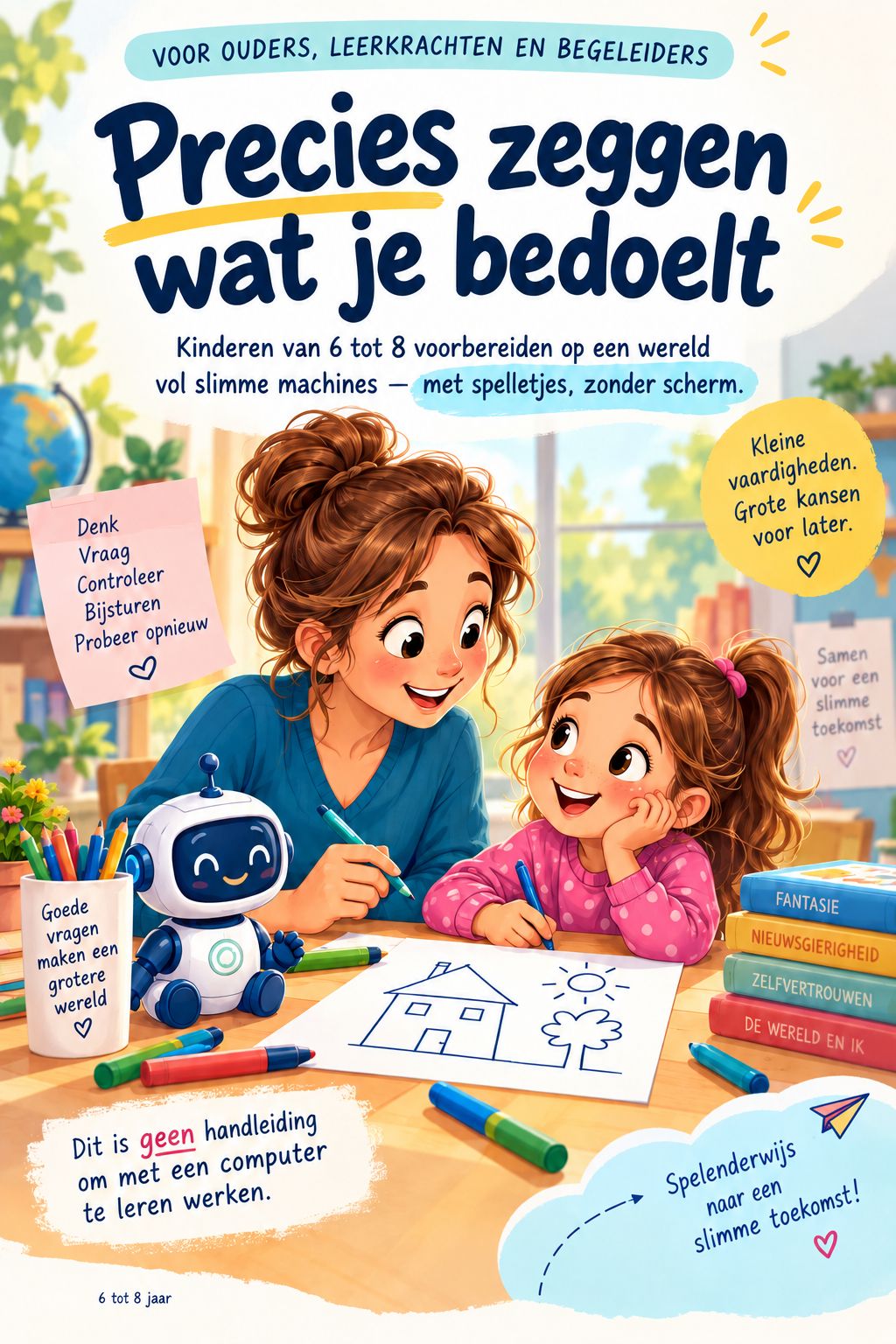
- Leer jij kinderen van 6–10 jaar al “prompten”? #AIreadiness En nee: ik bedoel niet dat we ze achter ChatGPT moeten zetten. Gisteren zat ik op de infoavond van het 2de leerjaar van mijn dochter en bleef één vraag hangen: Welke vaardigheden hebben onze kinderen nodig in een wereld waarin ze steeds vaker zullen samenwerken met slimme machines? Volgens mij vooral deze: 🗣️ precies zeggen wat je bedoelt 👀 beseffen dat de ander niet weet wat jij in je hoofd hebt 💡 goede vragen stellen 🔍 controleren of je kreeg wat je vroeg — én of het
- Microsoft heeft geld, developers en infrastructuur genoeg om morgen een Notion-clone te bouwen en te integreren in M365. Ze doen het niet. En dat is geen toeval. 🔁 Deze week kreeg ik de vraag of Microsoft Loop wordt uitgefaseerd. Officieel niet. In de praktijk wel: er komt niets meer bij, er gaat alleen nog af, en de technologie wordt gerecycleerd in Copilot Pages. Loop is geen product meer, het is een bouwsteen. 🧠 Ondertussen schakelen onze klanten (en wijzelf) massaal van M365 naar Notion voor kennis: consultancies, AI-first
- Laat je AI-oplossing bouwen door een externe partner? Dan koop je iets dat nooit af is — en waarvan alleen de bouwer weet hoe het verder moet. Steek dat budget in je eigen mensen. Bouw een interne community van AI Champions, begeleid door een onafhankelijke AI-adoptiecoach. Mensen die AI definiëren, modelleren en laten evolueren: over vijf jaar zijn dat kernprofielen in elk bedrijf. Geef ze geen vis, leer ze vissen — want de vijver verandert elke maand.
- Maakt AI SaaS en no-code overbodig bij KMO's? Mijn visie:
- Meer dan 20 jaar was OneNote mijn brein. Ik begon toen het nog een bestand op mijn pc was, lang voor de cloud. Nota's, research, transcripts, syntheses, deliverables, SOP's — alles zat erin. Vier jaar geleden stapten we met heel ODUM.digital over naar Notion. Ik was de laatste; Hans Nissens trok me erin mee 🙏☺️. Wat we wonnen: → Eén pagina delen met een klant, zonder logingedoe — werkt met Microsoft, Google of wat dan ook. In OneNote deel je minimaal het hele notebook: alles of niets. → En eens erbij, werken ze mee. Een
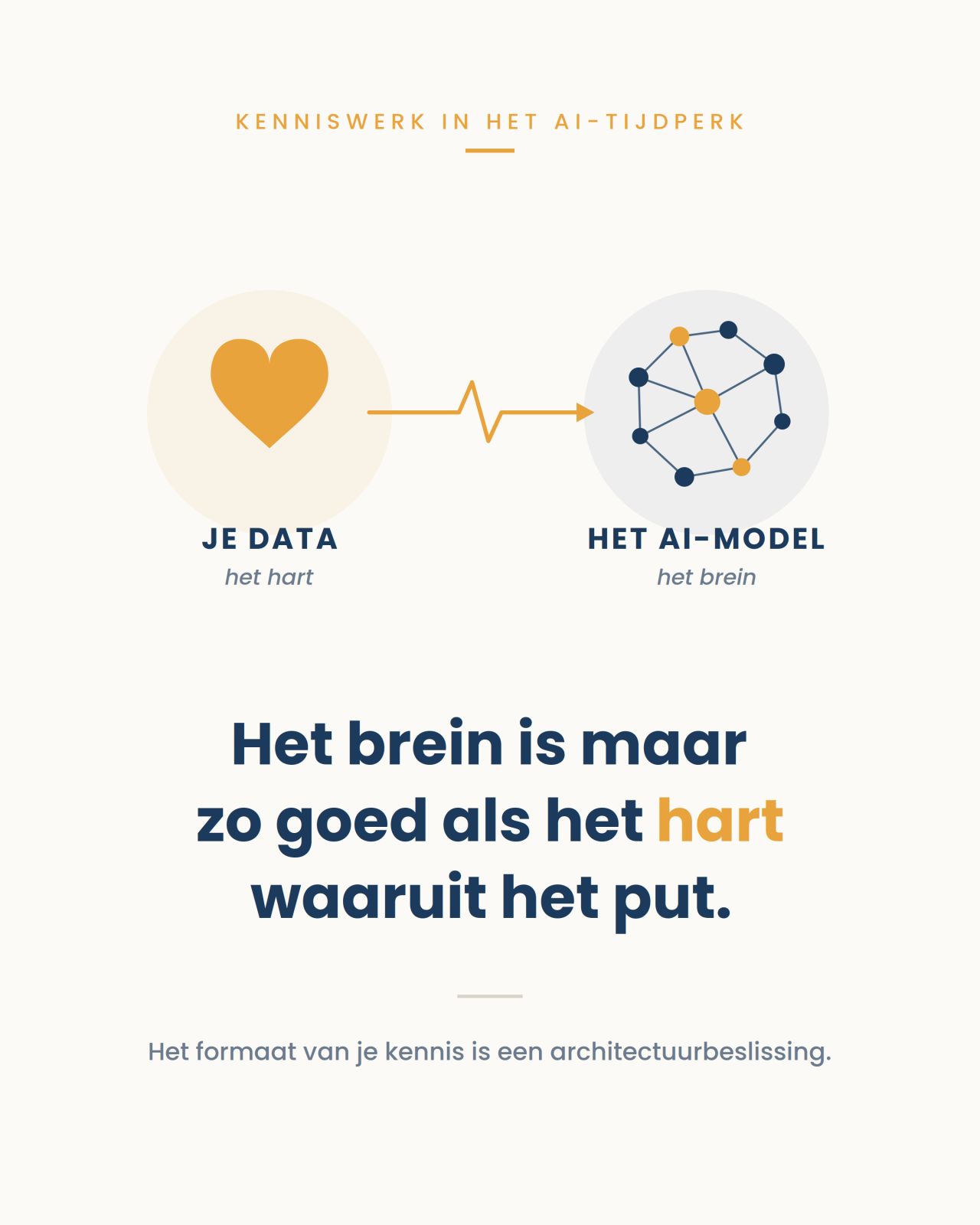
- Het probleem is niet dat KMO's niets doen. Ze doen voortdurend iets — brandje per brandje, tool per tool. Wat ontbreekt is iemand die uitzoomt.
- Bewust kiezen betekent niet: alles buiten Odoo zoeken. Meestal net omgekeerd. Mijn vier vuistregels voor wie met Odoo werkt: 1. Blijf zo dicht mogelijk bij de standaard. Gebruik de modules zoals ze bedoeld zijn — daar zit de kracht van de suite. 2. Durf extern te integreren waar een domein strategisch is en voorbij de suite groeit. Een Shopify als je een sterke B2C-webshop wil, een MES dat verder gaat dan wat Odoo aankan. 3. Beperk maatwerk. Moet je modules zowat herprogrammeren en weet niemand nog hoeveel werk erin zit, dan ben
- Gezocht: freelance Digital Project Manager (ERP) — aan de kant van de klant Bij ODUM.digital begeleiden we de Belgische mid-market (KMO's, familiebedrijven en non-profits, 50-500 medewerkers) als fractionele CIO. Onze Digital Challengers tekenen het IT-landschap uit en selecteren de technologie en implementatiepartners — waaronder de ERP-keuze. Maar dan start de implementatie — en bij veel klanten is er intern niemand die zo'n groot en complex traject kan trekken. Die rol vullen wij in. Daarvoor breid ik ons netwerk van
This page shows public professional information only, each fact cited. Is this you? send a correction, or ask for removal within 24 hours, no questions asked.