
Overview
Siderova studied at Sofia University St. Kliment Ohridski, completing a bachelor's degree between 2006 and 2010 and a master's degree in technological entrepreneurship and innovative management in information technologies between 2010 and 2012. She obtained IBQMI Certified Kanban Coach (September 2018) and Certified Lean Project Manager (October 2018) credentials, followed by Fit for Purpose (May 2019) and Kanban Coaching Professional (August 2019) from the David J Anderson School of Management. She was a guest on the Stellar Work Audio Transmissions podcast in June 2024.
Sonya Siderova is the founder and chief executive of Nave, registered as Nave Ltd. She is based in the Antwerp Metropolitan Area. Nave is a Kanban analytics and flow metrics suite for agile teams. Named customers include Syngenta, Ramsey Solutions, The Economist, Holcim, Doodle, Nubank and Uklon. The product has been SOC 2 compliant since May 2024 and is GDPR compliant. Atlassian named Nave Marketplace Rising Star Partner of the Year 2026 at Team '26 in Anaheim. The company describes itself as a small team, has recently launched AI-powered insights for flow analytics, and runs a newsletter community of about 60,000 subscribers. Nave began as a software development agency for startups. Around mid-2018, while Siderova was working with a five-person digital signage startup team that tracked work in Trello, no Kanban analytics tool on the market integrated with Trello, so the team built its own. That internal tool became the Nave product, and Siderova moved on to develop it full time. Siderova acts as product manager for Nave and writes its blog. She is a Kanban Champion, a Kanban Coaching Professional (David J Anderson School of Management, 2019) and holds IBQMI Certified Kanban Coach and Certified Lean Project Manager credentials from 2018. She speaks English, Dutch and Bulgarian.
Career history

Insights & ideas
The through-line
Across these sources, Sonya Siderova returns again and again to one conviction: decisions about work should come from evidence in the data, not intuition, authority, or habit. She repeatedly describes situations where a team looked healthy by traditional measures (velocity, sprint consistency) but was actually failing customers, and where the fix came from looking at flow data rather than working harder [1][3][14]. Over time this position sharpens from "prove there's a better way" toward something more behavioral: she has learned that evidence alone doesn't change minds, and that people need to arrive at conclusions themselves by comparing old and new approaches side by side [5][15]. Her focus has also broadened from individual team metrics toward systemic accountability, arguing that when commitments slip or burnout happens, the system is at fault, not the person absorbing the pressure [4][11].
On evidence over intuition
Siderova's writing is full of moments where she distrusts an average, a velocity chart, or a stable-looking board until she sees the underlying distribution. She found that one team's "mean was 21 days" while the "mode was 1 day," with a long tail to 130 days, concluding "if you don't know the probability, you don't know the risk you're taking when you make that promise" [9]. She applies the same instinct to a Scrum team whose "sprints were consistent" and "velocity was remarkably stable" yet whose work "was taking up to 76 days to reach the customer" [14]. Her general rule: "This is exactly why I want to see the evidence before I make a decision" [3], and she starts diagnosing not by asking how to move faster but "whether they needed to" [3].
On accountability and the system, not the person
She repeatedly redirects blame away from individuals toward the systems they work in. On delivery dates: "they're still expected to own the commitment... we start questioning the person making the forecast instead of the system that makes the forecast unreliable. I don't think that's where accountability belongs" [4]. On burnout: "I think we've put too much responsibility for burnout on the people experiencing it... The problem is the system they're working in," adding from her own experience running such a system that "some of the most committed people were the ones who absorbed that pressure for the longest" [11]. She extends this to transformation efforts, arguing leaders should "make every change prove itself before you make the next one" rather than designing an end state up front and pushing through it [7].
On changing minds and letting go of old habits
Siderova draws on a personal story, her daughter's teddy bear, to explain why proof isn't enough to make people change: "I used to think that if I could prove there was a better way of doing something, people would naturally want to change. I don't think that anymore" [5]. Her method now is to run new approaches alongside old ones until people trust the comparison, as with teams at Doodle who didn't believe a probabilistic forecast until they "tested them against" their own estimates and found "the forecasts were proving more reliable than their own predictions" [15]. She applies the same principle to herself, describing her instinct to jump to newly noticed problems as something that "never came naturally" to overcome, since "every interruption came with a perfectly reasonable justification" [13].
On focus and simplicity in improvement
She warns against loading teams with too many concepts at once: "Most improvement efforts fail because people try to learn everything at once... Every metric becomes equally important. Which means none of them are" [10]. Her preferred approach is sequential mastery: "Give the team one thing to get good at. Make it a habit. Once that's under control, introduce the next capability" [10]. This same preference for simple, low-cost interventions appears when she finds that removing a waiting state could cut delivery time by "around 30%" with "no additional people, no new tooling, no pressure to work faster" [3], and when she resolves technical arguments by returning to "what problem are we actually trying to solve here" instead of comparing solutions [12].
From the stage
In podcast appearances, Siderova discusses personal practices and philosophy not covered in her written posts. She describes committing to "no work after 5 p.m., on weekends, or during holidays" as a game-changing boundary that improved her mental clarity and creative thinking, and let her "revisit her purpose" and bring her whole self to work while feeling energized rather than drained [16]. She also explains how she persuades business leaders to invest in process improvement by framing initiatives around concrete outcomes like delivery speed rather than data collection itself, and describes using "blocker clustering analysis," distinguishing active time from waiting time, and threshold-based dashboard metrics to prioritize which bottlenecks to fix [17]. She further states her belief, after six years in the market, that successful teams "solve their own specific problems by pulling solutions from various approaches rather than following prescribed methodologies," rather than following any framework "by the book" [18].
Takeaways
- When diagnosing a delivery problem, look at the distribution behind an average before trusting it; one team's mean of 21 days hid a mode of 1 day and a tail to 130 days [9].
- Before asking a team to work faster, check whether waiting time, not work time, is the real cost; removing one waiting state could cut delivery time by about 30% with no new people or tools [3].
- Frame delivery commitments around risk tolerance, not just a date, using confidence-based options like "10 days, with 70% confidence" versus "20 days, with 95% confidence" [2].
- To change how people work, let them compare the new approach against the old one directly rather than just asserting it's better, as Doodle's developers did before trusting probabilistic forecasts over their own estimates [15][5].
- In improvement programs, introduce one habit at a time, such as "never let old work grow older," rather than teaching cycle time, throughput, WIP limits, and forecasting all at once [10].
- When a technical argument stalls, return the group to the underlying problem instead of comparing solutions, so no one has to "win" for a decision to get made [12].
Media & appearances
- Uncommon ChangeYouTubeLeading with Intention ft. Sonya SiderovaSonya Siderova discusses how she established work-life boundaries by committing to no work after 5 p.m., on weekends, or during holidays, which she credits as a game-changing practice that improved her mental clarity and creative thinking. She explains that respecting time off allowed her to step back, revisit her purpose, and bring her whole self to her work while feeling energized rather than drained.
- Uncommon Leadership PodcastYouTubeWhy Your Systems Decide Whether You SucceedSonya Siderova discusses how to persuade business leaders to invest in process improvement by framing initiatives in terms of concrete business outcomes like delivery speed rather than data gathering itself. She explains her approach to identifying and resolving bottlenecks in workflows using blocker clustering analysis and distinguishing between active time and waiting time, and describes using dashboards with threshold-based metrics to prioritize which bottlenecks to address and maintain system health.
- Stellar Work PodcastYouTube#4 Sonya Siderova - Flow Kanban Dashboards (getNave)Sonya Siderova discusses how Nave's Kanban Analytics tool helps teams improve their workflows by making data-driven decisions rather than rigidly following agile frameworks by the book. She explains that after six years in the market, she believes successful teams solve their own specific problems by pulling solutions from various approaches rather than following prescribed methodologies, and that Nave's purpose is to help teams identify what works in their own context to deliver better products faster.
In the news
- You can make your delivery metrics look a lot better without actually improving delivery. Just start the clock later. Imagine a customer asks for something in January. It sits in the backlog for three months, development starts on April 10, and five days later it’s in production. How long did it take to deliver? Five days? Or more than three months? Both numbers are technically correct. They’re just telling you very different things. And I think this is where we need to be really careful with delivery metrics. If I start measuring
- I saw a job posting for a Human-Centered Change Manager this week 😳 And I'm thinking, what other kind of change management is there? You can redesign the process. Change the operating model. Introduce a new tool. Roll out a new way of working. But at some point, people have to decide to work differently. That part cannot be rolled out. I’ve seen organizations spend months designing a transformation and then treat adoption as the final step. Train everyone. Communicate the change. Give them the new process. Measure whether they’re
- I love seeing what happens when a conversation doesn’t end when the session does. Marco took the conversation we started at the Kanban Leadership Retreat around AI, flow data and the human in the loop and developed it much further here. My favorite part is where he brings it back to the system itself. When the numbers can’t be trusted, AI isn’t creating the problem. It’s exposing decisions about the workflow and measurement that were never made explicit in the first place. Thank you for taking the conversation further, Marco.
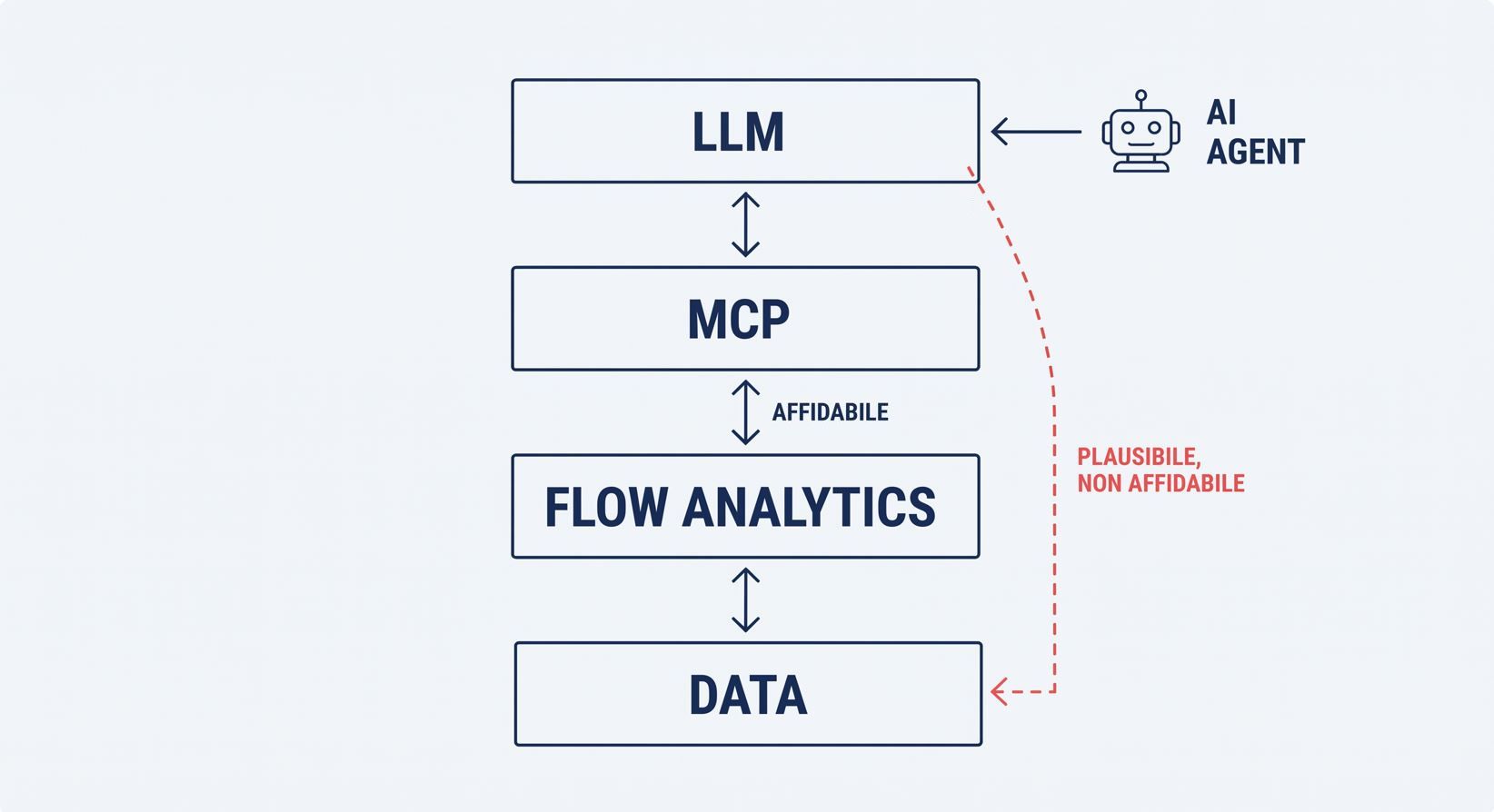
- An engineer wires the tracker's API to an LLM in a sprint, and the demo answers every question leadership throws at it. Months later a team renames two workflow states, the same question returns a different number, and nobody can say which one was right. Sooner or later, every one of these experiments arrives at that moment. And it's a decision, whether or not anyone treats it as one. The numbers your org plans around need an engine underneath them: calculation rules written down, tested, and applied the same way to every question,

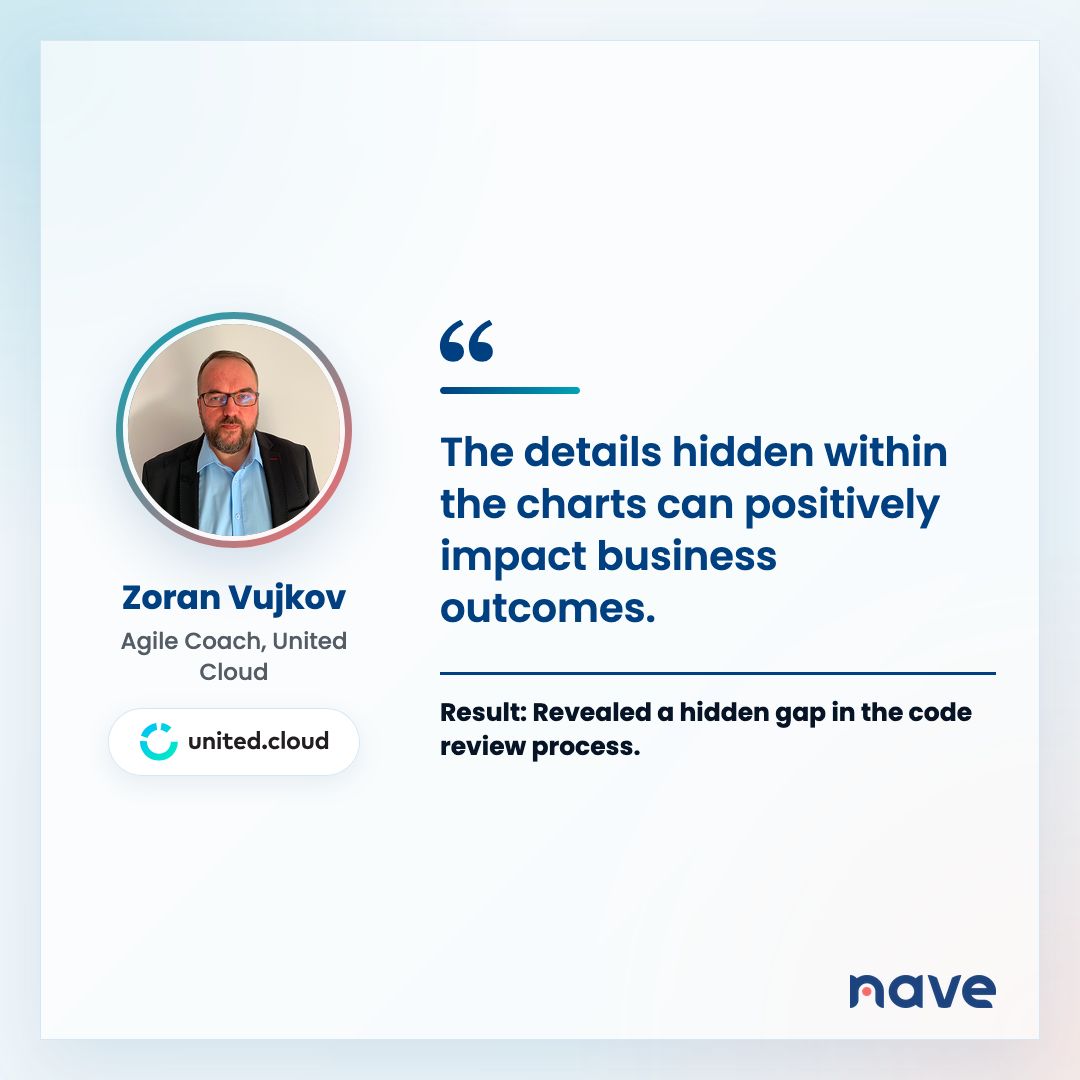
- Zoran Vujkov noticed something strange in the data. His teams were good at prioritizing work while it was being developed. Then the work reached code review. And somehow, those priorities disappeared. Zoran is an Agile Coach at United Cloud, working in an environment of more than 30 teams. While analyzing flow efficiency in Nave, he spotted the gap. As he put it: "We're really good at nailing down our priorities during development, there's a bit of a blind spot when it comes to code review." He could have stopped at "code review
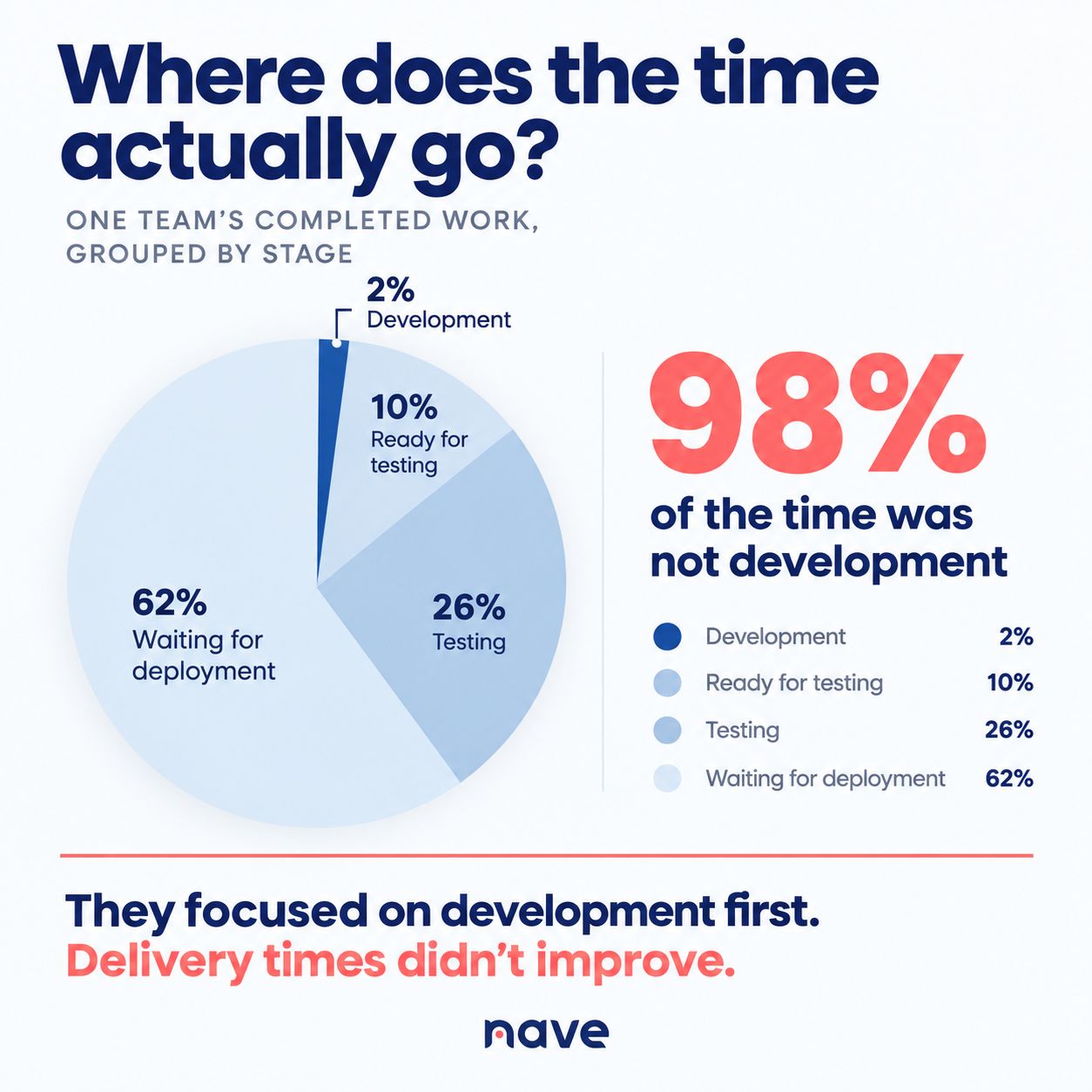
- Leadership tells you engineering is the bottleneck. They want you to help make development faster. What do you do? I wouldn’t argue with them. I also wouldn’t start fixing engineering. I’d test the assumption first. I can ask one question: “Take our completed work this quarter and tell me which stage the time actually went to.” I ran exactly that analysis on one of our Development boards. using Clause and the Nave MCP. Development never exceeded 2%. It was waiting for Deployment that represented 62% of the total delivery time.
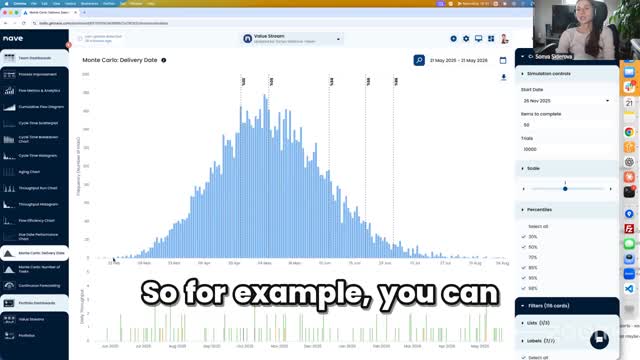
- Antony told me his team had delivered 85% of what they committed to in Q1. That’s a strong result. He attributed it to being ruthless about prioritization. Later in the conversation, I opened a forecast and showed him another piece of evidence I would want before making the next quarterly commitment: what has this team actually demonstrated that it can finish? The delivery history gave us a range of outcomes, each with a different probability. And that immediately gave him a threshold to work with. If the next quarterly plan
- Sometimes people tell me they don’t need predictability. They ship a few times a year and they always hit those dates. Or they have no deadlines at all, and the work is done when it’s done. And honestly, they have a point. If that’s the situation, predictability may not be a problem worth solving. But I think we’re asking the wrong question. The practices that make delivery predictable are the same practices that make delivery better. Predictability isn’t really the goal. It’s what starts to show up when the system itself gets
Related profiles

This page shows public professional information only, each fact cited. Is this you? send a correction, or ask for removal within 24 hours, no questions asked.