
Overview
Solvice was founded in 2015 in Ghent by Christophe Van Huele and Kenny Helsens. Van Huele earned a PhD at Ghent University researching combinatorial optimization for healthcare scheduling and built the company's first solution for a large university hospital in Leuven. He serves as Founder and CTO. Bert Van Wassenhove serves as CEO. The company operates from Kleindokkaai 19 in Ghent with a team in the 11 to 50 range.
The product suite is delivered as APIs that embed mathematical optimization and machine learning into customer applications. OnRoute solves constraint-based vehicle routing across fleets, handling capacity, skills, service windows, and multi-day planning. OnShift automates workforce scheduling and shift generation under labour-law and SLA constraints. OnPick covers warehouse picking, OnStock covers inventory optimization, and additional Drive Time Matrix and Directions APIs round out the stack. The company cites up to 35% road-time reduction through its optimization layer.
Solvice raised an early round from imec.istart. On 2 April 2026 Quickbase, an AI operations platform owned by Vista Equity Partners, acquired Solvice NV to extend its resource management capabilities. Financial terms were not disclosed. Initial integration plans target embedding OnRoute into FastField Pro and OnShift into Quickbase Business and Enterprise during the second half of 2026, while the standalone APIs remain available to existing customers.
Funding history
- imec.istart pre-seed round
- 2 April 2026: Acquired by Quickbase (Vista Equity Partners portfolio); terms undisclosed
Key people


In the news
- A home health planner sits down Friday afternoon with 30 patient visits to route. She has until 4pm. She will pick a decent order, check it against the rules she remembers, and ship it. The plan will be fine. The hours she spent building it will never appear in anyone's business case, because planning time does not show up in the fuel bill. It shows up when the operation tries to grow and the planning job will not scale with it. Wanda Space: a 6 hour scheduling process, now under 30 minutes. UZ Leuven: three days of scheduling work
- Any vendor who hands you a single ROI percentage for route optimization is guessing. Including us. The number moves on four things about your operation: jobs per resource per day, distance between jobs, cost of a job, and how long a job takes. Two field service companies with identical technician counts can land in completely different places on the same project. What we can tell you is where the value shows up. Drive time: BPS cut 23% across 47 technicians. Planning time: Wanda Space went from a 6 hour scheduling process to under
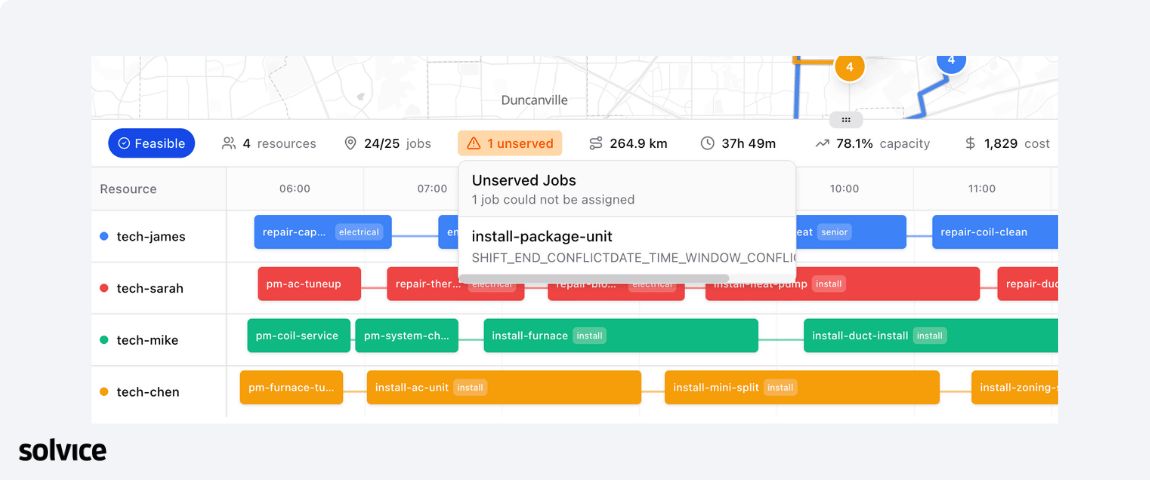
- Log the reasons your solver returns and read the distribution across a month rather than a shift. Skill constraints dominating usually means your certification data is stale, not that you are short of qualified people. Capacity constraints dominating usually means the vehicle model is wrong, or the wrong vehicles are on the wrong rounds. Time window conflicts dominating often means sales is promising windows operations cannot serve. Most teams read an unassigned job as "the day was full". More often it is a modeling defect that
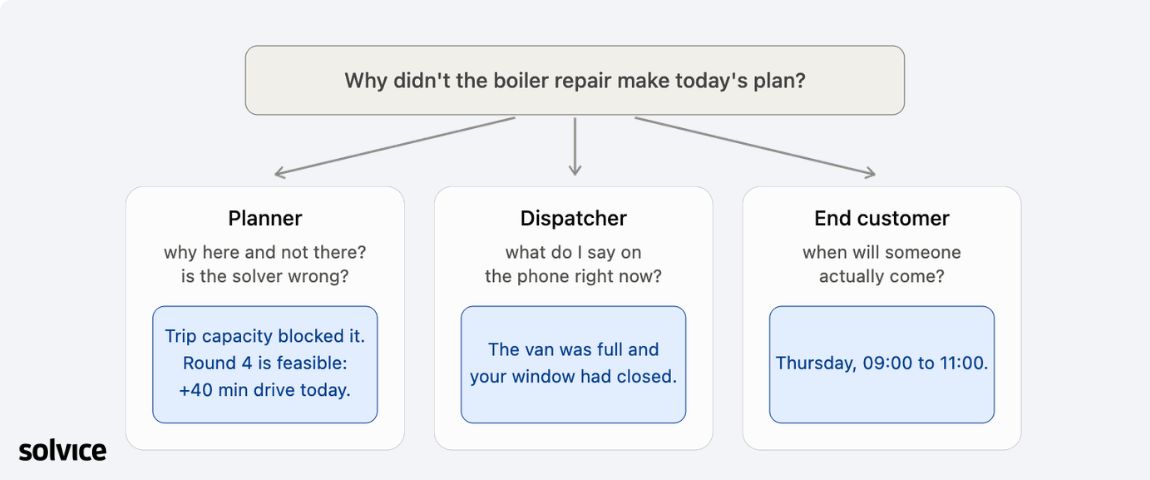
- At 08:40 a dispatcher takes a call. The boiler repair booked yesterday did not make today's plan, and the customer wants to know why. Every scheduling product has to render that screen eventually. Most render it empty, and "the system could not fit it in" is not a reason, it is an apology. Three different people ask why a job went unassigned, and none of them want the same answer. The planner needs the binding constraint and what the alternatives cost. The support agent needs one sentence. The customer needs Thursday morning, not a
- 𝗪𝗵𝗲𝗿𝗲 𝗱𝗼𝗲𝘀 𝗔𝗜 𝗮𝗰𝘁𝘂𝗮𝗹𝗹𝘆 𝗳𝗶𝘁 𝗶𝗻 𝗮 𝗹𝗼𝘄-𝗰𝗼𝗱𝗲 𝗮𝗽𝗽? 𝗡𝗼𝘁 𝘄𝗵𝗲𝗿𝗲 𝗺𝗼𝘀𝘁 𝗽𝗲𝗼𝗽𝗹𝗲 𝗮𝗿𝗲 𝗽𝗼𝗶𝗻𝘁𝗶𝗻𝗴 𝗶𝘁. Ask a language model to build the schedule and it returns something that looks right and quietly breaks half your constraints. It predicts text. It does not search a space of millions of possible plans. So split the work. The low-code platform holds the data and the people. A constraint-based solver makes the decision, feasible by construction. And an AI assistant sits on
- 𝗟𝗲𝘁’𝘀 𝘁𝗮𝗹𝗸 𝗮𝗯𝗼𝘂𝘁 𝗟𝗼𝘄-𝗖𝗼𝗱𝗲 𝗮𝗻𝗱 𝗢𝗽𝘁𝗶𝗺𝗶𝘇𝗮𝘁𝗶𝗼𝗻 𝗔𝗜 Low-code and AI let almost anyone build the app their business runs on. The catch: build everything as code, especially without a software background, and you get a black box. A heap of logic nobody can see into. The fix is not less building. It is where you build. On a low-code platform your data stays visible and access-controlled, like spreadsheets you own. Then you plug the hard decision, routing, scheduling, the combinatorial part, into a
- 𝗜𝗳 𝘆𝗼𝘂 𝗿𝘂𝗻 𝗳𝗶𝗲𝗹𝗱 𝘀𝗲𝗿𝘃𝗶𝗰𝗲 𝘀𝗰𝗵𝗲𝗱𝘂𝗹𝗶𝗻𝗴 𝗶𝗻𝘀𝗶𝗱𝗲 𝗠𝗶𝗰𝗿𝗼𝘀𝗼𝗳𝘁 𝗗𝘆𝗻𝗮𝗺𝗶𝗰𝘀 365, 𝗼𝗻𝗲 𝗾𝘂𝗲𝘀𝘁𝗶𝗼𝗻 𝗱𝗲𝗰𝗶𝗱𝗲𝘀 𝘁𝗵𝗲 𝗿𝗲𝘀𝘁: 𝗪𝗵𝗶𝗰𝗵 𝘀𝗼𝗹𝘃𝗲𝗿 𝘀𝗶𝘁𝘀 𝘂𝗻𝗱𝗲𝗿𝗻𝗲𝗮𝘁𝗵 𝘁𝗵𝗲 𝗱𝗶𝘀𝗽𝗮𝘁𝗰𝗵? Our customers have been embedding the Solvice APIs in Dynamics 365 for over three years, across use cases of very different complexity, and in SAP and Quickbase too. The integration is the easy part. The solver is where field service is won or lost. OnRoute carries
- 𝗥𝗼𝘂𝘁𝗲 𝗼𝗽𝘁𝗶𝗺𝗶𝘇𝗮𝘁𝗶𝗼𝗻 𝗶𝗻 𝘄𝗮𝘀𝘁𝗲 𝗰𝗼𝗹𝗹𝗲𝗰𝘁𝗶𝗼𝗻 𝘂𝘀𝗲𝗱 𝘁𝗼 𝗯𝗲 𝗮 𝗯𝗮𝗰𝗸-𝗼𝗳𝗳𝗶𝗰𝗲 𝗰𝗼𝘀𝘁 𝘁𝗼𝗼𝗹. 𝗧𝗿𝗶𝗺 𝗳𝘂𝗲𝗹, 𝘁𝗶𝗱𝘆 𝘁𝗵𝗲 𝘀𝗰𝗵𝗲𝗱𝘂𝗹𝗲, 𝗺𝗼𝘃𝗲 𝗼𝗻. That is changing. Operators now use it to win municipal contracts, cover labor shortages, and hold service reliability as expectations rise. 20 percent-plus efficiency, pointed at growth, not just cost. The word doing the work is strategic. And strategic only holds if the solver models what waste actually runs on: multi-trip

Alumni 1 went on to found or lead
 Kenny HelsensCo Founder→Founder at Crane Bioworks
Related profiles
Something wrong or missing? Send an update. Fixed within 24 hours.