
Overview
Gilles Mattelin has achieved two acquisitions before the age of 40, making him one of the more prolific exits-to-fund operators in the Belgian tech market.
His first exit came at Intuo, a Ghent-based HR tech and performance management platform that Gilles co-founded. Intuo was acquired by Unit4 in March 2019. At Intuo, Gilles served as Co-Founder and VP Sales, building the commercial side of the platform.
After Intuo, Gilles co-founded Henchman alongside Jorn Vanysacker and Wouter Van Respaille during the COVID pandemic, launching the product in June 2021. Henchman is a Ghent legal AI company that helps lawyers search, reuse, and draft contracts faster using AI-powered clause retrieval from a firm's own document history. The company raised EUR 6.5M Series A in 2023 and was acquired by LexisNexis in 2024, launching as Lexis Create+.
Following the Henchman exit, Gilles and Jorn Vanysacker formalized their investment activities into 100IN, a EUR 12M pre-seed fund targeting Belgian and European product-focused startups with EUR 100K checks. The fund aims to back 100 companies. Julie Capiau joined as a third partner.
Gilles also founded Tout Bien Pils, a Belgian craft beer brand, reflecting a broader entrepreneurial curiosity beyond pure tech. He has invested in more than 20 startups over his career.
Earlier in his career, Gilles was Business Development Manager at Medufy, an e-learning platform for healthcare professionals.
Gilles operates as a hands-on commercial founder who builds product-led companies with strong sales cultures. His two SaaS exits, in HR tech and legal AI, demonstrate a consistent ability to find enterprise software niches with acquisition-grade value. The 100IN pre-seed model reflects his belief that Belgium needs more early-stage capital density.
Career history
- Managing Partner2024 - present100INEUR 12M pre-seed fund, EUR 100K tickets, 100 target companies
- Co-CEO & Co-Founder2020 - 2024Henchmanlegal AI, acquired by LexisNexis 2024
- Foundercraft beer brand, ongoingTout Bien Pils
- Co-Founder & VP SalesHR tech / performance management, acquired by Unit4 March 2019Intuo
- Business Development ManagerMedufye-learning, healthcare
- Founder100IN


Education
Finance ManagementVlerick Business School
- FBFinance / BusinessFlanders Business School (FBS))
Talks about
Insights & ideas
The through-line
The consistent position across everything Gilles Mattelin says is that ignorance and speed beat preparation. He describes starting out as "pure naïviteit denk ik. En moest ik zo naïef niet geweest zijn, ik had het misschien gedaan, hè. Wij wisten niks hè. Niks. Letterlijk niks." [4], and rather than treating that as a warning he treats it as the enabling condition. The advice that follows is blunt and repeated: "Als je die ambitie van dagen hebt, stel het dan niet lang uit en begint daar gewoon aan" [4], or more directly, "Just do it hè. Just just [ __ ] jump hè." [3] He is explicitly contrarian about the resume-first route, arguing against spending two years at a Big Four before founding because "je leert het sowieso pas als je een start-up start" [4], and against secrecy, since 99% of people who hear your idea will never act on it [4].
What has moved between the first company and the second is not the appetite for the jump but the discipline applied afterwards. Intuo is consistently described as the lesson: three products, three product teams, no focus [4], a fought integration and a broken earnout [4]. Henchman is the corrected version: one thing done well, a stated ambition announced out loud, buyers cultivated years in advance, and an exit engineered rather than accepted [3][4]. The underlying belief that survives both is about temperament: "Degene die volharden en die nieuwsgierig blijven, die winnen wel in the end sowieso." [3]
On selling the company
His M&A playbook starts long before there is a deal. Know from day one who could realistically buy you and build the relationship years ahead: Henchman understood that only Thomson Reuters, Litera and LexisNexis were plausible acquirers, and had been dining annually with LexisNexis corporate development for two years before the transaction happened [3]. When the negotiation arrived, leverage came from artefacts that already existed, the minimum-exit clause of €75M in the Adjacent term sheet and incoming funding offers of €100 to €120M, both used to argue that the board simply would not sell below those thresholds [3]. He is realistic about who comes knocking: "Besef goed, eenmaal je begint en als je goud in handen hebt, dan komen de Amerikanen achter u aan" [4], and equally aware of the asymmetry, "We zijn een mier hè. Een mier in vergelijking met een olifant en toch boeiten en zijn ze mee bezig." [4]
Running the process is a second job, which is why he credits the co-CEO structure as the decisive structural advantage during the sale: one CEO kept hitting revenue targets, which is essential while you are raising, while the other ran the parallel M&A track, since negotiating with 20 VCs is already full-time work on its own [3]. The ambition was never hidden either. "We staken ook niet onder stoelen of banken. We're gonna scale. We gaan snel groot worden en we gaan voor midden verkopen." [4]
On earnouts and integration
This is where he is most emphatic, because it is where he was burned. Refuse revenue-based earnouts in a strategic acquisition; they structurally misalign buyer and seller, as Intuo learned painfully [3]. The Intuo failure had a behavioural half as well: they promised employees nothing would change, then resisted being integrated by Unit4, which killed morale and the earnout [4]. His conclusion is that the acquirer will always want to integrate you fast, so fighting that is self-sabotage [4]. At Henchman they refused an earnout entirely, aligned instead on technical integration milestones such as implementation and merging [3][4], and told staff on day one "it's gonna change" [4]. The result was frictionless: nobody was stressed, and the acquirer got the two-year competitive head start it was paying for [3][4].
He applied the same logic to how the proceeds were split, rejecting LexisNexis structures that would have enriched the founders while shortchanging shareholders and employees [3]. Getting everyone paid cleanly also removed weekly shareholder pressure during the earnout period [3]. The reasoning is reputational as much as ethical: "Wij gaan geen money grab doen waarin dat wij rijk zijn maar dan de rest pist is op ons. Wij willen echt gewoon iedereen recht in de ogen. Gent is te klein daarvoor." [3]
On raising capital
His position is that the best moment to raise is the moment you have the least to show. Raise pre-product and pre-go-to-market, because before sales exist investors can only dream, whereas once you have customers they can call the unhappy ones and check the targets you missed, which makes later rounds harder to defend [4]. A second-time founder should therefore raise more, earlier, and spend it on experienced people: Henchman poached sales talent from Showpad and Silverfin and had CRM, customer success and a chief of staff in place before the first customer [4]. Capital is also what makes the guts usable in the first place, all you really need being "the guts, the dream, a good team (and a shitload of working capital 😅)" [2].
He is sharply critical of what the outlier stories have done to the market. Lovable and Aikido have blinded early founders into demanding insane valuations without a plan, and failing to grow into an over-valuation produces downrounds that destroy credibility with both the market and employees [3].
On focus and knowing your one number
Intuo is his case study in dilution of effort, with three products and three product teams and no clarity [4]. Henchman was deliberately the opposite, "one thing and one thing good": a single search bar, one pitch, one dev team, which made everything downstream from marketing to sales simpler [4]. That focus was expressed numerically too. The North Star metric was time-to-meaningful-action from a search result, repeated to everyone in the company, sitting under an explicit goal to sell to 30,000 lawyers and exit for over €100M by 2026, a target they beat on both speed and size [4].
Focus does not mean rigidity. The willingness to pivot on customer feedback was decisive at Intuo, where a white-label request from Fagron turned a course product for GPs into the learning management system that became the talent platform [3]. He looks for the same reflex in others, admiring a known Ghent second-time founder who is throwing everything overboard for a new product on the reasoning that every day of waiting means less capital left [4].
On inbound first
Growth advice is unusually specific. At both Intuo and Henchman inbound leads converted far better than outbound, and 60% of leads were inbound [4]. The instruction that follows is to be "inbound first": build the brand and the content before you scale an outbound sales motion [4].
On old markets and brand
He treats non-tech categories as an inversion of the software playbook. In beer, you disrupt a commodity product with brand and strong online profiles, his reference point being Average Rob playing the role that Paul and Logan play for Prime [4]. The capital should be smart money in the literal sense, investors who understand distribution and horeca contracts [4]. The same instinct shows in launching La Patate on the back of a team, a dream and investor working capital [2]. The reward he keeps returning to is not the outcome but the transformation: "Het is zo mooi om iets te kunnen dromen en dan dan werkelijkheid maken." [4]
On founding with friends
He rejects the standard warning outright. "Veel mensen zeggen ook dat dat een dom idee is hè om met vriend te ondernemen. Maar ik vind dat juist een best idee, want je kent ze het best. Dus waarom zou je dat doen met een wild vreemen?" [4] The argument is simply informational: you have more data on a friend than on a stranger, and that knowledge is what the partnership runs on.
On investing and what he backs
At 100IN, the €100K-ticket pre-seed fund, the filter is the person rather than the product. Decisions are often made within an hour, based on whether the founder is a "krijger" with the same fire he recognises in himself, with due diligence largely left to co-investing funds [4]. That deference extends to founders whose choices he would not make himself: "Wie ben ik dan om te zeggen dat ze dat niet mogen doen?" [4] The qualities he looks for in the people around the fund mirror the ones he looks for in founders, someone analytical and curious who is "not afraid to challenge assumptions" and wants a front-row seat to the Belgian and European startup ecosystem [1].
The ambition behind all of it is regional. He wants to watch the city grow into "een soort van Europese centrale tackhub die kan concurreren met Silken Valley, wie weet ooit" [4], which is also why reputation is treated as a hard constraint on how deals get done [3].
Takeaways
- Identify your three plausible acquirers on day one and start having dinner with their corporate development teams years before you need them; Henchman knew only Thomson Reuters, Litera and LexisNexis could buy them and had two years of annual dinners with LexisNexis behind the deal [3].
- Never accept a revenue-based earnout in a strategic acquisition; tie it to integration milestones instead, and tell staff on day one "it's gonna change" rather than promising nothing will [3][4].
- Raise before you have a product or a go-to-market, because once customers exist investors can call the unhappy ones and audit your missed targets [4].
- Be inbound first: at both Intuo and Henchman 60% of leads were inbound and converted far better than outbound, so build brand and content before scaling outbound sales [4].
- Do one thing well and give the whole company one number; Henchman ran on a single search bar and a time-to-meaningful-action North Star, against a stated goal of 30,000 lawyers and a €100M+ exit by 2026 [4].
- Run a co-CEO split during a sale process, with one founder protecting revenue targets and the other running M&A, since negotiating with 20 VCs is already a full-time job [3].
- Do not price your round off Lovable or Aikido; failing to grow into an inflated valuation triggers a downround that costs credibility with both the market and your employees [3].
- Skip the two years at a Big Four and pitch your idea openly, because "je leert het sowieso pas als je een start-up start" and 99% of listeners will never act on it [4].
In the news
- La Patate just raised funding and is scaling fast. They're looking for someone to build the operational playbook as they grow. 🍟 👉 If you've got multi-site or hospitality ops experience and know someone who fits, tag them below or reach out to me or Gilles Mattelin directly.
- Join us! 🍟 La Patate is hiring an Operations Manager to sit at the management table from day one and build the playbook that takes us from 1 to 20 (or more) locations, without losing an ounce of quality along the way. If you've got hospitality or multi-site experience, run things by the numbers, and want to build an organization rather than just manage one — let's talk. 👉 https://lnkd.in/eqzE3p2Y

- Einde, Bedankt en dan nu lekker verder knallen 💥🍟
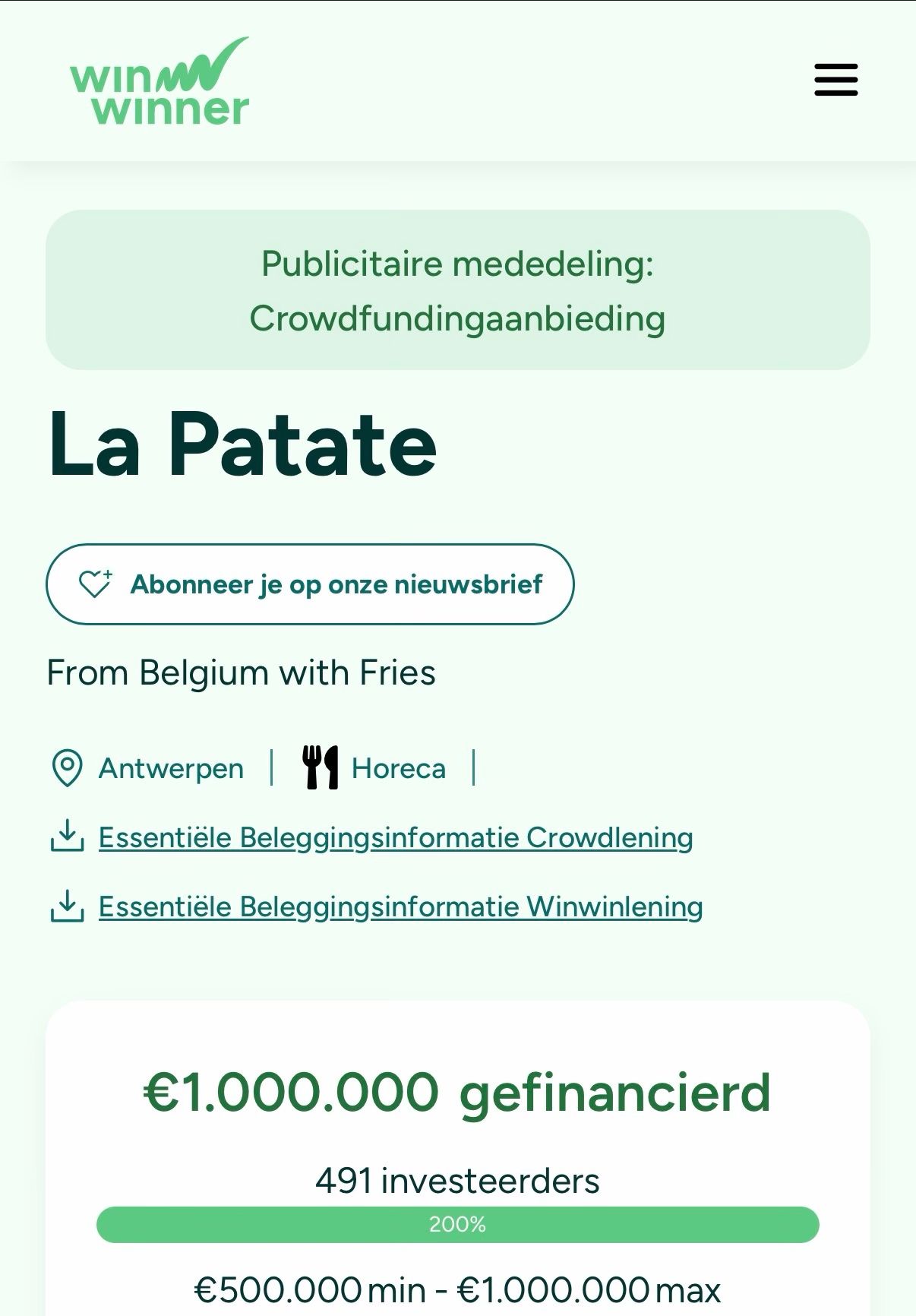
- Vlaanderen kan zich zijn afkeer van ambitie niet meer veroorloven. We hebben geen gebrek aan talent, kennis, ideeën of kapitaal. Wat we niet hebben is een cultuur waar we elkaar succes gunnen. Dat is dit weekend nog eens heel duidelijke geworden met de hetze rond de crowdfunding van La Patate. In Vlaanderen bewonderen we ondernemerschap zolang het bescheiden blijft. Een bedrijf mag groeien, maar liefst niet te snel. Een ondernemer mag succesvol zijn, maar niet te zichtbaar. Anders slaat bewondering heel snel om in argwaan. Die
- De friet is in opmars, denk ik.. ? Anders hadden we toch zoveel aandacht niet verdiend? Of is de media gewoon uit op CLICKBAIT? Met La Patate geven we iedereen de kans om mee te investeren, via een lening met een vast rendement. Te veel, te weinig, te lang, te kort: daar ga ik hier niet over discussiëren. Wie het niks vindt, tekent gewoon niet in. Wie erin gelooft, is welkom aan tafel. Het is simpel voor ons, we willen de Belgische frietcultuur laten schitteren. Vandaag in België, morgen hopelijk als exportproduct waar de rest
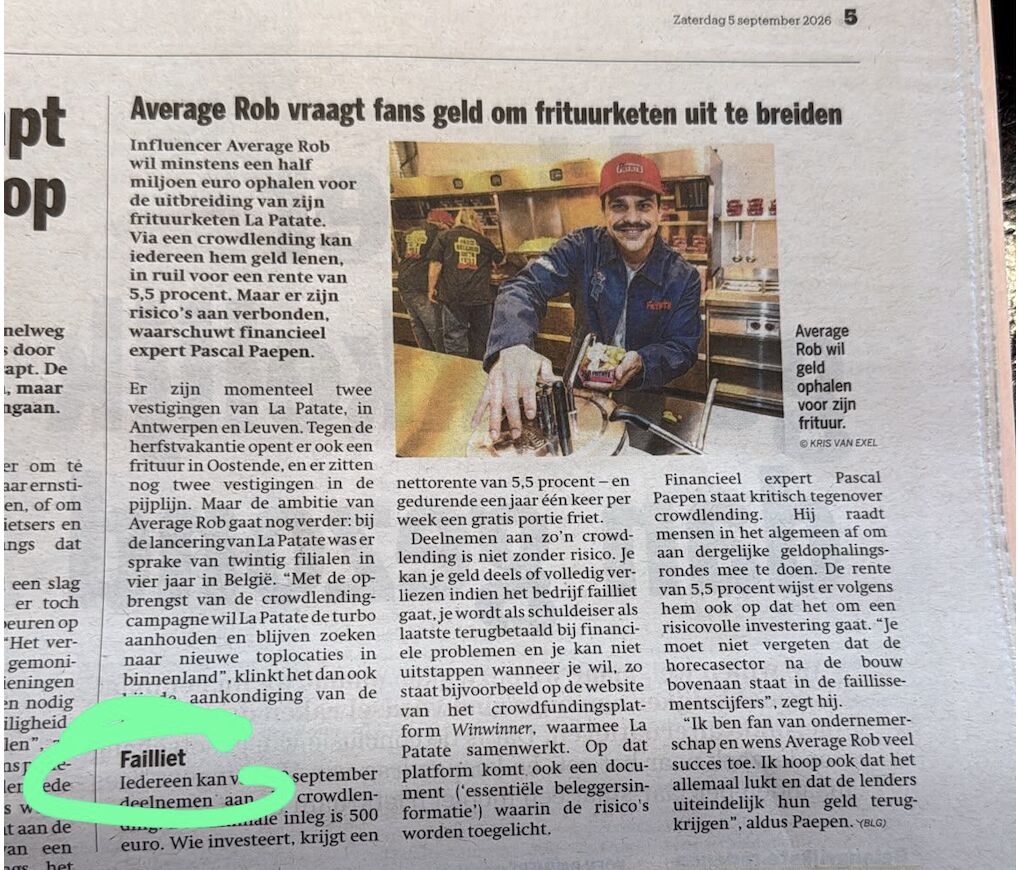
- If your work drains you, that's not normal. Go change it! I thought summer was going to be dead in VC. Turned out different. Nevertheless, I had the best summer ever. A job takes your energy. But when you start doing what you love and you are surrounded by the BEST people, it gives you energy. So grateful for this dream-team. 🍉❤️ Jorn Vanysacker Gilles Mattelin Stef-Kamil Fissette 100IN
- It was going to be a quiet summer, they said... Wild what you can pull off with great people around you <3 Eline Biesmans, Wim Maeyens, Jorn Vanysacker, Julie Capiau, Emiel Huughe, Lennert Bogaert, Leen Baeten, Jan Froyman, Stef-Kamil Fissette, Sien Declercq
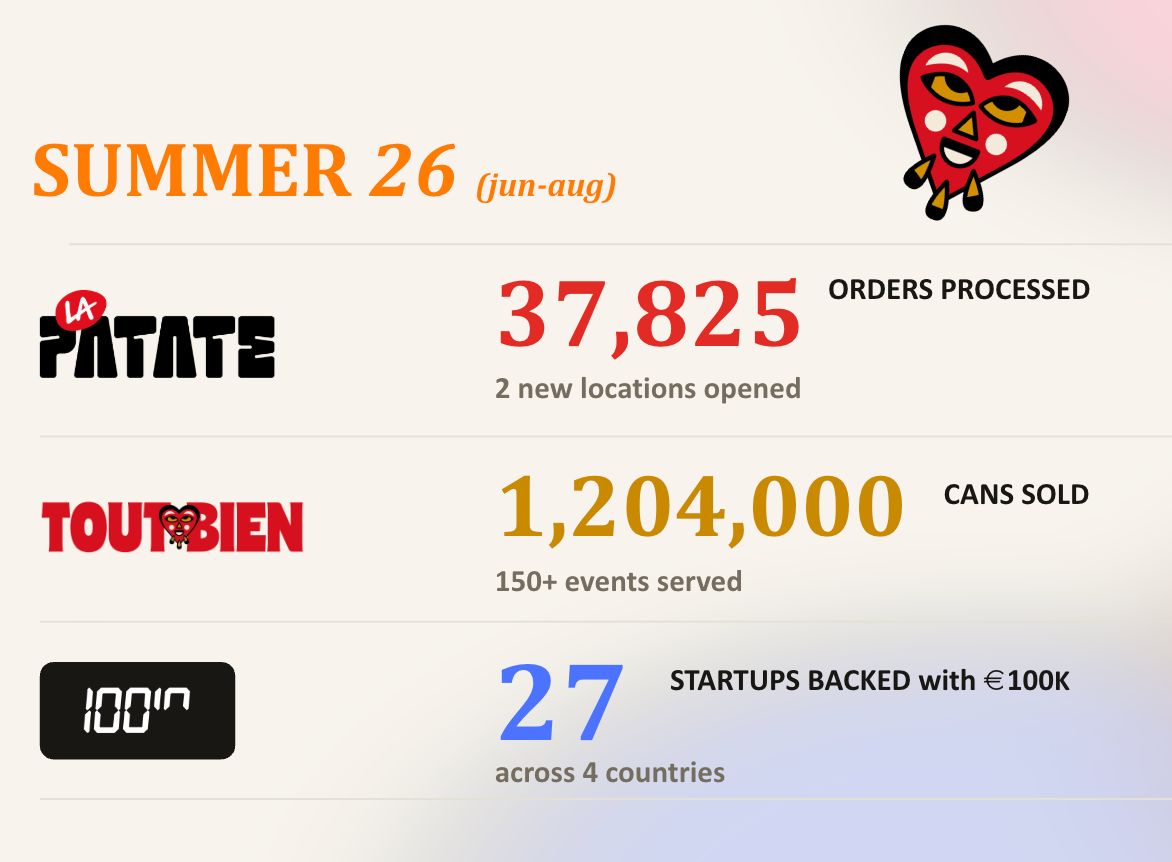
- Average Rob lanceert crowdlening voor frituurketen La Patate: 5,5 procent rendement en gratis frietLa Patate, het frituurconcept van mediafiguur Average Rob en serieondernemers Gilles Mattelin en Jorn Vanysacker, wil minstens een half miljoen euro ophalen om zijn groeiambitie te ondersteunen. Particulieren kunnen al vanaf 500 euro geldschieter worden.
The post Average Rob lanceert crowdlening voor frituurketen La Patate: 5,5 procent rendement en gratis friet appeared first on Trends.be.
DataNews · 4 Sept 2026
Related profiles
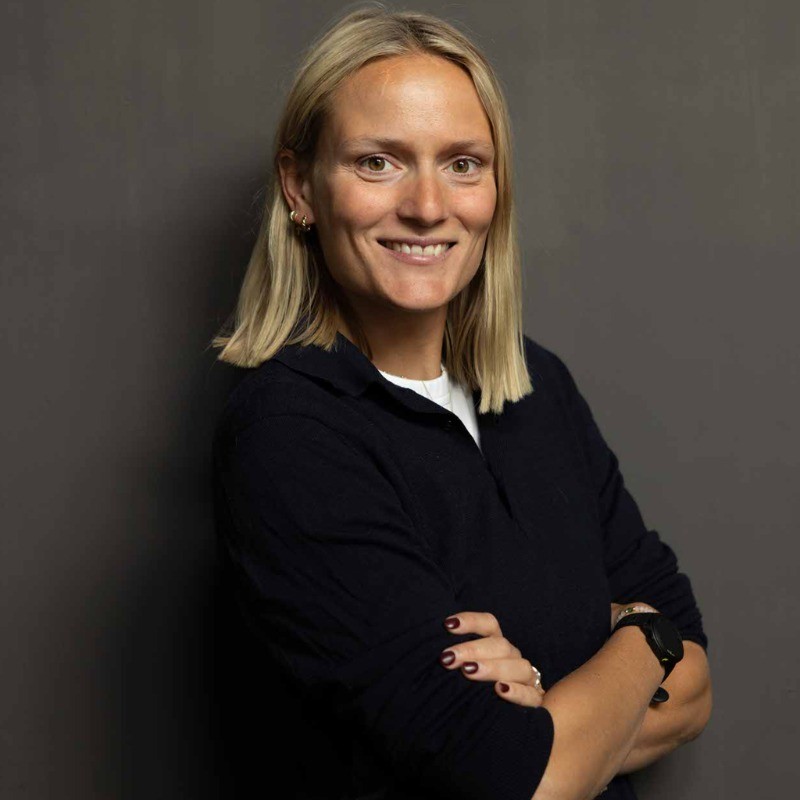 Julie CapiauCo-founders
 Jorn VanysackerCo-founders
 Wouter Van RespailleCo-founders
- YGhentLocation
100INRelated
This page shows public professional information only, each fact cited. Is this you? send a correction, or ask for removal within 24 hours, no questions asked.