
Talks about
Insights & ideas
The through-line
Across everything, Jorn Vanysacker argues the same thing from different angles: speed is the only real asset a startup has, and almost every mistake he has made or watched others make is a mistake that cost speed. Three products at Intuo meant sales hires took forever to train and evaluate, so Henchman was deliberately built as one deep product for one crystal-clear audience [1]. Intuo's positioning as a "nice to have" led directly to the rule that the next product had to be business-critical, with direct demonstrable ROI, simple, no setup or maintenance, minimal customization [3]. Talking to ten lawyers across five workshops before building killed wrong assumptions and saved an estimated half year [3]. The same instinct runs through his view of money: subsidies, term sheets and acquirers each get handled on their own track, because entangling them is what slows you down or kills you.
The second constant is temperament. He frames entrepreneurship as a bet most people never place at all, and the compounding effect of resilience over time. "De realiteit is dat er 0,1% van al uw maten eigenlijk jumpt en eigenlijk echt onderneemt, en dus dat is al zo'n voorsprong door gewoon te zeggen: ik ga het doen" [1]. What has shifted is his seat. Having built and sold twice, he now writes €100K pre-seed tickets through 100in [1], while deliberately holding back on new operating bets because Claude Code-level AI is enabling unseen product-building speed, which means many current products will be disrupted and the startups that survive will need extreme resilience [1].
On focus and choosing a business-critical problem
The Intuo lesson is the founding document for everything Henchman did. Running three products destroyed speed: every new sales hire took ages to train, and just as long to evaluate, which made the whole hiring loop slow and uncertain [1]. Intuo was also, in his own assessment, a nice-to-have, so the next product had to be business-critical with ROI you can point at, simple enough to need no setup or maintenance, and demanding minimal customization [3]. Those are not aesthetic preferences, they are the conditions that let a small team move.
Focus is enforced by refusal. Henchman stayed strictly on lawyers and law firms and turned down adjacent requests such as notaries, on the logic that a niche where you solve the single biggest pain lets you go 100% deep and move fast [3]. He puts it bluntly: "Als je nee zegt, [heb je] geen strategie — maar dat is echt wel zo" [3]. The customer research followed the same discipline, five workshops with ten lawyers each, done far earlier than at Rendeevoo, precisely to kill assumptions before they turned into code [3]. And the brand was pointed just as narrowly: memes and Instagram, a fresh and humorous voice aimed at 27 to 35 year old senior associates, deliberately positioned against the stereotype of stiff legal software [3].
On raising money without handing over the leverage
His hardest financial lesson is procedural. Keep subsidy dossiers such as Vlaio structurally separate from your capital round, and never accept suspensive conditions that tie investor money to subsidy approval. Intuo nearly went bankrupt when the dossier was rejected a week before Christmas [1]. The general principle is that instruments should not be allowed to depend on each other.
On the investor side of the table he applies the same clarity to convertibles. An uncapped CLA is lose-lose for an early backer: if the startup fails you lose everything, and if it succeeds you convert at the inflated Series A price with only a 20% discount. "Dus als investor: als uw bedrijf het slecht doet zijn gefuckt, en als het goed doet zijde gefuckt" [1]. So 100in always requires a valuation cap [1]. The underlying arithmetic is unsentimental: pre-seed math assumes 60 to 70% of investments die, returns have to come from a few superstars, and a 10x on an early CLA is the minimum expectation [1]. Founders should also not assume reputation carries them forever. Second-time founders raise seed largely on trust, but from Series A onward metrics like renewal rates and growth become decisive, and past success does not exempt anyone from proving the numbers [1].
On selling a company
The core of the exit playbook, which he attributes to Bart Swanson, is that desire is a discount. "You never wanna sell your business, first of all. Want als je dat ook maar uitstraalt, dan is uw prijs gewoon gedeeld door 10" [1]. The practical construction is to raise with genuine conviction so you generate real VC term sheets, warm up strategic buyers in parallel, and then force everything to converge in a two-week window with at least two potential acquirers on the table [1]. Ambition is set high on purpose: "We always envisioned 100 million. En zo: 100 million? Then ask for 200" [1].
What gets underestimated is what happens after signature. When Intuo was acquired the founders prepared a communication playbook and FAQs so employees would not panic about their jobs, and he treats internal communication around an acquisition as routinely neglected [3]. The earn-out period was the harder stretch: under Unit4 the founders lost control of their own P&L and hiring, COVID tightened the earn-out prospects, and none of that stress could be shared with the team [3].
On conflict, trust and one number
He reaches for 'Five Dysfunctions of a Team' to explain why so many companies stall: trust has to come before healthy conflict, and teams that get stuck at the conflict layer destroy accountability [2]. He thinks this is a specifically local problem. Flemish founders tend to nod along and hunt for compromise, which is unhealthy in the early conceptualization phase of a startup [3]. His conclusion is direct: "Conflict is dus noodzakelijk, gezond conflict weliswaar" [3].
The management tool he pairs with this is a single number per quarter that the whole team aligns on. Once that exists, arguments about ideas become objective, a question of which idea best moves the metric, rather than a subjective manager-versus-employee standoff [3]. He extends the same expectation of turnover to mentorship: you should outgrow your coaches, and if you never do, something is wrong [3].
On why B2B and not B2C
Rendeevoo, the London dating app, settled this permanently. B2C is capital-hungry, unpredictable and high-risk compared with B2B, and after that failure he concluded that operating a thin-margin consumer business is not where his energy lies [2][3]. He is careful to separate the judgement from regret, because they wound the company down correctly [2].
On marketing versus picking up the phone
He believes in authentic, helpful content marketing, the kind that genuinely solves a prospect's problem instead of pushing product, and he thinks it builds a flywheel. He also thinks founders lie to themselves about its timeline: it takes six to twelve months to show up in leads and revenue [3]. So the cash-position test decides the channel. "Als ge nu morgen geld nodig hebt, dan moet ge niet een marketing[campagne doen]... dan moeten we meer sales, dan moet ge bellen bellen bellen" [3].
On making the jump, and on optimism as a strategy
The practical advice for anyone considering it is to avoid locking yourself in financially, the mortgage and the expensive car, because those commitments make the jump much harder [3]. The advantage of jumping is larger than people think, given that roughly nobody in your circle actually does it [1]. What sustains you afterward is a compound of two traits: "Veerkracht en optimisme samen, die zeer powerful zijn in de long term" [3]. He tracks that optimism against evidence rather than mood, noting a month that was the best so far [3], and he keeps the scoreboard in its place: "Financieel succes is dan een mooie extra" [3].
On the Ghent ecosystem and paying it forward
He is bullish on where he operates and specific about why. "Er is echt een sneeuwbal aan het komen in Gent hè. Heel veel ex-techfounders hebben kapitaal. Die verstaan die business gemakkelijk en deployen heel gemakkelijk kapitaal in de markt" [1]. The non-financial half matters just as much: "Er zit super veel kennis nu vandaag de dag in Gent, in België. Massa's talent die je kunt aanwerven. Er zit massa's advisors, mensen die echt paying it forward gewoon advies geven, free of charge" [1]. His own €100K pre-seed tickets are part of that flywheel [1], and his current caution about operating again is aimed at the product layer rather than the ecosystem: AI is about to disrupt a lot of what exists today [1].
Takeaways
- Never let investor money depend on a subsidy dossier. Keep Vlaio and your capital round on separate tracks and refuse suspensive conditions, because a rejection a week before Christmas nearly bankrupted Intuo [1].
- Multiple products slow down hiring, not just roadmap. Sales hires took ages to train and evaluate at Intuo, which is why Henchman was one deep product with one clear target audience [1].
- Signal indifference in an M&A process, generate real VC term sheets, warm up strategics in parallel, and converge everything into a two-week window with at least two bidders [1].
- Always take a valuation cap as an early investor, because an uncapped CLA leaves you wiped out on failure and converting at an inflated price on success [1].
- Build for business-critical use with demonstrable ROI, no setup, no maintenance and minimal customization, and interview real users first: five workshops with ten lawyers each saved roughly half a year of development [3].
- Say no to adjacent segments. Refusing notaries kept Henchman 100% deep on the biggest pain of one audience [3].
- Give the whole team one number per quarter so idea debates become objective rather than manager-versus-employee arguments [3].
- Content marketing takes six to twelve months to convert. If you need cash tomorrow, make sales calls [3].
- Prepare a communication playbook and FAQ for employees before an acquisition is announced, and expect an earn-out to cost you control of your P&L and hiring [3].
- Don't take on a mortgage or an expensive car early, because financial lock-in is what stops most people from ever making the jump [3].
In the news
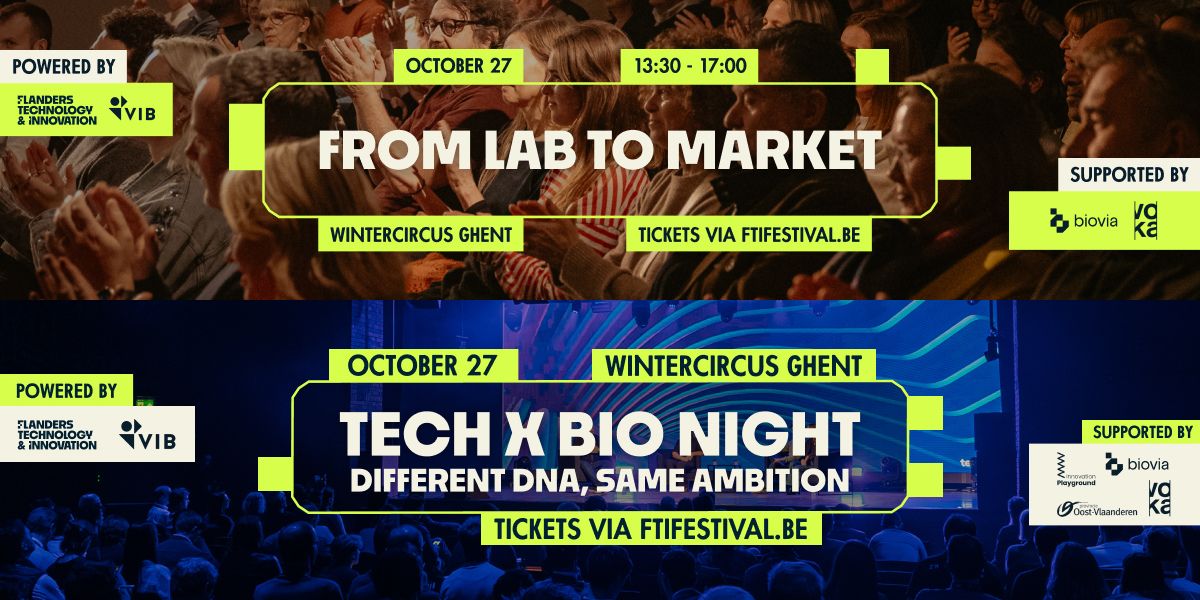
- Know what? Your research won't turn itself into a company. 🤯 That's why Biovia is joining VIB and Wintercircus Ghent for 𝗙𝗿𝗼𝗺 𝗟𝗮𝗯 𝘁𝗼 𝗠𝗮𝗿𝗸𝗲𝘁, a free, hands-on session built for PhDs, postdocs, masters, #entrepreneurs and early #spinoffs ready to take the step from research to company. Lessons straight from the horse's mouth 🐴 🎤 Jorn Vanysacker (100IN) 🎤 Carlo Boutton (Biotalys) 🎤 Christel Menet (Confo Therapeutics) 🎤 Wim Van Criekinge (Ghent University) 🎤 Annick Verween (VIB) 🪩 And if you want to keep the
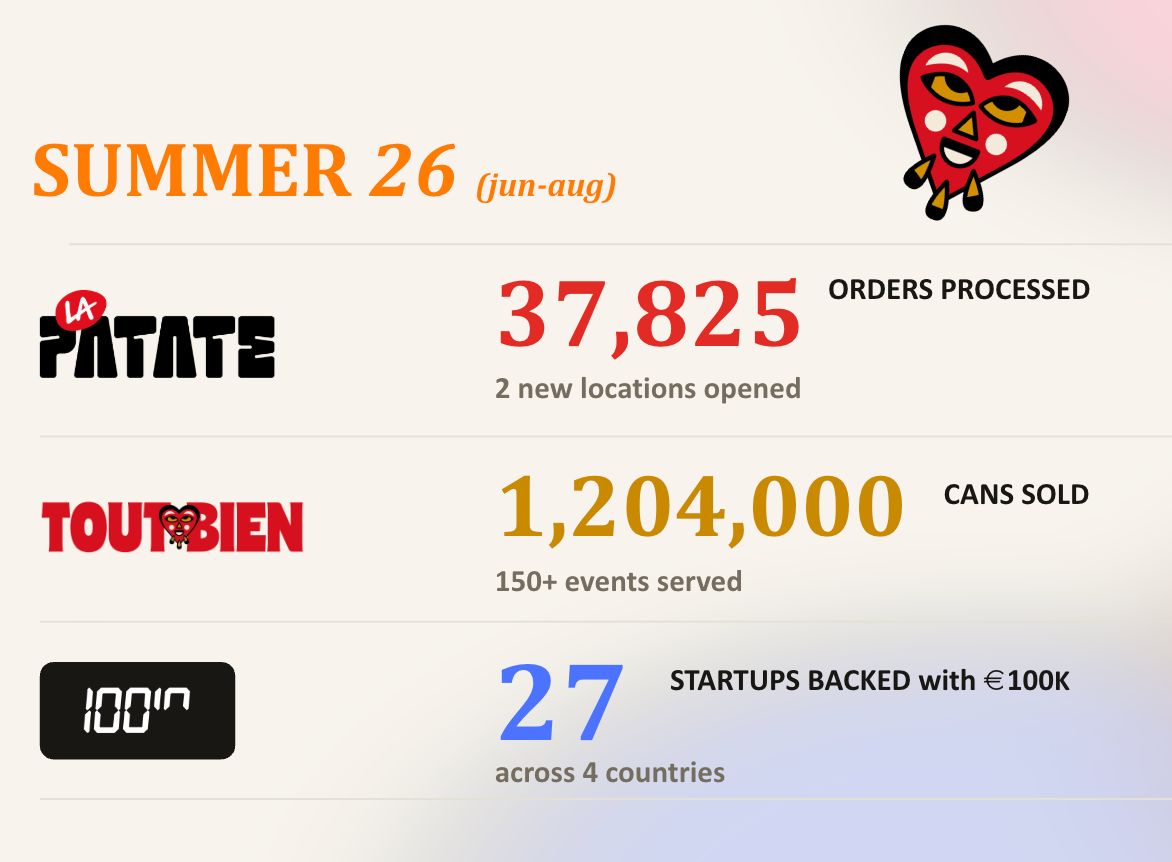
- If your work drains you, that's not normal. Go change it! I thought summer was going to be dead in VC. Turned out different. Nevertheless, I had the best summer ever. A job takes your energy. But when you start doing what you love and you are surrounded by the BEST people, it gives you energy. So grateful for this dream-team. 🍉❤️ Jorn Vanysacker Gilles Mattelin Stef-Kamil Fissette 100IN
- It was going to be a quiet summer, they said... Wild what you can pull off with great people around you <3 Eline Biesmans, Wim Maeyens, Jorn Vanysacker, Julie Capiau, Emiel Huughe, Lennert Bogaert, Leen Baeten, Jan Froyman, Stef-Kamil Fissette, Sien Declercq
- Average Rob lanceert crowdlening voor frituurketen La Patate: 5,5 procent rendement en gratis frietLa Patate, het frituurconcept van mediafiguur Average Rob en serieondernemers Gilles Mattelin en Jorn Vanysacker, wil minstens een half miljoen euro ophalen om zijn groeiambitie te ondersteunen. Particulieren kunnen al vanaf 500 euro geldschieter worden.
The post Average Rob lanceert crowdlening voor frituurketen La Patate: 5,5 procent rendement en gratis friet appeared first on Trends.be.
DataNews · 4 Sept 2026
- Het Forbes startupnieuws in VlaanderenStartups en scaleups vormen het kloppend hart van onze bedrijfswereld. Van The Beacon in Antwerpen tot het Wintercircus in Gent: Vlaanderen bruist van ondernemingszin. Forbes bundelt het belangrijkste startupnieuws van de afgelopen maand in één overzicht. Gilles Mattelin en Jorn Vanysacker lanceren frituurketen met Average Rob Het Tout Bien-bier heeft er een vettig neefje bij. […]
L’article Het Fo
Forbes BE Ondernemers · 6 May 2026
Related profiles


This page shows public professional information only, each fact cited. Is this you? send a correction, or ask for removal within 24 hours, no questions asked.