Overview
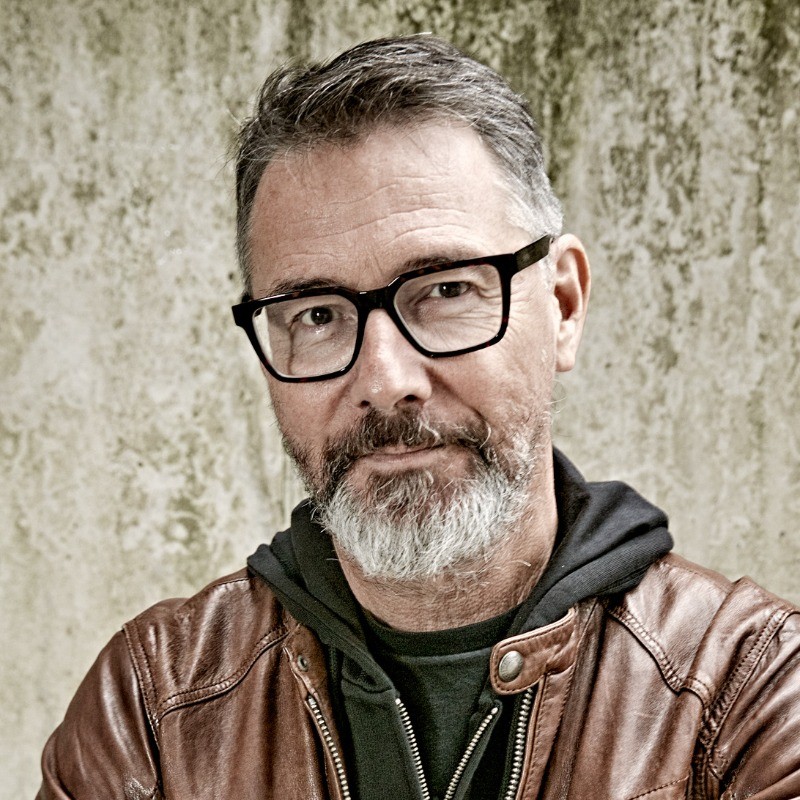
Jo Caudron has been active in Belgian digital business since the mid-1990s, making him one of the country's earliest voices on digital strategy and agency services. Over a 30-year career he founded or co-founded more than 20 companies spanning digital agencies, consultancies, and media ventures.
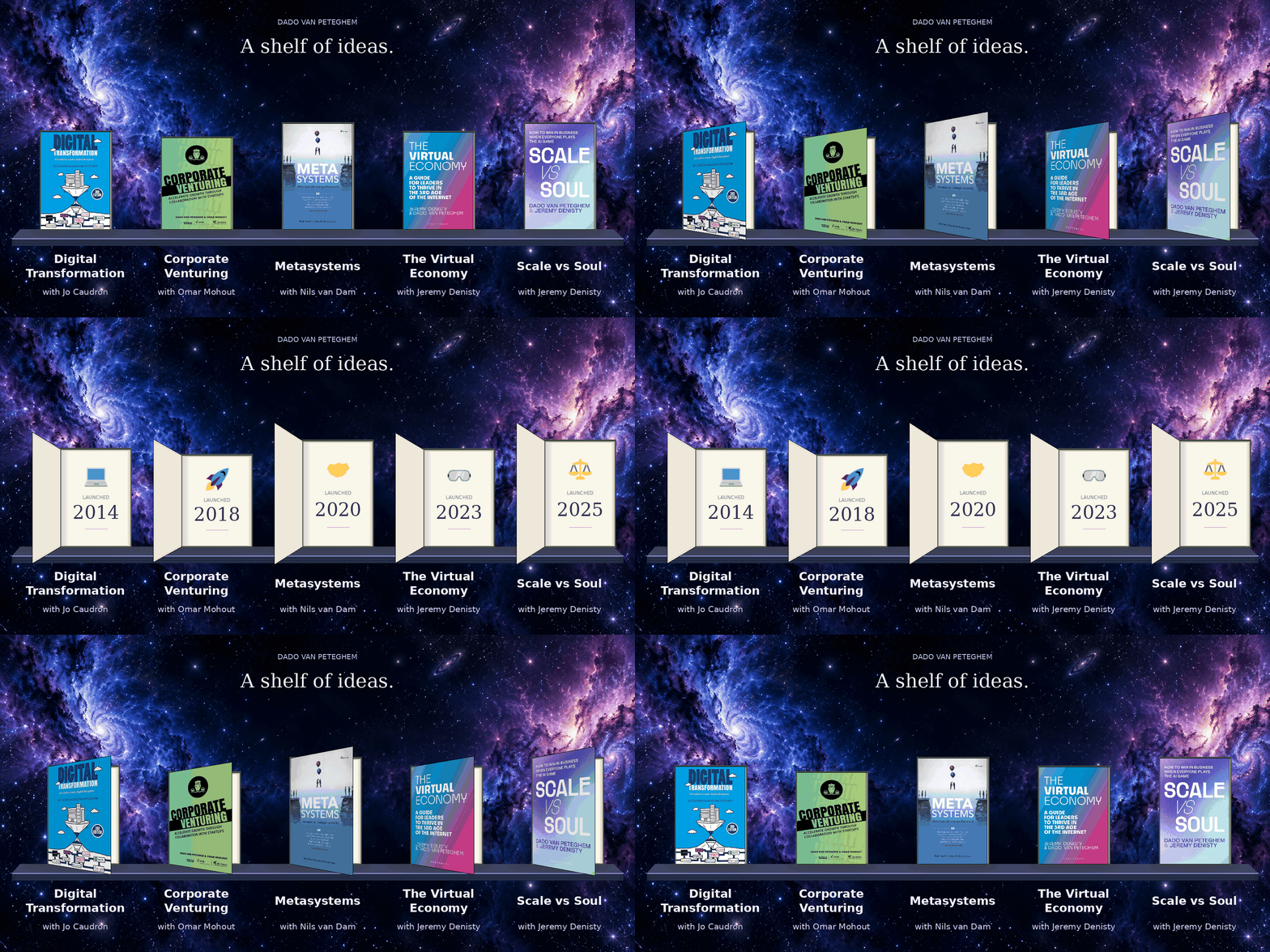
His most prominent co-founding efforts include Scopernia, a media and innovation consultancy, and Duval Union, which he built alongside Dado Van Peteghem. Together they co-authored "Digital Transformation" in 2014, a practical framework for companies navigating technology-driven change.
Jo's long tenure in Belgian digital positions him as a historical anchor for the country's digital services ecosystem, connecting the early web era to the current AI transformation wave.
Talks about
- European competitiveness
- Networking
- Artificial intelligence
- Disinformation & deepfakes
- Autonomous vehicles
- Never Waste A Good Crisis
- Digital Transformation
Insights & ideas
The through-line
Everything Caudron says now runs through one conviction: digitalisation was never really about technology. "Digitalisation gets reduced to technology, but it's a societal and economic transformation triggered by that technology" [7]. That framing has widened steadily over the years. In 2015 he was explaining disruption through Uber, Netflix and Airbnb, warning established companies that consumer preference for convenience and new digital business models would force them to rethink strategy or become obsolete [18]. By the time he was teaching the introductory day of the University of Groningen Business School and IT Academy Noord-Nederland programme, he noticed his own shift: "Toen ik dit voor het eerst deed, was mijn focus vooral op technologie gericht. Ondertussen zijn de trends en context zoveel breder geworden," with geopolitics, digital sovereignty, the absence of European strength, climate and society now part of the same mix of transformative forces [4]. He describes the same road in himself as in Gerd Leonhard: both started as speakers and writers on technology and "both ended up as citizens trying to use whatever reach we've built to help people understand how the world can, and should, change for the better" [9].
The second constant is that he believes we are at a hinge. "Ik geloof wel dat we op een scharnierpunt staan, echt een keerpunt in de maatschappij, geopolitiek, de wereldorde, economisch" [20]. He does not treat that as cause for despair. His books and talks are built around the question of whether the shock repositions Europe as a strong player in the emerging world order, and he says plainly: "I for one believe so" [1].
On why Europe has to rearm, and against whom
His most pointed argument reverses the usual reading of European defence. "Rearm Europe, dat gaat niet om ons militair en economisch te verdedigen tegen de Russen. De essentie is dat we ons moeten verdedigen tegen de Amerikanen. Niet dat we daar ooit mee gaan vechten, maar wel om niet meer gebulled te kunnen worden" [20][19]. The goal is not to cut ties but to be able to, so that Europe negotiates as an equal [19][20]. What Europe actually needs to defend itself, in his listing, is energy sovereignty, digital sovereignty and a strong economic landscape investing in the transition of industries like food, mobility and housing, with better organisation of the weaponry and military power already held ranking as the lesser priority [10]. Technological strength and a new innovation paradigm are, in his phrasing, among the best weapons available to get there [10]. The same set of questions runs through his conversation with Gerd Leonhard: the AI race and why Europe should step out of it, the state of digital sovereignty, what it would take to rebuild our own social media, and whether European industries can reinvent themselves by focusing on the future of energy, food, defence and mobility [8][9].
He is impatient with the idea that this is impossible. "Al die dat geld dat naar sociale media gaat, dus naar Amerikaanse platformen, dat kunnen wij perfect op 10 jaar omdraaien als we dat zouden wensen" [20]. His proof point is Huawei, which built its own operating system and cars in under a decade after being excluded from Android; dependence on US platforms for advertising, cloud and AI can be reversed in five to ten years [20]. He also insists Europe is already moving and nobody is watching: "Europe is moving faster and faster and most people are not noticing. The dominant narrative is still that Europe only talks and regulates, while others act" [12]. Against that narrative he sets France replacing Palantir in its intelligence services with ChapsVision, Mistral AI deployed to a million French civil servants, Earlybird and AVP launching E2D as a €500M defence and dual-use fund and the largest European defence VC ever, the E5 defence ministers positioned as the engine of a full European Defence Union, €22 billion added to InvestEU by the EC and EIB, and Armenia voting pro-European against Russian pressure. "Europe's gravity still pulls" [12].
On sovereignty as a democracy question
He refuses to let sovereignty be filed as a technical matter. "Digital sovereignty is a democracy issue, not just a tech one: when critical infrastructure sits with a handful of US and Chinese players, ideological decisions can have a huge impact on European realities" [6]. When he keynoted for Beltug he made a point of not diving into the tech details of digital sovereignty or autonomy at all, choosing instead to talk about the turning point Europe faces [1].
The Digital Euro is his sharpest worked example of the risk. Brazil built PIX, a free instant payment system owned by its central bank, used by 93% of Brazilians, which cut out Visa, Mastercard and Apple Pay; the US Trade Representative then labelled it a "discriminatory trade barrier" and threatened 25% tariffs, while the State Department's designation of two Brazilian gangs as Foreign Terrorist Organizations created a framing that could expose banks handling PIX transactions to secondary sanctions and dollar-clearing exclusion [13]. Europe plans a Digital Euro by 2029 precisely to build financial infrastructure outside the American perimeter, and the Brazil case shows the leverage that could be applied [13]. His conclusion about the underlying dynamic is deliberately unsentimental, and he draws it from a football row over Trump's "if they beat us, we'll say it was rigged": nobody obliges Europe to keep playing along with the US, not in football and not in its use of American social media, AI or cloud solutions; it means biting the bullet for a while, but that is how the game reinvents itself [11].
On AI as a turning point rather than another wave
The distinguishing feature of AI for him is velocity, not capability. "In my 30+ years of digital experience I've never seen a tech evolve so rapidly. Past digital waves took decades to land. This one is measured in months" [6]. Hence: "AI isn't another wave, it's a turning point, not because of what it can do, but how fast it does it and how that challenges our ability as society to absorb these changes" [7]. This is a sharpening of a point he was already making a decade earlier, when he argued the pace of change had accelerated from decades to years and warned against underestimating smaller disruptive players [18]. He is also willing to name the risk in blunt terms: "Technologie is op de rand van toxisch geworden als we niet opletten" [20].
On the junior problem and the future of work
His most concrete workplace argument is what he calls the "junior problem": typically juniors got the tasks nobody wanted, and matured through them, but "this kind of work is exactly what AI now does well. Stop training juniors today, and you won't have seniors tomorrow" [6][7]. The flip side is genuine opportunity, since AI "can also let (young) people punch above their experience level, if they pair their human power skills with the right tools" [7]. Behind both sits a macroeconomic worry he calls the economic singularity: if robots and AI make everything cheaper without human workers, purchasing power collapses, so capitalists will have to artificially sustain consumer income, much as Henry Ford deliberately set wages and hours to create a market for his product [19][20]. His summary position is that none of this is fate: "the future of work and our democracy isn't something that happens to us. It's shaped by the choices we make today" [6].
On news, AI gatekeepers and what actually breaks
He thinks the news value chain is closer to the edge than the industry admits. "Binnen 2 3 jaar kan AI de hele newslong decimeren en op termijn zelfs vervangen. En dat is super gevaarlijk" [20]. The mechanism is the Google headline-flash model put into overdrive, with AI answering news queries directly from source material and bypassing the newsroom entirely [19][20]. He does not accept the reassurance offered by European media tech leaders that humans will always supervise AI: he expects AI will become so good that either we will not understand it or we will simply let go [19][20].
Two other problems he insists on separating are distrust and news avoidance. Many people trust the media perfectly well and abandon news anyway, because it is relentless, negative and offers no solutions, which is his argument for solutions journalism [19][20]. Alongside that, newsrooms and the story mix have to become far more representative: residents of Molenbeek and young people will not watch a journaal in which they are structurally underrepresented [19][20]. On the economics he is direct: "Nieuws is gratis. Net zoals muziek gratis is. Wil je echt gratis muziek dan zing je. Waar je voor betaalt is de experience of het format of de snelheid waarmee je iets te te krijgt of de kwaliteit waarmee iets gemaakt is" [19]. Most current innovation, including news formats on TikTok, is a spin-off of the classic editorial process rather than something natively conceived for the audience where it lives, which is a good step that does not go far enough [19][20].
On community, and why media never had one
"Mediabedrijven zijn er traditioneel nooit in geslaagd om reële communities te bouwen" [20]. A household watching the seven o'clock news is loyalty, not community, because there is no interaction and no user creation: "Sorry, het journaal om 7 uur is geen community en zal het waarschijnlijk ook nooit zijn en moet het misschien ook niet zijn" [20][19]. Digital platforms won because connection and user creation sit in their basic DNA [19][20]. Formats like nws nws nws reach young people where they are, but they remain broadcast, using social platforms as distribution channels for repackaged news [19][20]. His rule is that community is an instrument for restoring connection and trust rather than a goal in itself, and media brands should not try to turn themselves into TikTok-style communities [19][20]. The same discipline applies to brands generally: a bus company like De Lijn should not build a community, its buses should run on time [19]. Brand ambassadorship was hype, since paid influencers are not authentic and real communities only form around brands people genuinely identify with, like Patagonia. Nobody is a fan of Nestlé [19].
On world wisdom instead of media literacy
"Wat dat we niet nodig hebben is mediawijsheid. We hebben wereldwijsheid nodig" [19][20]. The reason is that our moral compass is no longer individual but algorithmically influenced, and we may soon be unable to distinguish real from fake at all [20]. He makes the historical comparison deliberately provocative: the old ideological zuilen, for all their partisanship, offered four or five balanced editorial perspectives with a deontology and covered the world broadly, while today's twelve million hyper-individual algorithmic pillars leave people far worse informed [19][20]. He applies the same suspicion to synthetic content generally, noting of a comedy classic that the AI version is considerably less funny [3].
On the ideology behind the shock
He treats the political drivers as a subject in their own right, not background noise. "Peter Thiel is arguably the most dangerous man in the US - and nobody seems to notice" [15]. What makes Thiel exceptional in his reading is that he is the intersection where techno-utopianism, Christian conservatism and the White House converge: the man behind Palantir, which supplies surveillance data to intelligence services, the military and immigration authorities, the mentor of JD Vance, and "the architect of a worldview in which democracy and freedom are fundamentally incompatible" [15]. He points to Jorn Lelong's reporting in De Morgen on Dialog, the secret think tank Thiel has run for twenty years, convening CEOs, politicians and academics with no membership list and no leaked agenda until a hacktivist emptied the site, and notes that the forces behind Trump are what he set out to describe in F*ck The System, and other bad ideas for the future [15].
On writing an optimistic future
The books are where he builds the alternative rather than the critique. The World is Round took two years and sets out an optimistic future for a changing world dealing with societal depression and technological challenges, a vision reachable within ten years and based on voluntary adoption, covering work, housing and mobility, and the COVID-19 pandemic abruptly turned those scenarios into something readable as a post-corona guide [16]. Structurally it is a business and policy book about transformation beyond digital disruption, in four parts: why people feel increasingly pessimistic; three interconnected perfect storms in work, place and mobility that combine into a meta storm; an optimistic 2030 across multiple societal domains; and a framework for readers to apply the insights to their own transformation strategy [17]. A recurring thread across several of his books is the need for balance between nature and our needs around housing, economy, industry, mobility and agriculture, which he made concrete in the visienota 2050 for the Vlaamse Ardennen region and continues to develop with the Agentschap voor Natuur en Bos [5]. Mobility is one of the places where his optimism is most specific: self-driving technology matters not because it replaces private cars, but because it enables fine-grained driverless public mobility where traditional public transport such as De Lijn is collapsing, particularly in rural areas [19][20].
On the work itself
Seven books in sixteen years requires "een beetje gek zijn" [2]. It began in 2010 with a request for a short getting-started book on social media, written in a week on his first iPad while on holiday in Switzerland, which he notes is not the handiest way to work [2]. In 2011 came the first properly worked-through book, Media Morgen, based on advice he was already giving media companies that they had no ear for at the time, and his first collaboration with Dado Van Peteghem [2]. Het Nieuwe TV-kijken followed in 2014 with Dirk Wauters, Leo Neels and Geert Wellens, focused on the Flemish television landscape and figures he describes as depressing [2]. Alongside speaking, writing and strategy work he sits on advisory and supervisory boards, in tech but also construction, financial and administrative services and now logistics, and the companies share one thing: "het zijn lokale (familie)bedrijven die doorheen transitie gaan en die zich op een constructieve manier klaar willen maken voor morgen," most recently the RvA of Kris De Leeneer BV [14].
Takeaways
- Frame sovereignty as a democracy question, not an IT question: when critical infrastructure sits with a handful of US and Chinese players, ideological decisions elsewhere reshape European realities [6].
- The argument for European autonomy is negotiating leverage, not confrontation: build enough independence "om niet meer gebulled te kunnen worden" [20].
- Reversing dependence on US platforms for advertising, cloud and AI is a five to ten year project, not an impossibility; Huawei built its own OS and cars in under a decade after losing Android [20].
- Protect junior training deliberately, because AI now does exactly the entry-level work people used to learn on: "Stop training juniors today, and you won't have seniors tomorrow" [6][7].
- What makes AI a turning point is absorption speed, not capability: past digital waves took decades to land, this one is measured in months [6][7].
- Treat news avoidance and distrust as separate problems; people who trust the media still quit it because it is relentless and offers no solutions, which is the case for solutions journalism [19][20].
- Community is an instrument for trust, not a goal: the 7pm news is loyalty rather than community, and brands like De Lijn should fix their service instead of building one [19][20].
- The Brazilian PIX case is the warning for the Digital Euro: a successful sovereign payment rail attracted tariff threats and sanction exposure that could freeze banks out of dollar-clearing [13].
Media & appearances
- ScoperniaYouTubeWhat is 'The World is Round' about?Jo Caudron discusses that "The World is Round" is a business and policy book about broader transformation beyond digital disruption, structured in four parts: analyzing why people feel increasingly pessimistic, examining three interconnected "perfect storms" of change in work, place, and mobility that create a "meta storm," envisioning an optimistic 2030 future across multiple societal domains, and providing a framework for readers to apply these insights to their own transformation strategies.
- ScoperniaYouTubeJo Caudron on Digital Transformation at Meet-IT 2015Jo Caudron discusses how digital transformation and disruption are reshaping industries, using examples like Uber, Netflix, and Airbnb to illustrate how consumer preferences for convenience and alternative digital business models are forcing established companies to adapt or risk obsolescence. He emphasizes that the pace of change has accelerated from decades to years, warns against underestimating smaller disruptive players, and argues that organizations need to fundamentally rethink their strategies and behavior to compete in this transforming, agile world.
- ScoperniaYouTubeInterview met Jo Caudron door Nina van KlaverenJo Caudron discusses his book "The World is Round," which he wrote over two years to explore an optimistic future for a changing world dealing with societal depression and technological challenges. He explains that the book presents a future vision within ten years based on voluntary adoption, addressing issues around work, housing, and mobility, and notes that the COVID-19 pandemic has made his described future scenarios suddenly relevant as a potential post-corona guide.
In the news
- Looking back at 2014, it’s crazy how the world has evolved. Still happy that we tried to contribute to the conversation with our 5 books! Writing a book is easy in the beginning and hard towards the end, especially the last 20% where you need to bring everything together. But it forces you to clarify your thinking and define a direction, a North Star, something to believe in when the future feels foggy. Thanks to my compagnons de route: Jo Caudron, Omar Mohout, Nils van Dam and Jeremy Denisty for the shared thinking, the debates
- What can I add to this? Thank you Peter Lambrechts for this message. I’m grateful I can inspire you and many others with my story. 🙏🏼
- Binnenkort praat ik met Bart BECKS over innovatie. Na eerdere boekhandelgesprekken in Vlaamse steden met Koen Schoors (Gent), Kathleen Van Brempt (Antwerpen), Steven Van Hecke (Leuven) en Steve Gold (Oostende), is Brussel nu aan de Beurt. Europa beschikt over sterke universiteiten, toponderzoek en technisch talent, maar de grootste technologiebedrijven zitten nog steeds vooral in de VS en China. Welke rol kan Europa (opnieuw) opnemen in de wereldwijde AI- en techrace? Bart BECKS, is serial entrepreneur en bestuurslid van de European
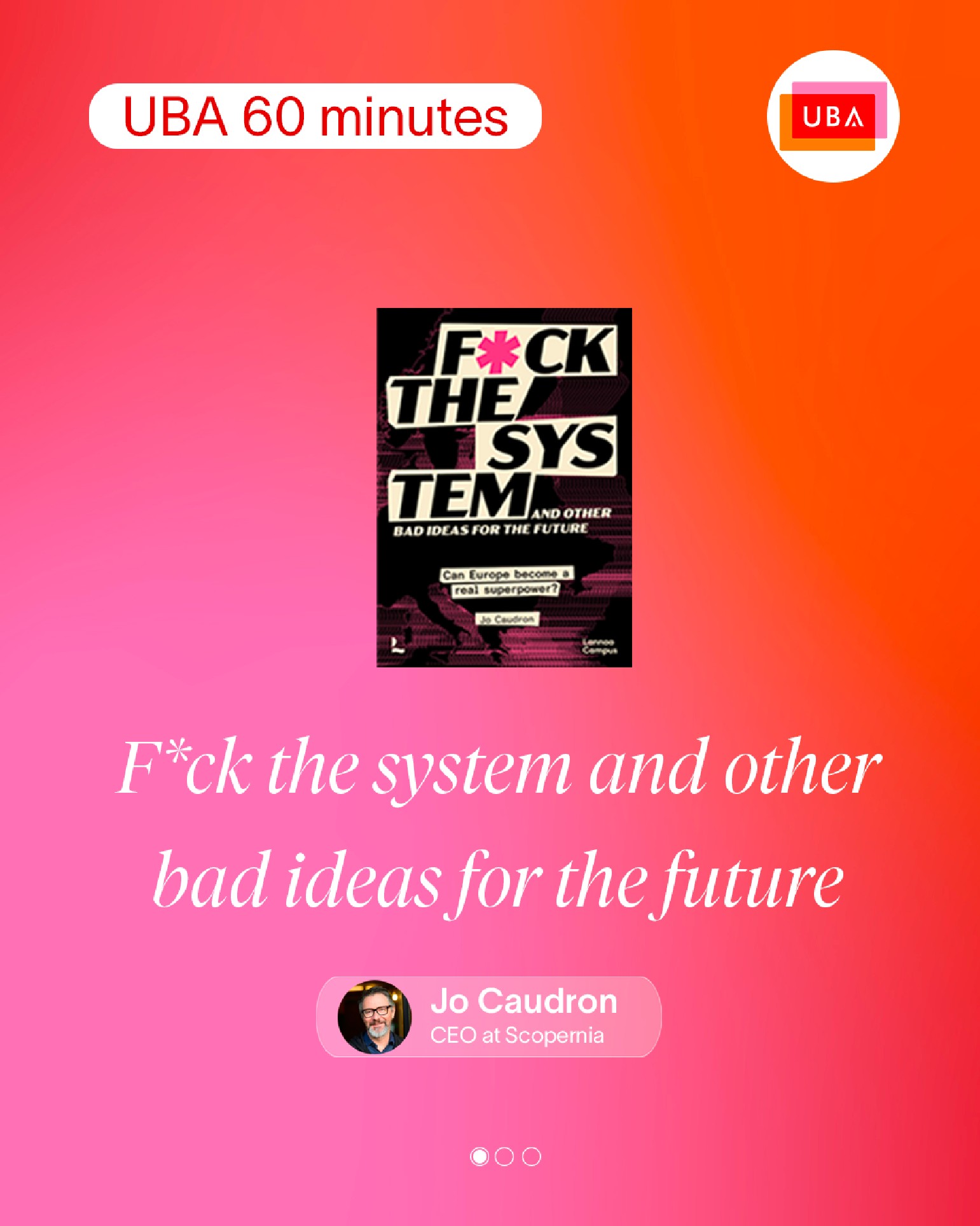
- Happy to kick this UBA Belgium book presentation series off. Curious to see how advertisers look at the current global turmoil and how Europe should act. Other October sessions by Marc Fauconnier and Steven Van Belleghem
- Fuck the system, and other bad ideas for the future" by Jo Caudron is not a comfortable read. It's a call to stop asking permission and to build something better instead of quietly complying. If you’ve ever felt the system wasn’t quite built for you (and, as a self-proclaimed “rebel with a cause,” I certainly have 😉 ) this book tells you: you were right. Now do something about it. Read it. Then decide what you're going to change. 💪 Jo Caudron
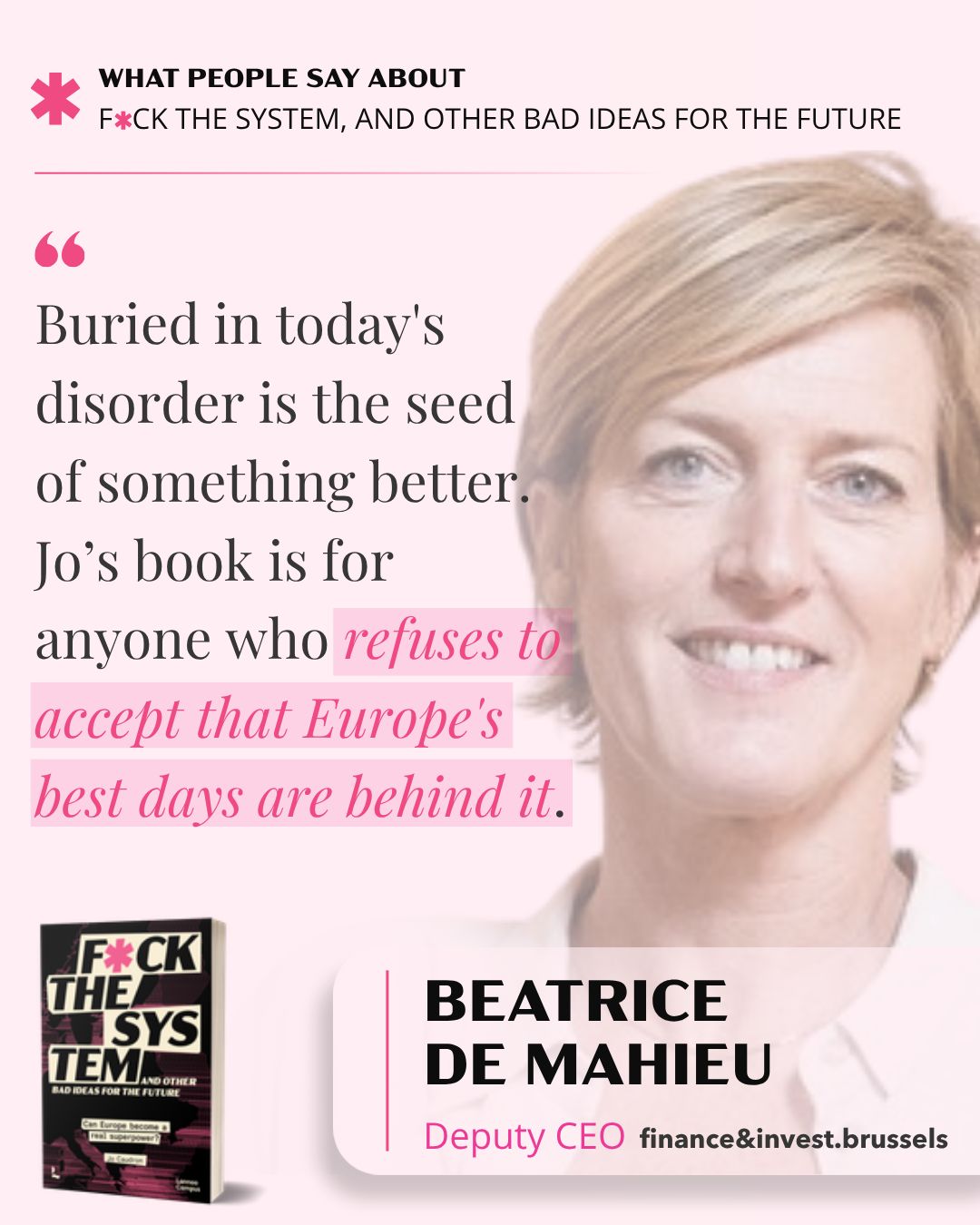
- Beatrice de Mahieu is one of the people who decide which companies in Brussels get funded. She has built a startup hub, led BeCode, and spent fifteen years listening to people promise a future. Beatrice is a hard audience for a book about hope in Europe, so her reaction means a lot to me. Thank you Bea for these kind words 🙏 The book is now available in Dutch and in English. Check it out: https://lnkd.in/eNirUTnX
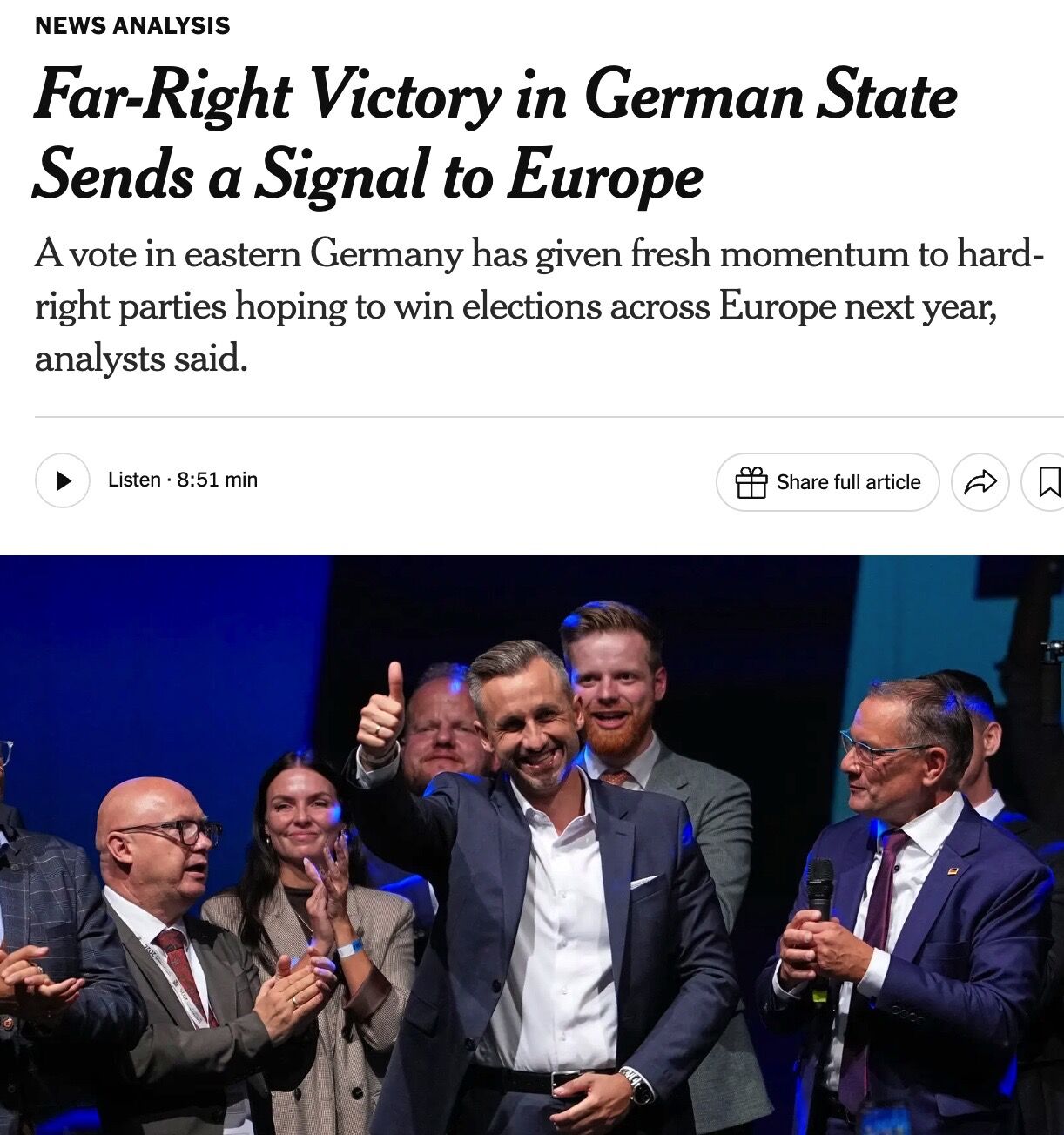
- De verkiezingsuitslag van het AfD in Saksen-Anhalt doet me denken aan een belangrijke passage uit mijn boek: wat denken kiezers te kopen als ze extreem stemmen? In F//ck The System en andere slechte ideeën voor de toekomst, beschrijf ik het mechanisme van de "populistische leugen". Deze werkt altijd op dezelfde manier: je wordt als populistische partij verkozen op een eenvoudig programma, vaak maar 3 punten. Minder migratie! Meer koopkracht! Het volk tegen het establishment! Eens verkozen voer je een agenda uit waarvoor je
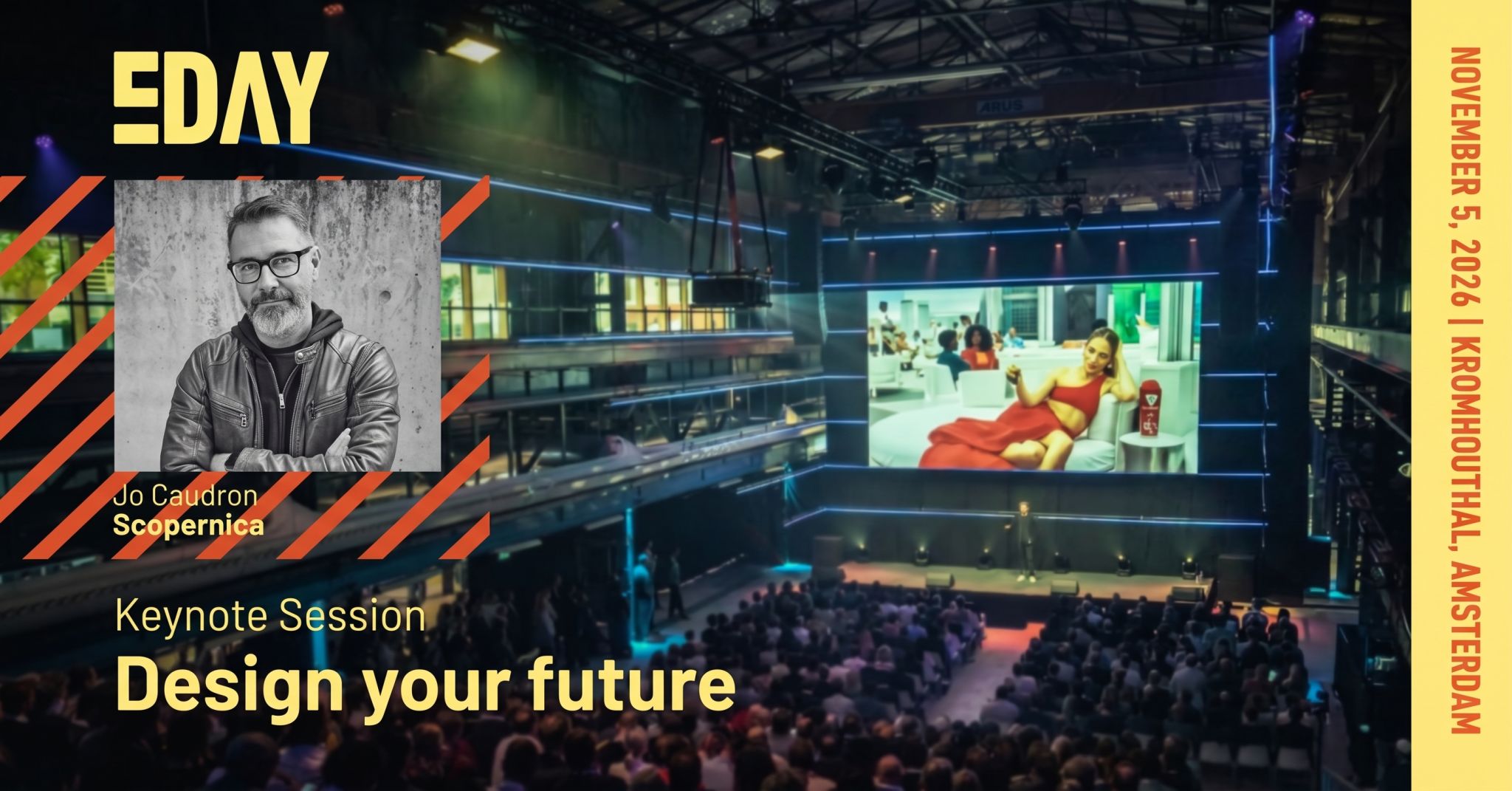
- Speaking in The Netherlands - I Love It (to quote De Jeugd Van Tegenwoordig). On November 5th, I'll be taking the stage at the major Emerce Eday event in Amsterdam. Yes, geopolitics, AI and the worldshock we're currently facing will have a massive impact on business and branding too. Are you ready? Let's M*F* go! Check it out here: https://lnkd.in/dWPF9KXK #EmerceEDAY #Geopolitics #BrandStrategy #FutureOfBusiness
Related profiles
This page shows public professional information only, each fact cited. Is this you? send a correction, or ask for removal within 24 hours, no questions asked.