
Overview
Jonathan founded Robovision in Ghent with a background in physics and AI. The company develops computer vision platforms for industrial applications, enabling companies to deploy AI vision at scale without deep technical expertise.
As founder and chairman of Robovision, Jonathan shaped the technical vision and strategic direction of the company. He remains active in the Belgian AI and deep-tech community as a speaker and advocate.
Jonathan founded Robovision in 2009, combining machine vision and robotics into a deep learning platform deployed in over 1,000 commercial applications across agriculture, manufacturing, retail, and healthcare. He is a regular speaker and lecturer on AI, vision, and the future of autonomous systems.
Career history
- ChairmanAug 2022 - PresentRobovision
- CEONov 2008 - Aug 2022Robovision
- ColumnistJun 2022 - Presentde Tijdfreelance
- Guest LecturerAug 2021 - PresentLondon Business School
- FounderRobovision


Education
Master, Engineering Applied Physics1996 - 2002Ghent University
- Exchange, Applied Physics, Computer Vision & Neuroscience, ETH Zurich1999 - 2000
Talks about
Insights & ideas
The through-line
Across everything, one preoccupation recurs: intelligence is now cheap to obtain but expensive to distribute, and the hard engineering is on the distribution side. In 2018 the argument was that deep learning had broken the old constraint on machine capability, so the bottleneck moved from inventing intelligence to packaging it: "We no longer have to create intelligence our own, it's created for us... and the only thing we need to do is pay the electricity bill and invest in deep learning servers" [2]. Years and more than a thousand deployed machines later, the same instinct shows up as scepticism about generality for its own sake, with the reminder that "compute isn't free, validation isn't optional" [1].
The shift over time is one of tone rather than direction. The early framing is expansive, almost utopian, reaching for democratized expertise and better healthcare for the world [2]. The later framing is that of an operator who has counted the cost of each deployment and now asks where the extra capability actually earns its keep [1].
On general world models versus task-specific perception
The question of whether a robot needs a general-purpose world model or "just enough perception to nail the task in front of it" is answered from deployment experience rather than theory: "the romance is in general world models, but the economics are usually in task-specific perception" [1]. The illustration is deliberately unglamorous. A harvester in a greenhouse "doesn't need to understand the universe — it needs to find the tomato, every time, at scale" [1]. Every-time-at-scale is the operative phrase; reliability under repetition, not breadth of understanding, is what the customer is buying.
This is not a fixed position. The line between the two approaches "is moving", and the interesting question is precisely where world models "start earning their compute cost" [1]. The test proposed is economic rather than intellectual: generality has to pay for the compute and the validation burden it adds, and until it does, the narrow perception system wins on the numbers.
On what deep learning actually broke
The pivotal claim is about a rule that no longer holds. "Will computers ever be smarter than humans? And until some years ago I had to say no, no, because a system can never be smarter than its engineer. But this rule has been broken" [2]. The mechanism is the move away from hand-coded sequential logic: intelligence now emerges from data and compute, so the practitioner's job becomes feeding labeled data to neural networks on GPUs [2]. What used to be an intellectual ceiling becomes an operating expense.
The other unlock is about the data that was previously unreadable. 72% of internet data is visual, photos and video that computers historically could not understand, and deep learning opens up that majority [2]. This explains why the whole enterprise is built around perception rather than text or structured records.
On why projects do not scale and platforms do
Robovision pivoted from bespoke image-processing work to a platform in 2014 for a structural reason: custom projects required assigning too many smart people, which made the company itself the scalability bottleneck [2]. The ambition that followed is stated without hedging: "We want to become the SAP of AI" [2]. The point of the comparison is enterprise-wide standard infrastructure, self-service rather than consultancy.
A platform then produces its own control problem. Clients began trading trained models on USB sticks, corrupting the model export feature, and the response was to internalise distribution: "They started trading USB sticks and at that point in time we realized that we lost the control of the system, so we started to build our own AI store" [2]. The precedent invoked is the Apple App Store consolidating the mobile disruption [2]. The lesson generalises: whoever owns the exchange layer owns the market that forms on top of it.
On transfer between industries
Evidence for the platform thesis comes from how little had to change between very different domains. A system built for teaching machines to recognize plants moved almost unchanged to solder-joint inspection in electronics and to petabyte-scale medical imaging at the NIH [2]. The same networks generalize across industries [2], which is what makes a horizontal product defensible rather than a set of vertical consulting engagements wearing a product label. It is also the pragmatic version of generality: reuse of the tooling and the architecture, not a single model that understands everything.
On democratizing expertise, and the bigger motive
The stated purpose behind the technology is expertise rather than knowledge. "If we can democratize expertise in the same way that we have democratized knowledge with the internet, we can build a better health care system for the world" [2]. The distinction matters: the internet distributed information, and the claim here is that machine learning can distribute the judgement that used to sit only in trained specialists.
Underneath that sits a far broader ambition, stated plainly: "That is my true driver in life, is to kill the nation-state" [2]. It places the platform work inside a view of technology as a solvent for the boundaries that ration access to expertise.
Takeaways
- Judge generality by its bill: "the romance is in general world models, but the economics are usually in task-specific perception", and the useful question is where world models "start earning their compute cost" [1].
- Reliability at scale is the product spec. A greenhouse harvester "needs to find the tomato, every time, at scale", not understand the universe [1].
- Deep learning removed the ceiling that "a system can never be smarter than its engineer"; intelligence now comes from data and compute rather than hand-coded logic [2].
- If your delivery model requires assigning many smart people per client, the company is the bottleneck; that is the trigger to become a platform [2].
- Losing control of distribution, in this case customers trading trained models on USB sticks, is the signal to build your own store before someone else owns the exchange layer [2].
- Cross-industry transfer is the proof of a platform: the same networks moved from plant recognition to solder-joint inspection to petabyte-scale medical imaging at the NIH [2].
- Aim at democratizing expertise, not just knowledge, which is the route to "a better health care system for the world" [2].
In the news
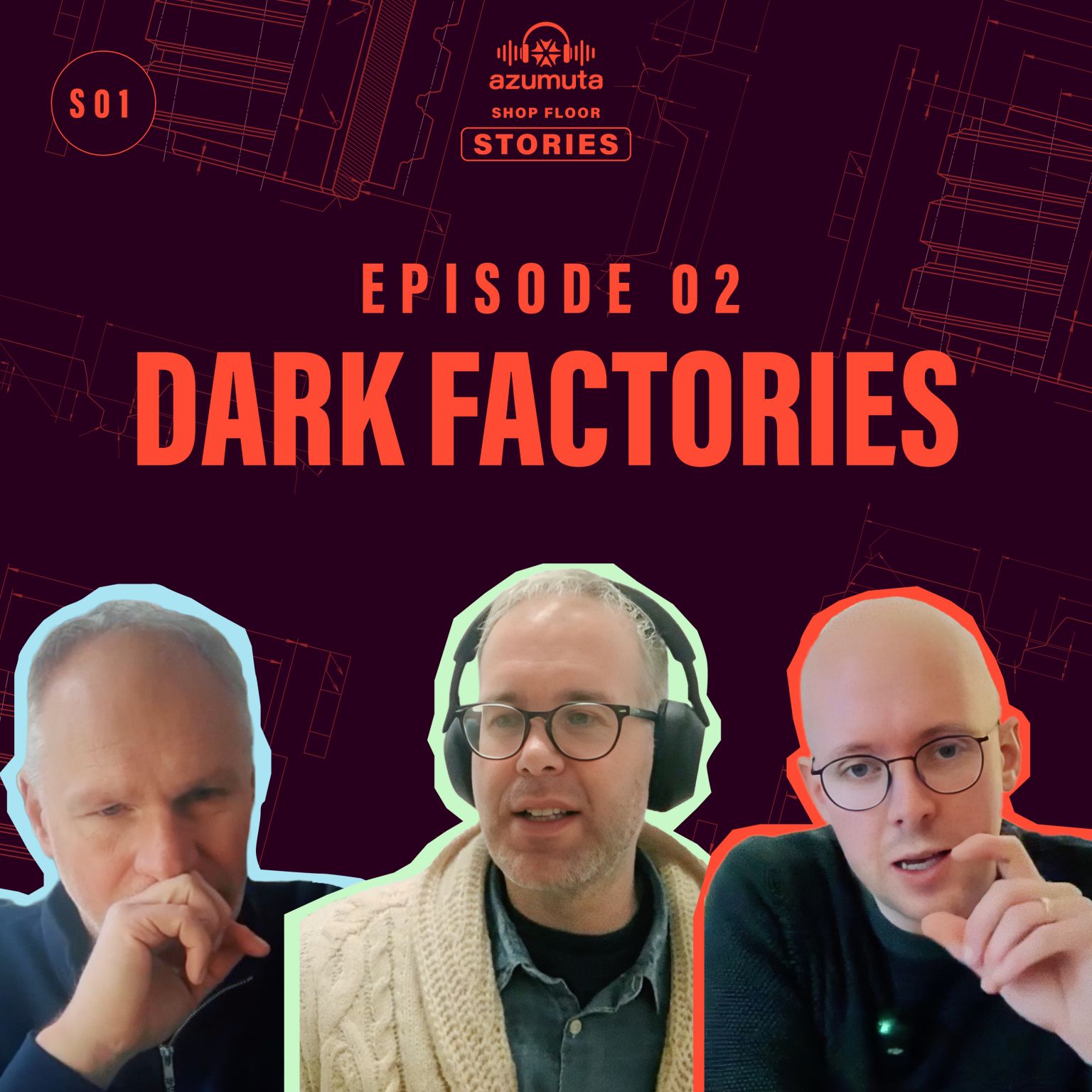
- When we recorded episode 2 of Shop Floor Stories with Jonathan Berte (Robovision), this line stuck with us: "It's very gimmicky that he brings you coffee, but you will fire him anyway." Context: he's talking about humanoid robots that wander outside their job description. Sure, it's fun when the robot surprises you with coffee. But the moment a robot shows up somewhere it's not supposed to be, it's getting "fired". After all, that's the same standard we hold people to, right? Predictability isn't boring, it's the whole point on a
- Honoured to be sharing the stage at MACHINA Summit 2026 in Paris next week. The panel question cuts to the heart of what I've spent years building at Robovision: does a robot need a general-purpose world model, or just enough perception to nail the task in front of it? 🌍 vs. 🎯 My honest take from 1,000+ machines deployed in the real world: the romance is in general world models, but the economics are usually in task-specific perception. Compute isn't free, validation isn't optional, and a harvester in a greenhouse doesn't
Related profiles

This page shows public professional information only, each fact cited. Is this you? send a correction, or ask for removal within 24 hours, no questions asked.