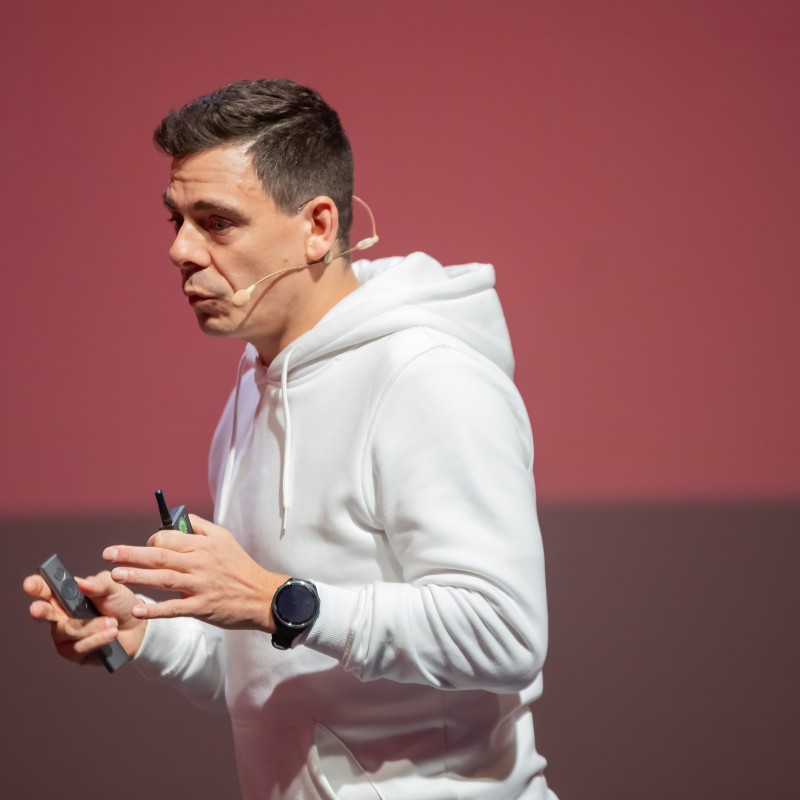
Overview
Based in Aalst, Kevin co-founded CHILI publish to automate the production and adaptation of marketing materials, removing the bottleneck of manual design work for brands and publishers. The platform is used by global brands to produce localized and personalized marketing assets efficiently.
Louis Jonckheere serves on the board of CHILI publish.
LinkedIn Voice
Posting style: Primarily product and company focused. Posts a mix of personal commentary, CHILI GraFx product updates, and event recaps. Lower personal engagement, often reposts company content. Brief and functional rather than narrative-driven. Key themes: Brand governance in AI content generation, CHILI GraFx platform and integrations (Bynder, etc.), content supply chain speed, hiring at CHILI publish, web gaming and omnichannel retail events Avg engagement: 22 likes, 2 comments Notable post: Short observation on Apple's ecosystem strength amid AI hype, standing out for being personal and opinionated rather than product-related (39 likes, 1 comment)
Career history

Insights & ideas
The through-line
Everything Kevin Goeminne says circles one problem: getting brand-correct material out the door at volume. The way he frames it is deliberately unglamorous, "How do you actually produce thousands of on-brand marketing assets across retailers, markets, channels and languages - without growing your creative team at the same pace?" [5]. That question sits underneath the whole arc of the work, from an online document editor built to run in HTML5 across browsers and mobile devices [14] with open APIs usable for web-to-print and marketing systems [16], through to a platform he now describes as redefining brand execution at scale [6] and as the best in the market for branded and compliant content at scale for print and digital [9].
What has shifted is the mechanism, not the mission. The early framing is technical and integration-led: a technology company rather than an out-of-the-box product, built to plug into DAM systems, MIS platforms and other installed solutions [14]. The current framing is agentic and governance-led: a design file becomes a design system through conversation with agents, so local markets can produce on-brand localized content themselves [2]. The constant is his suspicion of anything that only works in the showroom. On AI his stated interest is not the capability itself but "what happens after the demo" [5].
On brand execution at scale
Brand execution is treated as a hard operational problem, not a creative one. He states plainly that it "is a complicated task for brands at scale" [2], and the scale he has in mind is retail-shaped: weekly promotions, localized campaigns, retail media, in-store communication and AI-powered content production [5]. The bottleneck he keeps pointing at is headcount, specifically the assumption that more output requires a proportionally bigger creative team [5]. The alternative he proposes is structural, turning a design made in InDesign, Photoshop or Figma into a design system so that local markets can produce content that is both on-brand and localized, "content that resonates and sells" [2]. The output has to work across print and digital [9], which is why the underlying editor was built to visualize and edit graphical documents in a browser [16].
On what happens after the demo
He positions himself against the general enthusiasm rather than inside it: "Everyone is talking about AI. I'm even more interested in what happens after the demo" [5]. The AI work he chooses to highlight is correspondingly narrow and practical, an improved model behind an agent that can do manual cropping "just like a designer would do it" [9]. The larger bet is on agents as the interface to governance, with conversation as the means of converting a static design into a governed system [2], a theme he has taken to a public forum under the heading of AI governed design systems [2]. Demos are still part of the sales motion, and he offers them directly and personally [6], but the claim he wants judged is what survives contact with production.
On brand drift and why compliance theatre fails
His sharpest argument is that slow approval processes do not prevent risk, they only relocate it. The illustration is exact: a banner took three days to approve, the event lasted two hours, so the team did not wait, opened Canva, and shipped something with no disclaimer, the wrong logo and no audit trail [11]. His conclusion is that "The compliance process didn't stop the risk. It just made sure the risk happened without a paper trail" [11], and that consequently "the fix isn't faster reviewers" [11]. The systemic version of the same worry is about AI: it "is coming for visual branding the same way it already took over writing", and where the drift in written brand voice was accepted and barely noticed, he argues the visual stakes are different [13]. Compliance, in this reading, has to be built into the production tool itself rather than bolted on as a review queue.
On being a platform, not a product
From early on he has resisted describing the company as a finished application. It is a technology company whose job is a powerful online document editor working in HTML5 across browsers and mobile devices, deliberately not an out-of-the-box product [14]. The commercial logic of that choice is explicit: by integrating with other solutions and demonstrating product value, the company avoids price wars [14]. The integration surface is broad, covering DAM systems, MIS platforms and other vertical solutions [14], and has included a connector that lets existing Pagelex customers bring the online document editing capability into their current installations [14]. The product line was built the same way, with Chili Publisher as the browser-based editor with open APIs usable for web-to-print and marketing systems, alongside Chili Rendro, an HTML5 PDF viewer SDK [16]. The umbrella idea he uses for this is a universal graphics engine that lets marketers, printers and brand owners get value from the software systems and data they already run, and so finish their digital transformation journeys [15]. Growth, he has said, is double-digit and driven by exactly that demand [15].
On shipping speed
Velocity is something he treats as visible evidence rather than a claim. The tell he chooses is documentation debt of the good kind: the platform evolves so fast that the full "Getting started video series" gets redone every three months [4]. He is candid that the run has been hard rather than smooth, describing weeks in the business through the metaphor of a video game boss fight, learning the pattern, rage-quitting, coming back: "Beat the big boss. Then the bigger one, no retries" [7]. The reward is flow, and immediately after it the next level, which is where he places his own anticipation [7]. The ambition attached is not modest, "building a world-class solution competing with the biggest software companies in the world" [3].
On hiring and how he recruits
Recruiting is done in the same voice as everything else, framed as an invitation into momentum rather than a job description. The pitch is the trajectory itself, a fast-growing platform going up against the largest software companies, and the ask is to "Join us on this crazy and fun ride" [3]. He removes the friction personally, inviting direct messages with questions before anyone applies [3]. The office question gets the same light touch: he wonders aloud whether air conditioning is the real perk that brings people back in, adding "If we only knew it would be that easy" [8].
On working the network in person
He treats face-to-face presence and the network as primary channels. He shows up at Groceryshop in Las Vegas [5], Shoptalk [10] and Henry Stewart Events in London [9], and in each case the message is the same, come and say hi, ping me, let's connect [5][9][10]. He also uses the network openly and without ceremony, asking directly for an introduction into Kroger and Kroger Technology & Digital [12]. The community-building version of this is Spicy Talks, a platform that brings partners, customers and staff together from brands, printers, packaging companies and agencies to share vision and stories and to network [15]. Even the origin story is told in this offhand register: the name was settled three days before incorporation when a colleague suggested Chili, which was available and worked across languages [16].
Takeaways
- Judge AI claims by production, not presentation, "Everyone is talking about AI. I'm even more interested in what happens after the demo" [5].
- The scaling test for brand content is whether output can rise across retailers, markets, channels and languages without the creative team rising with it [5].
- Slow approvals do not remove risk, they push it into unmanaged tools, "The compliance process didn't stop the risk. It just made sure the risk happened without a paper trail" [11], so "the fix isn't faster reviewers" [11].
- Convert design files from InDesign, Photoshop or Figma into a design system through agent conversation, so local markets can localize without going off-brand [2].
- Sell integration over features to stay out of price wars, connecting to DAM systems, MIS platforms and existing installations and letting product value do the arguing [14].
- Visual brand drift from AI deserves more resistance than written drift got, because the stakes differ [13].
- Treat rewriting the "Getting started video series" every three months as a sign of healthy product velocity, not a documentation failure [4].
- Ask the network directly for what you need, including named introductions into target accounts [12].
Media & appearances
- INKISHYouTubeINKISH.TV Proudly presents: CEO Kevin Goeminne · Chili Publish · Aalst, BelgiumKevin Goeminne discusses how Chili Publish was named three days before incorporation when one colleague suggested "Chili" as an option that was available and worked across languages. He explains that Chili Publish offers two main products: Chili Publisher, an online document editor for editing and visualizing graphical documents in a browser with open APIs usable for web-to-print and marketing systems, and Chili Rendro, an HTML5 PDF viewer SDK announced at Drupa.
- PrintingNews.comYouTubeGRAPH EXPO 15: Kevin Goeminne, CEO, Co-Founder, CHILI PublishKevin Goeminne discusses CHILI Publish's new connector for Pagelex, which allows existing Pagelex customers to integrate CHILI's online document editing capabilities into their current installations. He explains that CHILI Publish positions itself as a technology company focused on creating a powerful online document editor that works in HTML5 across browsers and mobile devices, rather than an out-of-the-box product, and emphasizes their strategy of integrating with various solutions like DAM systems, MIS platforms, and roofing solutions to avoid price wars by demonstrating product value.
- INKISHYouTubeINKISH.TV proudly presents: Kevin Goeminne · CEO Chili Publish · Aalst · BelgiumKevin Goeminne discusses Chili Publish's "Spicy Talks" platform, which brings together partners, customers, and staff from brands, printers, packaging companies, and agencies to share vision, stories, and network. He explains that the company is experiencing double-digit growth driven by demand for digital transformation solutions, particularly their universal graphics engine that helps marketers, printers, and brand owners leverage existing software systems and data to complete their digital transformation journeys.
In the news
- Today in the Belgian press: "JYSK continues growth in Belgium". I guess it's not a coincidence that they use CHILI GraFx for their brand execution! https://lnkd.in/et-pPdMp

- Your agency relationship ends on a Friday. How many Mondays before someone else can produce your weekly promotion? If the answer is months, you do not own your blueprint, whatever the contract says about IP. Pay your agency for the work. Own the blueprint. New issue out now.

- For all the #adobe and #figma users out there! Are you already using design agents? Struggeling to keep up with the nevere ending requests? Our design agent helps you to get more content faster to market. It will you make the super hero that turns campaigns into localized content in minutes! https://lnkd.in/ejZi-E93

- Things are getting real ;)
- Brand execution is a complicated task for brands at scale. With our platform your turn a design(Indesign, Photoshop, Figma) into a design system through conversation(agents) allowing your local markets to produce on-brand localized content that resonates and sells. Don't miss this ground breaking webinar: https://lnkd.in/eF7hH2E8

- Our platform is growing fast and we are building a world-class solution competing with the biggest software companies in the world. Join us on this crazy and fun ride! You can DM me if you have questions before applying.
- When your platform is evolving so fast you get to redo your full "Getting started video series" every 3 months! Great work CHILI publish team! Brand execution is being redefined as you get tanned on your vacay. Don't miss it! https://lnkd.in/eKcnFUXY
- Everyone is talking about AI. I'm even more interested in what happens after the demo. How do you actually produce thousands of on-brand marketing assets across retailers, markets, channels and languages - without growing your creative team at the same pace? That's the conversation I hope to have at Groceryshop 2026. If you're looking at how to scale weekly promotions, localized campaigns, retail media, in-store communication or AI-powered content production, let's connect! See you in Las Vegas. #Groceryshop2026 #RetailMarketing
Related profiles
 Louis JonckheereRelated
CHILI publishAffiliation
- YAalstLocation
- PBram VerniestCo-founders
- PJoeri PaelemanCo-founders
This page shows public professional information only, each fact cited. Is this you? send a correction, or ask for removal within 24 hours, no questions asked.