
Overview
Luc Verstraete is the founder of CreditPeople, which he started in October 2022, and is based in Pulle. Since November 2016 he has also run LuVerCon BV as its manager.
Between April 2019 and October 2022 he was managing director for Belgium at Mail to Pay Belgium. He spent seven years at Telenet group, joining in July 2009 as billing and payments manager and then serving from October 2010 to October 2016 as director of billing, payments and credit exposure. Before that he worked at Coca-Cola Enterprises Belgium, first as finance and administration manager from 2000 to 2004 and then as customer service manager from 2005 to June 2009. He began his career at Belgian Shell, where he was customer service manager from 1992 to 2000.
Verstraete holds a master's degree in economics from Ghent University, completed in 1992, and took a course in LEAN in administration at UAMS in 2010.
Career history

Insights & ideas
The through-line
Verstraete's fixed idea is that an invoice is not money and that the gap between the two is where companies quietly bleed. He points customers at line 40 of their annual accounts, "vorderingen op ten hoogste één jaar", and insists the figure is "meer dan een boekhoudkundige regel — het is omzet die nog niet is omgezet in cash op je rekening" [1]. The loss is rarely dramatic: "𝘊𝘢𝘴𝘩𝘧𝘭𝘰𝘸 𝘷𝘦𝘳𝘭𝘪𝘦𝘴 𝘫𝘦 𝘯𝘪𝘦𝘵 𝘪𝘯 éé𝘯 𝘥𝘢𝘨. 𝘑𝘦 𝘷𝘦𝘳𝘭𝘪𝘦𝘴𝘵 𝘩𝘦𝘵 𝘣𝘦𝘦𝘵𝘫𝘦 𝘣𝘪𝘫 𝘣𝘦𝘦𝘵𝘫𝘦" [6]. From that follows the promotion of credit management from back office to boardroom: it is "geen administratief detail, maar een directe hefboom op uw winstgevendheid" [5], and "geen bijzaak, maar een noodzaak" [7].
The second half of the through-line is the counterweight he never drops: the collections process is a conversation with a person. Understanding and empathy come before pressure, because customers live through illness, unemployment and other circumstances that affect their ability to pay, and immediate pressure damages both the relationship and basic humanity [12]. The two halves are meant to hold together rather than compete, which is the whole argument of "menselijk handelen" combined with the recognition that delivered goods must be paid for [8].
On cash versus turnover
The commercial case is arithmetic. An unpaid invoice of €1,000 at a 5% margin requires €20,000 of extra turnover to make good, and at lower margins the figure climbs further [5]. That is why he treats a large receivables position as a symptom rather than a fact of life, one that usually only becomes visible "rond de jaarafsluiting of de belastingaangifte, wanneer je zwart op wit ziet hoeveel er nog openstaat" [1]. The stated aim is that next year the same amount sits on the bank account instead of the balance sheet [1]. Put more simply, the promise to clients is faster collection at lower cost: "Jij maakt de factuur en verstuurt ze. Wij volgen verder op" [11].
On credit risk and the bankruptcy wave
He reads the Belgian insolvency numbers as a direct cash flow threat rather than economic news: 6,257 bankruptcies in the first half of 2026, a record for the fifth consecutive year, with Flanders up 5.4%, construction accounting for 23% of the total and nearly one in five hitting wholesale and retail [7]. His framing is that "achter elk van die faillissementen zit een keten van onbetaalde facturen", so when a customer falls over, the supplier feels it immediately [7]. The practical instructions are to know a customer's credit risk before delivering, to keep monitoring payment behaviour even of customers who have paid correctly for years, and to spot early signals of payment trouble before the bankruptcy appears in the newspaper [7]. Nobody controlling their own cash flow can afford to sail blind [7].
On a repeatable collections cycle
Rather than ad hoc chasing, he works from a fixed six-step cycle: debtor scoring and profiling to know who you are dealing with before things go wrong; preventive action to head off payment problems early; follow-up in the debtor's own language, addressing them in the way that works for them; payment plans and dispute handling that reach a solution without breaking the relationship; escalation to legal or collection steps only when there is genuinely no alternative; and reporting with portfolio insight so the client always knows where they stand [6]. The same logic appears in how the offer is structured, from first reminder through to collection: recruiting and seconding experienced credit controllers who slot into an existing team, analysing and optimising the credit management process, or taking over invoice follow-up entirely with the right technology behind it [1]. The shorthand for all of it is the right people, the right processes and the right tools [11].
On collecting without losing the human
He rejects the idea that collection is a hard confrontation between creditor and customer, and puts the question directly: "Kun je klantvriendelijk én consequent invorderen? Absoluut" [8]. Behind a late payment there is often a story, a temporary liquidity problem, an administrative error or a personal situation, so listening stays essential [8][12]. The other side of the balance is equally firm: goods and services were delivered, an undisputed invoice represents value the company has already created, and "tijdige betaling is geen gunst, maar een normale commerciële afspraak" that underpins the continuity of companies, employees and suppliers [8]. The route through is hyperpersonalisation combined with a human touch, which he argues improves customer experience and payment outcomes at the same time [12], and follow-up in the debtor's own language [6]. He also notes that workplaces now hold four active generational groups, each requiring a different approach [12].
On people and the credit management profession
The talent side is treated as part of the same product, not a sideline. He advertises vacancies for credit management professionals and routes candidates to Ann Verdonck and Yolanda Smets [4], and he actively opens the door to recent graduates in finance or legal practice looking for a first job [9]. The seconding model rests on credit controllers who fit seamlessly into the client's own team [1].
On building two things at once
He sees no conflict between running CreditPeople and taking on an additional role at Nymus, a project he describes with visible appetite: "Hier ga ik met veel goesting voor!" [2]. His claim is that the roles reinforce each other, that CreditPeople remains fully active and that he still has every ambition to keep building it, since "beide rollen blijken opvallend complementair: de ene versterkt de andere" [2].
On reading and switching off
Holidays are when he finally picks up a book, and the choice this time was deliberately light: Dan Brown's Het ultieme geheim, which he found gripping from first to last page while still giving something to think about, alongside a second recommendation, the Nimbus [10]. He turns it back on his network by asking what is on their summer reading list [10].
Takeaways
- Read line 40 of the annual accounts as unconverted revenue, not an accounting entry, and set an explicit target to shrink it year on year [1].
- Use the margin maths in conversations with management: at a 5% margin, a €1,000 write-off costs €20,000 of replacement turnover [5].
- Monitor payment behaviour of long-standing, reliably paying customers too; early signals arrive well before the bankruptcy notice [7].
- Build follow-up as a fixed cycle, from scoring and prevention through payment plans and disputes to escalation and portfolio reporting, with escalation reserved for genuine last resort [6].
- Lead with understanding before pressure; immediate pressure damages the relationship, while an undisputed invoice still represents value already delivered [8][12].
- Adapt the approach to the individual, including their language and their generation, since four generational groups are now active at work [6][12].
- Choose the delivery model that fits the organisation: seconded credit controllers, process optimisation, or full outsourcing of invoice follow-up [1][11].
Media & appearances
- POM 🇧🇪YouTube"Gij zult nooit het menselijke uit het oog verliezen" - met Luc Verstraete (CreditPeople)Luc Verstraete (presented as "Luuk Verstraat") discusses how understanding and empathy should precede pressure when collecting payments, emphasizing that people experience life circumstances like illness and unemployment that affect their ability to pay. He argues that applying immediate pressure damages customer relationships and violates basic humanity, and advocates for hyperpersonalization combined with human touch to improve both customer experience and payment outcomes. He also notes that modern workplaces now have four active generational groups that require different approaches.
In the news
- 30+ years in credit management. That is not something you can improvise. Meet the first speaker for Nymus On Track: Luc Verstraete, Business Unit Director at Nymus. Luc has spent his whole career helping finance teams get paid faster and keep their cashflow healthy. On stage, he will share where accounts receivable is heading, and give a first look at something we have been quietly building at Nymus. We are keeping that part under wraps for now. To see it, you will have to be in the room. 📅 19 november 2026 📍 Van der Valk

- 𝗢𝗽 𝘄𝗲𝗴 𝗻𝗮𝗮𝗿 𝗱𝗲 𝘇𝘄𝗮𝗮𝗿𝘀𝘁𝗲 𝗸𝗹𝗮𝗽 𝗶𝗻 𝘁𝗶𝗲𝗻 𝗷𝗮𝗮𝗿. Volgens De Tijd zal in 2026 één op de honderd Belgische kmo's failliet gaan, het slechtste cijfer in tien jaar tijd. Stijgende kosten, hogere rentelasten en druk op de marges maken bedrijven kwetsbaarder dan ooit. Maar wat opvalt bij faillissementen is dit: het zijn zelden verlieslatende bedrijven die omvallen. Het zijn bedrijven die zonder cash komen te zitten. Winst op papier redt niemand als de facturen niet op tijd binnenkomen. Net daarom is goed

- Ook in Frankrijk is Peppol nu een feit. Nymus is er alvast klaar voor.
- Heel sterk aanbevolen. Marleen Miechielsen is echt een topper!!
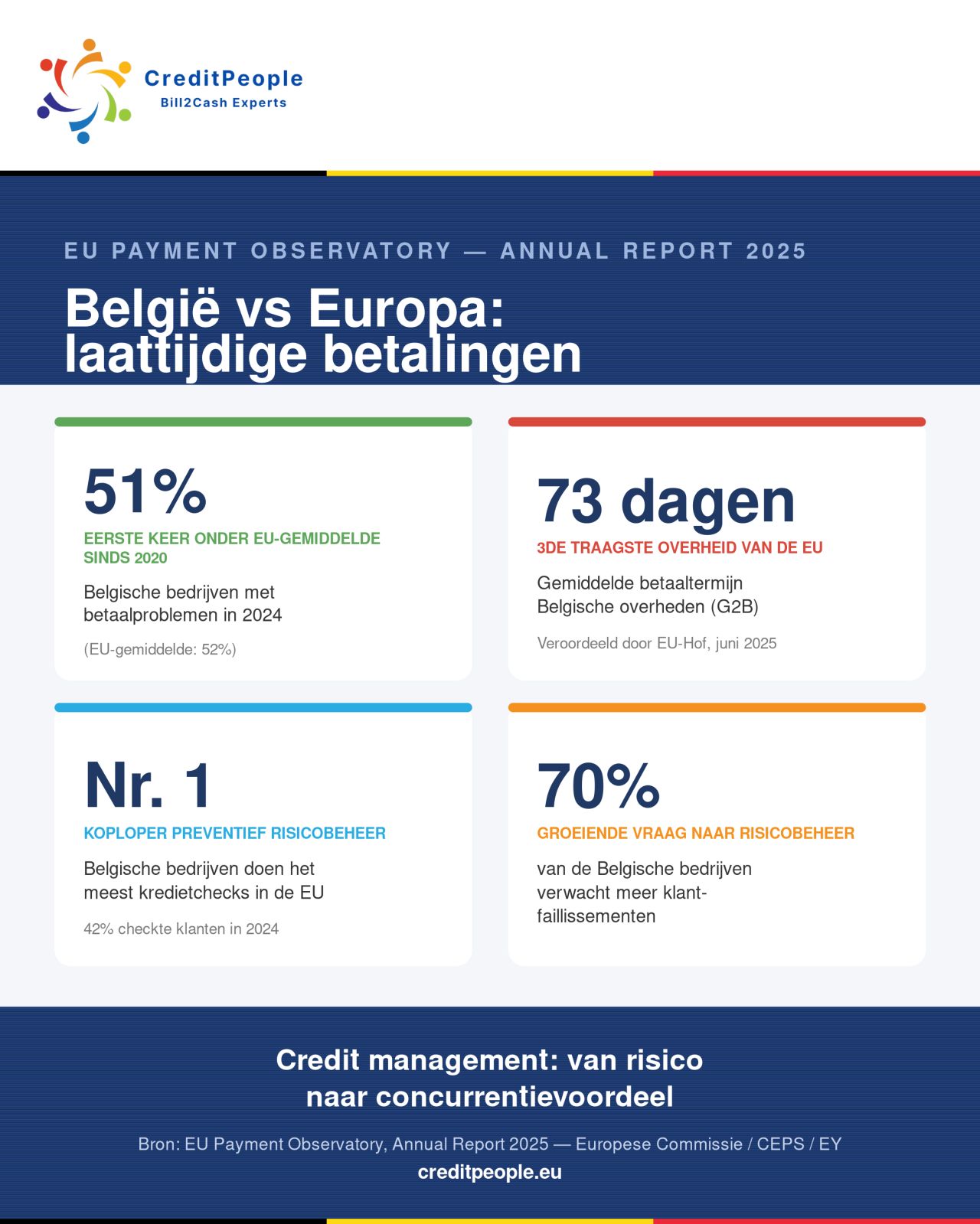
- 𝗕𝗲𝗹𝗴𝗶𝗲 𝗯𝗲𝘁𝗮𝗮𝗹𝘁 𝗯𝗲𝘁𝗲𝗿 𝗱𝗮𝗻 𝗴𝗲𝗺𝗶𝗱𝗱𝗲𝗹𝗱... 𝗯𝗲𝗵𝗮𝗹𝘃𝗲 𝗱𝗲 𝗼𝘃𝗲𝗿𝗵𝗲𝗶𝗱. 🇧🇪 Het nieuwe EU Payment Observatory rapport (2025) toont een genuanceerd beeld voor België: ✅ Voor het eerst sinds 2020 scoort België onder het EU-gemiddelde qua laattijdige betalingen (51% vs 52%). ⚠️ Maar Belgische overheden zijn de 3de traagste betalers van Europa (73 dagen) — en werden in juni 2025 veroordeeld door het Europees Hof van Justitie. 📈 70% van de Belgische bedrijven verwacht meer klant-faillissementen —
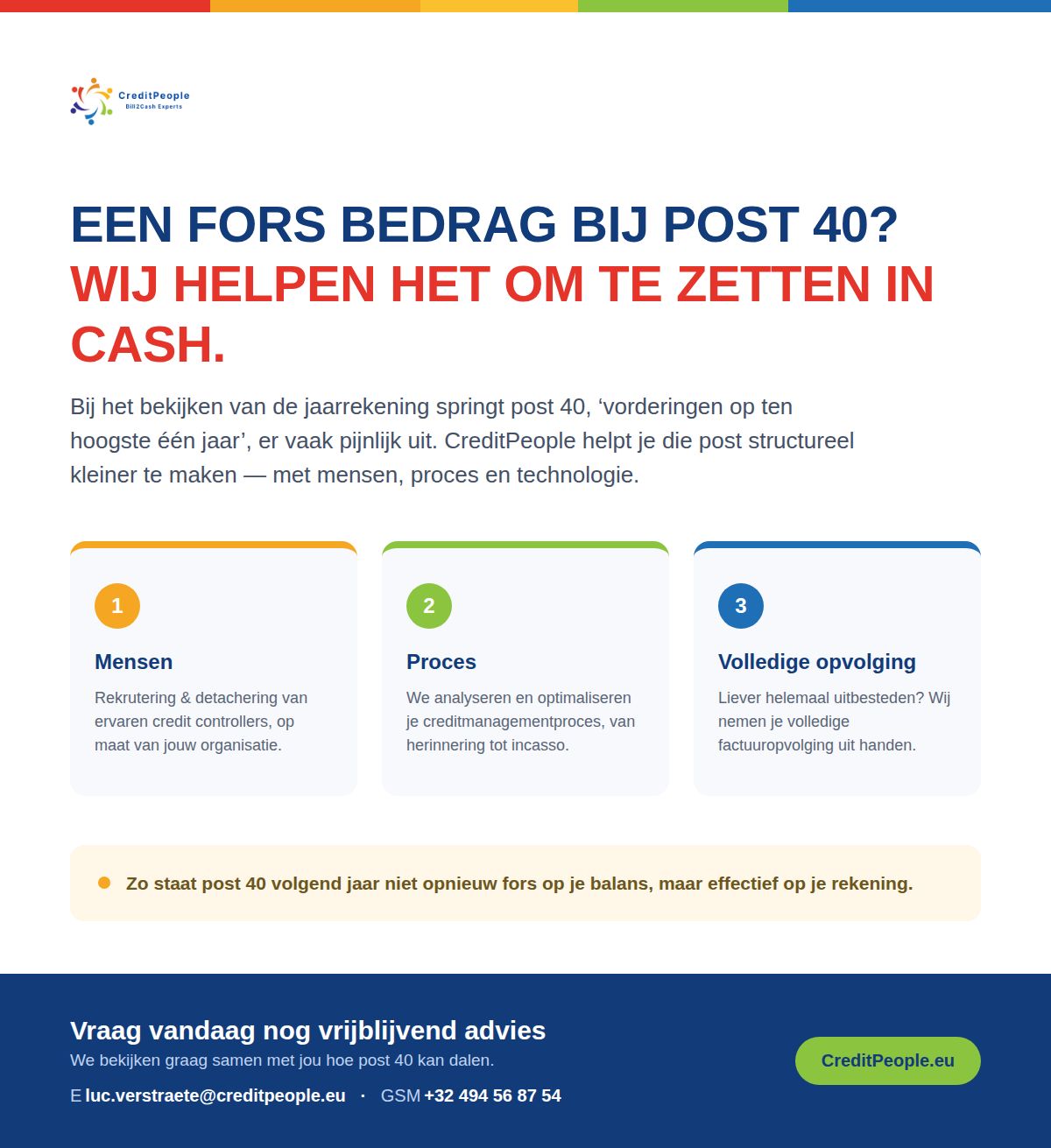
- 𝙋𝙤𝙨𝙩 𝟰𝟬 𝙫𝙖𝙣 𝙯𝙤𝙧𝙜 𝙣𝙖𝙖𝙧 𝘾𝙖𝙨𝙝. Zie jij bij het bekijken van je jaarrekening een fors bedrag staan bij post 40, 'vorderingen op ten hoogste één jaar'? Dat cijfer is meer dan een boekhoudkundige regel — het is omzet die nog niet is omgezet in cash op je rekening. Vaak wordt dat pas echt zichtbaar rond de jaarafsluiting of de belastingaangifte, wanneer je zwart op wit ziet hoeveel er nog openstaat. Bij CreditPeople helpen we je die post structureel te verkleinen, op de manier die bij jouw organisatie past: -
- Onze CEO Luc Verstraete, vervult vanaf heden een extra rol bij Nymus. 💪 Deze rol sluit naadloos aan bij de activiteiten van CreditPeople.eu. We kijken enorm uit naar wat deze mooie nieuwe stap betekent voor de toekomst van beide bedrijven! 🤩
- Heel blij en enthousiast om te delen dat ik een mooie extra uitdaging opneem bij Nymus! 🚀 Een prachtig project dat we samen aan het uitwerken zijn. Binnenkort volgt hierover veel meer nieuws. Hou dit dus zeker in de gaten! 👀 Graag een welgemeende dank aan Sven Dauwe voor de fijne samenwerking en het vertrouwen. Hier ga ik met veel goesting voor! En intussen blijft CreditPeople.eu natuurlijk onverminderd actief. Ik heb daar zelf nog volop de ambitie om verder te bouwen, en beide rollen blijken opvallend complementair: de ene
This page shows public professional information only, each fact cited. Is this you? send a correction, or ask for removal within 24 hours, no questions asked.