Talks about
- Artificial intelligence
- Leadership
- Change Management
- Finance Transformation
- The CFO role
- Long-term thinking
- European competitiveness
Insights & ideas
The through-line
Everything Peter De Keyzer says circles one idea: the world has stopped being predictable, and the people and institutions that survive that will be the ones who understand the technology in front of them and can explain what it means. Covid, in his reading, was not the shock itself but the warm-up for it, "eigenlijk een dress rehearsal voor wat er de komende jaren zit aan te komen" [1]. From that premise everything else follows: forecasting tools built for a stable world are worthless, leaders who cannot read the new instruments will frighten the people who work for them, and a continent that answers uncertainty with more rules will simply become poorer.
The second half of the through-line is that technical mastery is table stakes and human judgement is the differentiator. Whatever AI hands everyone equally, the advantage moves to whoever can turn it into something persuasive, clear and calm. His measure of clarity is brutally simple: "Als je er niet in slaagt om jouw business, jouw concrete case, jouw probleem uit te leggen in één zin, dan begrijp je het zelf niet goed" [1].
On AI as a superpower rather than a threat
The framing is deliberately unsentimental. "Wie geen AI gebruikt zal zijn job vervangen zien worden door AI. Wie weet hoe hij AI moet gebruiken, die hoeft daar ook geen schrik van te hebben" [1]. For a CFO this arrives as an addition rather than a subtraction: "Elke cfo krijgt er een soort superkracht bij. Als je als eerste het omarmt, als je er als eerste mee begint, dan ga jij er echt het verschil mee kunnen maken" [1]. The premium is on being early, because the advantage is in adoption speed, not in the tool itself.
There is also a duty of understanding attached to the job. A CFO who has not personally grasped what AI does will make the team anxious, and the image he reaches for is a captain who cannot read the chart: "Het is alsof je als kapitein op een schip niet weet hoe je een zeekaart moet interpreteren. Dan zal de bemanning heel ongerust zijn" [1]. Providing calm means knowing how the technology will hit every individual role on the team, not just the department's output [1]. The broader disruption is unprecedented in one specific way. AI is the first technology to threaten intellectual professions, lawyers, notaries, judges, and unlike the farm workers displaced by the tractor, those professions have the institutional power to block it by declaring it unethical [1].
On communication as the real differentiator
Once AI helps all ten CFOs equally with the numbers, the numbers stop distinguishing anyone. What is left is who can explain the implications most persuasively and most empathetically, the human skills the machine cannot replicate [1]. That is why he treats communication as a discipline to double down on rather than a soft extra. The one-sentence test is the entry point: failure to compress the business, the case or the problem into a single sentence is evidence of muddled thinking, not of a complicated business [1]. And the goal of that clarity is not visibility for its own sake. "Don't settle for attention. Demand influence" [1].
On throwing away the Excel file
Multi-year forecasting in a spreadsheet is, in his view, foolish in a world this unpredictable. "Gooi die Excel file weg en gebruik een bierkaartje. Op een bierkaartje kan je jouw scenario's proberen te plannen" [1]. The beer coaster is not a joke about rigour, it is a statement about what kind of rigour matters: the useful questions are what if I can't export to the US, what if there's no electricity for a week [1]. Working through a handful of concrete shocks arms a company better than extending four years of line items with false precision, precisely because the shocks are coming and Covid was only the rehearsal [1].
On why people build companies, and what crises reveal
He rejects the money-first account of entrepreneurship outright. "Niemand richt een bedrijf op om rijk te worden. Dat kan een neveneffect zijn, maar mensen richten een bedrijf op omdat ze een probleem willen oplossen" [1]. That problem-solving instinct is also what makes crises useful rather than merely dangerous. Under stress the true nature of people, of countries and of companies surfaces, which makes a crisis the ideal moment to show what a company actually stands for. Companies that are genuinely what they claim to be have no reason to fear one [1].
On Europe regulating itself into decline
The diagnosis is compressed into a line he says is truer than ever: "US innovates, China replicates, Europe regulates" [1]. The shortage is not creative. "Het is niet het gebrek aan ideeën die we hier hebben, maar we slagen er niet in om die ideeën om te zetten in bedrijven, producten en die bedrijven te laten schalen tot wereldspelers" [1]. He traces the regulatory reflex to history: having lived too long next to the Soviet bloc, Europe absorbed the illusion that rules can design a perfect world, when the world is in fact built by entrepreneurs [1].
Two structural fixes follow. The first is energy, where the argument is categorical: a country cannot become rich or stay rich without abundant, cheap energy, and if European prices remain where they are the continent faces gradual impoverishment [1]. The second is the internal market. If borders outside Europe are going up, the borders inside it have to come down, which means one genuine single market and one big European capital market [1].
On defense as a metaphor for how a country is governed
Defense manufacturers cannot sell to businesses or citizens, so they only add production lines against purchase guarantees from governments running twenty to thirty years. Scaling Europe's fragmented and sub-standard defense industry therefore requires exactly the kind of long-term commitment that is hardest to extract from current politics [1]. He reads Belgium's handling of this as diagnostic of its governance generally: living in the here-and-now, handing out money for fridges and electric cars, while the long-term strategic challenges go unattended [1].
Takeaways
- Adopt AI first and treat it as an added capability: "Wie geen AI gebruikt zal zijn job vervangen zien worden door AI. Wie weet hoe hij AI moet gebruiken, die hoeft daar ook geen schrik van te hebben" [1].
- A leader who cannot personally read the technology will unsettle the team, like a captain who cannot interpret a sea chart [1].
- When AI levels everyone's analysis, persuasive and empathetic communication becomes the differentiator, and the test of understanding is explaining the problem in one sentence [1].
- Replace multi-year spreadsheet forecasts with a handful of concrete shock scenarios: no exports to the US, no electricity for a week [1].
- Treat Covid as a rehearsal rather than an exception, and use crises to show what the company genuinely stands for [1].
- Europe's problem is conversion, not ideas: cheap abundant energy and a real single market and capital market are the preconditions for scaling companies to world players [1].
- Rebuilding defense industry capacity requires twenty to thirty year government purchase guarantees, since the sector has no commercial buyers [1].
- Aim past visibility: "Don't settle for attention. Demand influence" [1].
In the news
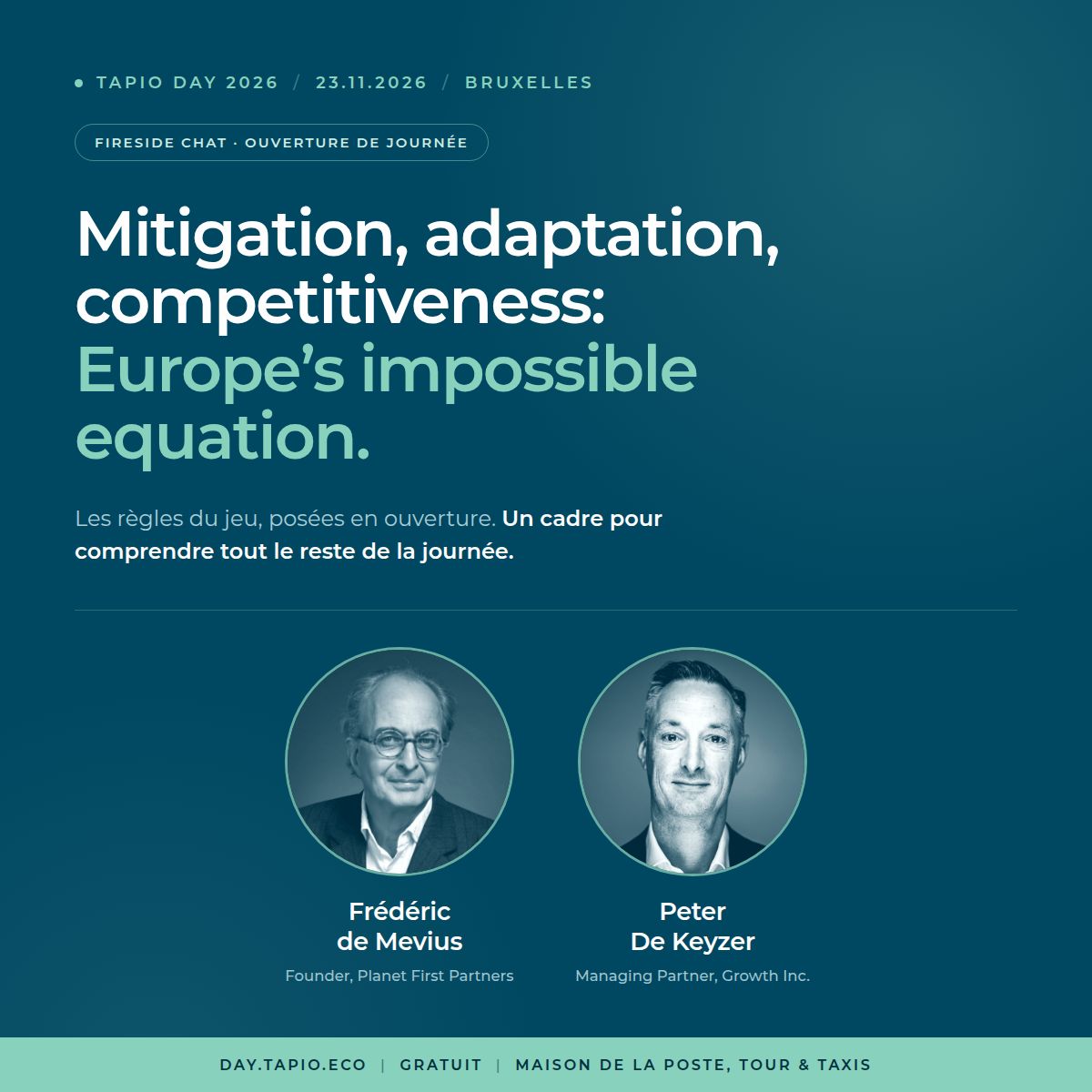
- Quand le call de préparation d'une conférence tourne au débat, tu sais que le sujet est critique et mérite sa place au Tapio Day 2026. Quand ce call a lieu avec Frédéric de Mévius, Peter De Keyzer et Sergio Henrique Collaço de Carvalho, tu réalises le chemin parcouru en 7 ans et à quel point ton métier est passionnant. Le sujet en question ? “Mitigation, adaptation, competitiveness: Europe's impossible equation”. Nous avons décidé de placer cette conférence en début de journée, tant le sujet est structurant. C’est un rappel des
- podcast] V-ICT-OR op de sofa ... Rudy Aernoudt | professor, schrijver, (EU) econoom en kabinetschef van MR-voorzitter Georges-Louis Bouchez ... over 'Belgium 2040'. • Blijft België hangen in stilstand, of kiezen we eindelijk voor strategie? • Zijn lokale besturen de sleutel tot een slimmere overheid? • Wordt AI de hefboom die publieke dienstverlening opnieuw uitvindt? Dit en vele vragen worden beantwoord in deze 34 minuten. Luister en ontdek meer 👉 https://ow.ly/wIxY50ZLc9n Prof. Rudy Aernoudt Peter De Keyzer Karl Drabbe

Related profiles


This page shows public professional information only, each fact cited. Is this you? send a correction, or ask for removal within 24 hours, no questions asked.