
Overview
Ruben Verhack is a co-founder of datameister, based in Gent. He founded Datameister in June 2023, and has worked as an independent consultant at DM-OG since October 2020.
Before that he was a senior AI engineer at Oqton, Inc from July 2021 to May 2023, and chief data scientist at journy.io between August 2020 and June 2021. From May 2019 to July 2021 he was a co-founder of Hyperfusion.ai, where he worked as a medical AI vision expert. Earlier he was self-employed at Ninetynine from 2008 to 2012, and co-founded TeeShed in 2007. He was event manager and later co-curator at TEDxGhent between 2014 and 2016.
Verhack completed a double PhD in computer engineering at Technische Universität Berlin and Ghent University, running from October 2012 to May 2020, and was a researcher at Technische Universität Berlin in late 2012. He holds a master's degree in computer science from Technische Universität Berlin, a master in computer science and software engineering and a bachelor in information technology from Ghent University, and attended secondary school at Klein Seminarie Roeselare.
Career history

In the news
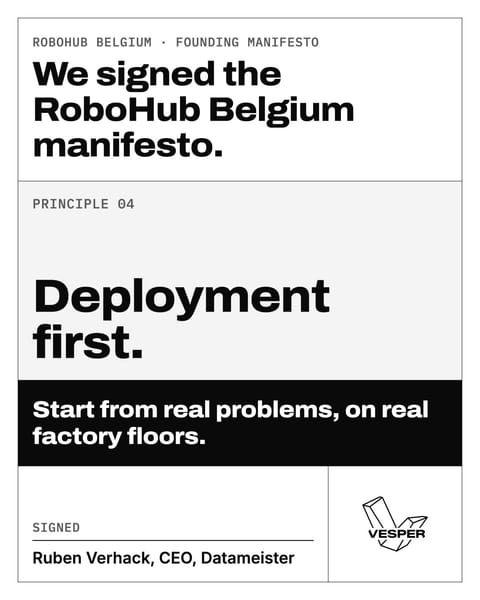
- Our CEO Ruben Verhack just signed the RoboHub Belgium founding manifesto, because we are firm believers in principle 04, Deployment First: 𝘀𝘁𝗮𝗿𝘁 𝗳𝗿𝗼𝗺 𝗿𝗲𝗮𝗹 𝗽𝗿𝗼𝗯𝗹𝗲𝗺𝘀, 𝗼𝗻 𝗿𝗲𝗮𝗹 𝗳𝗮𝗰𝘁𝗼𝗿𝘆 𝗳𝗹𝗼𝗼𝗿𝘀. Every few weeks there’s another humanoid doing a backflip online. Great for the press, but walk into a plant that same week and the same stations are still done by hand. Getting a robot to run every shift on a complex line of a real plant reliably is the actual challenge, and it’s where most projects still
- Great interview with Bram Vanderborght, and thank you for mentioning Datameister. 100% agree that Europe can't wait much longer. And that we should build this together as an ecosystem, instead of copying the vertical model of Tesla or Unitree. That's also why I also signed the RoboHub manifesto. Deployment first, start from real problems. Bram says you can pre-program a robot to fry an egg, but a robot that figures out by itself what to do is not there yet. According to him, the challenge is the massive amount of training data that
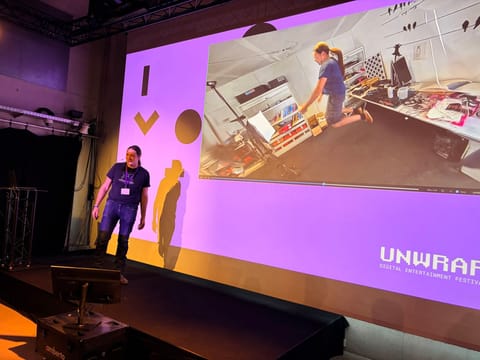
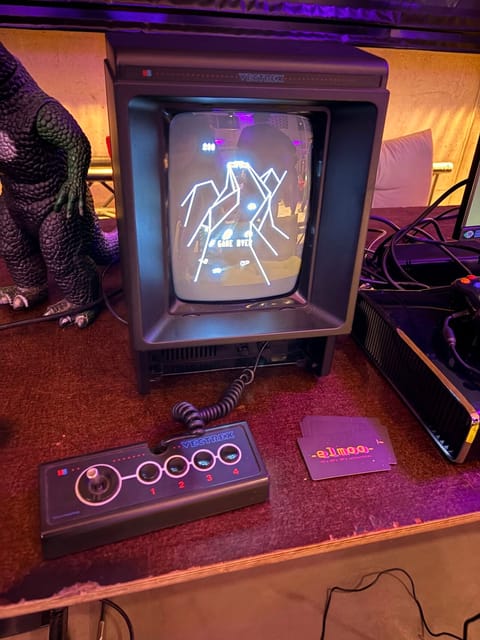
- Today I hosted and curated the AI track at UNWRAP Festival, a conference on game development, VFX and media. An exception between all the robotics events I’m doing now, but it’s where my roots lie. In my career I’ve been swerving between manufacturing/robotics and entertainment. At first glance they seem miles apart, but game tech keeps finding its way into industrial applications. Ironically, that’s often the only way to properly capitalize on it. In the age of Physical AI there are plenty of examples. Medal, the game clip
- Eka just raised $150M at a $1.45B valuation (!), on a model that feels force instead of only seeing. Impressive work, and a step in the right direction: trained in simulation, with force, as short skills under a general model. More and more people are waking up to it, vision-only VLAs are not the right fit for the factory. You can add touch. Even then, end-to-end learning is the wrong shape for manufacturing. The VLA path stays finicky, labour intensive and hard to carry over to the next task. Every new task starts with hours of
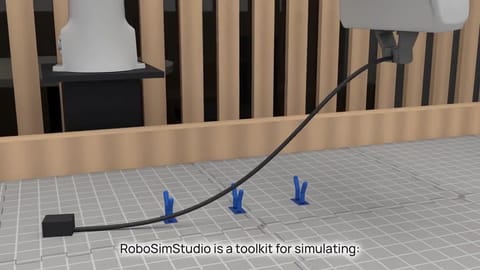
- 100% agree that estimating physics from a video is the scalable way to build digital twins. RoboSimStudio shows how far it already gets even on deformable objects. From Ken Goldberg’s AUTOLab at Berkeley with NVIDIA: a coding agent turns a video of a robot task into a physics simulation in about an hour, a soft sponge included. Open source (!) We build twins the same way, from video, and add what is already known, like the CAD/kinematics of the parts. The twin doesn’t need to be perfect either, our perception handles the
- Completely sold out! See you tomorrow. We'll be revealing what we've been working on in stealth for the last half year. Official announcements will follow.
- Next Tuesday we'll be present in Diepenbeek with Flanders Make to talk Physical AI & Robotic Manipulation. Despite daily demos on humanoid robots flawlessly performing complex tasks, we see that in practice, factory floors still rely on classic automation for robotic tasks with little underlying intelligence. Certification and practical integration lag behind, and maintainability of intelligent robotic systems remains a big open question. In two talks, our CEO Ruben Verhack lays out our vision for solving that. In the morning
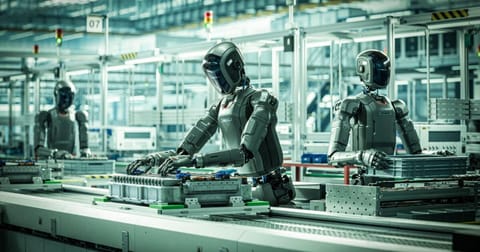
- Come and find me, I will be attending MACHINA! Where Intelligence meets the Physical World. See you at Station F, Paris. #MACHINA #PhysicalAI #Robotics #StationF #Paris
Related profiles

This page shows public professional information only, each fact cited. Is this you? send a correction, or ask for removal within 24 hours, no questions asked.