Overview
Sophie Manigart is listed by Omar Mohout among the most connected women in the Ghent tech ecosystem, alongside Annie Vereecken, Danae Delbeke, Greet Vandewalle, Isabelle Tennstedt, and Hilde Windels.
She holds the Gimv Private Equity Chair at Vlerick Business School and has spent over three decades researching how entrepreneurial companies finance themselves. She holds a Civil Engineering degree, an MBA, and a PhD in Management from Ghent University. She has been a guest professor at Wharton, London Business School, and IE Business School in Madrid. Beyond academia she has advised startups on finance strategy, worked with VC funds, and served on the investment committee of the Baekeland Fund.
Career history
- Full Professor, Ghent University and Vlerick Business School
- Holder of the Gimv Private Equity ChairVlerick Business School
- Guest Professor, Wharton Business School; London Business School; IE Business School
- Board MemberGimvquoted private equity firm
- Board Member, Belgian Venture Capital and Private Equity AssociationBVA
- Board MemberAXA Belgium
- Board MemberBW Ryhove


Talks about
Insights & ideas
Sophie Manigart's contribution to this exchange is that of an interviewer drawing out expertise on family offices in private markets, but even in that role her own emphases come through in what she chooses to probe: co-investment structures, fund selection due diligence, and the strategic advantages family offices hold over traditional private equity funds [1]. The conversation she steers with Florin Vasvari centers on a recurring theme in her work, namely how sophisticated capital allocators can learn from and eventually outgrow their reliance on intermediated fund structures [1].
A key thread she elicits is the idea that co-investment is not just a return-enhancing tactic but a learning mechanism. The logic, as drawn out in the interview, is that an investor first commits to a private equity fund, then co-invests alongside it, and in doing so absorbs the fund's approach closely enough to eventually replicate it independently: "you learn what they're doing and then you just do it yourself, right, and then at that point you don't pay any fees anymore" [1]. This framing treats fund relationships as a training ground rather than a permanent arrangement, with fee avoidance as the natural endpoint of accumulated expertise [1].
Manigart's line of questioning also surfaces the theme of patient capital as a genuine structural edge. Family offices, unlike traditional PE funds bound by fund-life constraints and fundraising cycles, can afford to time markets contrarially and hold positions longer, a point she has Vasvari elaborate on as central to why family offices are well positioned in private markets [1]. This is not presented as an abstract advantage but as something that shapes concrete decisions: when to enter, when to co-invest, and when a fund relationship has served its purpose and can be replaced by direct investing [1].
Underlying the interview is a practical due diligence orientation. The discussion of fund selection is framed not as a one-off screening exercise but as an ongoing evaluative process that feeds into the co-investment and eventual independence pathway [1]. Manigart's approach here reflects a consistent interest in the mechanics of how capital allocators build capability over time, rather than treating fund selection and direct investing as separate, unrelated activities [1].
The clearest concrete takeaway from this source is the progression she elicits from Vasvari as a model: fund investment leads to co-investment, co-investment leads to learning, and learning leads to independent execution without fees [1]. This sequence functions as a compact thesis about how patient, well-resourced capital can graduate from being a fund investor to being a direct market participant, a pathway framed as particularly available to family offices given their structural flexibility [1].
In the news
- What an achievement! Our Master's in International Management is ranked as the 6th master's programme WORLDWIDE. This truly recognises the quality of our programme. Congratulations to the whole team! And good luck to our incoming cohort of MIMS students. #Vlerick #MIMS Kerstin Fehre Veroniek Collewaert (she/her) Valerie Versprille
- Continuation vehicles (CVs), in which a private equity (PE) fund sells portfolio companies to a new fund that the same GP continues to manage, currently account for about 20% of all PE exits worldwide (Jeffries 2025). This phenomenon carries risks: GPs have a better understanding of the quality of the underlying assets, while they sell to themselves and will receive carried interest on the return realised from the transferred asset. So, this arrangement is fraught with potential risks: which assets are sold to a CV? At what
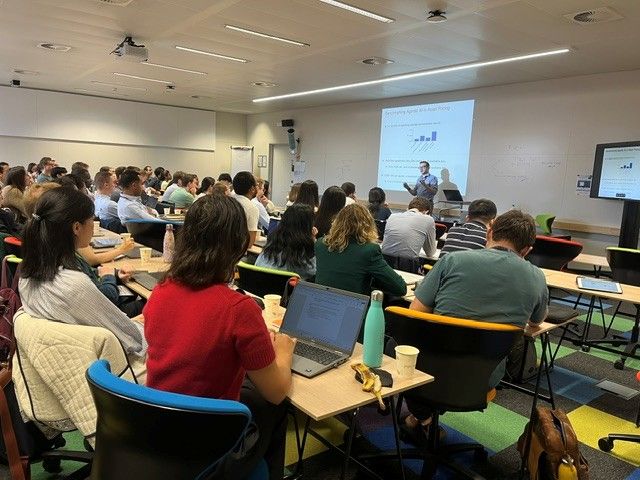
- How exciting to have a full auditorium of Finance PhD students from around the world discussing with Ralph Koijen from The University of Chicago Booth School of Business on how AI enhances our research capabilities. AI significantly expands the toolkit available to researchers, enabling us to ask questions we could only have dreamed of before. And we realise this is just the beginning. This doctoral programme is part of the pre-EFA conference European Finance Association hosted by Vlerick Business School, and initiated by
Related profiles
- YGhentLocation
 Isabelle TennstedtEcosystem peers
 Greet VandewalleEcosystem peers
 Danae DelbekeEcosystem peers
- PHilde WindelsEcosystem peers
- PAnnie VereeckenEcosystem peers
This page shows public professional information only, each fact cited. Is this you? send a correction, or ask for removal within 24 hours, no questions asked.