Overview
The second half is an interview with Steven Latré, who left IMEC to become head of AI at OpenChip, an 11-month-old Catalan-rooted European AI chip scale-up with 175 employees aiming to compete with Nvidia on sustainable, safe and scalable AI. Latré details the exploding compute demand of AI (models growing 100x per year, agents multiplying inference cost another 100x, 'sleep time compute'), the ecological cost (GPT-3 training used ~700,000 liters of water; datacenters could grow from ~100 TWh to 6-20x that in a decade), and argues datacenters must be treated as critical national infrastructure sited near energy sources. He advocates 'AI at multiple speeds' with pricing that internalizes environmental cost, dismisses AGI by 2027 ('there is no path to AGI' with language models alone, citing Moravec's paradox and Yann LeCun), and ends with practical tips: be sparing with deep research features and don't say thank you to chatbots.
Talks about
Insights & ideas
The through-line
Everything Steven Latré says circles one arithmetic problem: the compute demanded by AI models has decoupled from the compute chips can supply. Until 2010 AI's compute needs doubled every two years, roughly in step with Moore's law; since 2010 models have grown by a factor of about 100 per year while chips still improve only twofold every two years [1][2]. That gap is not an engineering inconvenience, it is the thing that determines how much energy and water AI consumes, where datacenters get built, what a query should cost, and whether Europe has any opening at all. His formulation is blunt: "100 keer meer rekenkracht betekent 100 keer meer energie, 100 keer meer water" [1][2].
The second thread is a refusal to treat any of this as somebody else's problem. He frames AI as a societal event rather than a technical one and puts the burden on the people building it: "AI is ondertussen veel meer dan gewoon wat een technologische revolutie geworden. Het is een maatschappelijke revolutie en ik denk dat de mensen die daaraan het ontwikkelen zijn, dat die een maatschappelijke plicht hebben om dat op de juiste ethische manier te brengen" [1], counting himself explicitly among them [2]. The same instinct explains his impatience with European fatalism and his dismissal of AGI speculation: both are ways of avoiding the disruptions already happening.
On the compute gap and the energy it burns
The structural picture is that chips can no longer keep up with models, so the shortfall is paid in electricity and cooling water [1][2]. Two developments make it worse rather than better. Agentic AI multiplies inference compute by roughly another factor of 100 against a single question-and-answer step, because models chain many steps and talk to each other, with Manus computing for over an hour on a single task [1][2]. And sleep-time compute means models now pre-compute, or "dream", while idle, so AI systems effectively burn compute 24/7 even when nobody is prompting them [1][2]. Meanwhile every major LLM provider, Google, OpenAI and Microsoft among them, is signing deals with nuclear power providers to lock in energy for their datacenters [1].
He does not think the underlying economics hold. The value the models deliver today does not match the infrastructure investment standing behind them, which makes the current pattern of ever-larger compute spending unsustainable [1].
On datacenters as national infrastructure
Datacenters have become critical national infrastructure in the way railways and water mains are, and Latré argues governments should direct where they are built rather than leaving the siting to pure economics, because economics ignores the societal factors [1][2]. His worked example is Amsterdam, which hosts so many datacenters because transatlantic cables land nearby. Connectivity, not proximity to energy, drove those decisions, and that is precisely the wrong optimization for the AI era [1][2].
On AI at multiple speeds
The correction he expects is tiered: "AI at multiple speeds", where fast answers cost more in compute and more in money, and the energy impact of a model gets priced into its usage automatically [1][2]. This is the consumer-facing counterpart of his infrastructure argument, making the physical cost visible at the point of use rather than hiding it in a flat subscription.
The same logic reaches down into silicon. At OpenChip the energy budget is built into the chip itself, so consumption can flex with the available renewable supply, deliberately trading peak performance for efficiency and safety [1]. Further out, superconducting digital chips could run around 100 times faster at the same energy use, though only below minus 35 degrees, which turns a datacenter's worth of compute into a shoebox wrapped in a freezer [1][2].
On Europe's opening
The proof case is DeepSeek. A few hundred people working across the boundary between hardware and software optimization produced a model roughly 36 times more energy-efficient than a standard GPT-style one [1][2]. Latré reads that as evidence Europe can leapfrog despite its disadvantages in chips and capital: the leverage is in the hardware-software bridge, not in raw scale.
What he rejects is the reflex to talk the continent out of trying. "We kunnen blijven zeggen: ja maar Europa dit en Europa dat en we zijn er niet klaar voor. Laten het ons gewoon echt proberen" [1][2]. His own reason for working on it is personal rather than commercial: "Ik had een soort van bijna morele verantwoordelijkheid dat ik voelde, ook zelfs naar mijn kinderen toe later, dat ik kan zeggen van kijk, ik heb tenminste geprobeerd om aan die Europese AI verder te werken" [1][2].
On why AGI is a false debate
"Eigenlijk moeten we eerlijk zijn, we hebben geen enkel pad richting AGI" [1][2]. Language models pattern-match brilliantly on exam-style language tasks and fail at simple physical reasoning, which is Moravec's paradox in action, so on AGI by 2027 his answer is absolutely no [1][2]. More than wrong, he considers the argument a distraction: AI already carries enormous disruptive risk in energy and jobs without ever becoming AGI, and Terminator-style what-if scenarios pull attention away from the problems society actually has in front of it [1][2].
His alternative framing puts humans at the centre by default: "Voor mij is niet de rol van wij als mens in AI. Ik zou het willen zeggen: de rol van AI is die van een assistent in de wereld van mensen" [1][2].
On work, jobs and what efficiency is for
The labour impact arrived in reverse of the forecasts. Five years ago the expectation was that drivers would be automated first; instead the creative sector took the early hit, with Albert Heijn using AI voice-overs for its ads [1]. That leaves an open societal question he thinks is worth asking deliberately rather than by default: whether the efficiency gains from AI should always be converted into more output, or whether they could instead buy better work-life balance, a shorter workweek among the options [2].
On not repeating the internet's mistakes
Thirty years after the internet was invented we are still making course corrections on the damage done by unchecked techno-optimism, Solid personal data vaults being one such repair job [1][2]. He treats that as the template to avoid with AI, which is the practical content of the "maatschappelijke plicht" he places on developers [1][2].
On what users should actually do
The advice at the individual level is to match the tool to the task rather than route everything through a model: "Kan ik de vraag stellen op Google? Indien wel, stel ze dan alsjeblieft op Google" [1]. And on politeness to chatbots, which costs compute like any other prompt: "Zeg niet per se thank you, want voorlopig hebben ze nog geen gevoelens hè" [2].
Takeaways
- The core number to hold onto: since 2010 model compute has grown roughly 100x per year while chips improve 2x every two years, and the gap is paid in energy and water [1][2].
- Agentic AI adds another ~100x on inference over a single query, and sleep-time compute means systems burn energy round the clock even with no users [1][2].
- DeepSeek's ~36x energy-efficiency edge, built by a few hundred people bridging hardware and software, is the evidence that Europe can leapfrog without matching US chips or capital [1][2].
- Datacenter siting should be directed by governments as critical infrastructure; Amsterdam's cluster exists because transatlantic cables land there, an optimization for connectivity that makes no sense in the AI era [1][2].
- Expect and design for "AI at multiple speeds", with faster answers priced higher and environmental impact built into the cost of a query [1][2]; at OpenChip the same principle is baked into the chip, whose consumption flexes with renewable supply [1].
- There is no known path from LLMs to AGI, and AGI by 2027 is a no; the debate distracts from present-day disruption in energy and jobs [1][2].
- The job disruption arrived where nobody predicted, hitting the creative sector before drivers, as with Albert Heijn's AI voice-overs [1].
- Ask Google when Google will do, and skip the thank-yous; the models have no feelings yet and every prompt costs compute [1][2].
In the news
- SCHRIJF IN: AI for LEARNING DAY | 3 december ++ AI verandert de manier waarop organisaties leren, opleiden en talent ontwikkelen. Daarom brengt Stijn De Groef met AI for Learning Day op 3 december learning professionals, HR-leiders en AI-experts samen voor een dag vol praktijkverhalen, inspirerende gesprekken en concrete cases die tonen wat (niet) werkt, wat niet werkt. Of je nu net begint met AI of al volop experimenteert: je gaat gegarandeerd naar huis met nieuwe ideeën, waardevolle contacten en praktische inzichten die je

- Amai. 😂 Ik heb mij letterlijk even aan de kant van de weg moeten zetten van het lachen. Wat een fantastisch voorbeeld van hoe interacties met AI nog altijd compleet uit de hand kunnen lopen. Tegelijk informatief, absurd én vooral verschrikkelijk grappig. Dank aan Steven Latré en Kobe Ilsen voor dit pareltje. 😄 Maar achter de hilariteit zit ook een serieuze boodschap: AI wordt een ongelooflijk krachtige technologie. Net daarom zal het goed harnessen ervan — AI ontwerpen, sturen en begrenzen zodat ze doet wat we écht willen — alleen
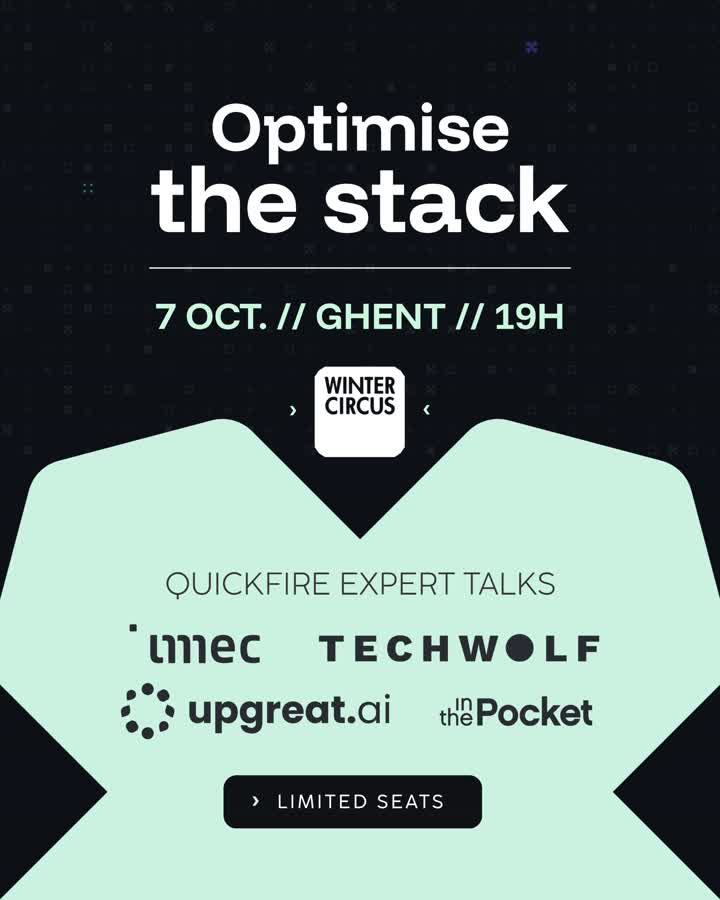
- A different kind of stack party... On October 7, imec, TechWolf, In The Pocket, Upgreat AI, and Wintercircus Ghent are hosting an evening dedicated to the layers behind the AI boom - maximizing your intelligence per euro and ensuring your organization is prepared to scale even further. Our CTO, Jeroen Van Hautte 🐺, will take the stage alongside Jeroen Lemaire (In The Pocket), Steven Latré (imec), and Upgreat AI, mixing strategic perspectives with technical insights on the evolving AI landscape, the infrastructure and economics
Related profiles


This page shows public professional information only, each fact cited. Is this you? send a correction, or ask for removal within 24 hours, no questions asked.