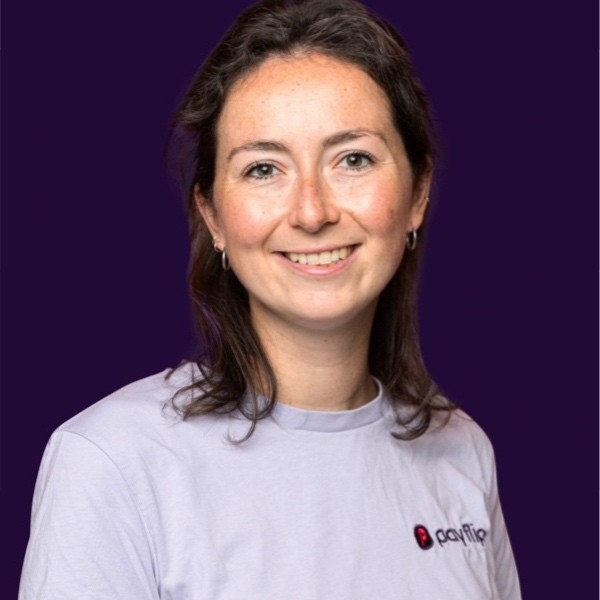
Overview
Maura Nachtergaele is CEO and co-founder of Payflip, a Brussels-based Belgian HR tech company helping employees understand and optimize their salary packages through transparent benefits management.
Maura Nachtergaele is the co-founder and chief executive of payflip, a company she started in August 2019. She is based in Brussels.
From September 2019 to September 2020 she was Head of Impact at Funds For Good. Before founding payflip she worked at Baker McKenzie Belgium as a junior tax associate from September 2017 to August 2019, having been a summer trainee at the firm in September 2016. She was a legal assistant at Allen & Overy from October 2016 to May 2017 and a summer trainee there in August 2016. Earlier she was a trainee at Mazars Belgium from October to December 2015, a summer trainee at NautaDutilh in September 2015 and at Dumon, Sablon & Vanheeswijck in August and September 2014, and a repetitor with Legima studiekeuze, vakbijles en coaching rechtenstudenten from September 2015 to December 2016.
She studied law at Ghent University, taking a bachelor's degree and a Master of Laws, and spent 2014 to 2015 studying law and economics at the University of Copenhagen. She went on to complete an Executive Master en Gestion Fiscale at the Solvay Brussels School of Economics and Management and studied corporate finance at EHSAL Management School.
Talks about
Career history

Insights & ideas
The through-line
Everything Maura Nachtergaele says circles back to one conviction: pay is the last taboo in Belgian working life, and someone has to make it legible, modern and fairly priced. "Verloning blijft een beetje in die taboesfeer... een beetje verloning sexy maken, modern maken, is wel hetgeen waar dat we bij payflip vier jaar geleden mee begonnen zijn" [2]. That mission extends outward from the employee to the merchant: the fees layered onto meal and eco vouchers in Belgium are, on her reading, opaque and too high, and Payflip's answer is to charge no commission on transactions at all, which makes it "drie keer goedkoper voor handelaren" and, as she frames it, "100% Belgisch. Because Belgium earns it" [1].
The second thread is temperament. She has built a company that refuses the standard growth script, and she applies the same sobriety to herself. "Wij willen eigenlijk niet groeien at all cost. Zoiets als hypergrowth, dat zegt mij niets, niet als professional en niet als bedrijf" [2]. The one place she says she got the calibration wrong is in the opposite direction: she was too modest, too slow, too polite about what the product was worth [2].
On making compensation less of a taboo
The founding insight is that compensation sits in a taboo zone and that the fix is presentational as much as technical, making pay "sexy" and modern after four years of work on the problem [2]. She is bullish on the moment for the category: "It's a good time to be in HR" [2]. The compensation landscape in Belgium is complex enough that she treats it as a reason to move deliberately rather than fast, because rushing a vision into a tangled regulatory market backfires [2].
That same logic drives her public alignment with UNIZO, Comeos, Niels Albert and the tens of thousands of merchants complaining about the opaque and high costs around meal and eco vouchers [1]. The pitch is structural rather than promotional: no Payflip commissions on transactions, which is what produces the threefold cost advantage for merchants [1].
On bootstrapping, then deliberately killing the revenue that funded you
Payflip bootstrapped for two years on tax consultancy work, rulings and copyright remuneration schemes, which did two jobs at once: it generated cash and it taught the founders the market they were about to sell software into [2]. Living conditions matched the model. "We leefden wel als franciscanen" [2].
The decisive move was cutting that consultancy stream off on purpose in order to become a pure SaaS company, and it was that transition, not any cash emergency, that triggered the January 2023 raise [2]. She is explicit that the money functioned as a safety net for a business-model change rather than as a necessity [2]. By then the company was at €600-700K ARR, and the round came in at €1.25M with Smartfin, KBC and PMV [2].
On raising money and choosing an investor
Her most transferable fundraising lesson is procedural: hire an experienced interim CFO with an investor network specifically for the raise. That opened doors to family offices and investment bankers, and taught the founders to bypass account managers and go straight to the banks' investment bankers [2]. The second lesson is the familiar VC advice that actually held up, talk to investors before you need them: Smartfin's Thomas Depuydt had reached out over LinkedIn long before the round, so a term sheet arrived quickly once it opened [2].
The choice between two near-identical offers was settled by a coin toss that was never really about the coin. "Filip heeft mij omhoog gegooid en dan letterlijk kop of munt. En was het de ene partij geworden en dat voelde net niet goed, dus dan hebben we zelf de munt eruit gedraaid" [2]. The flip surfaced a gut feeling rather than making the decision. As for what the money bought beyond cash, she rates the maturity boost and the media exposure, but above all the budget to hire a head of sales and a head of engineering. Those candidates cared about the salary, not about whose logo was on the cap table [2].
On pricing without apology
The clearest regret is pricing. Payflip started at €79 per employee per year and was, in her word, too polite about charging for a product that was still imperfect [2]. "Ik denk dat een Amerikaan dat onmiddellijk ging verkocht hebben aan het triple wat dat wij deden" [2]. The point is not that the early product was better than they thought, it is that politeness about an imperfect product is a habit worth breaking early.
On refusing hypergrowth
Growth at all costs is rejected on grounds of damage rather than taste: she argues hypergrowth creates harm that is avoidable, and that Payflip needed time to shape its vision inside a complicated compensation market [2]. "Zoiets als hypergrowth, dat zegt mij niets, niet als professional en niet als bedrijf" [2]. It is a position she holds both personally and as an operating principle for the company.
On lowering the barrier to starting
She traces her own entrepreneurial threshold dropping to a specific and undramatic experience: watching her roommate Ella build an STD-testing startup at their kitchen table. Seeing "what's under the hood" is what made starting a company feel achievable [2]. The corollary is a warning against her own defaults: "Minder perfectionistisch zijn... You're just missing out on fun" [2].
On holding your own seat lightly
The founders periodically ask each other whether they are still the right people in their roles, and she says plainly that she would step aside if someone else would add more value to Payflip [2]. It is the same sobriety that produces the refusal of hypergrowth, applied to the CEO chair.
Takeaways
- Fund the early years with adjacent consultancy work, then cut it deliberately once you commit to pure SaaS; treat the raise as a safety net for that transition rather than as a rescue [2].
- Bring in an experienced interim CFO with an investor network for the raise itself, and go straight to the banks' investment bankers instead of through account managers [2].
- Take investor meetings long before you need capital: a LinkedIn approach from Smartfin's Thomas Depuydt months earlier turned into a fast term sheet [2].
- When two offers look identical, flip a coin and watch your reaction; the flip exposes the gut call rather than replacing it [2].
- Do not be "polite" about pricing an imperfect early product; €79 per employee per year was a self-inflicted discount [2].
- Investors' names do not close hires; budget does. The main post-round benefit was being able to pay for a head of sales and a head of engineering [2].
- Compete on structure, not messaging: charging no commission on transactions is what makes Payflip three times cheaper for merchants than the incumbent meal and eco voucher fees [1].
In the news
This page shows public professional information only, each fact cited. Is this you? send a correction, or ask for removal within 24 hours, no questions asked.