
Overview
Thomas Cambier is a co-founder of FlockScore, which he started in September 2025. He is based in Gent. Since June 2024 he has also been an adjunct professor in product analytics at EADA Business School.
Cambier spent four years at Glovo, joining as a data analyst in June 2021 and moving through roles as senior data analyst, senior product data analyst and data manager for product analytics before becoming senior manager for product analytics from April to October 2025. Before that he was at Volvo Group, first as a process quality engineer from August 2019 and then as a business controller until June 2021. Earlier he worked as a junior consultant on the Market Assessment Program run by EADA and ACCIÓ, spent a month as a PLC program assistant at Audi Belgium in 2017, and tutored mathematics and science at Het Bijlesbureau between 2016 and 2020.
He studied electrical engineering technology at Ghent University, taking a bachelor's degree and then a master's in automation, followed by a master of science in mechatronics at Transilvania University of Brasov and a master's in international management at EADA Business School.
Career history
In the news
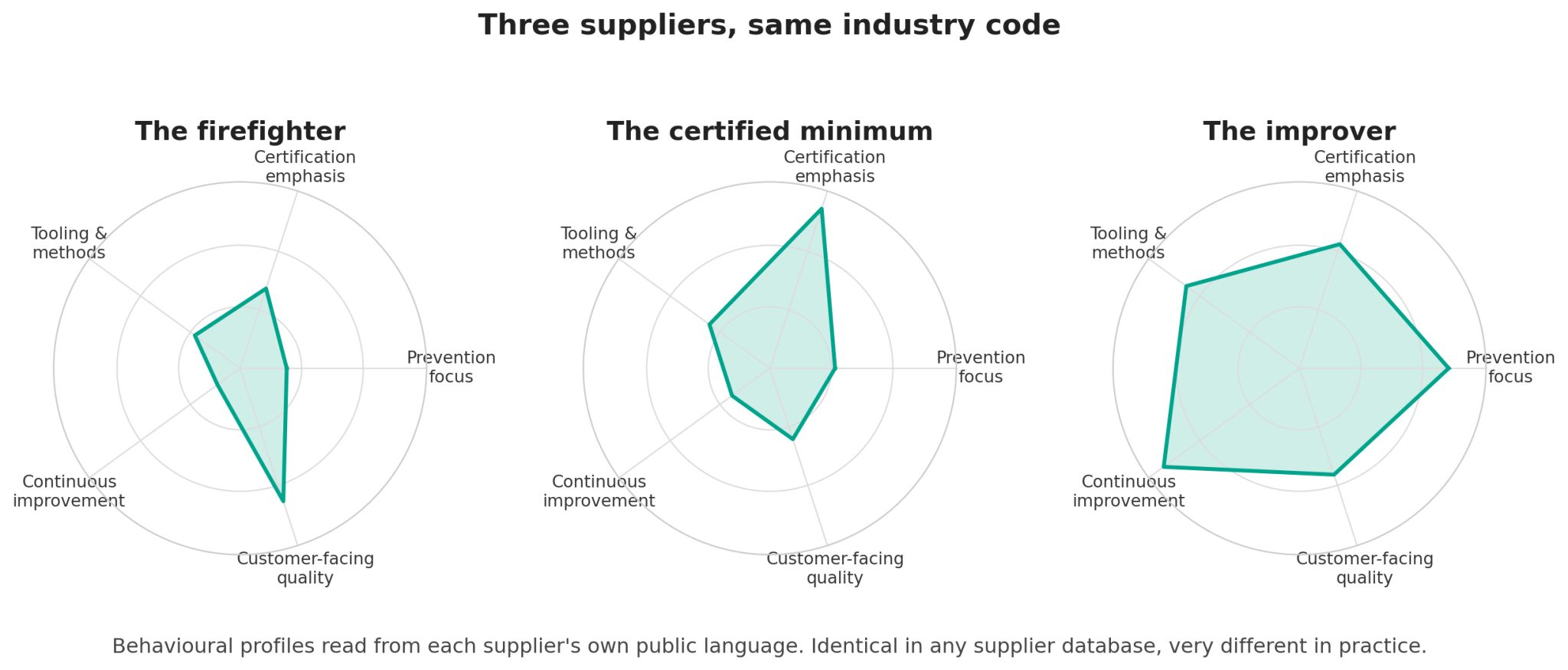
- Data Science in Procurement, post 4/4. Your suppliers are already hinting where they are heading. To understand how suppliers perform, we combined dozens of sources, including what manufacturing suppliers publish themselves. Out of those, one source stood out: job postings, tens of thousands of them, across multiple languages. What a company asks a quality profile to do is a good indicator in how the quality function is actually behaving at a certain point in time. Hiring to prevent problems reads very differently from hiring to
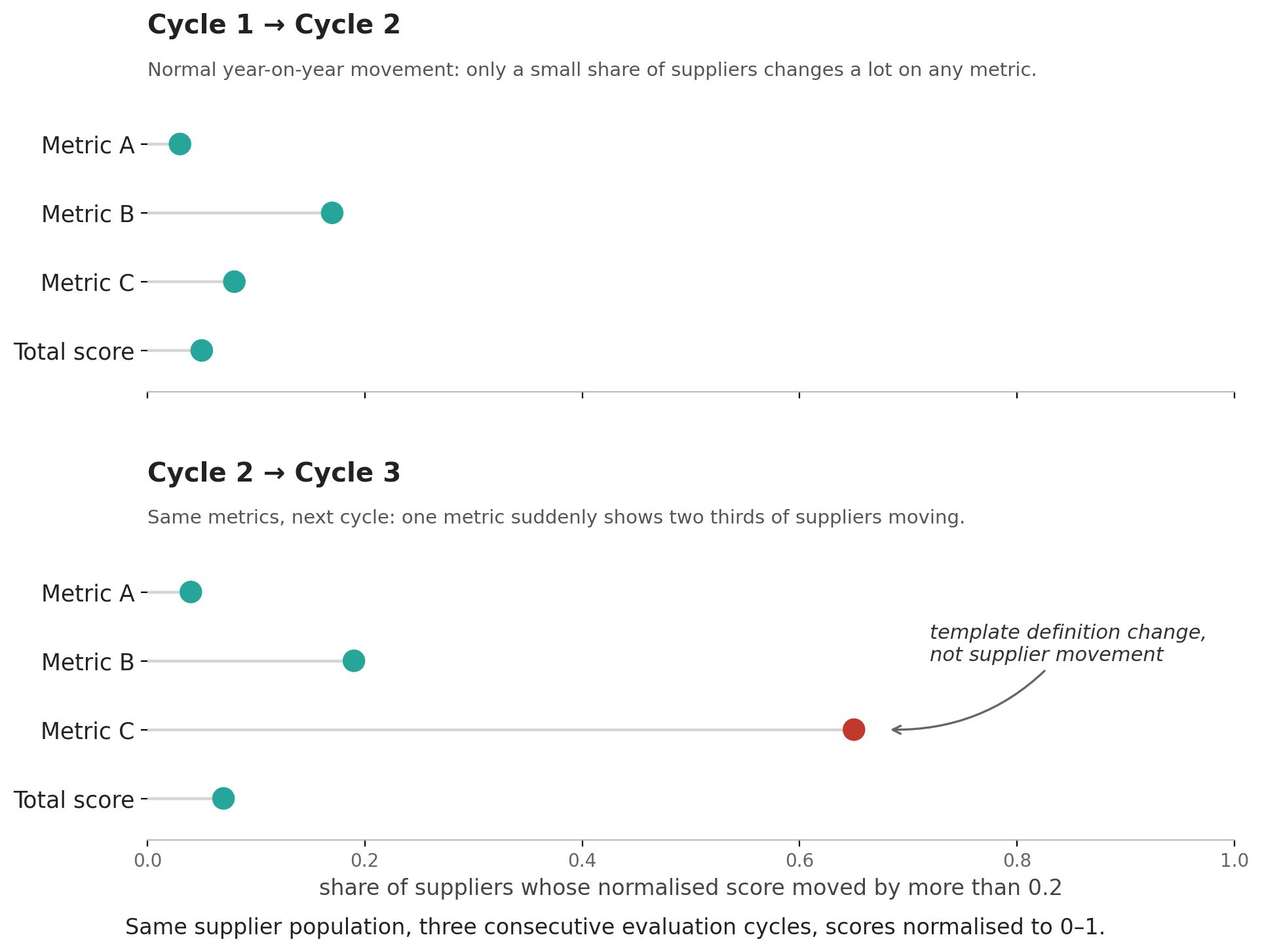
- Data Science in Procurement, post 3/4. Is your data measuring the supplier, or your template? On any multi-year dataset, the pattern is usually sensible. Externally anchored metrics (e.g. sustainability) are sticky, last year mostly predicts the current year. Operational metrics, like delivery for example, vary more. Then we saw something strange in a dataset: roughly two thirds of suppliers appeared to jump in a single cycle. That’s more than anything we’d seen before. Individual suppliers move for their own reasons, however
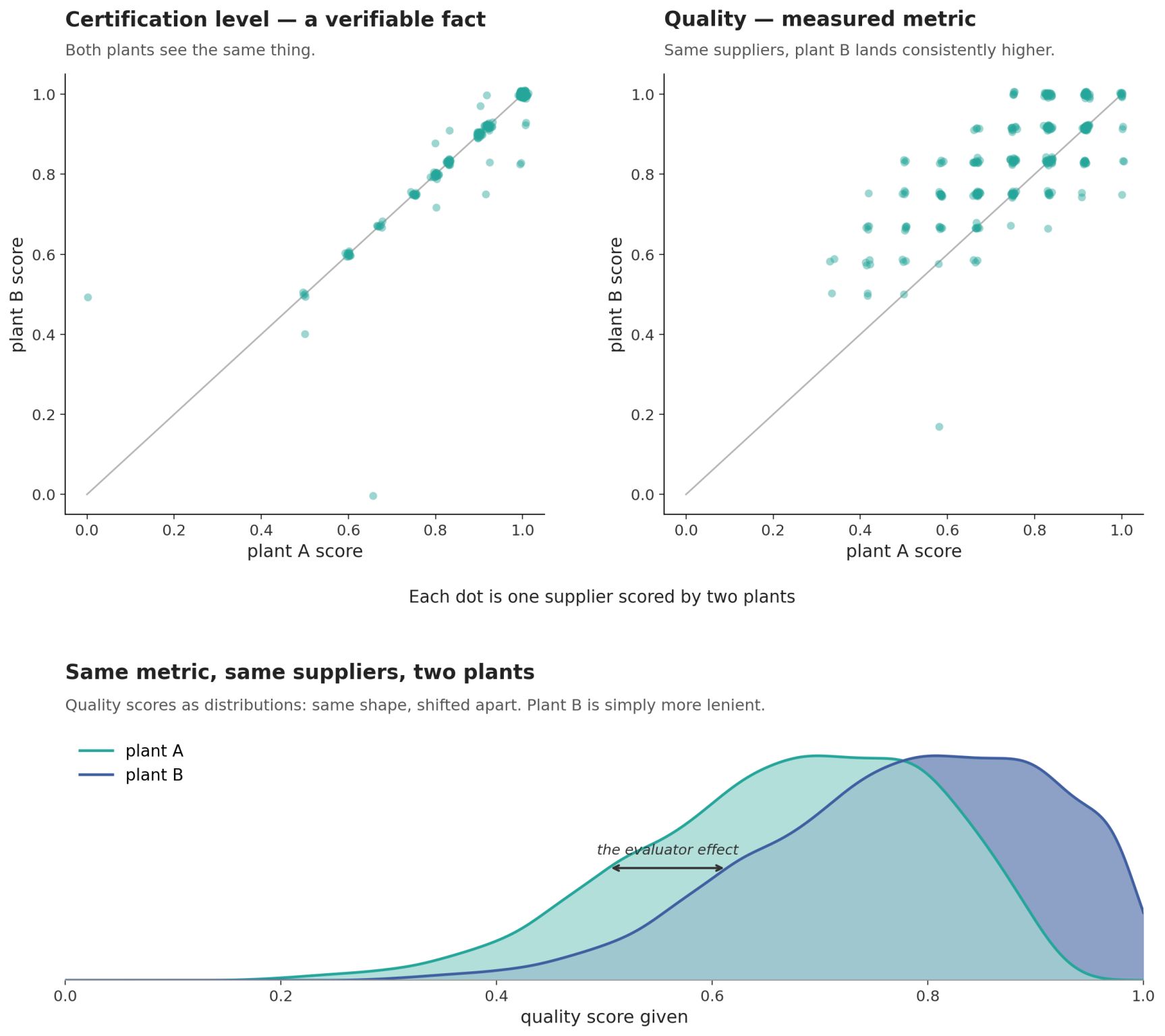
- Data Science in Procurement, post 2/4. Facts travel between evaluators, judgements do not. When different plants or business units evaluate the same supplier, how often do they agree? In the multi-site data we work with, it completely depends on the type of field. Hard facts or booleans like a third-party rating or a certificate that either exists or not, reproduce almost perfectly between evaluators. Locally measured or judged performance, e.g. quality or delivery, varies a lot. The gap between the strictest and the most
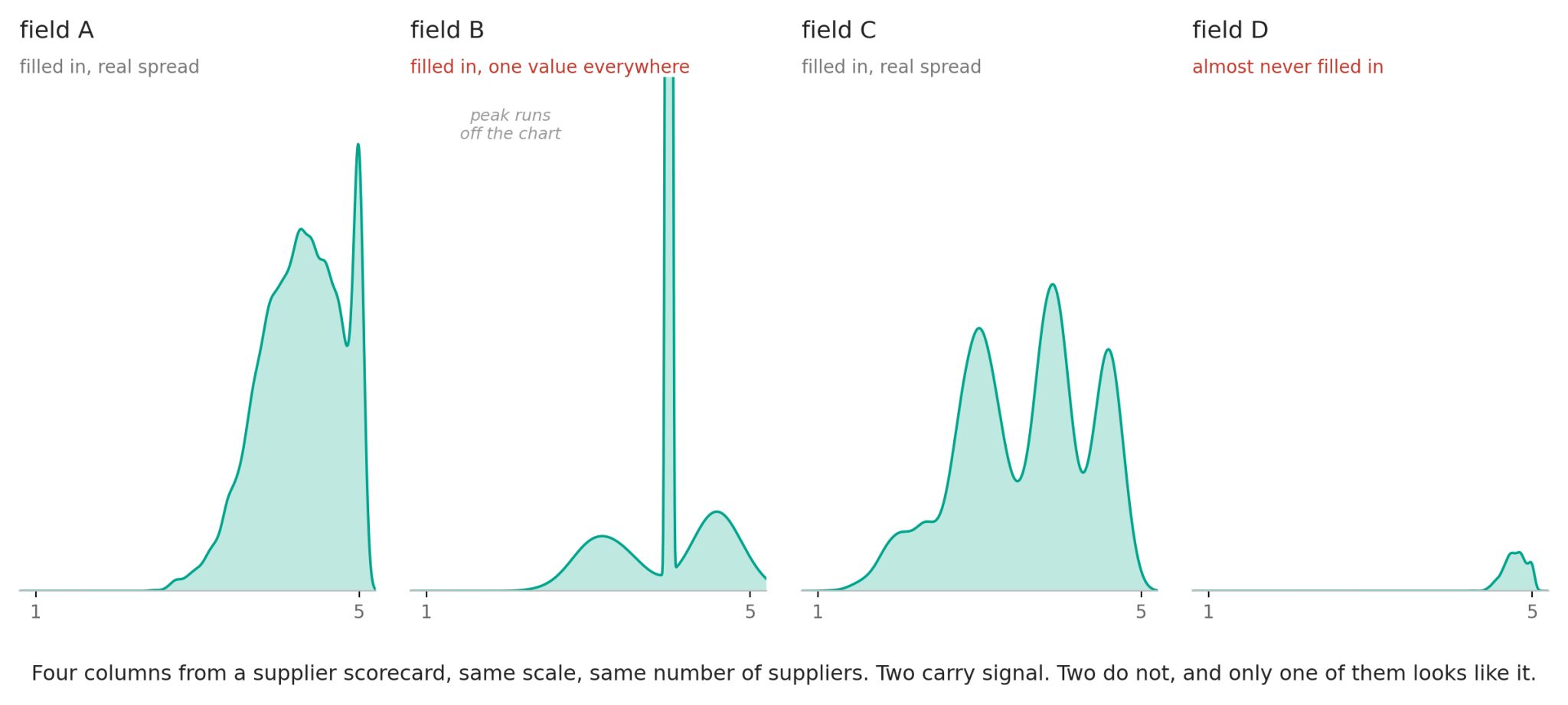
- Data Science in Procurement, post 1/4. A mini-series over the coming weeks on what we learned from pooled supplier scorecards, and what it might mean for your own scorecarding. We spend a lot of time inside the supplier evaluation data that procurement teams have been collecting for years. Most of it is genuinely useful. Some of it only looks that way. The picture below shows patterns from the intelligence we collected, they represent four columns from a supplier scorecard. Think of them as sub-categories to rate on (e.g.
- Back in Barcelona, and back at EADA. This week I wrapped up the last session of the digital business analytics elective with the master students. One intense week covering Product Management and Product Analytics. A lot of the students don't come from a technical background, so the challenge is always the same: how do you take something like experiment design or statistical significance and make it click for someone who's potentially going to be a product manager, not a product data scientist? You let them get their hands dirty
Related profiles

This page shows public professional information only, each fact cited. Is this you? send a correction, or ask for removal within 24 hours, no questions asked.