Overview
Bouten recounts his path from organizing youth-movement parties to In The Pocket and Showpad (grown to nearly $100M revenue), and explains Entourage's model as a founder-led VC and hands-on venture studio under one roof, revealing exclusively that they closed a second fund closing bringing the fund to €40M.
Talks about
Insights & ideas
The through-line
What runs through everything Bouten says is a preference for making over talking. "De hele essentie is dat van niets iets maken hè, from zero to one" [2], and the value sits precisely in the difficulty: "Het is wel net in het overwinnen van die uitdaging dat er heel veel waarde zit" [2]. That belief hardens into a test he applies to founders and to himself. "I see a lot of people with like big words and big ideas and nice slides and great PowerPoints, but at the end of the day, these are words. And words, in what we do, don't matter that much. It's about delivering, shipping, creating something, putting it out there" [1].
The shift over time is in what he thinks it costs to do that. The early framing is ambition and pace: a new software category, a target of "way over 100 million in recurring revenue" within five years [3]. After a crash in 2016 he began treating entrepreneurship as top sport, prioritising sleep, meditation, less alcohol and recovery, on the argument that you cannot perform through all-nighters and constant travel [2]. And the later framing is subtractive: focus as the scarce resource, obsession sustained over years, a phone left at home to protect it [1].
On focus as the scarce resource
"Focus is definitely the new gold in some way" [1]. He is explicit that this is not a productivity preference but the mechanism behind everything he has built: "To achieve something great you need a ton of focus, and for a sustained amount of time. I wouldn't have been able to build Showpad to what it is if I wouldn't be like crazy amount of focus and obsession" [1]. The practice that follows is deliberately blunt. He leaves his phone at home on some days, on the reasoning that most urgent things solve themselves within a day [1]. The same instinct appears in what he learned at Netlog, where the lesson was that young people can achieve a great deal if they focus, work hard and surround themselves with the right people [2].
On execution speed as the real moat
Speed is what he measures, and he treats it as defensible in itself. Squire went from almost nothing to a product demoable to large software providers in four to six weeks, and that speed is the key moat in a European blue-ocean market that will not stay uncontested [1]. But he separates the demo from the business. What will actually differentiate Squire is production-grade trust: data storage controls, confidentiality, the coding and structuring of notes, and deep integration into GP workflows and legacy software [1]. The same eye for a shift already visible in the data drove In The Pocket, whose founders bet on mobile by watching Netlog's traffic charts move from web to mobile before smartphones were mainstream, and concluded every company would need its products and content on mobile within ten to twenty years [2].
On why traditional venture capital is dead
"I believe traditional venture capital is dead in some way. There's so many funds out there, there's actually quite a lot of money to be found as an entrepreneur. How are you going to differentiate as an investor? It's actually quite hard" [1]. Entourage's answer is to be founder-led and to put a venture studio and a fund under one roof [1]. The differentiation extends to how the relationship starts and how it is conducted. Potential co-founders and the studio "date" first, spending weeks working together with no strings attached, on the reasoning that a founder-investor relationship will last more than ten years and trust has to exist before the paperwork [1]. Once invested, the posture is deliberately non-directive: "I always tell them, look, it's what I will share you from my experience, but you have to do with it whatever you want, and if you want to ignore it, fine. Entrepreneurs should have all the freedom to build the company they want to build" [1]. The value he thinks an investor actually adds is belief: "I believe as an investor that you want to make people believe that they're going to do exceptional things" [1]. That the second closing of the €40M vehicle was raised with one email and completed five days later, he reads as a verdict on the team rather than the thesis [1].
On co-founder relationships, the thing that actually kills startups
From his vantage point as an investor, the most common reason startups fail is that things go wrong between founders and shareholders, usually because people, priorities and situations change, in the way a relationship you stop investing in changes [2]. His prevention is documentary and early: write the worst cases down on paper when you found, covering what happens if one founder leaves, loses motivation or dies, because the drafting itself reveals how your co-founders think before there is anything to fight about [2]. Alongside that he wants a decision rule. Even among equal co-founders, one person should hold final authority, "the buck stops with me"; Showpad's three co-founders had that agreement explicitly, and never needed to invoke it [1]. Authority and equity are separate questions in his view. Carrying CEO responsibility, taking the investor conversations and absorbing "the shit", does not necessarily create more value than a VP Product building great products, so equal splits among equal co-founders make sense [1]. Where tension does build, he found an external coach inside the Showpad management team, unbiased and without history, could surface what would otherwise have stayed under the table, a process that was confronting and then reliably followed by relief and energy [2].
On culture, hours and hiring for obsession
He refuses the founder-hours expectation while keeping the intensity. You cannot expect early employees to work founder hours; you hire for obsession and accountability instead, and you set expectations explicitly during recruitment, where interviewing on a Sunday or at 9pm is itself a signal about the culture [1]. The measure is output and energy: "I don't care about the hours, I care about the vibe that people give, the energy that they give into the company, the quality work that they do" [1]. The cultural counterpoint from earlier is the same anti-formalism: "Je moet geen kostuum dragen om succesvol te zijn" [2], a lesson from Netlog, where watching founders in their twenties succeed planted his first seed of entrepreneurship [2].
On product-led versus sales-led growth
He treats these as sequencing rather than a doctrine. Product-led and sales-led growth are not mutually exclusive; Showpad started product-led and shifted to sales-led to win enterprise deals above $1M a year, and the choice turns on resources, focus and go-to-market stage [1]. His regret is that Showpad stopped product-led entirely [1]. The structural argument for starting product-led is that it is easier to layer a sales organisation on top of a proven, easy-to-onboard product than to do the reverse, so the early product foundation makes the later enterprise motion possible [1]. The category thesis behind Showpad was that companies had invested in CRM, content management and marketing automation, and in nothing that made sales teams more relevant and productive before, during and after a sales conversation [3], with the stated ambition to become the world leader in sales enablement [3].
On scale changing the job
A company of 600 people needs a fundamentally different environment and a different kind of leadership than a startup of ten to twenty, and that judgement is what led him to step aside as CEO after ten years and hand over to Hendrik [2]. Scale also erodes things that were free at the start. Trust and psychological safety arrive naturally when everyone knows each other's kids and partners, and once the company spans time zones you have to deliberately invest time and in-person moments to manufacture them [2].
On health, loneliness and knowing yourself
"Gezondheid is echt wel de basis van alles" [2]. The 2016 crash is the pivot: afterwards he approached entrepreneurship as top sport, with sleep, meditation, less alcohol and recovery as the training regime [2]. He is equally direct about the psychological cost: "Ondernemen is vaak eenzaam... iedereen kijkt naar jou, iedereen verwacht dat je de perfecte beslissing neemt" [2]. Covid forced a second reckoning, confronting him with the fact that he had believed himself a present father while travelling around 200 days a year and was not; being kept at home built a far better bond with his children and reordered his priorities [2]. The advice that follows is about authorship rather than balance: do not chase other people's dreams or successes, be brutally honest about your strengths and weaknesses, invest in knowing yourself, and make choices grounded in who you are [2].
Takeaways
- Judge founders and yourself on shipped output, since "words, in what we do, don't matter that much. It's about delivering, shipping, creating something, putting it out there" [1].
- Treat focus as the constraint on greatness, sustained over years, and defend it physically, including leaving the phone at home on the grounds that most urgent things resolve themselves within a day [1].
- Start product-led where you can: layering a sales organisation on a proven, easy-to-onboard product is easier than the reverse, and stopping product-led entirely once enterprise deals arrive is a mistake worth avoiding [1].
- Write the worst-case founder agreements down on paper at the outset, covering departure, lost motivation and death, because the exercise exposes how your co-founders think before anything goes wrong [2].
- Give one co-founder final decision authority without giving them more equity; CEO responsibility does not necessarily create more value than a VP Product building great products [1].
- Do not expect founder hours from early employees; hire for obsession and accountability, signal the culture explicitly during interviews, and evaluate energy and quality of work instead of hours [1].
- Spend weeks working with a potential co-founder or portfolio founder with no strings attached before committing, because the relationship has to survive ten years or more [1].
- Bring in an unbiased external coach at management level to surface tensions that would otherwise stay under the table; the conversation is confronting and is followed by relief and energy [2].
- Once the company crosses time zones, schedule trust deliberately, since the psychological safety that came free when everyone knew each other's families does not scale on its own [2].
In the news
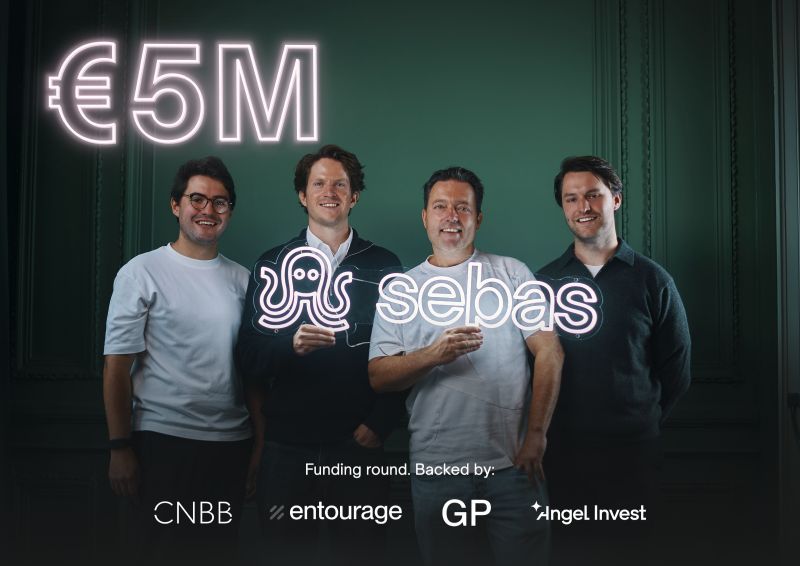
- Happy to share Entourage Ventures is leading the €5 million funding round of Sebas, together with Green Park Investment Partners, CNBB Equity Partners and Angel Invest. Sebas is building the AI-native property manager for Europe. They’ve already completed their first two acquisitions, built a strong organic growth engine, and reached 10,000 units under management. The Sebas journey started a year ago with internships at different property management companies, where the founders quickly saw the enormous potential for AI to
- Exciting milestone today for Conveo with the announcement of their $50M Series A. Congrats to Dieter De Mesmaeker, Hendrik Van Hove and the entire team! 🚀 Amazing to see the progress from the initial AI research assistant to today's consumer understanding infrastructure, used by over 400 enterprises globally. Glad we backed you with Entourage at the pre-seed, and excited for what's ahead! cc Pieterjan Bouten, Maarten Mortier, Anne-Elisabeth, Sixtine, Erwan, Illja, Florian Hendrickx 🔥 https://lnkd.in/ev_vZMmd
Related profiles
ShowpadAffiliation
LighthouseAffiliation
In The PocketAffiliation
ML6Affiliation
CorilusAffiliation
NetlogAffiliation
SquireAffiliation
This page shows public professional information only, each fact cited. Is this you? send a correction, or ask for removal within 24 hours, no questions asked.