
Overview
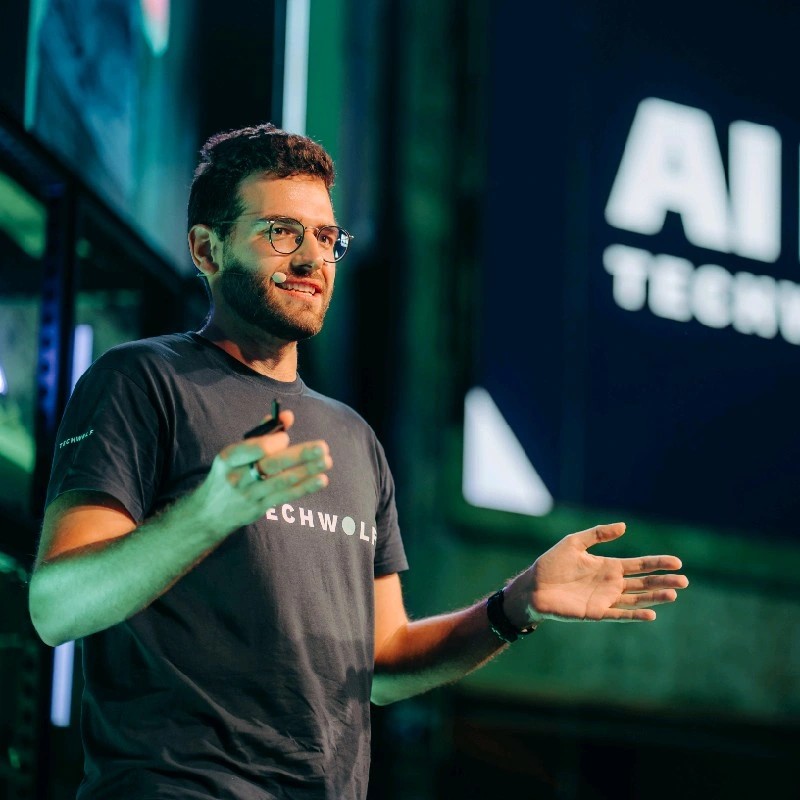
Andreas co-founded TechWolf in Ghent, leading the company as CEO while building one of Europe's most recognized AI-Native HR tech platforms. TechWolf applies AI to Skills Ontology and workforce intelligence, helping large enterprises understand and map their internal capabilities.
Andreas was named to Forbes 30 Under 30 and selected as a World Economic Forum Technology Pioneer in 2022, giving TechWolf significant international recognition. He participates in Syndicate One as an LP, connecting him to the Brussels-based angel syndicate and the broader Belgian investor network.
LinkedIn Voice
Posting style: Direct, confident, sometimes provocative. International perspective with Belgian pride. Posts every 2-3 weeks. Reposts industry content. Key themes: TechWolf US expansion (NY office, Bay Area observations), skills AI and open source models, Belgian tech ecosystem support (Syndicate One, Ghent pride), enterprise HR Avg engagement: 184 likes, 9 comments Notable post: 2026 kickoff combining US visa, wedding, and product launch, 520 likes and 28 comments.
Career history
- Co-Founder & CEOMar 2020 - PresentTechWolf
- Co-FounderSep 2018 - Feb 2020TechWolforiginally a university project
- Co-FounderSep 2024 - PresentWintercircus Ghent
- PledgerJan 2025 - PresentFounders Pledge
- AI Engineer InternJul 2017 - Aug 2017ML6


Education
Master of Science, Computer Science Engineering2017 - 2020Ghent University
Talks about
Insights & ideas
The through-line
Andreas De Neve's central claim is that the job title has stopped being a useful unit of analysis. An accountant today carries the same title as an accountant a century ago and does an almost entirely different job [3], and the same drift is now accelerating under AI: titles hold still for decades while the work beneath them is rewritten [2]. From that follows everything else he argues. If you want to know what AI is doing to your workforce, you have to look at skills and tasks, not headcount by title [2][3]. And the skill that matters most is the ability to keep learning: "De wereld is aan de mensen die zich kunnen aanpassen. Dat is puur Darwin. De regels van het spel zijn herschreven en er gaan winnaars en verliezers zijn." [2]
Alongside that runs a deliberate cooling of the surrounding hype. He is sceptical of the public story about AI-driven job destruction, sceptical of the timelines, and unwilling to accept that whole jobs are going away. The question he thinks is actually open is not employment volume but quality: "Ik ben niet bezig met gaat er nog werk genoeg zijn voor iedereen? Ik denk dat er nog werk gaat genoeg zijn voor iedereen. De vraag is gaan we er allemaal beter van worden?" [3]
On skills as the unit of analysis
Because titles are stable and work is not, De Neve argues companies must analyse their workforce through skills to understand where AI adoption actually lands [2][3]. The method TechWolf applies is to classify all work in a company into tasks that are intrinsically human, tasks that can be augmented, and tasks that can be fully automated [2][3]. A job, in his framing, is a structured set of tasks, decisions and interactions, and AI touches only parts of it [3]. Run the exercise and the result is consistent: "Er zijn heel weinig cases waar AI gewoon een job één op één zal vervangen." [3] His preferred image for the mismatch between mechanisation and replacement is agricultural: "Maar de stieren hebben de boer ook niet vervangen hè, Tim." [2][3]
On AI washing
He is blunt about what large employers say when they announce AI-driven cuts: "Bij heel grote bedrijven is dat heel veel AI washing." [2][3] Attributing layoffs to AI plays better on Wall Street than admitting a weak long-term forecast, and it dresses ordinary restructuring in a more flattering narrative [2][3]. What he sees inside Global 2000 clients does not support the story. Actual adoption is limited, and at some large firms the most recently approved LLM is more than six months old [2][3].
On why the transition is slower than people think
De Neve puts full AI and agent-driven operations ten to twenty years out [2][3]. His benchmark is the cloud migration: roughly 30% of running software today is cloud-based, meaning 70% still is not, decades into that shift [2][3]. That gap is the reason he thinks people have time to adapt rather than a reason for complacency [3].
On what happened to TechWolf's engineers
The strongest evidence he offers against one-to-one replacement is his own company. Almost no code at TechWolf is written by humans any more, and the same 40 engineers are all still there [2][3]. "Bijna niets van code wordt nog door mensen geschreven, maar dat wil gewoon zeggen dat er heel veel meer code is om door mensen te laten reviewen." [2] Output per person rose and the work shifted into review and coordination [3]. The new equilibrium produced more output, not fewer people [2].
On seniority, juniors and hiring
Years of experience are being repriced. In TechWolf's own interviews, "Soms hebben wij schoolverlaters die betere cases maken dan mensen met 15 jaar ervaring" [2][3], and he argues someone with three years of experience and strong AI skills can out-produce a twenty-year veteran who barely uses the tools [2][3]. That leads him to expect the prevailing junior-hiring narrative to reverse. The first logical conclusion was that AI does entry-level work, so hire fewer graduates [3]; the second, which he thinks is coming, is that entry-level talent plus AI can do mid-level work, so companies need more of them. He reads IBM's plan to triple graduate hiring in 2026 as the leading indicator [2][3].
On cognitive load and whether we end up better off
What AI adds is not hours but intensity. People get considerably more done and finish the day more mentally exhausted, the "brain fry" of being constantly switched on [2][3]. This connects to his one genuine reservation about the whole shift. History's labour transitions suggest there will be enough work [3], but if AI takes over the creative parts of the process, work may become less stimulating, and that, not unemployment, is the question he keeps returning to [3].
On disruption as the sales narrative
TechWolf's commercial story starts with macro shocks: Covid, the supply chain crisis, the talent shortage, and now the LLM wave [2][3]. Without change in the world there is no transformation, so the more dynamic the environment, the more companies need skills data to plan [2][3]. The growth has followed: "In de laatste 18 maand zijn we eigenlijk van minder dan een miljoen omzet in de US naar meer dan 10 miljoen gegroeid." [2][3] He also invests in bringing customers together on the theme, convening a few dozen of them with leaders from GSK, AMD and Service at a Skills Strategy Summit on AI workforce transformation [1].
On not selling the company
Being an API-first set of AI models that plugs into other platforms makes TechWolf an obvious target for platforms with weak AI capabilities, and the offers arrive on schedule: "Elk jaar hebben wij aanbieding gekregen om het bedrijf te verkopen. Maar dat is niet waarom dat een bedrijf start." [2][3] What has changed is the arithmetic, not the answer: "Ja, nu vijf jaar later zitten wij continu in dezelfde situatie, maar gaat over 100 of honderden miljoen dollar" [2], and at that scale, he says, the numbers start to lose meaning [3].
Takeaways
- Analyse your workforce by skills and tasks, not job titles: titles stay constant for decades while the work underneath them changes completely [2][3].
- Classify every task as intrinsically human, augmentable, or fully automatable; done properly, very few jobs turn out to be replaceable one-to-one [2][3].
- Treat AI-attributed layoffs at large firms with suspicion, since the AI story scores better on Wall Street than a weak forecast does [2][3].
- Expect a slow transition. Only about 30% of running software is cloud-based, so full agent-driven operations are ten to twenty years out [2][3].
- More AI output does not mean fewer engineers: at TechWolf almost no code is human-written and all 40 engineers remain, because review volume exploded [2][3].
- Reconsider graduate hiring rather than cutting it. Entry-level talent with strong AI skills can do mid-level work, which is why IBM plans to triple graduate hiring in 2026 [2][3].
- Budget for cognitive load, not hours: people finish the day more exhausted because they are constantly switched on [2][3].
- Use market shocks as the opening of the sales narrative, because without change in the world there is no transformation to sell [2][3].
In the news
Related profiles

This page shows public professional information only, each fact cited. Is this you? send a correction, or ask for removal within 24 hours, no questions asked.